

Alternatives to mass produced furniture in the UK: handmade or mass-produced
The lower upfront cost isn’t the whole story. If you’re weighing alternatives to mass-produced furniture in the UK, handmade pieces give makers more control over materials, proportions, construction and finish. Factory-made furniture is generally produced in standard sizes and finishes. Handmade pieces typically cost more upfront, while mass-produced options are convenient and less expensive to buy.
It’s understandable to choose a ready-made piece that suits your budget and is easy to place. But the right choice also depends on how you use your furniture, the space it needs to fit and the character you want it to bring to your home.
This guide compares materials, craftsmanship, adaptability and upfront cost, then sets out what to consider when choosing a UK maker. Independent furniture makers typically have lead times of 6 to 8 weeks, so we’ll also look at how timing fits into the decision. By the end, you’ll have a clearer way to decide whether handmade, mass-produced or vintage furniture makes sense for your home.
Key Takeaways
- Compare materials, joinery and finish, rather than assuming that handmade or factory-made construction alone determines quality.
- Measure your room and consider how the furniture will be used; made-to-measure work can suit awkward layouts, while standard sizes may be convenient for straightforward spaces.
- Weigh the upfront cost against how long you expect to use and enjoy the piece, as well as the care it may need.
- When considering timber and other materials, look for clear information about their sourcing and think about whether the piece can be repaired or maintained.
- Allow for the making time when choosing a UK craftsperson: independent furniture makers typically have a lead time of 6 to 8 weeks.
Sustainably sourced timber and natural materials
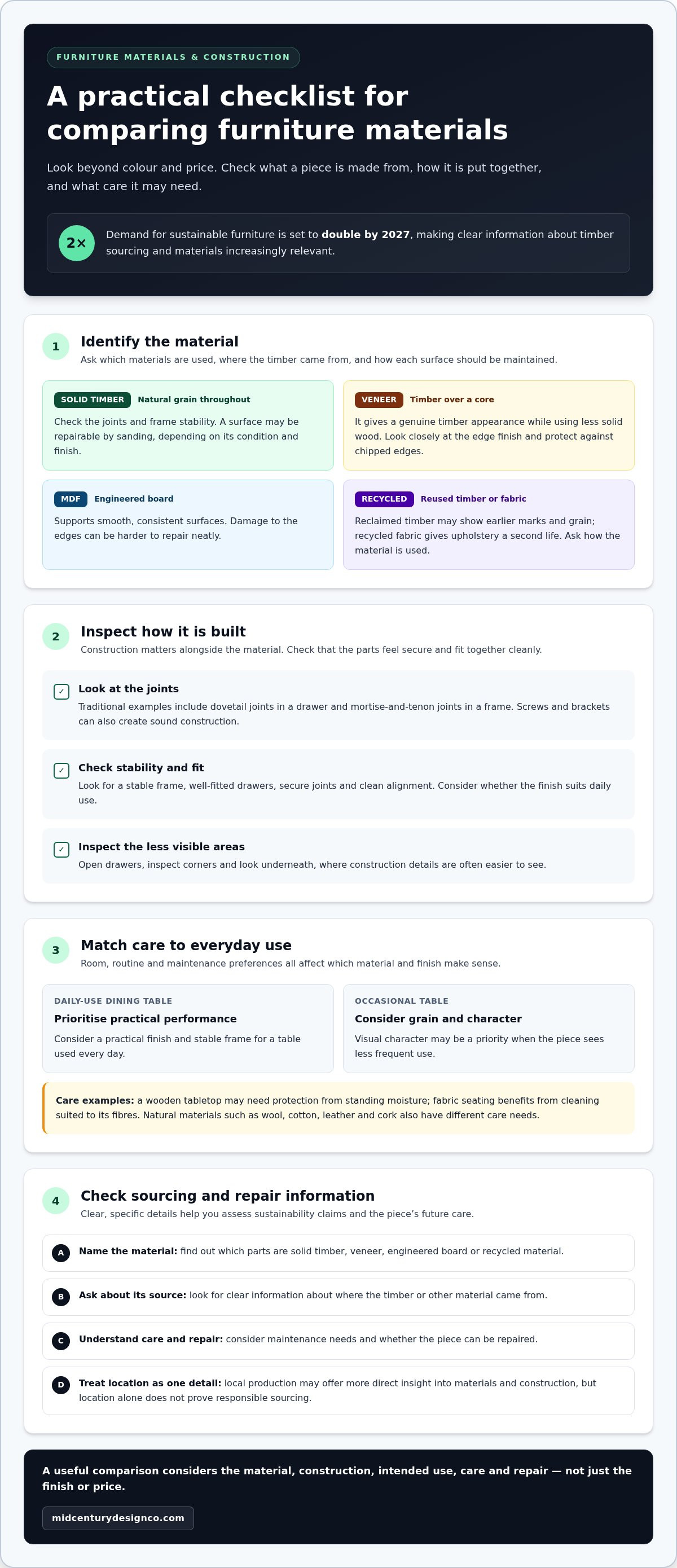
Material choice shapes a piece’s appearance, construction and future care. Demand for sustainable furniture is set to double by 2027, making timber sourcing and material transparency increasingly relevant to UK buyers. Ask what the main materials are, where the timber was sourced and how each surface should be maintained. These practical details help you compare pieces beyond colour or price.
Solid timber, veneer and engineered boards each have different properties. A solid-wood table shows natural grain and may be repairable by sanding, depending on its condition and finish. Veneer is a thin layer of wood over a core, giving the surface a genuine timber appearance while using less solid wood. MDF is an engineered board that supports smooth, consistent surfaces, but damage to its edges can be harder to repair neatly.
Look beneath the finish. Traditional joinery, such as dovetail joints in a drawer or mortise-and-tenon joints in a frame, connects components through shaped timber. Screws and brackets can also create a sound construction. Check that joints feel secure and align cleanly. Open drawers, inspect corners and look underneath, where construction details are often easier to see.
Construction quality affects how long furniture remains useful. A stable frame, well-fitted drawers and a finish suited to daily use all matter. Bespoke furniture is less likely to need replacing because its materials and construction are described as higher standard. That is not a guarantee of longevity: care, household use and repairability also influence a piece’s working life.
Natural materials include timber, wool, cotton, leather, cork and natural-fibre upholstery, each with different care needs. A wooden tabletop, for example, may need protection from standing moisture, while a fabric seat benefits from cleaning suited to its fibres. Recycled materials offer another option: reclaimed timber brings its earlier marks and grain into a new design, while recycled fabric gives upholstery a second life. Ask how recycled content is used in the structure or surface rather than relying on a broad label.
To compare sustainability claims, identify the material, find out its source, then consider its care and repair needs. A clear description should specify which parts are solid timber, veneer, engineered board or recycled material. Consider manufacturing too: local production may give you more direct insight into materials and construction, but location alone doesn’t prove responsible sourcing.
| Option | Material detail | Construction focus | Useful consideration |
|---|---|---|---|
| Solid timber | Natural grain throughout | Joints and frame stability | Surface care and repair |
| Veneered board | Timber surface over a core | Edge finish and substrate | Protection from chipped edges |
| Recycled materials | Reused timber or fabric | How material is incorporated | Source, condition and upkeep |
| Mass-produced engineered board | Consistent manufactured panels | Fixings and drawer alignment | Suitability for intended use |
Match the material and construction to the room, daily demands and your maintenance preferences. A dining table used every day needs a practical finish and stable frame, while an occasional table may prioritise grain and visual character.
Why Choose Bespoke Handmade Furniture Over Mass-Produced Options?
Bespoke furniture can suit unusual room dimensions and awkward layouts. A made-to-measure dining table, for example, can be designed for a narrow kitchen or a projecting chimney breast. Handmade design also lets the maker adjust proportions, materials and finishes to suit the room.
Household routines matter as much as appearance. A family that eats at the dining table each evening may prioritise a sturdy surface and comfortable seating. Someone working from home may need a desk with room for papers, a lamp and a laptop. Share these everyday needs during the design process so the finished piece works for the life around it.
Independent and design-led furniture retailers can help explain the difference between a standard design and a personalised commission. Look for clear details about dimensions, materials, finish and construction. If a table comes in set sizes, compare its measurements with your room before choosing. For a commission, discuss how the design will suit the space and which changes are possible.
Customisation can be practical, not just decorative. You might specify a dining table’s length, choose a timber tone to complement existing chairs or request storage for particular objects. A favourite colour or distinctive handle can add personality, but the piece should still work with surrounding furniture and everyday routines.
Design collaborations offer another route to distinctive furniture. A maker working with an interior designer, architect or craftsperson may combine skills such as cabinetry and metalwork. Ask how each collaborator contributes to the finished design. Their roles should be clear, especially when the piece uses several materials or construction techniques.
Online purchases need particular care because photographs can’t fully convey scale, surface texture or wear. Handmade pieces may differ slightly from images, while vintage furniture can have marks or repairs that are difficult to judge on screen. Compare listed measurements with your room, review photos from several angles, and understand the condition description and delivery arrangements before buying.
For an individual commission, allow for the making schedule: independent furniture makers in the UK typically have a lead time of 6 to 8 weeks. Design discussion, material choices and changes can all shape the process. Bring measurements, room photographs and a clear description of how the piece will be used. These details give the maker a useful starting point without losing sight of the room’s character.
Choose bespoke handmade furniture when room dimensions, household routines or a particular design vision call for a more considered fit. Standard furniture may suit a straightforward room and an immediate need. A custom piece is most valuable when its specific adjustments solve a real problem.
Trade-offs between upfront cost and custom furniture
Handmade furniture typically costs more upfront than mass-produced alternatives, while factory-made pieces offer convenience and a lower initial cost. Compare the purchase with the years of use and enjoyment you expect, not just the till price.
Furniture Character and Customisation
Character comes from details such as grain, proportions, handles and finish. A standard dining table may come in a set range of colours, while a personalised design can coordinate with existing chairs or flooring. These choices can make a room feel more coherent, but they also add decisions to the buying process.
Before choosing a finish, consider how the piece will be used. A tabletop for daily meals needs a surface suited to regular cleaning, while an occasional table may put more emphasis on visible grain. Note the room’s existing colours, intended use and care preferences. This short brief keeps customisation focused on practical needs as well as appearance.
Furniture can also gain character from age and previous use. A vintage piece may carry marks that distinguish it from a newly made item; these signs are part of its history, not custom options. Bespoke work offers choices during design, while vintage shopping means selecting a finished piece with an existing look.
Custom and Handcrafted Furniture
Handcrafted describes how furniture is made; custom describes whether its design is adapted for a buyer. A maker can handcraft a standard design without changing its dimensions, materials or finish. A commissioned piece, by contrast, may be tailored to a particular room, with choices about proportions, colour and surface treatment.
Custom work may involve more discussion and decisions than buying a ready-made piece. Choosing a dining table finish, for example, means balancing the desired appearance with cleaning and maintenance. Ask for the design, materials and finish to be set out clearly before production begins. That makes it easier to compare what the upfront cost covers.
Consider carbon impact as part of a wider assessment of materials, rather than treating “handcrafted” as proof of a lower impact. Materials, manufacturing, transport and how long the furniture remains useful all matter. A well-loved piece that suits its room may avoid early replacement, whether handmade or factory-produced.
Made-to-Order and Bespoke Furniture
Made-to-order furniture is produced after a customer places an order, usually from an existing design or set of options. Bespoke furniture is designed or adapted for a particular buyer, such as a table sized for an awkward alcove. Made-to-order describes timing; bespoke describes the degree of personalisation.
The distinction affects both choice and cost. A made-to-order table may offer a choice of colour or finish while retaining standard dimensions. A bespoke design can address specific room measurements or storage needs, but typically involves more individual design work and a higher initial cost.
For either option, compare the final specification with your room and routines. Note the required dimensions, preferred finish and intended use, then decide which details genuinely need tailoring. This keeps the investment focused on useful differences, rather than customising features that won’t change how the furniture works.
UK sustainable furniture brands and their locations
A maker’s location can help you understand where furniture is designed, made and dispatched. For a UK purchase, distinguish the maker’s workshop from the timber’s origin: British-made furniture doesn’t automatically use British timber. Find out where each stage happens for a clearer picture of the supply chain and its transport footprint.
Nearly 80% of the British furniture-making industry consists of small workshops with fewer than ten people. That gives buyers a useful starting point when looking for independent makers, but workshop size alone doesn’t establish sustainability. Compare the materials, construction and manufacturing details for the individual piece. A bespoke coffee table, for example, might use locally sourced reclaimed timber, or imported timber with documented origins.
Names can also point towards particular design approaches. Sebastian Cox aims to double the area of wild land and woodland in the UK by 2040. This is a stated aim, not proof that every piece associated with a maker uses a particular timber. Look for information specific to the furniture: species, source, recycled content and finish. The Worshipful Company of Furniture Makers has worked to protect the heritage and integrity of British woodcraft for centuries, reflecting the craft’s long history.
For timber described as sustainable or legally certified, look for clear documentation of its origin and chain of custody. Certification can help trace materials, but establish which components it covers. A piece might combine a certified timber frame with other materials. Check whether the description applies to the whole item or selected parts, and consider whether its construction allows repair.
Mattresses show why end-of-life planning matters. The UK threw away 7 million mattresses in 2017. This figure underlines the value of considering recycling routes before purchase, particularly for bulky furniture and furnishings. Check what materials a product contains and whether its components can be separated for recycling. Retailer take-back schemes can also affect disposal, so read the terms for the item and your location.
Retailer sustainability initiatives can cover sourcing, packaging, delivery or end-of-life handling. Compare each claim with a practical detail: does the retailer identify material origins, explain recycled content or describe a collection scheme? A broad environmental statement is less useful than a specific account of what happens to timber, packaging or an old mattress.
To assess a UK maker, note the workshop location, material origins, manufacturing stages and any stated recycling arrangements. Compare these details with your priorities, such as a shorter transport route or a repairable frame. This helps distinguish a meaningful sustainability commitment from an attractive label, without assuming every nearby or handcrafted piece has the same footprint.
Differences between handmade and mass-produced furniture
The clearest difference is control. Handmade furniture gives its maker more say over materials, proportions, construction and finish. Mass-produced pieces are generally made at scale in standard sizes, finishes and configurations. Neither method guarantees quality, so inspect the individual piece and match it to its intended use.
Traditional joinery, solid construction and quality finishes can contribute to strength. Check how a drawer fits, whether the frame feels stable and how the joints meet. A handmade cabinet may show small variations from piece to piece, while factory production aims for consistency across a run. These differences affect appearance and repair, not simply craftsmanship.
Materials also shape the comparison. Mass-produced furniture may use engineered materials such as MDF to reduce cost and speed production. MDF creates smooth, uniform panels, while solid timber shows its own grain and suits a different aesthetic. Check the material used in each component, since one piece may combine timber, veneer and board.
Use these practical checks before choosing:
- Dimensions: compare the stated measurements with your room, especially where a standard size may not fit an alcove.
- Construction: inspect joints, drawer movement, frame stability and the finish on visible and less-visible surfaces.
- Future care: consider whether components can be repaired, and whether cushions can be refilled if the piece is upholstered.
Handmade furniture offers greater scope to adapt a design, but independent UK makers typically have a lead time of 6 to 8 weeks. Mass-produced furniture is usually the more convenient choice for a ready-to-buy need. It can suit first homes, rental properties, temporary rooms and tight budgets, where standard dimensions and lower upfront cost may be priorities.
Longevity depends on more than how a piece was made. A well-constructed item that suits daily routines may remain useful; unsuitable dimensions or difficult maintenance can make any purchase less practical. Compare cost per year alongside the enjoyment a piece brings, and consider whether repair could extend its useful life.
For a considered comparison, choose one item you need, such as a dining chair or coffee table. Note its intended use, available space, material preferences and budget, then assess handmade and mass-produced examples against the same criteria. Vintage furniture is another distinct option: it has been made before, so its character and condition vary from piece to piece.
If a distinctive period aesthetic appeals, explore furniture with considered design as you compare styles, construction and character.
The Mid Century Design: Sideboards & Storage
The Mid Century Design Company offers a considered next step if you’re drawn to furniture with history and distinctive design. Its Sideboards & Storage provide practical space for tableware, books or treasured objects, while their proportions and details can make a room’s visual centre.
Explore its genuine vintage mid-century modern and Danish furniture when comparing ready-made new pieces with furniture that already has its own character. The range also includes Dining Sets, Chest of Drawers, and Coffee Tables & Occasional Tables, offering ways to bring a consistent period aesthetic into different rooms. Since each vintage piece has its own form and presence, consider its dimensions, storage capacity and place in your interior.
Visit The Mid Century Design to explore the furniture.
Choose a piece that feels at home
Your next step needn’t be furnishing an entire room. Choose one piece that will shape how the space feels, then let its lines, material and presence guide the details around it. If you’re exploring alternatives to mass-produced furniture in the UK, consider whether a vintage design brings the individuality and sense of history you want at home.
The Mid Century Design Company’s Sideboards & Storage, Dining Sets and Chest of Drawers offer different ways to bring mid-century character into everyday spaces. Start with the room you use most and picture how a considered piece might sit alongside what you already own. A home becomes personal gradually, through objects chosen with care.
For a closer look or to discuss your next step, contact The Mid Century Design Co. Let your favourite find become the beginning of a room that feels unmistakably yours.
Frequently Asked Questions
What should you consider when shopping for furniture?
Start with the room’s purpose, who will use it and the space around the piece. For a dining chair, consider seat comfort, height and whether it tucks beneath your table. Check access routes too: measure doorways, stair turns and lifts against the furniture’s dimensions before ordering. Then decide what matters most: storage, ease of care, adaptable styling or a particular material. This narrows your choices without focusing on appearance alone.
What are the best alternatives to mass-produced furniture in the UK?
Useful alternatives to mass-produced furniture in the UK include bespoke handmade pieces, vintage furniture and designs made with reclaimed materials. The right choice depends on whether you value tailored dimensions, existing character or a particular material story. Vintage pieces bring established proportions and signs of age; bespoke furniture allows design decisions for a specific room. Compare the individual item’s condition, construction and usefulness rather than relying on a category label.
Where can I buy handmade furniture from UK makers?
You can buy handmade furniture directly from independent makers, through design-led retailers, or via online marketplaces supporting small British businesses such as angliamarket.com. Browse portfolios for examples similar to your intended piece, such as a dining table or fitted storage, and note whether the maker shows finished work, drawings or material samples. If you’re open to furniture with a past rather than a new commission, The Mid Century Design Company sells genuine vintage pieces, including Danish furniture.
How much does bespoke furniture cost in the UK compared with mass-produced furniture?
Bespoke handmade furniture typically costs more upfront than mass-produced furniture, which is generally more convenient and less expensive to buy initially. The final bespoke cost depends on the design, materials, dimensions, finish and work involved. Compare written specifications, not just headline totals, then consider how long you expect to use the piece and the enjoyment it brings. This is more useful than comparing purchase prices alone.
What are the best UK furniture brands using reclaimed or sustainable materials?
There isn’t one best choice for every buyer: compare each maker’s materials, sourcing details and manufacturing approach. Distinguish new furniture made with reclaimed timber from vintage furniture, which reuses an existing piece rather than commissioning new production. The Mid Century Design Company specialises in genuine vintage furniture, with pieces that are eco-friendly and built to last. Look for clear information about a product’s materials before judging its sustainability.
What should I check when choosing a UK furniture maker?
Review examples of completed work, material descriptions and the maker’s explanation of construction. For a dining table, clarify its finished dimensions, surface treatment and how the design will suit your room. Ask for the agreed design, finish and delivery arrangements in writing so you can compare proposals accurately. A maker’s portfolio can show whether their style and attention to detail match what you have in mind.
How can I commission custom furniture, from finding a maker to delivery?
Begin with a brief: describe the piece, its intended use, room measurements, preferred materials and a realistic budget. Find a maker whose portfolio reflects the style and construction you want, then discuss a design, specification and written quotation. Agree on the finish and delivery arrangements before work begins. Consider access routes and placement during planning, not just the furniture’s final position. This gives the maker practical information from the outset.