

Authentic Mid Century Modern Office Furniture: A Curator’s Guide to Timeless Workspaces
Why settle for a disposable desk that loses its lustre after a single season when you could work at a piece of history? It's exhausting to sift through endless flat-pack "retro" imitations that lack the weight, the scent, and the soul of genuine 20th-century craftsmanship. You likely feel the frustration of searching for quality amongst a sea of fakes, wondering if a 1960s masterpiece can truly handle the demands of a modern laptop and dual monitors.
This guide empowers you to navigate the vintage market with the discerning eye of a seasoned curator. You'll discover how to identify authentic mid century modern office furniture, distinguishing investment-grade teak and rosewood from mere replicas. We'll explore how to source pieces that bring a sense of sanctuary to your British home study, ensuring your workspace is both a functional hub and a gallery of functional art. By understanding the heritage of Danish design and modular systems, you can invest with confidence, creating a room that feels deeply personal and stays relevant for decades.
Key Takeaways
- Learn to spot the hallmark design features, including tapered legs and organic curves, that distinguish authentic mid century modern office furniture from mass-produced imitations.
- Explore the functional brilliance of iconic designs like the Staples Ladderax system to create a modular workspace tailored to your unique requirements.
- Discover why the rich patina of original teak and rosewood offers a sustainable, investment-grade alternative whilst avoiding the rapid depreciation of modern replicas.
- Master the balance of past and present by learning how to discreetly manage modern technology cables within the minimalist frame of a vintage desk.
- Gain the confidence to source high-quality pieces by identifying maker's marks and the subtle indicators of genuine 20th-century craftsmanship.
What Defines Authentic Mid Century Modern Office Furniture?
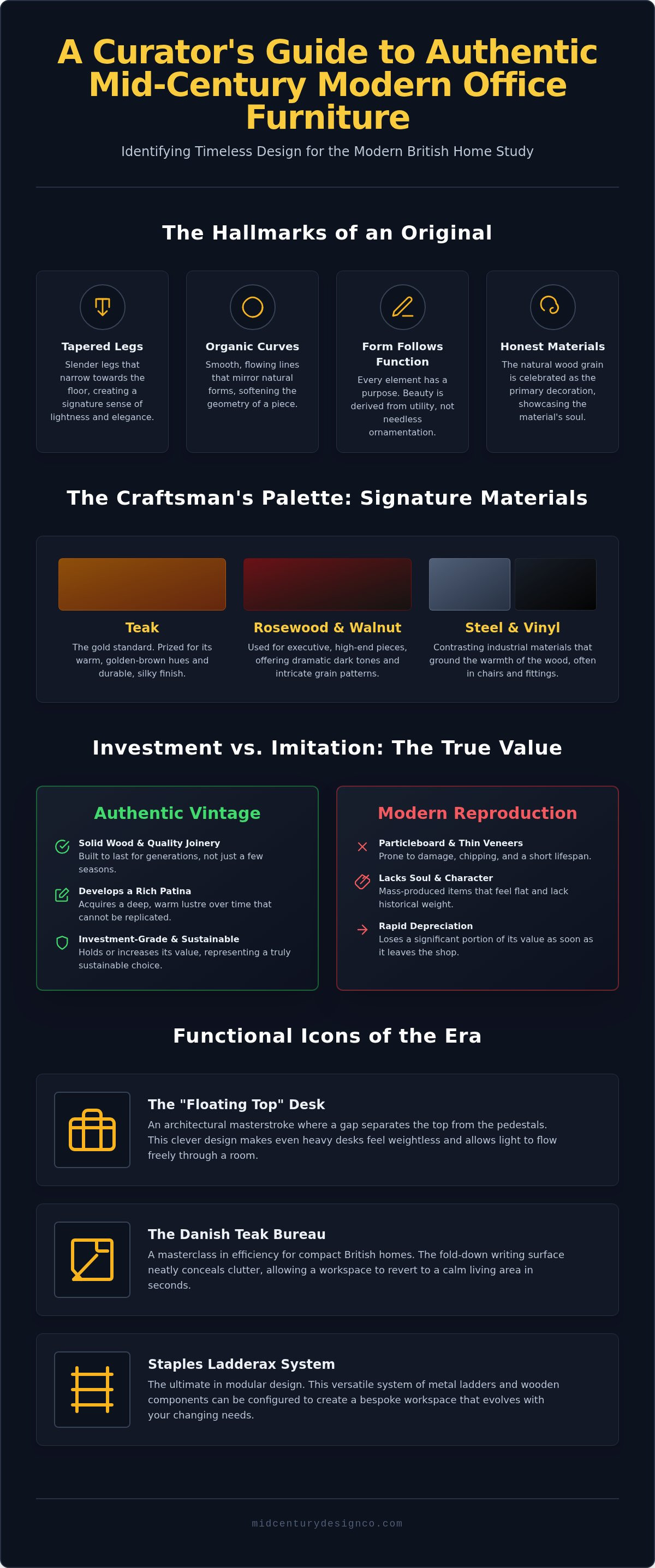
Authentic mid century modern office furniture isn't merely a style; it's a historical movement that flourished between 1945 and 1970. Born from a post-war desire for progress, the era's core philosophy was simple: form follows function. This meant stripping away the ornate, heavy carvings of previous generations to reveal the inherent beauty of the object's purpose. You can identify these pieces by their distinctive tapered legs, which create a sense of weightlessness, and organic curves that mirror the natural world. This specific office aesthetic represents a deliberate balance of industrial efficiency and domestic warmth.
The Philosophy of Functional Art
Post-war designers sought to democratise beauty, bringing high-end design into the everyday home office. Before this shift, British studies were often dominated by cumbersome Victorian or Edwardian desks that felt imposing and static. By the 1960s, the silhouette changed entirely. Desks became light and airy, often featuring "floating" tops that allowed light to pass through the room. There's an honest quality to these pieces. Rather than hiding the construction under layers of thick lacquer, designers allowed the wood grain itself to serve as the primary decoration. It's a celebration of the material's soul, where every joint and curve serves a practical and aesthetic goal.
Key Materials and Textures
The choice of timber defines the character of the space. Teak remains the undisputed gold standard of the era, prized for its warm, golden-brown hues and high oil content that provides a tactile, silky finish. For those seeking a more dramatic, executive feel, rosewood and walnut offer darker tones and intricate, swirling grain patterns. British and Danish craftsmen often paired these woods with contrasting textures to create visual depth:
- Teak and Oak: A classic combination found in Danish desks, offering exceptional durability and a bright, inviting palette.
- Rosewood: Reserved for high-end statement pieces that command attention and project a sense of historical weight.
- Steel and Vinyl: Frequently seen in mid century modern office furniture such as swivel chairs, these materials introduced an industrial edge that grounded the warmth of the wood.
While many modern reproductions use low-quality veneers or particleboard, authentic vintage pieces rely on solid wood and high-quality joinery. This structural integrity ensures that a desk from 1965 remains as sturdy and reliable today as the day it left the workshop. It's the difference between a temporary fixture and a lifelong companion for your creative work.
Iconic Examples of Mid Century Workspace Design
Selecting iconic mid century modern office furniture is about more than just aesthetics. It's an investment in pieces that solved the spatial challenges of the 20th century with grace. Take the "Floating Top" desk. By creating a deliberate gap between the drawer pedestals and the desktop, designers achieved a sense of architectural suspension. It's a masterstroke of 1960s engineering. This design makes even a heavy teak piece feel as though it's hovering, allowing light to flow through your study rather than being blocked by a solid mass of wood.
For those working in more compact British homes, the Danish Teak Bureau is a masterclass in efficiency. These pieces offer a fold-down writing surface that conceals the day's clutter once the work is done. It's the perfect solution for a multi-functional living space. You can transition from a productive office to a calm living room in seconds, simply by lifting the lid on your mess. These bureaus often feature hidden compartments and small drawers, perfect for organising stationery without the need for bulky modern plastic trays.
The Versatility of Staples Ladderax
Few systems capture the spirit of the era like Staples Ladderax modular shelving. Originally designed in the 1960s, this system uses floor-standing or wall-mounted metal ladders to support a bespoke arrangement of cabinets, shelves, and dedicated desk units. The contrast between the industrial black or white metal and the warmth of the teak wood grain is striking. It allows you to build a workspace that evolves. You can move components as your library grows or your technology requirements change, making it a truly future-proof choice for a home office.
Sculptural Seating: The Office Chair
A desk is only half the story. Finding an authentic mid century office chair UK collectors prize involves looking for sculptural silhouettes and "compass" leg designs. These chairs often outperform modern budget alternatives because they were built with high-quality bentwood and robust swivel mechanisms. Whether you choose a piece with its original vinyl or one that's been sympathetically re-covered in a period-correct wool, the comfort is surprisingly advanced. These chairs were designed for long hours of administration. The pitch of the back and the curve of the seat often provide better support than today's mass-produced plastic options.
Investing in mid century modern office furniture ensures your workspace feels like a curated sanctuary rather than a corporate cubicle. If you're ready to find a piece that carries this narrative, you might explore our latest collection of original vintage desks and seating.
Authentic Vintage vs. Modern Reproductions: The Real Cost
Choosing between a genuine 1960s piece and a modern high-street replica is a decision that extends far beyond the initial purchase price. There is a palpable soul in a desk that has weathered six decades of creative thought. This depth is found in the patina. Unlike the flat, uniform finish of a modern reproduction, the surface of authentic mid century modern office furniture tells a narrative through its varied wood grain and soft, honeyed glow. Whilst a contemporary desk often relies on a thin, superficial stain to mimic age, vintage teak possesses a deep, oil-rich character that only matures with time.
Sustainability also plays a vital role in this choice. By sourcing existing furniture, you are participating in a truly circular economy, rescuing high-quality materials from the landfill and avoiding the carbon footprint of new manufacturing. It's a quiet act of environmental stewardship. You aren't just buying a workspace; you're preserving a legacy of mid-century craftsmanship that was built to last several lifetimes rather than a single decade.
Joinery and Craftsmanship
The structural integrity of a 1960s piece is immediately evident the moment you open a drawer. Look for the tight, interlocking teeth of dovetail joints and the presence of solid wood edges. These are the hallmarks of a period when furniture was an investment in longevity. Contrast this with the cam-locks, plastic brackets, and MDF cores found in modern "retro-style" offerings. There is a satisfying weight and a muted "thud" to a well-made vintage drawer that mass-produced items simply cannot replicate. These technical details ensure that your desk remains stable and silent, even under the weight of modern hardware.
The Investment Angle
From a financial perspective, the "cost" of a reproduction is often higher in the long run. A new replica depreciates the moment it enters your home, much like a new car. Authentic vintage pieces, however, often hold or even increase in value as they become rarer. This is particularly true for "investment grade" items like a signed Danish desk or a well-preserved mid century modern sideboard repurposed for office storage. Once these original pieces are gone, they cannot be replaced. Investing in an original is a savvy financial move, ensuring that your study is furnished with assets that grow in beauty and worth whilst providing a sanctuary for your daily work.
How to Style Mid Century Office Furniture in a British Home
Styling mid century modern office furniture in a contemporary British home is an exercise in curated contrast. You don't need to live in a 1960s time capsule to appreciate these pieces. A vintage teak desk looks spectacular against the soft, chalky "off-white" walls found in modern renovations. This juxtaposition allows the wood's natural orange and honey tones to pop, creating a focal point that feels both historic and fresh. To manage the inevitable clutter of modern technology, use discrete cable management like leather cord wraps or weighted floor hubs. These allow you to organise your workspace without drilling into or obscuring the original timber grain.
Lighting serves as the final layer of your sanctuary. Pair your workspace with a classic British Anglepoise lamp for focused task lighting or a Guzzini-style acrylic dome for a softer, sculptural glow. If your office shares space with a living area, use a Staples Ladderax system to define the boundary. By configuring the metal ladders as a partial room divider, you create a "zonal" office. This provides a clear mental shift from domestic life to professional focus without the need for permanent walls or heavy renovations.
The Power of the Centrepiece
Let the furniture breathe. Position your desk near a window where natural light can dance across the grain, but avoid direct sunlight that might bleach the finish over time. To maintain a domestic feel, consider repurposing a vintage chest of drawers for filing and stationery storage. This keeps the room feeling like a refined home study rather than a corporate suite. Soften the hard lines of the wood with a thick wool rug or heavy linen curtains. These textiles create a textured, sensory environment that encourages focus and provides acoustic dampening for those frequent video calls.
Practicality for the Modern Professional
While style is paramount, ergonomics cannot be ignored. Most vintage desks sit at a standard height, but it's wise to check yours against your preferred office chair before committing. Protect your original floorboards or parquet from the pressure of tapered legs by using high-quality felt pads. If you find it difficult to "switch off" at the end of the day, a Danish bureau remains the ultimate solution. Simply close the writing slope to hide your laptop and paperwork. This simple act physically and mentally ends the working day, allowing your office to return to a place of rest.
Ready to transform your study into a sanctuary of style? Browse our hand-picked selection of authentic mid century modern office furniture to find your next centrepiece.
Sourcing with Confidence: The Curator’s Choice
Sourcing authentic mid century modern office furniture is an exercise in discernment. It's about looking past the surface. A specialist curator understands the provenance of a piece, identifying the subtle signatures of a Danish master or the robust construction of a British workshop. When browsing a listing, demand structural honesty. Look for detailed photos that capture the movement of the teak grain, the precision of the joinery, and the soft wear of the original finish. These aren't flaws. They are the fingerprints of history. A piece that looks too perfect often hides a lack of soul, whilst an original item wears its age with a dignified grace.
At The Mid Century Design Co., we focus exclusively on original vintage pieces. We don't sell reproductions. There's a specific joy in owning a desk that has been curated, not just stocked. It's the difference between a mass-produced commodity and a piece of functional art that carries a narrative from the 1960s into your study. We look for the makers' marks and the specific timber selections that defined a decade of design excellence. This dedication ensures that every item we offer is an investment-grade discovery that brings character to your home.
The Role of the Expert Friend
A curated gallery experience feels different from a high-street furniture shop. It's a partnership. We act as your expert friend, providing the peace of mind that comes with a verified 1960s original. You aren't just buying a chair. You're inviting a piece of history into your sanctuary. Envision the warmth of a rosewood desk under your hands. Imagine the stillness it brings to your creative process. These pieces were designed to be lived with, touched, and appreciated daily. They ground a room with their historical weight and sensory warmth, turning a simple study into a place of inspiration.
Your Next Discovery
Your journey toward a timeless workspace doesn't have to be a struggle amongst the sea of flat-pack replicas. We offer nationwide UK delivery for our unique items, ensuring these rare discoveries reach your study safely. Each piece is ready to begin its next chapter with you. Explore our curated collection of authentic mid-century modern office furniture and find the soul your workspace has been missing.
Your Sanctuary Awaits
Creating a workspace that inspires shouldn't feel like a compromise. By choosing mid century modern office furniture, you're investing in a legacy of craftsmanship that prioritises both the soul of the material and the needs of the professional. You've discovered how the deep patina of original teak outshines modern replicas, and how the modular brilliance of a Staples Ladderax system can adapt to your evolving creative life. These pieces are more than just utility; they're functional art that holds its value whilst grounding your study in a rich, historical narrative.
As specialists in authentic Staples Ladderax systems and curated Danish design, we offer only expertly sourced original furniture with no modern reproductions. We provide nationwide UK delivery on all our pieces, ensuring your next discovery reaches your home study with the care it deserves. It's time to step away from the disposable and embrace a workspace that reflects your discerning eye for quality and heritage.
Discover your next investment-grade office piece amongst our curated vintage collection and begin the journey of transforming your home study into a true sanctuary of style.
Frequently Asked Questions
Is mid century modern office furniture comfortable for all-day use?
Yes, authentic pieces were designed for administrative longevity. Many chairs from this era feature advanced swivel mechanisms and bentwood frames that offer surprisingly sophisticated support. These items were crafted during a time when office work was a formal, all-day discipline, ensuring the ergonomics remain practical for your modern creative sessions and providing a sanctuary of comfort in your own home.
How can I tell if a mid-century desk is an original or a reproduction?
Identify originals by checking for maker's stamps, labels, or gold-embossed marks inside the drawers. Genuine 1960s pieces use traditional dovetail joints and solid timber edges rather than the cam-locks and thin, printed veneers found in modern replicas. The physical weight and the silent, smooth glide of the drawers are also reliable indicators of historical quality that you can feel with every use.
Does vintage teak furniture require a lot of maintenance?
Vintage teak is surprisingly resilient due to its naturally high oil content. You don't need an arduous routine; a simple application of high-quality teak oil once or twice a year is usually sufficient to keep the grain hydrated. This gentle process preserves the honey-coloured glow and prevents the timber from becoming brittle or faded, ensuring your furniture remains a beautiful part of your workspace.
Can I use a vintage desk with a modern computer and monitor?
You can certainly use a vintage desk with modern hardware. These desks were originally built to support heavy mechanical typewriters and thick ledgers, making them more than sturdy enough for contemporary monitors and laptops. We recommend using felt pads under your equipment to prevent surface scratches and protecting the wood from heat with a desk mat to maintain the piece's historical integrity.
Why is authentic mid-century furniture more expensive than modern retro-style pieces?
Authentic mid century modern office furniture commands a higher price because it's a finite resource made from premium hardwoods. Unlike mass-produced "retro" furniture that depreciates instantly, original pieces are investment-grade assets. You're paying for historical provenance, superior joinery, and a piece that likely increases in value over time, making it a savvy financial choice for your home study and a lasting legacy of design.
What is Staples Ladderax and why is it popular for home offices?
Staples Ladderax is a modular shelving system consisting of metal ladders and adjustable wooden units. This versatile system is a cornerstone of mid century modern office furniture because it allows you to build a bespoke workspace that fits your room dimensions perfectly. You can easily integrate a desk, cabinets, and bookshelves into one cohesive, airy structure that evolves with your needs over time.
How do I care for the wood grain on a 1960s office desk?
Maintain the grain by dusting regularly with a dry, lint-free cloth to prevent build-up. Avoid placing your desk in direct sunlight or near radiators, as extreme heat and UV rays can bleach the rich timber tones. If the wood begins to look parched, a light application of Danish oil will restore its original lustre and sensory warmth, keeping the piece looking its best.
Is it better to buy British or Danish mid-century office furniture?
Both regions offer exceptional quality, though their aesthetics differ slightly. Danish pieces often lean toward a more minimalist, sculptural silhouette, whilst British makers like G-Plan produced robust, practical designs. Your choice should depend on whether you prefer the light elegance of Denmark or the sturdy character of British teak, as both offer excellent longevity for a home study.