

Curating the Soul of Your Home: A Buying Guide to Danish Mid-Century Modern Furniture
Your home shouldn't just house your life, it should echo your spirit. In an era of disposable design, finding a piece that carries its own history is a rare joy. You likely appreciate the sculptural lines and tactile warmth of Danish mid century modern furniture, yet the market can feel like a minefield of clever reproductions and confusing terminology. It's natural to worry about whether a grand rosewood sideboard will overwhelm a modest UK lounge or if that teak chest is truly the work of a master craftsman.
We understand that you're looking for more than a table or a chair; you're seeking a soul for your space. This guide promises to simplify the selection process, helping you invest in authentic pieces that offer both sensory comfort and long-term value. We will explore how to identify genuine makers, understand the rich character of different wood grains, and learn how to integrate these timeless treasures into your modern sanctuary whilst supporting a more sustainable, circular way of living.
Key Takeaways
- Uncover the philosophy behind the 'Golden Era' of Nordic design and how its balance of form and function creates a serene, sanctuary-like environment.
- Master the art of identifying authentic Danish mid century modern furniture by spotting signature joinery details and the unique patina of original teak veneers.
- Find the perfect storage solutions for contemporary UK floorplans, from the expansive 'Long John' sideboard to space-saving writing bureaus.
- Understand the long-term investment potential of original vintage pieces from iconic makers like McIntosh and Younger compared to modern reproductions.
- Learn how to curate a home that reflects your soul whilst supporting sustainable, circular design through the acquisition of functional art.
The Essence of Danish Mid-Century Modern Design
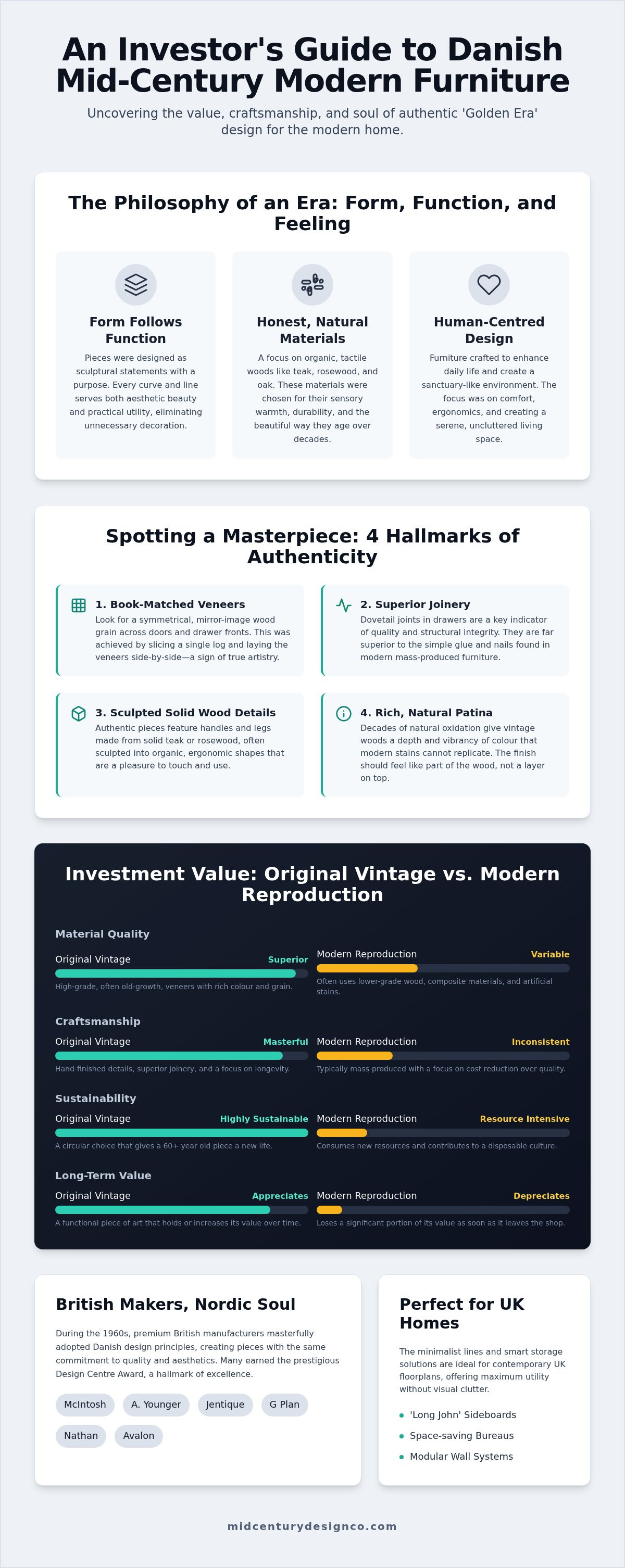
To truly appreciate Danish mid century modern furniture, we must step back into the 'Golden Era' of the 1940s through the 1960s. This period saw a radical shift in how we perceived our domestic surroundings. Designers in Copenhagen and beyond rejected the heavy, dark clutter of the Victorian age. They sought something lighter. Something more honest. This movement, often described as The Essence of Danish Mid-Century Modern Design, prioritised the human experience over mere decoration. It wasn't just about making chairs; it was about reimagining the soul of the home.
The famous mantra "form follows function" was revolutionised during this time. It wasn't just about utility. It was about structural poetry. A sideboard wasn't just a box for plates; it was a sculptural statement. This era introduced a sensory warmth that remains unmatched by modern materials. Teak, with its high oil content and honeyed glow, became the definitive wood of the movement. Rosewood offered a more dramatic, figured grain, whilst oak provided a sturdy, blonde honesty. These materials weren't just chosen for their looks. They were selected for their longevity and the way they age alongside their owners.
It's vital to distinguish between "Made in Denmark" and pieces built under "Danish Design" principles. During the 1960s, many premium British manufacturers adopted these specific silhouettes. They used the same high-grade veneers and joinery techniques. Whether a piece was crafted in a small Danish workshop or a larger UK factory, the commitment to quality remained the same. The spirit of the design was the unifying factor.
Why Danish Aesthetics Endure in Modern UK Homes
Contemporary UK interiors often struggle with limited floorplans. The minimalist lines of mid-century pieces are incredibly versatile. They offer significant storage without the visual bulk of traditional furniture. There's also a deep emotional factor at play. In a world of digital screens and flat plastics, the organic touch of vintage wood acts as a grounding anchor. It counters digital fatigue. Choosing original vintage is also a radical act of sustainability. These pieces have already lasted sixty years. They're ready for sixty more. It's a circular design choice that respects the planet.
Masters of the Craft: UK Manufacturers and Nordic Pioneers
British makers like McIntosh and Jentique were instrumental in bringing Danish mid century modern furniture aesthetics to the UK. They didn't just copy the Nordic masters. They refined the style for British tastes. They maintained local craftsmanship whilst embracing the sleek, Scandi-inspired silhouettes that homeowners craved. Many of these pieces carried the prestigious Design Centre Award. This was a mark of excellence that guaranteed a standard of design and durability. It's a standard that far exceeds most modern alternatives found on the high street today.
Identifying Authentic Danish Craftsmanship and Patina
Identifying authentic Danish mid century modern furniture requires a keen eye for what we call structural poetry. This is most evident in the meticulous matching of wood grains. Master craftsmen of the era would slice a single timber log and lay the resulting veneers side-by-side. This technique, known as book-matching, creates a symmetrical, flowing pattern across drawer fronts and cupboard doors. It is a level of detail that modern mass-production simply cannot replicate. When you run your hand across a vintage sideboard, you should feel the seamless transition between these layers of history.
The joinery itself tells a story of quality. Look for dovetail joints in the drawers. These interlocking wedges aren't just a decorative flourish; they are a mark of structural integrity. Solid teak handles, often sculpted into organic, ergonomic shapes, provide a tactile connection to the maker's intent. These details were designed to be used daily, yet they possess the grace of fine art. You might also find original labels from makers like G Plan, Nathan, or Avalon tucked inside a drawer or on a back panel. These brands were the vanguard of the British movement that embraced Nordic silhouettes.
The Language of Teak: Grain and Colour
Honey-toned teak is the definitive hallmark of the era, but don't overlook the dramatic, dark swirls of aged rosewood. These woods possess a depth and vibrancy that only comes from decades of natural oxidation. The Definitive Guide to Authentic Mid Century Modern Sideboards is an essential resource for learning how to spot these specific grains and the superior joinery of the 1960s. This natural aging process creates a visual warmth that modern stains try, and fail, to mimic.
Hardware and Finishing Touches
Hardware should be subtle yet substantial. Sculpted or slatted handles, often carved from solid teak, define the Danish mid century modern furniture aesthetic. Tapered legs and hidden hinges also contribute to that iconic, floating silhouette. We believe the soul of an object lies in its patina. This is the unique character a piece acquires over time, from the gentle sun-bleaching on a tabletop to the slight darkening of the wood near a well-used handle. We value this original narrative over the sterile, uniform look of modern restoration. If you're looking for a piece that carries its history with pride, you might view our curated selection of authentic storage to find a statement piece for your home.
Choosing the Right Storage: Sideboards, Bureaus, and Modular Systems
The soul of a room often rests in how we organise its contents. In the world of Danish mid century modern furniture, storage is never merely utilitarian. It's a sculptural anchor. The 'Long John' sideboard, with its elongated, low-slung profile, has become the definitive choice for the contemporary media centre. Its height allows for a television to sit at eye level whilst the expansive teak surface remains a gallery for your favourite ceramics. For those navigating the constraints of a compact UK floorplan, the writing bureau offers a sophisticated solution. It provides a dedicated workspace that can be closed away, returning the room to a place of rest once the day's work is done.
Evaluating your space requires more than a simple tape measure. You must consider the visual 'weight' of a piece. A solid teak sideboard possesses a gravity that can ground a large living area, but in a narrow hallway, it might feel imposing. Measuring for depth is critical. Many vintage units were built with generous proportions that may not align with modern apartment corridors. We always suggest marking out the footprint on your floor with masking tape. This allows you to walk around the ghost of the furniture, ensuring the flow of the room remains uninterrupted and serene.
The Versatility of the Mid-Century Sideboard
A McIntosh sideboard is a masterclass in adaptability. Whilst it was originally intended as a dining room buffet, its clean lines allow it to function beautifully as a focal point in a lounge. You may hear these pieces referred to as 'credenzas', a term more common in American or Italian design, but in the UK, the 'sideboard' remains the heart of the home. Balancing a large teak piece with contemporary decor is an exercise in contrast. Try pairing the warm, organic grain of the wood with cool, minimalist art or a collection of lush, green houseplants to create a vibrant, lived-in sanctuary.
Modular Storage: The Staples Ladderax Advantage
For the true collector, Staples Ladderax systems offer the ultimate in modular 'structural poetry'. These systems are the perfect companion to Danish mid century modern furniture because they grow alongside you. You can start with a single bay and add shelves, bureaus, or cabinets as your needs evolve. The flexibility is unmatched. We love the aesthetic tension created by mixing glass-fronted display units with solid teak cabinets. It allows you to showcase your most treasured objects whilst hiding the more mundane elements of daily life behind beautifully figured wood doors.
Standout Icons: Standout Pieces from Our Collection
Every collection has its stars. These are the pieces that define the spirit of Danish mid century modern furniture through their silhouette and history. The McIntosh Medium Teak Sideboard is a prime example. Crafted in Kirkcaldy, it represents the pinnacle of Scottish manufacturing influenced by Nordic lines. Each unit we curate possesses a unique patina, a soft glow that only decades of careful use can bestow upon high-quality teak. It's a piece that doesn't just sit in a room; it anchors it.
The John Herbert for Younger 'Long John' Sideboard is another Scandi-inspired buffet icon that commands attention without shouting. Its proportions are perfectly balanced, offering a sleekness that few modern pieces can match. For those who require ultimate flexibility, the Staples Ladderax 3-Bay System remains the gold standard of 1960s modular design. It turns a bare wall into a functional landscape of shelves and cabinets, allowing you to build a library or a display that evolves with your life. We also hold a deep appreciation for the Jentique Danish Design Sideboard, particularly for its striking solid teak handles that feel as organic as they look.
Compact Solutions for Modern Living
Not every home requires a seven-foot sideboard. The Remploy Writing Bureau is a clever pyramid-style desk that offers a generous workspace whilst occupying a minimal footprint. It's an ideal piece for adding character to a bedroom or a quiet corner of a lounge. If you're a vinyl enthusiast, Nathan Parker Knoll Media Units provide the perfect sanctuary for your LP collection, blending 1960s charm with practical storage. The Avalon 'Long John' is another sought-after gem, prized for its sophisticated, clean lines and lighter visual weight that suits contemporary apartments perfectly.
Modular and Flexible Cabinetry
Versatility is the hallmark of vintage design. Our vintage teak modular sideboards allow you to arrange two-unit combinations to fit custom alcoves or sprawling walls, giving you a bespoke feel without the bespoke price tag. For narrow hallways where every inch matters, the slim-line elegance of glazed glass bookcases offers storage without closing in the space. These pieces allow your library to breathe whilst protecting your most treasured volumes. To see how these icons might transform your home, you should browse the full Sideboards and Storage collection for our current availability.
Investing in History: The Long-term Value of Original Vintage
Choosing Danish mid century modern furniture is a decision that rewards both the eye and the portfolio. Whilst modern flat-pack alternatives are designed for a short lifecycle, these vintage icons were built to endure. They represent a finite era of craftsmanship. Premium wood grains like rosewood and golden teak are increasingly rare. These materials are no longer used in the same way today due to environmental protections. Owning a piece from the 1960s means holding a slice of design history that grows more precious as the years pass. It is functional art that retains its soul and its market value.
Preserving this investment is a simple act of stewardship. To keep the wood's natural spirit alive, place your furniture away from direct heat sources and harsh sunlight. A gentle buff with a high-quality beeswax every few months is often all that's required. Avoid modern silicone-based sprays. They can create a plastic-like build-up that masks the true character of the grain. By treating these objects with respect, you ensure they remain a sanctuary of style for decades to come. Your home becomes more than a living space. It becomes a curated gallery of heritage.
The Sustainable Choice for the Discerning Buyer
Choosing pre-loved furniture is perhaps the most elegant way to reduce your carbon footprint. It is the definitive antithesis of 'fast furniture' culture. Every sideboard or chest of drawers you rescue from the past is one less item destined for a landfill. There is a profound beauty in the idea of passing down a piece of design history. You are not just buying a storage unit; you are curating a legacy for the next generation. It is a circular way of living that values quality over quantity and narrative over novelty.
Your Journey with The Mid Century Design Co.
We are dedicated curators. Our focus remains exclusively on original vintage pieces that carry an authentic narrative. We don't deal in modern reproductions or sterile restorations. Our commitment is to the original patina and the stories these pieces tell. With our national UK delivery service, the soul of Danish mid century modern furniture can reach your doorstep, regardless of where you reside. We invite you to find a piece that resonates with your personal style and brings a sense of calm to your home. Discover your next statement piece amongst our sideboards.
Your Journey Toward a Curated Sanctuary
Integrating a piece of history into your contemporary space is more than a design choice; it's a commitment to a slower, more intentional way of living. We've explored the tactile poetry of original wood grains and the structural integrity of master joinery. These elements ensure that authentic Danish mid century modern furniture remains a lasting investment in both aesthetic beauty and financial value. By choosing original vintage over mass-produced replicas, you're embracing a sustainable narrative that honours the craftsmanship of the past whilst grounding your home in the present.
Our collection is a carefully curated gallery of the 'Golden Era', featuring standout pieces from iconic makers like McIntosh, Jentique, and Staples Ladderax. We never stock modern reproductions; every item in our care retains its unique patina and historical soul. Whether you're seeking a 'Long John' sideboard or a modular shelving system, we provide national UK delivery to bring these timeless treasures directly to your door.
Shop our curated collection of authentic Danish sideboards and storage and begin curating a home that truly reflects your spirit.
Frequently Asked Questions
What is the difference between Danish Design and furniture actually made in Denmark?
The distinction lies in the geography of production rather than the soul of the design. "Made in Denmark" indicates the piece was crafted in a Danish workshop, whilst "Danish Design" is a broader term often used by British manufacturers who adopted Scandinavian aesthetics. Both can be authentic examples of the era if the craftsmanship meets the high standards of the time, prioritising clean lines and organic materials.
How can I tell if a mid-century sideboard is made of solid teak or teak veneer?
Most high-end Danish mid century modern furniture uses a combination of solid teak and premium veneers. You can identify solid teak on the high-traffic areas like sculpted handles, tapered legs, and the lipped edges of a sideboard. Large flat surfaces like tabletops use veneers to ensure the wood doesn't warp over time, allowing for the beautiful book-matched grain patterns that define the style.
Why is original vintage more expensive than modern mid-century reproductions?
Original vintage pieces are a finite resource, possessing a historical weight and material quality that modern reproductions cannot match. Whilst a new replica might look similar from a distance, it lacks the investment potential and the unique patina of aged wood. Authentic pieces from the 1960s often appreciate in value, making them a wise financial choice compared to mass-produced items that depreciate the moment they leave the showroom.
Will a large Danish sideboard fit through a standard UK doorway?
Most mid-century sideboards are designed with a depth of approximately 45cm, which allows them to pass through a standard UK doorway of 76cm with ease. We always recommend measuring your specific entry points and any tight turns in hallways before purchase. If you're concerned about a particularly large 'Long John' unit, our delivery team can often advise on the best approach for a smooth installation within your home.
How do I maintain the colour and grain of my vintage teak furniture?
Preserving the sensory warmth of your furniture requires minimal but consistent care. Keep your pieces away from direct radiators and harsh afternoon sun to prevent the wood from drying or fading unevenly. A light application of a natural beeswax every few months will nourish the grain. Don't use modern aerosol sprays; they contain silicones that can damage the original finish and cloud the wood's natural spirit.
What should I look for when buying a Staples Ladderax system for the first time?
When starting your Ladderax journey, focus on the condition of the metal or wooden uprights and the integrity of the support pins. Ensure the uprights are straight and the feet are intact, as these provide the structural poetry of the system. It's also worth checking that all the cabinets and shelves have their original hooks, as sourcing individual replacements for specific bays can be a significant challenge later on.
Are McIntosh and G Plan considered authentic Danish modern furniture?
McIntosh and G Plan are highly respected British makers who were at the forefront of the mid-century movement in the UK. Whilst they aren't Danish in origin, their designs from the 1960s are considered authentic examples of the Danish mid century modern furniture aesthetic. Makers like McIntosh were particularly known for their high-quality teak veneers and sophisticated silhouettes that rivalled the best exports from Copenhagen during the Golden Era.
Do you provide international shipping for your Danish furniture collection?
We don't offer international shipping at this time, as our focus is on providing a dedicated service within the United Kingdom. We provide a specialist national delivery service for all our large furniture items, ensuring each piece arrives safely at your home. This allows us to maintain the highest standards of care for these delicate, one-of-a-kind vintage treasures throughout their journey to your sanctuary.