

Danish Dining Chairs in the UK: A Guide to Sourcing Authentic Vintage Excellence
A mass-produced chair might support your weight, but it will never support a conversation. Functional art. Timeless craft. In a world of fleeting trends, the pursuit of authentic Danish dining chairs UK homeowners adore is about more than just utility; it's about welcoming a piece of history into your living space. You likely recognise the organic curves and the tactile warmth of mid-century timber, yet the market is frequently saturated with 'Danish-style' reproductions that lack the soul of the original 1950s craft.
We understand the uncertainty that arises when distinguishing between a genuine Niels Møller and a modern imitation, or whilst weighing the merits of rich rosewood against the honeyed glow of vintage teak. This guide offers the clarity you need to invest with absolute confidence. We'll explore the nuances of authentic joinery, the characteristics of specific designers, and the essential details that ensure your dining room becomes a curated sanctuary where every piece holds its value for generations to come.
Key Takeaways
- Discover why the organic warmth of teak and the dramatic grain of rare rosewood represent the pinnacle of mid-century craftsmanship and historical value.
- Learn the essential markers of authenticity to ensure you invest in genuine Danish dining chairs UK collectors prize, rather than depreciating modern reproductions.
- Master a professional buyer’s checklist for evaluating structural integrity, whilst learning to embrace the soulful patina that only sixty years of history can provide.
- Identify the signature silhouettes of iconic designers like Niels Møller to help you curate a collection that holds or increases its value over time.
- Gain the confidence to blend historical furniture with contemporary interiors to create a dining space that feels personal, unique, and sanctuary-like.
The Allure of Danish Dining Chairs: Why Original Design Still Reigns in the UK
The British dining room has undergone a quiet, sophisticated transformation. Whilst many trends arrive with a fanfare only to fade into the background, the demand for authentic Danish dining chairs UK collectors seek has never wavered. This isn't merely a preference for a specific silhouette. It's a deep-seated appreciation for furniture that transcends its primary purpose. To own an original piece from the Danish modern design movement is to possess a functional sculpture; an object that balances the weight of history with the lightness of visionary design. These chairs act as anchors. They provide a sense of permanence and sanctuary in a world that often feels increasingly transient. Finding the right Danish dining chairs UK market offers means looking beyond the surface to the spirit and narrative of the piece.
The Philosophy of Form and Function
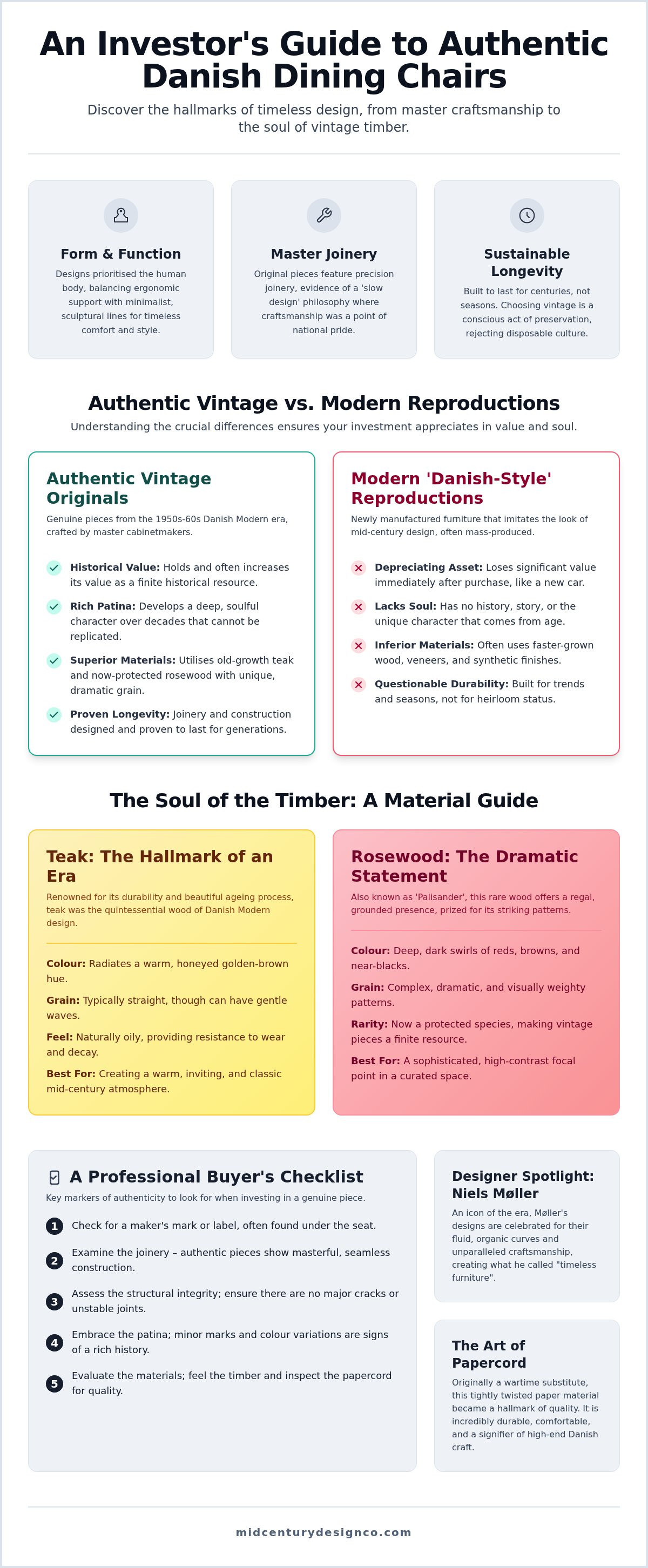
Danish designers didn't just build furniture; they studied the way we live. They prioritised the human body, ensuring that every angle supported the spine whilst maintaining the minimalist lines that define the era. This was 'slow design' in its purest sense. A single chair design might undergo years of refinement before it was deemed ready for a home. Unlike modern imitations that prioritise a 'look', these originals were engineered for comfort and tactile delight. The precision of the joints and the organic flow of the timber are evidence of a time when craftsmanship was a point of national pride. Danish Modernism is the art of marrying organic, sculptural curves with master joinery to create objects that feel as natural as the timber from which they were born.
Sustainability Through Longevity
Choosing vintage is a conscious act of preservation. For the British homeowner, these pieces offer a sustainable alternative to the 'disposable' culture of the modern high street. Every mark on a teak frame or slight softening of a leather seat tells a story. This character is something a factory-fresh reproduction can't replicate. Much like authentic mid-century sideboards, these chairs were built with an assumption of longevity. The soul of a vintage piece lies in its survival. Original joinery was designed to last for centuries, not just seasons. Teak and rosewood develop a rich, deep patina that only time can bestow. Investing in vintage prevents high-quality materials from entering the waste stream, ensuring that the excellence of the past continues to breathe life into the present.
Materials that Breathe: Teak, Rosewood, and the Soul of Danish Craftsmanship
To truly appreciate the Danish dining chairs UK collectors seek, one must first touch the timber. It's a sensory experience. Unlike the cold, uniform surfaces of modern mass production, vintage Danish furniture utilises wood as a living, breathing canvas. Master cabinetmakers of the mid-century era viewed timber not merely as a structural necessity but as a decorative element in its own right. They selected cuts that showcased the rhythm of the grain, ensuring that every chair possessed a unique fingerprint of nature’s design. This focus on material integrity is what gives these pieces their enduring soul.
Teak remains the hallmark of the period. Its honeyed, golden-brown hue radiates a warmth that softens the minimalist lines of a contemporary home. Rosewood, often referred to as 'Palisander', offers a more dramatic narrative. Its deep, dark swirls and complex grain patterns provide a visual weight that feels both regal and grounded. Because rosewood is now a protected species, these vintage pieces represent a finite historical resource. The Designmuseum Danmark highlights how this era elevated such materials through a deep respect for natural textures. When you run your hand across an original frame, you feel the wood itself, not a thick layer of synthetic lacquer. This tactile honesty is why many enthusiasts choose to explore curated Danish furniture that retains its original, soulful finish.
The Art of the Papercord Seat
Papercord is a triumph of Danish ingenuity. Originally developed as a durable alternative during wartime shortages, it became a signifier of high-quality craftsmanship, most notably in the works of Hans Wegner. It offers a surprising level of comfort, contouring slightly to the body whilst remaining remarkably resilient. Authentic papercord is tightly woven and designed to last for decades. To maintain a vintage weave, avoid harsh chemicals; a gentle, damp cloth is usually enough to preserve the integrity of the natural fibres and keep the seat looking pristine for years to come.
Joinery as a Statement
The true genius of a Danish chair is often hidden in its joints. Master cabinetmakers favoured finger joints and dovetails over the convenience of screws or nails. This creates a structural integrity that modern furniture simply cannot match. You'll rarely find a visible screw in a piece of authentic 1960s design. Instead, you'll find a seamless transition between the chair leg and the backrest that is so fluid and precise it appears as though the two components have grown together from a single piece of timber. This level of detail is a hallmark of the Danish dining chairs UK market's most coveted items.
Authentic Vintage vs Modern Reproductions: Why Originality Matters
The market for Danish dining chairs UK enthusiasts navigate is often clouded by the term 'Danish style'. It's a clever linguistic mask for modern reproductions that lack the substance, weight, and history of their predecessors. Choosing an original isn't just about aesthetics; it's a rejection of the disposable culture that defines much of modern manufacturing. A reproduction is a copy of a form. An original is the embodiment of a philosophy. These vintage pieces possess a patina that sixty years of use has gently etched into the timber, creating a narrative of family meals and quiet evenings that a factory-fresh copy simply can't replicate.
Much of the difference lies in the quality of the timber itself. Mid-century cabinetmakers had access to old-growth teak and rosewood, woods that had grown slowly over decades to produce a tight, oily, and incredibly durable grain. Modern copies rely on fast-grown plantation timber that often feels 'flat' and lacks the sensory warmth found in the history of the Danish Modern movement. Just like authentic mid-century sideboards, original Danish dining chairs UK collectors find are a finite resource. While a modern copy loses value the moment it leaves the showroom, a well-maintained vintage set is an asset that tends to hold or even increase its value over time.
The Pitfalls of 'Danish Style' Copies
Modern 'Scandi' furniture often prioritises a superficial look over structural integrity. You can often spot a reproduction by its uniform, artificial finish; modern lacquers are frequently applied too thickly, masking the natural texture of the wood. Try the weight test. An original solid teak chair has a reassuring heaviness that a veneer-heavy copy cannot replicate. Many modern pieces use hidden staples or poor-quality glue that fails within a few years, whereas a vintage chair relies on the enduring strength of masterfully cut joints. These structural failures are why 'budget' copies often end up in landfill whilst original pieces continue to serve after half a century.
The Value of a Designer’s Mark
Finding a maker's stamp is a moment of genuine discovery for any collector. Look for the burned-in labels or paper stamps of makers like Farstrup or Uldum Møbelfabrik tucked discreetly beneath the seat frame. These marks are more than just branding; they are a guarantee of a specific standard of Danish excellence and historical integrity. In the UK market, securing a complete, matching set of six original chairs is a significant triumph. It represents a curated piece of design history that brings a unique, storied presence to your home. Owning an authentic piece allows you to feel like a custodian of craft rather than just a consumer of a trend.
A Buyer’s Checklist: Identifying Quality and Iconic Designers
Sourcing authentic Danish dining chairs UK collectors desire requires a keen eye for both soul and structure. It's an exercise in discernment. When you evaluate a vintage piece, you aren't looking for the sterile perfection of a showroom floor. Instead, you're looking for the graceful aging of a masterpiece. A light patina, perhaps a slight darkening of the timber or a faint softening of the edges, is a badge of honour. It confirms the history of the piece. However, you must be wary of structural wobbles. A chair should feel like an extension of the floor. If the joints feel loose or the frame creaks under weight, the integrity of the master cabinetmaker's work has been compromised.
The name Niels Møller is synonymous with the pinnacle of Danish seating. His Model 71 and Model 78 chairs are iconic for their sculpted, organic backrests that seem to defy the rigidity of wood. If you're seeking a more dramatic silhouette, the 'Juliane' chair by Johannes Andersen is a masterclass in organic curves; its backrest flows with a fluidity that feels almost liquid. For those who prefer 1960s elegance, Niels Koefoed’s 'Eva' chair offers a high-back sophistication that brings a vertical rhythm to the dining room. You can view our latest collection of authentic Danish furniture to see these silhouettes in their original, curated glory.
Spotting the Master’s Hand
Specific designers left subtle clues in their work. A Kai Kristiansen 'Model 31' is distinctive for its sleek, angular profile and the way the frame cradles the upholstery with surgical precision. Henry W. Klein, designing for Bramin, often utilised rosewood or teak 'plugs' at the joints, turning a structural necessity into a decorative signature. To verify the integrity of the frame without a professional restorer, apply firm, diagonal pressure to the backrest whilst the chair is on a level surface to ensure there is no audible creaking or visible movement in the joinery. These details are the difference between a generic vintage find and a true investment piece.
The Importance of Proportions
Authentic Danish dining chairs UK homeowners find often have a smaller footprint than their bulky, modern British counterparts. This is intentional. They were designed to create a sense of space and airiness. Before you invest, measure the distance between your table legs carefully. Ensure that your chosen chairs, especially 'carver' models with armrests, can slide comfortably beneath the table top without clashing with the frame. Mixing different designers can work beautifully, provided you maintain a cohesive look through consistent wood types or similar seat heights. This creates a dining sanctuary that feels curated and personal rather than like a pre-packaged set.
Investing in History: Building Your Unique Dining Sanctuary
A dining room should feel evolved. Not purchased. Whilst the temptation to buy a matching set from a modern catalogue is strong, the result often lacks the soul and narrative found in a curated space. True sophistication lies in the interplay of textures and eras. The pursuit of authentic Danish dining chairs UK collectors value is ultimately about creating a sanctuary; a place where the tactile warmth of vintage teak meets the crisp clarity of contemporary life. By blending these historical pieces with modern art or minimalist lighting, you move beyond the 'showroom' look and into a space of personal expression.
Consider the visual dialogue between your seating and your storage. Pairing a set of sculpted teak chairs with a mid century modern sideboard creates a cohesive anchor for the room. The rich, oily grain of the timber provides a sensory depth that anchors the space, offering a quiet, organic contrast to the busy world outside. At The Mid Century Design Co., we view ourselves as curators of these stories. We don't just sell furniture; we help you find pieces that possess a spirit and a history that will continue to resonate in your home for decades.
Curating the Perfect Set
Finding a large, matching set of 8 or 10 original rosewood chairs in the UK is a rare feat of patience and discovery. Most historical finds appear in sets of four or six. If you require more, do not be afraid to mix similar silhouettes from the same era; this adds a layer of authenticity and 'expert friend' charm to your interior. You might frame your dining area using a Staples Ladderax modular shelving system to display ceramic finds and art, creating a backdrop that complements the minimalist profile of your chairs. Buy the best quality you can afford, even if it means building your collection one exquisite piece at a time.
Your Journey into Vintage Design
Starting a collection is a journey of quality over quantity. There is a profound emotional reward in sitting amongst pieces of 1960s history every evening, knowing that your furniture has already stood the test of time and will likely outlast the trends of tomorrow. These Danish dining chairs UK enthusiasts cherish are more than mere seats; they are investments in craftsmanship and sustainability. We invite you to explore our current curated collection at The Mid Century Design Co., where every piece is a genuine historical discovery waiting to become part of your home’s narrative.
Begin Your Curation of Timeless Craftsmanship
Finding the perfect Danish dining chairs UK market offers is an exercise in patience and appreciation. It's a journey into the heart of mid-century design. You've learned to distinguish the tactile warmth of original teak from modern imitations, whilst identifying the master joinery and designer marks that signify true investment potential. These pieces aren't just seats; they're functional sculptures that anchor your home in a narrative of enduring excellence and soulful history.
At The Mid Century Design Co., we act as specialist curators of original 1950s-70s design. We don't sell reproductions. Every item in our gallery is a genuine historical discovery, selected for its integrity and spirit. With nationwide UK delivery on all our authentic vintage pieces, your path to a unique dining sanctuary is closer than you think. Explore our curated collection of authentic vintage Danish dining chairs and find the piece that speaks to your home. Your journey into the beauty of the past starts today.
Frequently Asked Questions
How can I tell if my Danish dining chairs are authentic vintage or reproductions?
Authenticity is most often revealed through the joinery and the presence of maker's marks. Look beneath the seat frame for burned-in stamps or paper labels from manufacturers like Farstrup or Uldum Møbelfabrik. Genuine vintage pieces rely on masterfully cut joints rather than modern screws or staples. The timber itself should have a rich, oily texture; if the grain looks flat or the finish feels like a thick layer of plastic, it's likely a modern reproduction.
Is teak or rosewood better for mid-century dining chairs?
Neither timber is objectively better, as the choice depends on your personal aesthetic and the atmosphere you wish to create. Teak offers a honeyed, golden-brown warmth that feels inviting and soft in contemporary spaces. Rosewood, or Palisander, is prized for its dramatic, dark grain and historical rarity. Because rosewood is now a protected species, vintage pieces made from this timber represent a finite historical asset that often commands a higher value amongst collectors.
Are 1960s Danish dining chairs comfortable enough for everyday use?
Danish chairs were designed with human ergonomics as a central priority, making them exceptionally comfortable for daily life. Designers of the era spent years refining the curves of backrests and the tension of papercord seats to support the body naturally. Unlike many modern minimalist chairs that sacrifice comfort for a specific look, authentic 1960s pieces were engineered to be used and enjoyed for hours at a time.
What should I look for in terms of condition when buying vintage chairs in the UK?
Prioritise structural integrity over superficial perfection when browsing the Danish dining chairs UK market. A light patina or minor surface marks are part of a piece's history and soul; however, you should avoid chairs with significant structural wobbles or evidence of DIY repairs. Ensure the timber isn't cracked at the joints and that any papercord or upholstery is clean and intact. A stable, well-preserved frame is the foundation of a wise investment.
Why are sets of 6 or 8 Danish chairs so much more expensive than singles?
Sets are significantly more expensive because they are increasingly difficult to source in the modern market. Most original sets were split up over the decades, making a complete, matching group of six or eight a rare find for a curator. The price reflects the effort required to find and keep these sets together. For a complete dining room, a matching set provides a visual rhythm and consistency that individual chairs cannot replicate.
Do vintage Danish chairs require special maintenance or polishing?
Vintage timber requires very little maintenance to retain its beauty, provided you avoid harsh modern chemical sprays. A light application of a high-quality teak oil or clear furniture wax once or twice a year is usually enough to keep the wood nourished and glowing. For papercord seats, a gentle wipe with a damp cloth is all that's needed. Always keep your chairs away from direct heat sources to prevent the timber from drying out or warping.
Can I mix different styles of mid-century chairs around one dining table?
Mixing styles is an excellent way to create a dining room that feels curated and personal rather than like a showroom. To keep the look cohesive, try to stick to the same timber species, such as all teak or all rosewood. You should also ensure the seat heights are consistent so that your guests sit at the same level. This approach allows you to collect iconic designs one by one, building a narrative of discovery over time.
How do I identify the designer if there is no label on the chair?
Identification often requires a close study of the chair's specific design language and silhouette. You can compare the curve of the backrest or the profile of the legs to known examples in historical design catalogues. For instance, the sculpted, organic backrests of Niels Møller or the specific joint details used by Henry W. Klein are distinctive signatures. If a label is missing, the quality of the joinery and the proportions of the piece will still point to its master-crafted origins.