

Ergonomic Vintage Office Chair: A Thoughtful UK Buying Guide
What if the vintage chair that looks most at home in your study isn’t the one that feels best at your desk? A beautifully shaped seat can bring warmth, craftsmanship and a sense of history to a workspace, but regular desk work asks more of it than good looks alone. Choosing an ergonomic vintage office chair means checking how its proportions work with your body, desk and daily routine, rather than falling for its silhouette alone.
It’s understandable to wonder whether an original chair will feel comfortable, especially when contemporary designs often offer more adjustments. The answer depends on the individual chair, your build and how you work. This guide shows you how to assess fit, compare key measurements and decide whether features such as seat height, back support and armrests suit your desk. You’ll also learn how to weigh different vintage styles against your working habits, so you can choose an authentic piece with character and a practical place in your home office.
Key Takeaways
- Judge an ergonomic vintage office chair by how well it suits your body, desk and working habits, not by appearance alone.
- Compare seat height, seat depth and back support together to see whether a chair suits your usual working position.
- Weigh the character of vintage design against the greater adjustability often found in contemporary chairs, based on how you work.
- Use a four-step check: measure your desk, review the chair dimensions, test your posture and consider your daily routine.
- Explore authentic vintage desks and office chairs with fit and purpose in mind, as well as the character they can bring to a workspace.
What makes an ergonomic vintage office chair a considered choice?
A chair can have all the visual presence of a design classic and still feel wrong at your desk. The curve of a wooden back, the warmth of aged leather or the gleam of a metal frame may draw the eye, but these details don’t tell you whether the seat suits your body or working day. The key is to separate visual appeal from practical fit.
Ergonomic suitability isn’t guaranteed by a chair’s age, appearance or style. It comes down to how the chair’s proportions work with your body, desk and tasks. Seat height and depth affect where you sit in relation to the work surface, while the backrest’s shape affects how it meets your body. An ergonomic vintage chair is one that lets you work comfortably within your own setup.
Vintage describes a piece’s age and design character, not a guaranteed level of adjustment or support. Office-chair design has changed over time, as the history of ergonomic office chairs illustrates, but an older chair shouldn’t be judged by its era alone. Assess the individual piece and how it works for you.
Vintage character and ergonomic suitability are not the same thing
A sculptural profile may look inviting, yet the seat could be too deep, too high or shaped in a way that doesn’t suit you. Equally, a simple-looking chair may feel surprisingly comfortable. Don’t rely on style, maker or period as a shortcut for fit. Consider the seat and backrest, compare the dimensions with your desk, and use your experience of the chair to guide your decision.
Who might prefer a vintage chair at their desk?
A design-conscious home worker may value the individuality and craftsmanship of original furniture, particularly when the workspace is part of a carefully composed interior. A chair used for occasional correspondence or short sessions has a different role from one used for extended periods. Neither pattern points to a universal answer: practical fit and comfort should count alongside character.
Start by thinking about how you use your desk. Do you settle in for focused tasks, or sit down for shorter spells between other activities? Do you need to move freely, or stay close to a keyboard and screen? These details help you narrow down what matters. A chair should feel at home in the room, but it also needs to work with your routine.
The Mid Century Design Co. curates and sells authentic vintage mid-century furniture, including desks and office chairs. An original piece can bring a sense of history and distinctive design to a workspace. Because proportions and features vary from chair to chair, choose by looking at the individual piece rather than its silhouette alone. Consider how it will look in your space, then check whether its fit suits your desk routine. Next, look more closely at the physical details that can help you make that judgement.
Which ergonomic details matter when assessing a vintage office chair?
Assess the chair as part of your working arrangement, not as an object in isolation. Its seat height, depth and backrest shape influence one another, while your desk determines how comfortably you can reach your keyboard or writing surface. An ergonomic vintage office chair should suit this whole setup, even if it offers fewer adjustments than a contemporary model.
Ergonomic fit depends on the relationship between you, the chair and the desk, not on a label alone. Ask whether the chair’s proportions let you sit comfortably at your own workstation. Some vintage chairs have adjustable elements; others have a fixed seat or backrest. Assess the individual piece rather than assuming every chair from a particular period will have the same features.
Seat height, depth and back support
Start with the seat height. Sit close to the desk and notice whether your feet rest securely on the floor, your knees feel comfortable and your arms can reach the work surface without your shoulders lifting. If the chair places you too high or low, the desk may feel awkward even if the seat seems comfortable on its own.
Next, sit back fully. The seat should support your thighs without pressing uncomfortably behind your knees. Notice how the backrest meets your body: does its shape feel comfortable when you sit as you usually would, or does it leave you perching or leaning away? A chair can feel pleasant at first and different once you settle into a working position, so take time to assess the whole fit.
Armrests, movement and desk compatibility
Armrests give you somewhere to rest your arms, but they can also stop the chair moving close to the desk. Compare their height with the underside of the desk and check whether they catch on its edge or prevent you from sitting where you want. A chair without armrests may fit beneath a desk more easily. The right option is the one that works with your setup.
Swivel movement and castors are practical features, not proof of ergonomic suitability. A swivel base can make it easier to turn between nearby tasks, while castors can help you move around a workspace. Neither solves a seat that feels too deep or a height that doesn’t suit your desk. Think about whether movement is useful for your routine, and whether the chair feels stable as you use it.
Before deciding, compare the chair’s stated dimensions with your desk. Measure the space beneath the desktop, including any apron or drawer, and consider how much room you need to sit close. If you can try the chair, position it at your workstation or at a similar desk height. Check how your feet, knees, shoulders and back feel together rather than judging one feature in isolation.
These checks help you balance practical fit with the character of an original piece. Explore vintage office chairs with your desk measurements and working habits in mind.
Vintage office chair or contemporary ergonomic chair: which suits your work?
There isn’t a universal winner. An ergonomic vintage office chair can bring original design and distinctive character to your room, while a contemporary ergonomic model may offer a wider range of adjustments. The better fit depends on your working pattern, the support and adjustment you want, and the look you prefer around your desk.
Use this comparison to identify the trade-offs that matter to you. These are general tendencies, not guarantees: chairs vary, and a vintage chair should be judged on its own proportions and condition.
| Consideration | Original vintage chair | Contemporary ergonomic chair |
|---|---|---|
| Fit | Depends on the chair’s fixed proportions and how they suit your body and desk. | May offer more ways to adapt the chair to different users and working positions. |
| Adjustability | Some pieces have adjustments, but others may have a fixed seat or backrest. | Often designed with adjustable elements, though features vary by model. |
| Visual character | Brings the form, materials and individual character of an original piece. | Ranges from understated to prominent, with a contemporary design language. |
| Working pattern | May suit occasional desk use or longer sessions if the individual fit feels right. | Can be useful when you need to alter your position or share the chair between users. |
When original vintage character may be the priority
A vintage chair can give a workspace a sense of history, with distinctive forms and materials that feel more personal than generic office furniture. That appeal is strongest when the chair suits the room as well as serving a practical purpose. Age and design era, however, don’t prove comfort or condition. Where possible, assess the chair in person; otherwise, use its dimensions to judge whether it might suit your body and desk.
Consider the whole setting, too. A chair and desk may share a period or design sensibility, but their heights and proportions still need to work together. For ideas on bringing these elements into harmony, explore this guide to a mid-century modern desk in the UK.
When adjustability may matter more
If you work at a desk for long stretches, change position frequently or share your chair with someone of a different build, adjustability may be a priority. A contemporary chair with suitable adjustment options can make it easier to tailor the fit. Think about which adjustments you’ll actually use, then weigh them against the materials and visual character you want in your room.
For occasional desk use or varied tasks, a well-fitting vintage chair may suit your needs without the same range of controls. For extended sessions, a contemporary option may be preferable if its adjustments help you find a comfortable working position. Match the chair to your routine and assess it alongside your desk, rather than choosing by category alone.
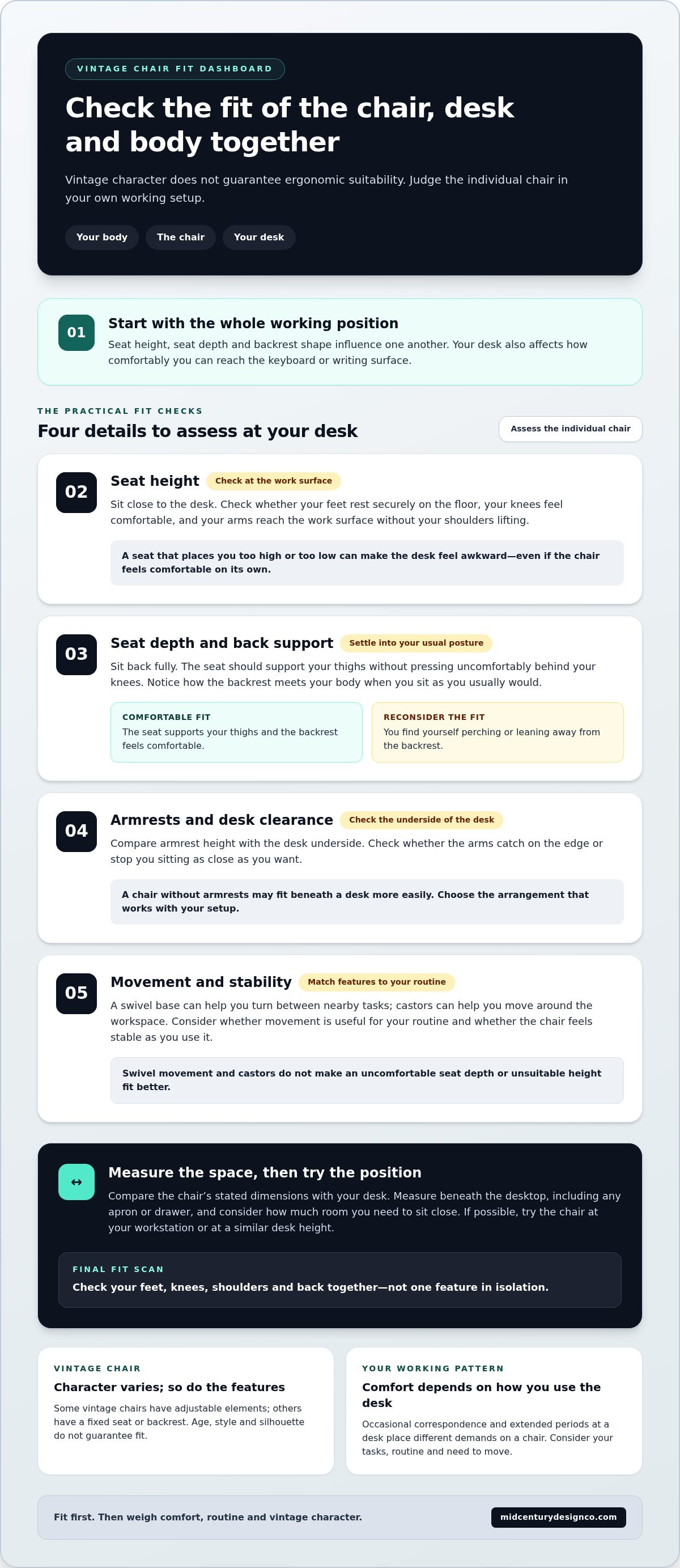
How to assess an ergonomic vintage office chair before choosing
A measured approach can reveal more than a first impression. Treat the chair as part of your workstation: compare its dimensions with your desk, consider how you sit, and test whether the arrangement feels natural. This four-step check helps you assess an ergonomic vintage office chair for your own use rather than relying on appearance or a general description.
- Measure your desk. Note the height of the work surface and the clearance beneath it, including any drawers or apron. This shows how much room there is for the chair and your legs, and whether armrests might get in the way. Consider how close you need to sit to reach your keyboard, screen or writing area comfortably.
- Review the chair’s dimensions. Compare its stated seat height and depth with your desk and preferred sitting position. Check the full width and height, too. A chair may fit beneath the desk but still feel cramped, or its arms may prevent it from moving close enough. Consider the backrest and base in relation to the space available.
- Test your posture. If you can try the chair, sit as you would during ordinary work rather than briefly posing for an impression. Settle back, place your feet as you normally would and reach towards the desk. Notice whether you feel pressure behind your knees, whether your back meets the backrest comfortably and whether your shoulders remain relaxed.
- Consider daily use. Think about the tasks you’ll do and how long you usually sit at a stretch. A chair for occasional correspondence has a different role from one used for extended desk sessions. Check whether you can move naturally, turn or shift position as your work requires.
Measurements to compare with your desk
Measurements make online descriptions more useful. Compare the seat height with the level at which you need to work, and check whether the seat depth lets you sit back without pressure behind your knees. Allow for the chair’s arms and backrest when checking clearance, and include the base if floor space is limited. Dimensions can’t tell you exactly how a chair will feel, but they can help you spot an obvious mismatch before taking a closer look.
A practical comfort and condition check
Look beyond the upholstery or finish. Notice whether the chair feels stable when you sit, whether its movement suits your workspace and whether visible wear affects how it functions. These are condition checks, separate from judging ergonomic fit. If you’re assessing the chair remotely, use its measurements and description to form a realistic view, while remembering that comfort varies between people and depends on how the chair is used. No set of dimensions can guarantee that a chair will feel right to you.
A practical chair can still feel at home in a thoughtfully arranged interior. For ideas on blending function with character, explore how to style mid-century modern furniture. To find an original chair with considered design, explore vintage office chairs and compare their details with your desk and working habits.
Finding an original vintage office chair with character and purpose
The final choice brings practical judgement and personal taste together. The Mid Century Design Co. curates and sells authentic vintage mid-century furniture, including desks and office chairs. Its collection focuses on original vintage pieces rather than modern reproductions, bringing the distinctive presence of period design to contemporary workspaces.
An original chair can feel singular: its design belongs to another era, yet it may become part of the everyday rhythm of working from home. That character is a reason to look more closely, not a substitute for checking fit. The right ergonomic vintage office chair should appeal to the eye and suit your desk routine. Consider the individual chair, its dimensions and your own comfort rather than assuming age or style guarantees a particular level of support.
Why authenticity changes the buying experience
An original vintage chair is a piece from its own time, while a modern reproduction is newly made to draw on an earlier design language. The distinction matters if you value the presence and individuality of original furniture. Each chair has its own form and materials, and its character can make it a thoughtful focal point in a room. Authenticity alone, however, can’t tell you how it will feel to sit in. Let the design draw you in, then weigh it against the practical details that matter to you.
Approach each chair as an individual. Don’t assume its history, condition or comfort based solely on its appearance or period. Instead, consider the information available for that particular piece and how its proportions relate to your workstation. A chair’s visual story may be compelling, but its suitability for your body and tasks is personal.
Bring the chair into a considered workspace
Imagine the chair beside your desk, but picture more than the finished arrangement. Think about how it will sit in the room’s palette and scale, then picture yourself drawing it up to the desk, settling in to work and moving away when the task is done. Its silhouette may lend the room warmth or contrast, while its dimensions determine how naturally it fits into your setup.
A complementary desk and chair can make a home office feel intentional rather than assembled from unrelated pieces. But visual harmony shouldn’t overrule fit. Keep your measurements and working habits in mind as you explore, and let character and comfort guide the decision. The Mid Century Design Co.’s curated vintage furniture includes original office pieces that can be assessed on their own merits.
Ready to find a piece for your workspace? Browse the curated vintage furniture collection and consider which pieces could feel at home in your room and routine.
Make room for a chair that feels like yours
The right choice can shape more than a corner of your home office. It can make the space feel intentional, inviting you to settle into work while adding a piece of design with a life beyond the desk. Picture the chair in your room, consider how it will serve your working day, and give comfort as much weight as character.
An ergonomic vintage office chair needn’t look like a conventional office chair to have a place in a considered workspace. The Mid Century Design Co. curates authentic vintage mid-century furniture, including desks and office chairs. Its collection offers a starting point for finding an original piece that suits your taste and the atmosphere you want to create.
Keep both the feel you want for your room and the practical demands of your desk in view. Explore authentic vintage office furniture and find an original piece for your workspace.
Frequently Asked Questions
Can a dining chair work as an office chair?
Yes, a dining chair can suit occasional desk use if its height, seat depth and back support work with your desk and posture. It may be comfortable for writing a few notes or handling a brief task. Dining chairs may lack swivel movement or adjustments, though, so don’t assume one will suit a full working day. If you plan to use it regularly, try it during a realistic desk session and notice how it feels over time.
Do vintage office chairs always have castors?
No, vintage office chairs vary, and you shouldn’t assume a particular chair has castors. A fixed base can work well at a desk that doesn’t require frequent repositioning, while moving between tasks may make a mobile chair more convenient. Consider the flooring, the space around your desk and whether the chair feels stable as you sit and move. Castors can aid movement, but they don’t guarantee comfort or ergonomic fit.
How can I protect wooden flooring from an office chair?
Use a protective mat or floor-friendly pads suited to your floor finish and the chair’s base. The right option depends on the surface, so choose material that is appropriate for your flooring. Grit caught beneath the chair can mark wood; gentle, regular cleaning around the chair helps keep it at bay. After adding protection, check that it doesn’t make the chair unstable or hinder comfortable movement across the floor.
What is the best way to care for a vintage office chair?
Care for a vintage office chair according to its materials. Dust it gently and regularly, then use a cleaning method suited to the wood, metal or upholstery. Test any product on an inconspicuous area first, and avoid harsh cleaners or excess moisture, which may affect the surface. Different materials need different approaches, so avoid one-size-fits-all treatments. Gentle care helps preserve the chair’s existing character without assuming every finish responds in the same way.
Can I use a vintage office chair for long working days?
Possibly, but suitability depends on the individual chair, your body and whether you can change position during the day. Before relying on an ergonomic vintage office chair for extended work, spend time testing its seat, back support and relationship to your desk. A brief sit may not reveal how it feels over a longer session. Build in regular movement breaks, too; a vintage appearance alone can’t establish all-day comfort.
Should my office chair arms fit beneath my desk?
If you want to sit close to the desk, the armrests need enough clearance to pass beneath it. Compare their height with the underside of your desk, allowing for any apron or drawer that reduces space. If the arms meet the desk edge, you may have to sit further back than you prefer. An armless chair can suit some setups just as well; choose according to your fit and working habits.