

Extending Mid-Century Dining Table: A Thoughtful Buyer’s Guide
The largest table isn’t always the best choice. An extending mid century dining table can look perfectly proportioned in a showroom, then dominate a dining room when its leaves are open. The better question is whether its mechanism, dimensions and condition suit the way you live.
It’s natural to focus on how many guests a table might seat, but everyday comfort matters just as much. Check how the extension works, where any separate leaves will be stored and whether there’s room to move around the table both closed and extended. With a vintage piece, condition and evidence of its history also deserve careful attention.
This guide explains how to compare butterfly, drop-leaf and removable-leaf designs, measure your space for everyday meals and occasional gatherings, and check for wear, missing components and uncertain origins. The aim is to help you choose an original table with character that also works practically in your room.
Key Takeaways
- Compare how each extending mid century dining table opens, where its leaves are kept and which parts need checking before purchase.
- Assess the closed and extended dimensions alongside chair movement, so occasional extra seating won’t compromise everyday comfort.
- Look beyond the silhouette: check that all leaves are present and inspect the surface, joints and extension mechanism for signs of wear.
- Ask what evidence supports the table’s maker, date and provenance. Age alone doesn’t confirm authenticity.
- Consider room fit, mechanism, condition and identity together to find an original vintage table that suits your home and the way you gather.
Why an extending mid-century dining table can suit everyday life and entertaining
An extending dining table offers a practical everyday footprint, with the option to make room for a shared meal. Its usable top grows through one or more leaves or sections, making it adaptable when household routines change or guests gather. The maximum length is only part of the decision. Closed dimensions, opening style and the clearance around the table matter just as much.
An extending mid century dining table can combine function and character, but vintage examples vary in construction and condition. Check each table’s measurements and extension mechanism, and confirm whether all leaves are included. A table’s age or appearance alone doesn’t confirm its maker or history.
What makes an extending table different from a fixed dining table?
A fixed table provides a consistent surface for daily meals. An extending design can stay compact for everyday use and open out when more surface space is needed. Extra length doesn’t create more room around the table, though. Chairs still need space to move, and people need to be able to pass comfortably. Seating capacity depends on the table’s dimensions and chair width, rather than being universal.
Why mid-century proportions still feel at home today
Clean lines and carefully judged proportions help mid-century furniture sit naturally in a range of interiors. Some vintage tables show the warm grain of teak, while the shape of the legs and edge can give even a simple design a distinctive presence. The movement’s history and defining characteristics are outlined in Mid-century modern, a useful context for understanding the design language behind these pieces.
In daily life, a vintage table can be more than an occasional centrepiece. It might serve for breakfast, paperwork and long dinners, with its extension reserved for occasions that call for extra room. Consider how the table will look and function when closed, then picture it fully extended with chairs in place. For a broader look at how a table and chairs work together, explore the guide to retro dining tables and chairs.
How mid-century extending table mechanisms work, and what to compare
The opening action affects more than how a table grows. It determines which components need to be present, how much effort it takes to extend the table and whether you’ll need somewhere to store separate leaves. Listings may use mechanism terms differently, so treat the description as a starting point and ask how the specific table opens.
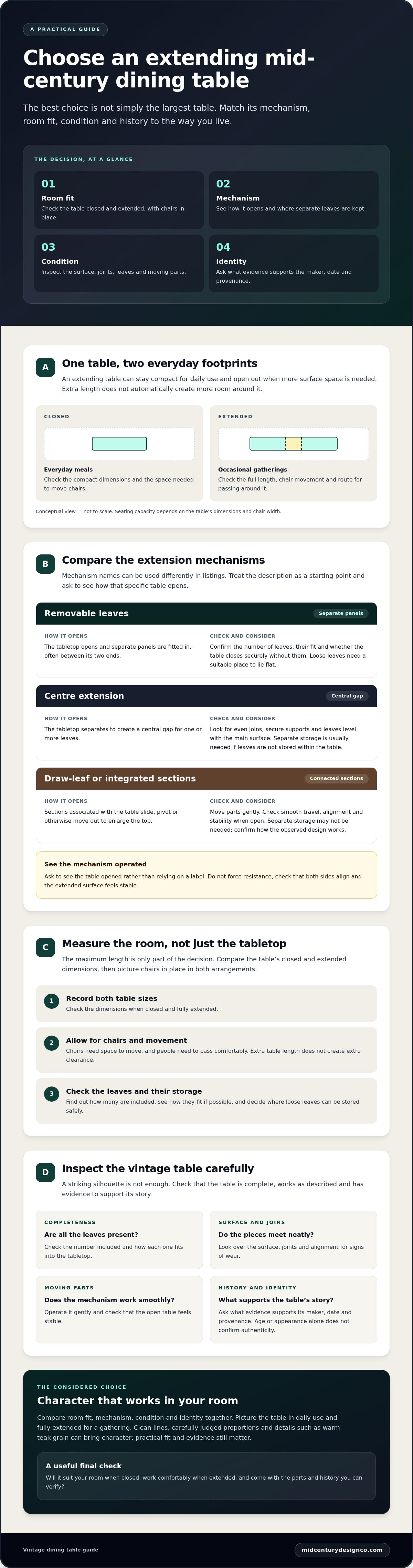
A table’s mechanism determines how it expands and which components need checking. Use this comparison to guide your questions, then confirm the construction of the individual piece.
| Format | How it opens | What to inspect | Storage to consider |
|---|---|---|---|
| Removable leaves | Separate panels are fitted into the opened tabletop, often between its two ends. | Check the number of leaves, their fit and whether the table closes securely without them. | Loose leaves need a suitable place to lie flat when not in use. |
| Centre extension | The tabletop separates to create a central gap for one or more leaves. | Look for even joins, secure supports and leaves that sit level with the main surface. | Usually required if the leaves aren’t stored within the table. |
| Draw-leaf or other integrated sections | Sections associated with the table slide, pivot or otherwise move out to enlarge the top. | Move the parts gently; check for smooth travel, alignment and a stable surface when open. | Separate storage may not be needed, but confirm how the observed design works. |
Removable leaves and centre extensions
With separate leaves, the tabletop is opened and the additional panels fitted into place. This can offer useful flexibility, but completeness matters. Ask how many leaves are included and, if possible, see each one fitted. Check that the edges meet neatly and the surface sits level. Also consider where you’ll keep loose leaves. An extension is less convenient if its components are difficult to store safely.
Draw-leaf and integrated designs
Integrated sections remain connected with, or stored within, the table as it extends, although construction varies between designs. Ask to see the mechanism operated rather than relying on a label such as “draw-leaf”. Open it gently, without forcing resistance, and check that both sides align and the extended surface feels stable. Don’t assume that one table’s operation or construction applies to another.
These details can make an extending mid century dining table straightforward to use, or turn hosting into a more involved task. If you’re considering a vintage piece, explore the vintage dining collection and check the mechanism and included components against the individual listing.
Compare extending mid-century dining tables by space, seating and condition
A graceful profile may catch your eye first. Before choosing, compare the table’s everyday footprint with the space it occupies fully extended, then consider how its mechanism, leaves and condition fit your routine. A table that looks elegant on its own still needs to work with your chairs, room layout and daily movement.
Assess both everyday and extended dimensions before deciding. Compare the closed length and width with the measurements when every leaf or section is in place. Then consider chair width and leg position. A broad apron or supports near the ends may affect where chairs can sit, even if the tabletop appears spacious. Seating capacity depends on these details, not simply on the table’s overall length.
- Space: Will the closed table sit comfortably in its usual position? Can it extend without blocking a doorway or the main route through the room?
- Use: How often will you extend it, and does opening it feel manageable for the people who’ll use it?
- Completeness: Are all the leaves present, and do they fit and align with the main top?
- Condition: Are the surface, joints, supports and moving parts in a state that suits your intended use?
Which extension format suits your routine?
If you host often, prioritise a mechanism that opens comfortably and leaves that are straightforward to handle. If the design uses loose panels, decide where you’ll store them between gatherings. For occasional use, that storage requirement may be an acceptable trade-off for a table that stays compact most of the time. During an inspection, ask the person who’ll operate it to try the mechanism gently. Ease of use is personal.
There’s no universally best format. A self-contained design may reduce the need to store separate pieces, while a table with loose leaves may suit a home with suitable storage. Compare the actual table rather than relying on a mechanism label, as vintage construction and terminology can vary.
How condition changes the comparison
Look closely at the tabletop, joints, supports and moving parts. Note visible damage, loose connections or signs that the extended surface sits unevenly. Check that leaves match, fit securely and meet the tabletop cleanly. Test movement gently, without forcing it. If anything feels unstable or catches, ask for an explanation before deciding.
Wear isn’t automatically a flaw. Patina and small marks can speak to a table’s life, while problems with stability, alignment or operation may affect how reliably it serves your home. Weigh its character against the condition you can see, and check any claims about its materials, maker or history against the individual listing.
Measure your room and inspect a vintage extending dining table before buying
A few careful checks can turn an attractive find into a confident choice. Measure your space, compare both table configurations and inspect details that photographs can’t fully convey. Don’t estimate dimensions from an image. Ask the seller for the actual measurements, both closed and fully extended.
Measure for daily use and the fully extended position
Work through the room in stages. Removable tape on the floor can help you picture the table’s footprint and see where chairs and walkways will fall.
- Measure the room. Note its length and width, along with fixed features and the position of nearby furniture.
- Mark the closed table. Use the seller’s measurements to map its full footprint on the floor, including the legs or supports if they affect chair placement.
- Repeat with the table extended. Mark the complete length and width, then allow for chairs to be pulled out and people to move around them.
- Check routes and obstructions. Consider door swings, radiators, walkways and furniture that could limit seating or prevent the table from opening fully.
There’s no single clearance figure that suits every layout. Compare the space around your marked footprints with how you use the room, and make sure the table won’t obstruct access when extended. Your measurements can also show whether you’ll need to move other furniture for occasional gatherings.
Questions to ask and checks to make before committing
Once the dimensions appear workable, ask for a closer look at the table itself. If you can’t inspect it in person, request clear photographs of the tabletop, underside, joints, supports and extension mechanism, both closed and open.
- Which leaves are included, and are they confirmed as belonging with the table?
- How are separate leaves stored, and can you see each one fitted?
- Does the mechanism move smoothly, and does the table remain stable when extended?
- Are there visible marks, damage or repairs on the surface or underneath?
- Can the seller support any details given about the maker, date or material?
For an extending mid century dining table, a measured floor plan and careful inspection help balance vintage character with everyday practicality. For inspiration, explore the curated vintage dining collection, then check the measurements and documented details of any individual piece.
Choose an original extending mid-century dining table with confidence
The right choice brings several considerations together: room fit in both configurations, an extension mechanism that suits your routine, sound condition, complete leaves and credible evidence of the table’s identity. A striking shape may draw you in, but it should also work with your chairs and leave the room comfortable to use.
Original vintage furniture is different from a modern reproduction made in a period-inspired style. However, age alone doesn’t prove that a table is authentic, and a familiar silhouette doesn’t confirm who made it. Consider the available evidence alongside the practical details, and assess each table on its own merits.
What provenance can, and cannot, tell you
A maker’s mark, construction details and seller documentation can help support an identification. Ask what evidence underpins claims about the maker, date or origin, and check that descriptions are specific to the table rather than inferred from appearance. Treat attribution as something to verify, not as a guarantee. For more guidance, read the existing guide to identifying original mid-century furniture pieces.
When a curated vintage table is the right choice
Choose vintage if you value the character of an individual piece and the enduring appeal of mid-century design, as well as a table that can serve everyday meals and shared occasions. The Mid Century Design Co. sells curated original vintage mid-century furniture, including dining sets and chairs. Explore individual listings to compare a table’s measurements, mechanism and condition with what you need at home.
Before deciding, return to the essentials:
- Room: Does the table fit closed and extended, with space for chairs and movement?
- Mechanism: Can you operate it comfortably, and are its components complete?
- Condition: Does its visible wear suit the way you intend to use it?
- Identity: Are claims about its maker, date and materials supported by available evidence?
Stock changes, so don’t assume a particular extending mid century dining table is available. Review the details of each listing, then browse the current collection of authentic vintage furniture for inspiration. The best fit is one whose character feels right at home and whose practical details stand up to closer attention.
Find the table that feels at home
The right extending mid century dining table is more than an elegant silhouette. It should suit your room both closed and extended, open in a way that works for your household, and have leaves and moving parts in a condition you’re comfortable with. Check the seller’s measurements and supporting details about the table’s identity rather than relying on appearance or age alone.
Keep your priorities close as you choose: room fit, mechanism, completeness, condition and provenance. A well-chosen original vintage table brings practical flexibility as well as the character of a design object shaped by time. The Mid Century Design Co. sells curated original vintage mid-century furniture, including dining sets and dining chairs. Browse the curated collection of authentic vintage furniture for inspiration, and take time to picture how a piece might work in your home. With thoughtful checks, you can find a table that suits everyday moments as well as future gatherings.
Frequently Asked Questions
What is an extending mid-century dining table?
An extending mid-century dining table is a vintage table designed to provide a smaller everyday surface that can be enlarged for shared meals. Depending on its construction, it may use separate leaves or have integrated sections that move out with the table. The term covers different designs, not one standard mechanism. Check how the specific table opens, which components are included and whether both configurations suit your room.
How many people can sit around an extending mid-century dining table?
There’s no standard seating capacity based on mid-century style alone. Usable space depends on the table’s length and shape, the position of its legs or supports, and the width of the chairs. Check the available edge space in both configurations, then consider whether diners can sit comfortably and move around the table. Treat any seating estimate from a seller as specific to that individual table.
How do I know whether an extending dining table is complete?
Ask the seller to list every included leaf and show how each one fits. Check that the surfaces align when the table is extended and that the mechanism moves without being forced. If the table has removable leaves, ask how they’ve been stored and whether they’re believed to belong with the piece. Confirm what’s included against the individual listing, rather than relying on a general description of similar tables.
Will an extending dining table fit in my room?
Measure your room and request the table’s actual dimensions both closed and fully extended. Mark each footprint on the floor, then check there’s room to pull out chairs and move around them. Include nearby doors, furniture and other obstructions in your plan. Photographs can help you understand a table’s appearance, but they can’t confirm its measurements or whether it will work with your particular room layout.
Are vintage extending dining tables practical for everyday use?
They can be practical for daily meals if the table’s dimensions, condition and mechanism suit your routine. Consider how often you’ll extend it, whether the leaves are manageable to handle and where separate pieces can be stored. Before buying, check the table’s stability and try the mechanism gently. Original vintage designs each have their own character, so assess the individual table rather than assuming every example will perform in the same way.
Can a damaged vintage extending dining table be restored?
Restoration may be possible, but the appropriate work depends on the table’s materials and the type of damage. The Mid Century Design Co. sells original vintage furniture and doesn’t offer furniture restoration services. If a table needs attention, have its condition assessed independently by an appropriate specialist before you buy, and clarify what work may be needed. Don’t assume restoration is included in a sale or that every issue can be resolved.