

Is Vintage Furniture a Good Investment in 2026? Style, Value and What to Consider
What if the best return on a vintage sideboard isn’t a higher resale price, but years of useful service and a character no new piece can quite reproduce? If you’re asking “is vintage furniture a good investment 2026”, the honest answer is that financial value can rise or fall, while personal and practical value can be enjoyed every day.
It’s understandable to want reassurance before committing to a piece. Authenticity, condition and provenance can be difficult to judge, and an attractive find may not suit your home or prove easy to resell. Approach vintage furniture as a considered purchase, not a promise of profit.
This guide will help you weigh possible resale value against quality, usefulness and lasting appeal. You’ll find practical checks for a piece’s origins and condition, as well as advice on measuring for your space. The Mid Century Design Co. hand-picks genuine vintage furniture, keeping restoration to a minimum and undertaking it only when damage is significant. Its pieces are eco-friendly and built to last, offering a meaningful return in everyday living even if their market value doesn’t rise.
Key Takeaways
- When asking “is vintage furniture a good investment 2026”, consider two kinds of value: potential resale value is uncertain, while everyday use, character and sustainability can endure.
- Maker, period, design, provenance and condition may shape buyer interest. Look for evidence behind claims about a piece’s history.
- Compare vintage and new furniture for originality, condition, care and usability. Individual vintage pieces vary, so resale value is never assured.
- Before buying, check that a piece suits its intended purpose and your space, assess its condition, and plan how it will reach its destination.
- The Mid Century Design Company hand-picks genuine vintage furniture and keeps restoration to a minimum, undertaking it only when damage is significant. Its pieces are eco-friendly and built to last.
Is vintage furniture a good investment in 2026? Start with what “investment” means
Vintage furniture can offer years of useful service and enjoyment, but a financial return is uncertain. If you’re asking, “is vintage furniture a good investment 2026?”, begin by separating two ideas: the possibility that a piece may later sell for more, and the value it brings to your home while you own it. One is measured in money; the other in daily use, personal meaning and the pleasure of living with well-made design.
A beautiful finish or evocative story can make a piece compelling, but neither proves that its resale price will rise. Future demand, condition and evidence supporting the piece’s history all matter. For a useful introduction to the history and characteristics of antiques, see Antique furniture.
What does “a good investment” mean when buying vintage furniture?
Financially, an investment is judged by what you might recover if you sell, compared with what you paid and any costs involved. As a home purchase, a vintage dining table might be valuable because it serves you every day, suits the room and gives it a distinct sense of character, even if its resale value stays the same or falls.
Buyers value different qualities. One may seek a recognised maker or rarity; another may care more about documented provenance, sound construction or practical storage. No furniture category or period is a guaranteed store of value. Ask two separate questions: “Would I be pleased to own this?” and “What evidence supports its potential appeal to another buyer?”
Why 2026 is not a promise of future appreciation
Think of 2026 as the moment to make a considered choice, not a forecast of what a piece will be worth later. Design tastes shift, condition can change through use, and future demand is difficult to predict. Even a desirable object may take time to sell, and the costs and circumstances of a sale can affect what you ultimately receive.
A strong narrative, sought-after look or appealing finish should prompt closer consideration, not certainty. Look for evidence that helps you understand the piece, and treat unsupported claims about its history or value with care. This guide offers a practical framework for weighing a purchase, not financial advice or a prediction of future prices.
Personal value is what a piece gives you over time; financial return is what a future sale can actually demonstrate. Keeping that distinction in view can make the decision clearer. If a vintage piece is useful, suits your home and feels meaningful to live with, its value need not depend on a rising market. Genuine vintage furniture can also be an eco-friendly choice and built to last, qualities that matter in daily life without guaranteeing appreciation.
What gives genuine vintage furniture lasting appeal, and what can affect value?
A vintage piece earns interest through more than its age. The maker, period, design quality, provenance and condition can all shape how buyers see it, but none guarantees a future price. A teak sideboard, for example, may appeal for its balanced proportions and useful storage; another buyer may be more drawn to a documented maker or distinctive design. If you’re weighing “is vintage furniture a good investment 2026”, treat these qualities as clues to potential interest, not a promise of appreciation.
Teak grain brings warmth and variation, while an age-related patina can show a piece’s life and use. These details add character, but they aren’t proof of rarity, authenticity or financial worth. A seller’s description is a starting point for questions, not evidence on its own.
Authenticity, provenance and design significance
Labels, construction details and documented history can help establish where and when a piece was made. Look for evidence that fits together: a maker’s mark, materials and construction consistent with the claimed period, and records or ownership history where available. A label may have been removed or replaced, so no single clue should carry the whole story. Provenance helps you understand an object; it doesn’t guarantee a higher resale value.
For a closer look at identifying details on one furniture type, The Mid Century Design Company’s guide to identifying authentic mid-century sideboards can help you know what to observe. Evidence supporting a specific sideboard’s origins won’t automatically establish the history of every vintage piece.
Condition, originality and the cost of ownership
Good looks matter, but so does how a piece functions. Check whether it sits steadily, doors and drawers work as intended, and essential components are present. Missing fittings, structural weakness or later alterations can affect day-to-day usefulness and future buyer appeal. Consider the care it will need and whether its size, storage and finish suit your home and habits.
Originality can be part of a piece’s charm, and refinishing or replacing components may change its character. Significant damage may need attention before the furniture can serve its purpose. The Mid Century Design Company keeps restoration to a minimum and undertakes it only when damage is significant, preserving original character where possible.
- Maker and period: Do the available details support the stated origin?
- Design and provenance: Is there evidence behind claims about the piece’s history or significance?
- Condition and practicality: Can it be used comfortably, and does it suit your space and care routine?
Demand can be shaped by maker, period, design quality, provenance, condition and practical appeal, without any of these predicting a return. The Mid Century Design Company hand-picks genuine vintage mid-century furniture, originally produced in its era. Its pieces are eco-friendly and built to last. Browse its curated vintage furniture to see the character and variety these original pieces can bring to a home.
Vintage furniture versus new furniture: which is the stronger long-term choice?
There isn’t one answer for every home. New furniture can offer consistent specifications and finish, while genuine vintage furniture is an individual object with its own materials, wear and history. If you’re asking “is vintage furniture a good investment 2026”, compare how each option will serve you rather than assuming either will hold its value or prove the better purchase.
| Consideration | Genuine vintage furniture | New furniture |
|---|---|---|
| Originality | An original piece with design details and character shaped by its era. | A newly made piece, often with more consistent specifications across the same model. |
| Condition | Each item varies; inspect its structure, finish and any alterations. | Condition is generally consistent when new, though materials and construction differ by piece. |
| Care | Care needs depend on its materials, finish and existing wear. | Care guidance may be supplied for the specific materials and finish. |
| Usability | Dimensions, storage and features vary between individual pieces. | Specifications can make it easier to select a particular size or configuration. |
| Environmental considerations | Reuse gives an existing piece another life; transport, care and future lifespan still matter. | New manufacture uses new materials, with impact varying by product and production. |
| Resale uncertainty | Future interest depends on the individual piece and changing buyer preferences. | Future resale value is also uncertain and depends on condition and demand. |
When genuine vintage furniture may suit you better
Choose vintage if original craftsmanship, distinctive design and the continued use of existing materials matter to you. A softly worn edge or mature patina can make a piece feel at home from the start, though some owners prefer a more uniform finish. Consider what the furniture needs to do. A sideboard should provide useful storage as well as look striking. Measure your space and think about how you’ll use the piece each day.
When a predictable new purchase may suit you better
New may suit you if matching specifications, an even finish or selecting a defined size matters more than owning an individual piece. That predictability can simplify planning, particularly where furniture must fit a precise space or coordinate with other items. It doesn’t make new furniture inherently inferior, just as age alone doesn’t make vintage better made. Compare the actual piece, not an assumption about its category.
Reuse can make vintage furniture an eco-friendly choice, and well-made pieces may be built to last, but no single purchase automatically has a lower total environmental impact. Transport, any work needed, ongoing care and how long you use the furniture all matter. The stronger long-term choice is the one that fits your priorities, condition expectations and intended use. Let practical suitability and pleasure in living with it lead; treat any future resale value as uncertain.
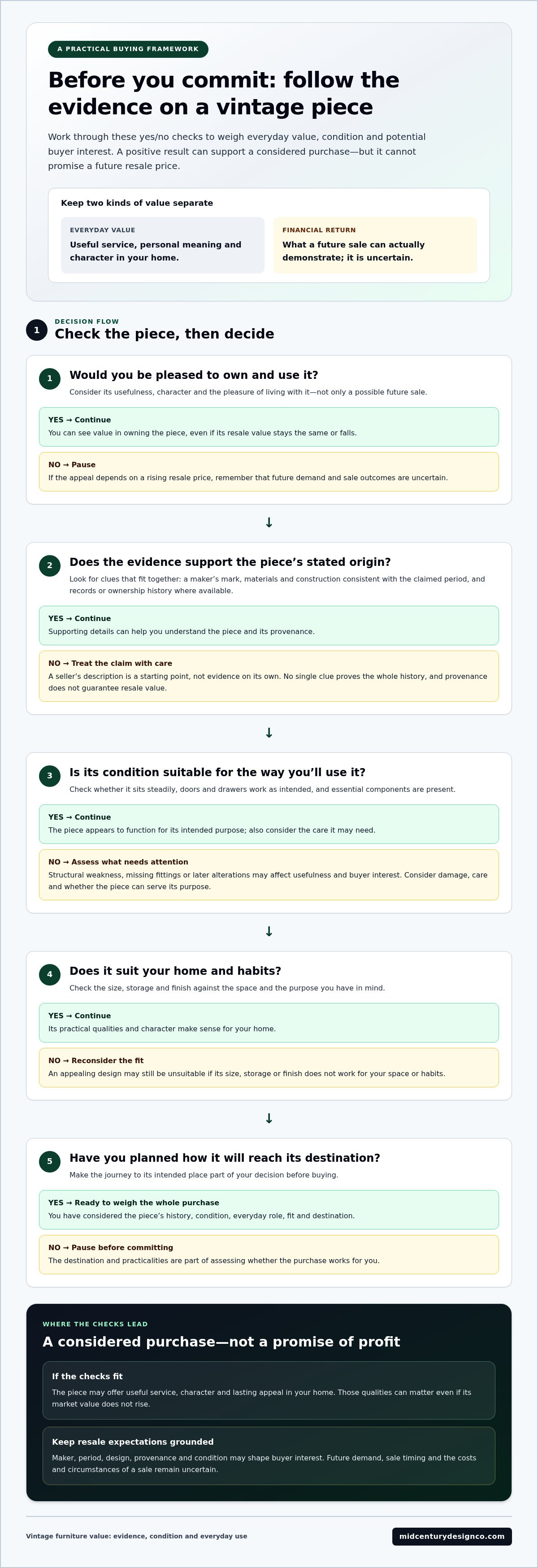
How to assess a vintage furniture purchase before you commit
A careful assessment can help you choose a piece that works in your home, not just one that looks appealing in a photograph. If you’re considering whether vintage furniture is a good investment in 2026, treat the purchase as a practical decision first: clarify how you’ll use it, compare its condition with the available evidence, and plan how it will reach its place in your home.
A five-step checklist for judging a specific piece
- Define its purpose. Decide what the furniture needs to do. A sideboard might need to store dinnerware, while a desk needs to suit the way you work. Check the available space and decide which signs of age you’re happy to live with.
- Review the description and evidence. Read the stated maker, period, materials and provenance carefully. Compare each claim with photographs and supporting details. A label, design feature or appealing story can be useful evidence, but no single clue proves a piece’s history or financial worth.
- Study the condition closely. Look for details of wear, damage, repairs, alterations and missing parts. Consider whether the structure and moving parts appear suitable for your intended use, and whether the photographs show the areas described.
- Think through care and future costs. Consider how the materials and finish will fit your home and routine, and whether any damage could require attention. Even a desirable piece may take time to resell, so don’t rely on a quick sale to make the purchase worthwhile.
- Plan the route into your home. Check the furniture’s dimensions against doorways, hallways, stairs and other access points before ordering. Measure these yourself. Customers are responsible for ensuring the item will fit, and furniture that doesn’t fit cannot be returned.
Check the practical details before ordering
Measure more than the final spot where the piece will sit. Note the narrowest point on its route, including turns, landings and door openings, and allow for how the furniture will need to be manoeuvred. A wardrobe that fits the bedroom may still be too large to pass through the hallway. Resolve any uncertainty about access before placing your order.
Delivery is to the ground floor. Delivery to a higher floor may involve an extra charge. Make sure the delivery arrangement suits the furniture’s destination before committing. On arrival, compare the item with its description and photographs, and inspect it promptly. Any damage or discrepancy must be reported within 24 hours of delivery. For eligible returns, the refund is less the delivery charges both to and from the warehouse.
A measured, evidence-led decision leaves less to chance, from the piece’s condition to its fit in your home. Explore genuine vintage furniture from The Mid Century Design Company as you consider what will serve your space and daily life.
How The Mid Century Design Company approaches vintage furniture value
The Mid Century Design Company hand-picks genuine mid-century pieces that were originally produced in their era, valuing their character as well as their place in a home. The focus is on furniture to use and enjoy, not a promise that its financial value will rise. Each piece has its own history and appearance, so the qualities that make it appealing are individual too.
For anyone still wondering “is vintage furniture a good investment 2026”, this approach offers a grounded way to think about value. A well-chosen piece can bring distinctive design and useful function to everyday life. Any future resale price remains uncertain.
Original character, carefully considered
Genuine vintage furniture carries details of its original making, from its proportions to the way its materials have aged. Teak is one material found in vintage furniture, though each piece has its own grain, colour and condition. These variations are part of its individuality, not a promise of a particular value.
The Mid Century Design Company keeps restoration to a minimum and undertakes it only when damage is significant. This means preserving original character where possible, rather than extensively rebuilding a piece or presenting a modern reproduction as vintage. The intention is to respect the object’s history while allowing it to have a useful place in a home.
Choose a piece to live with, not just to speculate on
Before choosing, picture the furniture in its intended role. Will it provide the storage you need, suit the available space and feel at home alongside the pieces you already own? A striking design is more rewarding when it also works with the rhythms of daily life. Consider the finish and signs of age, too, and whether you’ll continue to enjoy them as the room evolves.
Styling can help a vintage piece feel at ease in a contemporary home. The Mid Century Design Company’s guide to styling mid-century modern furniture offers ideas for bringing period design into a considered interior. Think about balance: a distinctive sideboard can have presence without requiring every item in the room to come from the same era.
The company’s vintage furniture is eco-friendly and built to last. Choosing an existing piece gives it continued use, while its practical value comes from how well it serves your home over time. Those are meaningful reasons to choose vintage, even without assuming a financial return.
If you’re ready to consider a piece for your own space, explore The Mid Century Design Company’s curated vintage range and take time to find a design that feels right to live with. Let fit, function and lasting affection guide the choice; any resale value is a possibility, not the measure of its worth.
Choose a piece whose value lives beyond the market
Before you buy, picture the furniture not as a figure on a future sales listing, but as part of the life you want your home to hold. The answer to “is vintage furniture a good investment 2026” may depend less on predicting the market than on choosing a piece you’ll value using every day. A beautiful object that fits your space and purpose can reward you in ways a resale estimate cannot promise.
The Mid Century Design Company hand-picks genuine vintage pieces sourced from original manufacturers or reputable vintage markets. Restoration is kept to a minimum and undertaken only when damage is significant, preserving original character where possible. The furniture is eco-friendly and built to last, qualities that support a thoughtful choice for long-term living rather than a guaranteed financial return.
Take an unhurried look at the pieces and designs that speak to you. Explore hand-picked vintage furniture from The Mid Century Design Company, and imagine what an enduring original could bring to your home.
Frequently Asked Questions
Is vintage furniture likely to increase in value?
Some vintage pieces may attract stronger interest over time, but appreciation is never assured. The question “is vintage furniture a good investment 2026” has no certain financial answer: demand, authenticity, condition, provenance and changing tastes all play a part. A sale can also take time, particularly if you’re waiting for the right buyer. Choose something you’ll enjoy using at home rather than relying on a future resale profit.
What types of vintage furniture are most sought after in 2026?
Interest depends on the individual piece and the buyer, so no category is a sure investment. Original mid-century storage and dining furniture, as well as Danish designs, may appeal to collectors and homeowners for their appearance and function. Popularity alone doesn’t establish future value. Consider whether the piece suits its intended use, whether its design appeals to you and whether the available evidence supports its description.
How can I tell whether vintage furniture is authentic?
Look for clues that support one another, such as maker’s marks, construction, materials, period details and documented provenance. A label can be useful, but it may not establish a piece’s full history; wear alone doesn’t prove age or originality. Compare the description with close-up photographs and note which details are documented rather than inferred. For a sideboard, examine the joinery and fittings as well as any maker’s mark.
Is teak furniture a good investment?
Teak alone can’t predict resale value. Its grain and patina may appeal to buyers, but the maker, design, condition, originality and future demand matter too. Consider whether the piece suits your needs and factor in appropriate care as part of ownership. Wipe spills promptly, clean gently and avoid harsh chemicals. Teak naturally develops a silver-grey patina; periodic teak oil can help retain a golden-brown finish. A teak table chosen for daily use may feel worthwhile even if its eventual sale price is uncertain.
Is buying vintage furniture better for the environment than buying new?
Reusing furniture can extend an existing object’s useful life and avoid buying a newly made replacement. That can make vintage an eco-friendly choice, though it doesn’t guarantee a lower overall impact in every case. The item’s condition, any repairs it needs, transport and how long you keep using it all affect the picture. Choose a piece that meets your needs and care for it so it remains useful.
Can vintage furniture be returned if it does not fit?
No. If an item doesn’t fit through your access points, it can’t be returned, so measure the furniture and its route into your home before ordering. For other returns, notify The Mid Century Design Company within 24 hours of delivery. You then have an additional 14 days to return the item. Refunds are less the delivery charges both to and from the warehouse.
How should I care for vintage teak furniture?
Wipe teak with a damp cloth for routine cleaning; use mild soap and water for a deeper clean, and avoid harsh chemicals. Wipe spills promptly, and use coasters, placemats and felt pads under heavy objects to help prevent marks and scratches. Teak naturally develops a silver-grey patina over time. If you prefer a golden-brown finish, periodic teak oil can help retain that appearance. For outdoor teak, clean it periodically and protect it with a cover.