

Lowboy Mid Century Dresser UK: A Guide to Choosing Vintage
What if the dresser that suits your room best isn’t the tallest one? When searching “lowboy mid century dresser UK”, it’s easy to focus on a piece’s finish or maker before considering its low, wide proportions and how they’ll work in your home. With vintage furniture, photographs can’t show everything, so the dimensions, drawer layout and condition description all matter when you’re deciding whether a piece will work in everyday use.
A lowboy’s appeal lies in its balance of useful storage and quiet presence. Its shorter form can sit beneath a mirror or artwork, while raised legs and considered detailing can make a room feel more open. But not every low chest will offer the storage you need or sit comfortably alongside your existing furniture.
This guide will help you recognise the lowboy form, distinguish it from taller chests, and assess proportions, condition and storage when comparing original vintage pieces. We’ll also look at the details that give mid-century furniture its character, so you can choose a dresser that feels at home in your space and works for daily life.
Key Takeaways
- Recognise the lowboy’s distinctive low, wide silhouette and compare it with taller bedroom storage.
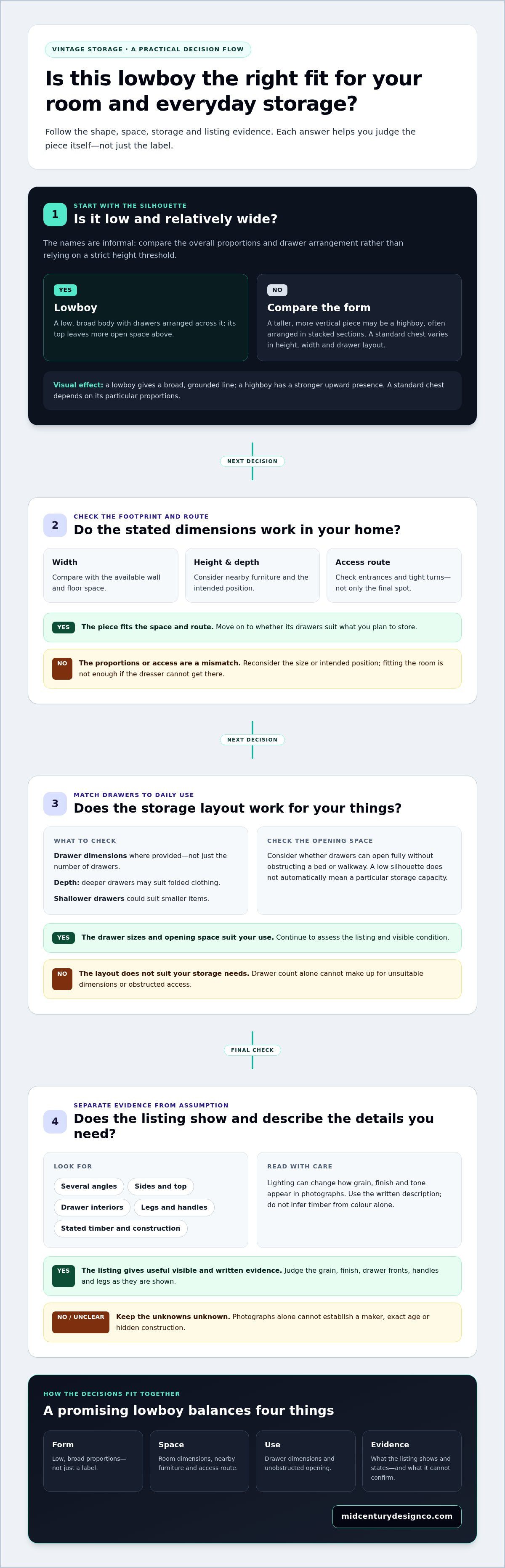
- Check a dresser’s dimensions against your room, access route and storage needs before deciding whether its proportions will work.
- Use the lowboy, highboy and sideboard comparison to identify the vintage storage form that best suits your space.
- Assess photographs, condition descriptions and construction details carefully, separating visible evidence from assumptions about a piece’s age or maker.
- Use this guide to choose a lowboy mid century dresser UK buyers can assess for character, practical use and a natural fit at home.
What is a lowboy mid-century dresser, and what makes its shape distinctive?
A lowboy is a low, wide chest of drawers, defined by its overall proportions rather than one fixed design. Its body spreads across the room horizontally, with a top that sits below the height of a taller chest. Put simply, a lowboy is a low, broad chest; a highboy is taller and arranged more vertically.
That outline can change how a room feels. A high piece draws the eye upwards and occupies more of the wall, while a lowboy leaves more open space above its top. Vintage examples vary in drawer layout, leg shape, handles and finish, so there is no single template every lowboy follows. Treat the name as a clue to the form, then assess the particular piece.
How does a lowboy differ from a highboy or a standard chest of drawers?
“Chest of drawers” is a broad category for drawer-based storage; “lowboy” and “highboy” describe particular forms within it. The labels are informal, so don’t rely on a strict height threshold. Compare the overall silhouette and the arrangement of the drawers instead.
| Form | Silhouette | Storage arrangement | Likely visual effect |
|---|---|---|---|
| Lowboy | Low and relatively wide | Drawers arranged across a lower body | A broad, grounded line with space above |
| Highboy | Tall and more vertical | Often arranged in stacked sections | A stronger upward presence |
| Standard chest of drawers | Varies in height and width | Drawers may be arranged in different layouts | Depends on its specific proportions |
Use the comparison as a starting point, not a substitute for looking closely. A wide chest may feel substantial, while a narrower example can appear more delicate, even if both are described as lowboys.
Why do lowboy proportions work in a mid-century interior?
Mid-century modern design often gives careful attention to proportion, simplicity and the relationship between furniture and its surroundings. The Mid-century modern design principles offer useful context for this emphasis on form. A lowboy can echo it with a composed horizontal outline, though every vintage piece has its own details and character.
Its lower profile may sit comfortably beneath wall art or alongside a bed, sofa or other furniture without competing for height. It can leave a wall feeling more open, too, though the effect depends on the room’s layout, ceiling height and the dresser’s scale. Picture the piece in your bedroom or living space: would its top align well with nearby furniture, and would the open wall above feel balanced?
For anyone exploring a lowboy mid century dresser UK, the defining quality is the relationship between form and setting. Look beyond the label to the piece itself, and consider how its width, height and details will work in your home.
Which details make a vintage lowboy dresser right for your room?
A lowboy’s appeal is only one part of the decision. To find a piece that works in your home, compare its footprint with the available space, consider what you’ll store and look closely at the details that give the dresser its character. Two pieces with a similar silhouette can differ in usable drawer space, construction and visual weight.
How should you judge a lowboy’s size and storage?
Start with the listing’s stated width, height and depth, then compare them with the intended position. Measure the wall and floor area, allowing room for nearby doors, walkways and furniture. Check the route into the room as well: the dresser needs to fit through the entrance and around tight turns, not just sit comfortably once in place.
Next, think about what you plan to store. Drawer count alone won’t tell you how useful a piece will be. A few deeper drawers may suit folded clothing, while shallower drawers could work better for smaller items. Look for drawer dimensions where they’re provided, and consider whether you can open the drawers fully without obstructing a bed or walkway. A low silhouette doesn’t automatically mean a particular storage capacity.
Which materials and design details deserve a closer look?
Read the individual listing for its stated timber and construction rather than assuming all vintage lowboys share the same materials. If a listing identifies teak, use that description as your guide; don’t infer the timber from colour alone. Grain, finish and tone can appear different in photographs depending on lighting, so compare the images with the written details.
Look beyond the top surface. Drawer fronts, handles and legs shape the dresser’s character and influence how it will sit with other furniture. Are the handles discreet or prominent? Do the legs create an airy feel, or does the body appear more grounded? These questions help you judge the piece’s presence without treating one design as the standard for every lowboy.
Photographs from several angles can reveal more than a straight-on view. Look for images of the sides, top, drawer interiors and legs, then note what each image actually shows. Photographs can provide evidence of visible details, but can’t establish a maker, exact age or hidden construction on their own. Keep those limits in mind as you compare pieces.
For broader context on how another storage form developed and functions in a room, the Morris County Historical Society’s history of sideboards is a useful read. A sideboard’s role and proportions differ from a dresser’s, so consider the intended use of each as well as its appearance.
- Measure: Check the space, floor area and access route against the listed dimensions.
- Match: Relate drawer depth and arrangement to the items you plan to store.
- Examine: Compare the timber description, grain, handles, legs and finish with the photographs.
These checks make browsing more focused. If you’re comparing original vintage furniture, explore curated mid-century chests of drawers and consider which details would feel at home in your space.
Lowboy vs highboy vs sideboard: which vintage storage form suits you?
Choosing between these forms is less about finding a universally better piece and more about deciding what your room needs. A lowboy gives a room a horizontal line; a highboy draws the eye upwards; a sideboard is often considered for shared living or dining spaces. Dimensions and drawer or cupboard layouts vary, so use the label as a starting point, not a substitute for checking the individual piece.
| Form | Typical silhouette | Storage access | Common room role |
|---|---|---|---|
| Lowboy | Low and broad | Usually drawers across a lower body | Bedroom storage or a lower storage surface in a living space |
| Highboy | Taller and more vertical | Drawers set higher, sometimes in stacked sections | Bedroom storage where vertical space suits the layout |
| Sideboard | Generally low and wide, with a form that varies | May combine drawers and cupboards | Shared living or dining space storage |
This is a broad comparison, not a promise of capacity or a rule about placement. Lowboys can have different drawer arrangements, and sideboard storage varies too. The guide to authentic mid-century sideboards offers more context if you’re weighing that distinct form against a chest of drawers.
When is a lowboy a better fit than a taller chest?
Consider a lowboy if you want storage beneath wall art, or if the room already has tall furniture and a lower line would balance the view. A highboy may suit a space with room to use the wall height but limited floor width. Neither form guarantees a particular amount of storage. Compare the height, width and depth of the actual pieces, then picture how each will sit beside your bed, wardrobe or other furniture.
When should you consider a sideboard instead?
A sideboard may suit a shared living or dining area where you want a broad storage piece. A lowboy is often used as a chest of drawers, but it can work beyond the bedroom too. The right choice depends on what you plan to store and how the room functions. Compare the furniture’s actual dimensions and layout rather than assuming a sideboard always offers more space or a lowboy belongs only in a bedroom.
For a lowboy mid century dresser UK search, let the room guide your decision: measure the available wall and floor space, think through your everyday storage needs, then weigh the piece’s visual presence. A well-chosen vintage form should feel right in its setting, not simply correct by name.
How to assess an original vintage lowboy before buying
A listing is your first close look at a vintage dresser, so read it methodically. Separate what the description states from what you can see, and note any gaps rather than filling them with assumptions. The Mid Century Design Co. sells original vintage furniture, not modern reproductions. Use these checks to compare pieces and decide which one suits your home.
- Check the dimensions. Compare the stated height, width and depth with your measurements of the intended position and the route into the room. If drawer measurements are given, consider whether they suit the items you plan to store.
- Study the photographs. Look for views of the front, sides, top, legs, drawer interiors and visible surfaces. Notice what is shown clearly and what isn’t; a photograph can reveal visible details, but it can’t establish hidden condition or provenance.
- Read the condition description closely. Look for disclosed wear, marks, damage, repairs or missing components. Compare those notes with the photographs, and distinguish signs of use from issues that could affect how you want to use or display the dresser.
- Review construction details. Note the listing’s description of materials, hardware and construction. Treat these as details about this particular piece, not assumptions that apply to every lowboy.
- Picture its intended use. Consider whether you want bedroom storage, a surface for display or a piece for another room. The dresser’s drawer arrangement and condition should suit that use as well as its proportions.
What should you look for in photographs and condition descriptions?
Look across the images rather than judging from the most flattering angle. Check whether the top, drawer fronts and legs are visible, and whether the interiors can be seen. If the description mentions a mark or repair, see whether the photographs show it. Images provide useful visual evidence, but don’t prove structural soundness, timber species, age or maker. Keep those limits in mind as you assess a lowboy mid century dresser UK listing.
How can you assess whether a dresser is genuinely vintage?
Consider construction, materials, hardware and any stated provenance together. A particular handle, leg shape or finish may be consistent with a period style, but no single feature proves when or where a dresser was made. Look for clear, specific descriptions, and keep confirmed details separate from interpretation. For ideas on making vintage pieces feel at home rather than untouchable, explore this guide to styling mid-century modern furniture.
With the listing details in view, weigh condition and character alongside practical use. Explore original vintage mid-century furniture and consider which piece’s documented details best suit your room.
Find an original lowboy mid-century dresser that feels at home
The right choice brings together practical fit and personal response. You’ve considered the lowboy’s form, compared it with other storage furniture and looked closely at individual listings. Bring those observations into one decision: will this piece fit the room, serve the way you live and feel at ease among the furniture you already value?
A simple final checklist before choosing your dresser
Pause over the details of the specific piece, not just the appeal of the category. A few final comparisons can help you decide whether a dresser that looks promising on screen is also right for your home.
- Confirm the fit. Compare the stated dimensions with the intended position, nearby furniture and the route into the room. Think about how the space will feel around the dresser, not only whether it can be placed there.
- Match storage to use. Consider the drawer layout alongside what you plan to keep inside. The form may suit the room, but its practical value depends on whether the drawers work for your everyday needs.
- Revisit the condition. Read the listing’s condition details alongside its photographs. Keep disclosed wear, damage, repairs or missing components in mind when deciding whether the piece suits your intended use.
- Trust your eye, with context. Weigh the stated materials, silhouette and visible character together. Consider whether the dresser’s particular details feel at home with your colours, textures and other furniture.
Make space for original mid-century character
An original vintage dresser carries the character of its own history. Variations in finish, grain, hardware and wear mean one piece won’t have the uniform appearance of a new reproduction. Those signs of individuality can be part of its appeal, provided the described condition and practical use feel right to you.
The Mid Century Design Co. specialises in curated, authentic vintage mid-century furniture, including chests of drawers, for customers across the UK. Choosing thoughtfully means noticing more than an outline or storage solution: it means appreciating the craftsmanship and history of an individual object, then giving it a considered place in your home. A lowboy mid century dresser UK shoppers choose should feel useful and visually at ease in its setting.
Let the measurements guide you, the listing details inform you and your sense of the room have the final say. Explore the vintage collection and discover original mid-century furniture for your home.
Let your next piece tell its own story
Choosing a vintage dresser can be the beginning of a more personal room. Rather than matching every piece perfectly, consider how you want the space to feel: calm and understated, or layered with objects that carry their own history. The right lowboy mid century dresser UK homes can welcome is one that supports daily life while bringing a distinctive presence to the room.
The Mid Century Design Co. specialises in curated, authentic vintage mid-century furniture, including chests of drawers and Danish furniture, for customers across the UK. Each original piece has its own character, inviting you to look beyond uniform finishes and imagine how its craftsmanship, age and form might sit in your home.
Browse with your room in mind, and let the details guide you towards a considered choice. Explore the curated vintage furniture collection and find an original piece for your home.
Frequently Asked Questions
What is a lowboy dresser?
A lowboy dresser is a low, broad piece of drawer furniture, with its main storage body closer to the floor than a tall chest. It generally presents drawers across a horizontal form rather than stacking storage upwards. The term describes the silhouette, not a fixed measurement or guaranteed drawer layout. Individual examples differ in leg height, proportions and detailing, so assess the particular dresser rather than relying on its label alone.
Is a lowboy the same as a chest of drawers?
A lowboy is a type of chest of drawers, but the terms aren’t equally specific. “Chest of drawers” describes the broad category of furniture with drawer storage; “lowboy” narrows it to a lower, wider form. A listing may use either term, or both. Focus on the pictured shape and stated dimensions to understand what the description means.
Can a lowboy dresser work in a small bedroom?
It can, provided its footprint and use suit the room. A lowboy mid century dresser UK buyers consider for a compact bedroom may leave more open wall space above than a taller chest, but its width or depth could still crowd a narrow walkway. Mark out the proposed footprint with tape, then check that drawers can open and the room’s doors and cupboards remain usable.
What should I measure before buying a vintage lowboy?
Measure the available floor area and wall space, then compare them with the listing’s stated width, height and depth. Include skirting boards or other features that may affect how closely the dresser can sit against a wall. Measure the route from the entrance to its intended position too, including narrow doorways and turns. If the listing gives drawer dimensions, compare them with the items you plan to store.
How do you care for a vintage wooden lowboy dresser?
For routine care, dust gently with a soft, dry cloth and avoid placing the dresser beside a heat source or in strong direct sunlight, which can affect wood and finishes over time. Wipe spills promptly rather than leaving moisture on the surface. Finishes differ, so don’t assume a polish or cleaning product is suitable; use care guidance appropriate to the specific material and finish.
Can a lowboy dresser be used outside the bedroom?
Yes, a lowboy may suit another room if its dimensions, storage arrangement and condition work for that setting. In a living room, it might hold items you want close to hand; in a hallway, check that its depth won’t obstruct the route through. Consider the intended use, what it will store and how its surface and proportions will sit with nearby furniture.