

Mid Century Dining Set UK: The Ultimate Buying Guide to Authentic Vintage
A true vintage table isn't merely a surface for meals. It's a preserved fragment of post-war optimism, a tactile narrative of British and Danish design history that breathes soul into a room. When searching for a mid century dining set UK collectors would prize, you've likely felt the pull of those iconic tapered legs and organic curves. Yet, the fear of accidentally purchasing a hollow modern reproduction often lingers. It's frustrating to seek the warmth of aged timber only to find yourself lost in a sea of "mid-century style" imitations that lack the spirit and weight of the originals.
Finding an authentic piece involves more than just a quick search. It requires an appreciation for the specific honey-coloured glow of Ercol elm or the deep, oily grain of high-quality teak. We'll help you identify the subtle hallmarks of genuine craftsmanship, from G Plan's sturdy joinery to the elegant minimalism of Danish imports. You'll discover how to evaluate condition, understand why certain woods suit your lifestyle better than others, and confidently select a piece that serves as a durable, historic focal point for your home.
Key Takeaways
- Learn the vital distinction between mass-produced "style" copies and the investment-grade originals that carry the soul of 20th-century craftsmanship.
- Identify the sensory warmth of different timbers, from the golden glow of teak to the distinctive, flowing grain of solid elm, when choosing a mid century dining set UK collectors would envy.
- Select the perfect configuration for your home by weighing the communal atmosphere of circular tables against the practical, space-saving elegance of a vintage drop-leaf set.
- Master the curator's eye for authenticity by learning to locate and verify iconic maker marks, including Ercol's blue stamps and the classic G Plan red labels.
- Evaluate technical details with confidence, ensuring you can spot high-quality book-matched veneers and original wood colouring before you invest.
Why Choose an Authentic Mid Century Dining Set in the UK?
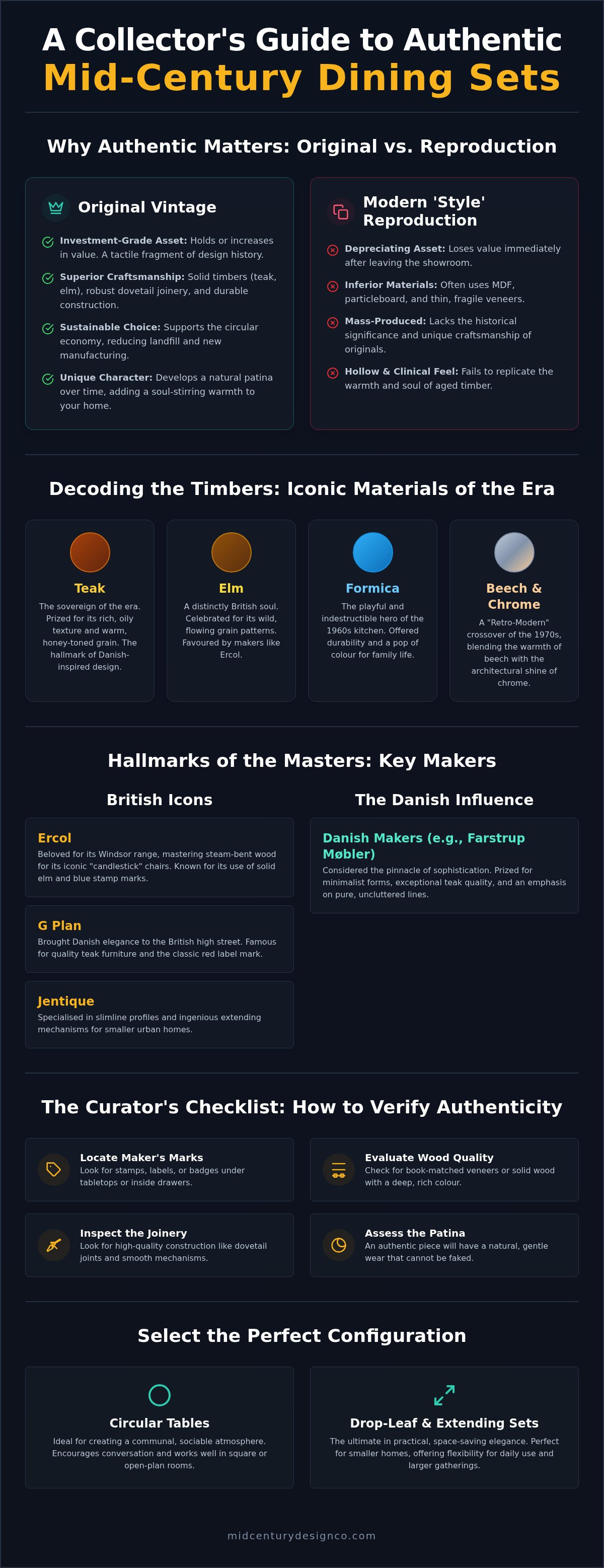
An original dining table is a storyteller. It carries the weight of decades, the laughter of countless Sunday roasts, and the quiet elegance of a design era that prioritised longevity over the fleeting trends of "fast furniture." When you source an authentic mid century dining set UK dealers have carefully curated, you aren't just buying a place to eat. You're acquiring a tactile fragment of history. The Mid-century modern movement was defined by a marriage of form and function that mass production today simply cannot replicate; it's the difference between a soul-stirring original and a clinical, hollow imitation.
Choosing vintage is also the ultimate sustainable interior choice. In a 2026 report, it was noted that 36% of consumers had bought pre-owned furniture in the past year, reflecting a growing desire for the circular economy. By opting for a set from the 1950s or 60s, you're rescuing high-quality timber from the landfill and reducing the demand for new, energy-intensive manufacturing. The natural patina found on these pieces, a gentle wear that softens the edges of teak or elm, creates a unique atmosphere that feels lived-in and welcoming from the moment it enters your home.
The Investment Value of Original Vintage
Modern furniture depreciates the moment it leaves the showroom, much like a new car. In contrast, authentic teak and elm sets are considered investment-grade assets. Rare models, such as the Ercol Windsor candlestick sets or specific Frank Guille designs for Austinsuite, have shown a remarkable ability to hold or even increase their value amongst collectors. Whilst a reproduction costs less initially, an original set is a long-term asset that you can enjoy for decades and eventually pass on. It's a sensible financial decision wrapped in an aesthetic triumph.
Superior Craftsmanship and Materials
The build quality of the mid-20th century remains unparalleled. Whilst modern copies often rely on MDF and thin, fragile veneers, original sets utilise solid beech frames, thick teak surfaces, and robust elm tops. You'll find 1960s construction techniques like dovetail joints and precision-engineered butterfly leaves that still glide smoothly after sixty years of use. This durability ensures your dining room remains a functional sanctuary for years to come. Many collectors find joy in creating a cohesive aesthetic by pairing their table with an authentic mid century modern sideboard, ensuring every element of the room shares the same heritage of craftsmanship and material integrity.
Navigating Iconic Materials and Makers
Teak remains the undisputed sovereign of the era. Its rich, oily texture and honey-toned grain define the Danish-inspired aesthetic that swept across Britain during the 1950s. In contrast, solid elm offered a distinctly British soul. Ercol’s use of elm, with its wild and flowing grain patterns, created pieces that felt like sculptures carved from the English countryside. For those seeking a mid century dining set UK families could actually live with, Formica emerged as the playful, indestructible hero of the 1960s kitchen. Later, the transition into the 1970s introduced a "Retro-Modern" crossover, where the warmth of beech met the clinical, architectural shine of chrome.
British Icons: Ercol, G Plan, and Jentique
The British furniture landscape was dominated by several titans who successfully translated avant-garde European ideas for the UK home. Ercol is perhaps the most beloved, specifically for its Windsor range. Its "stickback" or "candlestick" chairs are masterclasses in steam-bent wood, offering a lightness that belies their incredible strength. G Plan and Nathan took a different path, hiring prolific designers to bring Danish elegance to the high street. This era of refinement is beautifully documented at the Gordon Russell Design Museum, which showcases how pioneers like Sir Gordon Russell influenced the transition from utilitarian post-war furniture to modern art. Jentique, meanwhile, carved a niche for those in smaller urban dwellings, specialising in slimline profiles and ingenious extending mechanisms that still function perfectly today.
The Danish Influence: Teak and Minimalist Form
Whilst British makers were prolific, the Danish influence remained the pinnacle of sophistication for the discerning collector. Authentic Danish sets, such as those by Farstrup Møbler, are prized for their minimalist form and organic curves. You'll recognise these pieces by their tapered "cigar" legs and hidden, integrated handles that maintain a seamless, uninterrupted silhouette. These designs prioritised a lightness of touch, making them ideal for modern UK homes where space and light are at a premium. If you are searching for this specific blend of functionality and grace, you might consider a Vintage Mid Century Teak Danish Design Drop Leaf Table, which offers the perfect solution for compact dining areas without sacrificing historical character or material quality.
Selecting the Right Configuration for Your Space
The architecture of the British home often dictates our design choices. In the narrow footprints of Victorian terraces or the efficient layouts of modern city flats, the mid century dining set UK owners select must be as agile as it is beautiful. Circular tables offer a soft, communal flow that encourages conversation; they lack sharp corners, making them ideal for high-traffic zones where movement is constant. Rectangular designs provide a structured anchor for larger rooms. Success lies in balancing the table's footprint with the necessary clearance for seating, ensuring the room remains a breathable sanctuary rather than a cluttered passage.
Seating capacity is another delicate dance. Whilst it's tempting to crowd a table with as many chairs as possible, the mid-century aesthetic relies on a sense of "airiness." For daily life, ensure there's at least 60cm of width per person. If your space is truly premium, consider the visual weight of your chairs. A set of low-back G Plan chairs or Ercol's spindle-back designs allow the eye to travel through the piece, making even a small dining corner feel expansive and intentional.
Drop-Leaf vs. Extending Tables
Drop-leaf sets, particularly the iconic Ercol Elm designs, are the ultimate solution for compact dining. These tables allow you to fold away one or both sides, letting the piece rest discreetly against a wall when not in use. For those who enjoy hosting, extending tables equipped with hidden "butterfly" leaves are indispensable. Makers like Jentique perfected these mechanisms in teak, allowing a four-seater table to transform into a generous surface for six or eight guests in seconds. The leaf typically stores internally, preserving the table's sleek profile whilst providing the versatility needed for modern life.
| Table Type | Primary Benefit | Best For... |
|---|---|---|
| Drop-Leaf | Space-saving versatility | Small kitchens and studio flats |
| Extending | Adaptable hosting | Occasional dinner parties |
| Fixed | Visual statement | Dedicated dining rooms |
The Charm of Formica for Family Life
If your dining room is the bustling heart of a family home, wood veneers might feel too precious. Formica, the resilient hero of the 1960s, offers a playful yet indestructible alternative. Its non-porous surface handles spilled juice and crayon marks with ease, making it far more practical than delicate timber for homes with young children. It doesn't require the same level of maintenance as oiled teak, yet it retains that unmistakable vintage character. A Vintage Mid Century 1960s Sky Blue Formica Dining Set, often starting around £395, provides a vibrant, nostalgic focal point that manages the rigours of daily life without sacrificing your home's design integrity.
Assessing Quality and Authenticity Before You Buy
Authenticity is the cornerstone of value. When you're investing in a mid century dining set UK collectors would prize, you must look beyond the surface silhouette. Originality lives in the finer details that a modern factory reproduction simply cannot mimic. It's about the weight of the timber, the precision of the joinery, and those small, quiet markers of a piece's heritage. A true vintage set carries a narrative of quality that has already survived sixty years; your job is to ensure that story is genuine before it enters your home.
Start with a physical inspection of the "bones" of the furniture. Legs should be sturdy without excessive wobble, even on the more delicate, tapered Danish designs. Extending mechanisms, especially the "butterfly" leaves found in G Plan or Jentique tables, must glide with a satisfying, heavy smoothness. You should also learn to distinguish between a charming patina, such as the faint, silvered ring marks that whisper of past dinner parties, and structural damage like deep water swelling or split joints that compromise the piece's longevity.
Maker Marks and Stamps
Identifying an original often starts with a search for the maker's mark. These are usually tucked away in discreet locations, preserving the clean lines of the design. Use this checklist to hunt for authenticity:
- Check the underside of the main tabletop, specifically near the corners or the central seam.
- Look along the inner side rails or the underside of the seat on dining chairs.
- Inspect the housing of the extending mechanism for embossed metal plates or paper labels.
G Plan pieces often feature the iconic "Red Label" or the later gold embossed stamp. Ercol sets typically carry a blue or gold square label, often found on the back of a chair's seat or hidden beneath the frame. Don't panic if a stamp is missing; labels were often paper-based and could peel off over decades of use. In these instances, you'll need to rely on the specific construction details. For a deeper dive into these nuances, explore our guide on retro dining table and chairs UK styles.
Wood Grain and Finish
The visual depth of authentic timber is unmistakable. Aged teak possesses a rich, multi-tonal honey hue that modern chemical stains fail to replicate. You should look for "tiger-stripe" patterns in solid elm or the "book-matched" veneers on high-end teak surfaces, where the grain mirrors itself perfectly across a seam. We explicitly avoid modern reproductions to preserve the integrity of these finishes and the history they represent. If you're ready to find a verified original with a finish that only time can create, you can view our collection of authentic dining sets to see these material details for yourself.
Discovering Your Perfect Piece: Our Curated Collection
Finding the right mid century dining set UK homes deserve is a journey of discovery. Our collection is a curated gallery of 20th-century narratives, where each piece is chosen for its material integrity and design soul. From the sculptural curves of British elm to the architectural precision of Danish teak, these are not just objects. They are future heirlooms. We believe that a dining table should be the heart of a sanctuary, offering a tactile connection to a time when furniture was built to last a lifetime and beyond.
Ercol Windsor sets represent the pinnacle of British elm craftsmanship. These pieces are celebrated for their soft-moulded edges and the distinctive, wild grain of solid elm. Prices for these authentic sets typically start from £1150, reflecting their status as investment-grade furniture that only grows more beautiful with age. For those drawn to the warmth of the "golden era," our Danish-inspired teak sets from Jentique and G Plan offer elegant extending and drop-leaf options that prioritise both form and functionality. If your taste leans towards the vibrant and playful, our 1960s Formica sets bring bold colours and nostalgic gingham patterns into the modern kitchen. We also source rare finds for the dedicated collector, including architectural chrome-base sets and the minimalist work of Frank Guille for Kandya.
Standout Sets for the Modern Home
Certain designs possess a timelessness that allows them to slip effortlessly into contemporary interiors. The Ercol Windsor Solid Elm Plank Table & Dining Chair Set (£1250) is a prime example, offering a generous surface and those iconic, rounded edges that feel wonderful to the touch. For smaller urban spaces, the Vintage Mid Century 1960s Beech & Gingham Formica Round Drop Leaf Table (£549) provides a burst of character without overwhelming the room's footprint. If you require versatility for hosting, the Nathan extending set (£695) delivers a sophisticated Danish-style aesthetic with the practical benefit of a hidden butterfly leaf.
Complete Your Dining Room
A dining set is often the starting point for a wider aesthetic transformation. To create a truly cohesive space, you might consider pairing your table with a matching sideboard or a versatile Staples Ladderax system. These pieces share the same design language, ensuring that your room feels intentional and balanced. We invite you to explore the nuances of our inventory, linger on the grain patterns, and envision how these pieces will live within your own four walls. You can browse our full collection of authentic mid century dining sets today to find your home’s next heirloom.
Bring a Piece of Design History into Your Home
Choosing an authentic mid century dining set UK collectors value is an act of curation for your own sanctuary. It's about more than just aesthetics; it's a commitment to the enduring soul of 1950s and 60s craftsmanship. By focusing on the material warmth of solid elm and the architectural elegance of Danish-designed teak, you're investing in a narrative that modern reproductions simply cannot duplicate. These pieces have already stood the test of time. With the right eye for maker marks and joinery, they'll continue to serve as a durable focal point for generations.
We invite you to move beyond the search and begin your journey toward owning a genuine fragment of design history. Our inventory features only authentic originals, expertly curated to bring the best of British and Danish heritage to your space. With our safe national UK delivery, your next heirloom is closer than you think. Explore Our Curated Collection of Authentic Mid Century Dining Sets and find the piece that speaks to your home's unique spirit. It's time to create a dining space that feels as meaningful as the meals shared within it.
Frequently Asked Questions
How can I tell if a mid-century dining set is an original or a reproduction?
Identifying an original requires a keen eye for maker's marks, material weight, and the specific quality of the timber. Authentic pieces from the 1950s and 60s feature embossed gold stamps or paper labels under the frame. You'll notice that mid century dining set UK originals possess a substantial weight and solid wood frames, whereas modern copies often rely on lightweight MDF and thin veneers that lack the sensory warmth of the real thing.
Is teak or elm better for a daily-use dining table?
Both woods are exceptionally durable, but they offer different aesthetic spirits. Teak is naturally oily and resilient, making it a classic choice for the Danish-inspired home. Solid elm, the signature of Ercol, is an incredibly dense hardwood with a wild, flowing grain that handles the rigours of daily family life with grace. Your choice depends on whether you prefer the golden glow of teak or the sculptural impact of elm.
Do you provide national delivery for dining sets across the UK?
We offer a dedicated national UK delivery service for every mid century dining set UK customers purchase from our collection. We understand that these pieces are delicate fragments of history, so we ensure they are transported with the utmost care. Whether your home is in a bustling urban area or a tranquil rural setting, we can bring your chosen piece directly to your door, ensuring it arrives in the same beautiful condition it left our gallery.
How do I care for the wood finish on a vintage teak dining table?
Preserving the oily richness of teak is a simple yet essential ritual. You should avoid modern aerosol polishes, as they contain silicones that can build up and dull the finish. Instead, use a soft, lint-free cloth and high-quality teak oil once or twice a year to nourish the timber. Always protect the surface from heat and moisture with coasters or mats to prevent the dreaded white ring marks from appearing on the delicate grain.
Can I mix different mid-century makers, like Ercol chairs with a G Plan table?
Mixing makers is a wonderful way to create a curated, personal atmosphere that avoids the clinical feel of a showroom. Pairing Ercol chairs with a G Plan table, for instance, celebrates the shared design language of the era. The key is to look for harmony in the wood tones and the silhouette of the legs, ensuring the different pieces speak to each other with a consistent sense of proportion and historical weight.
What should I look for when checking the condition of a vintage drop-leaf table?
The support mechanism is the most critical element to inspect. Ensure the gate-leg or pull-out support moves smoothly and locks into place with no wobble. You should also check the leaves for any significant warping, which can occur if the table has been stored in a damp environment. Original brass hinges should be intact and free from excessive wear, ensuring the table remains level and stable when fully extended for your guests.
Why are original mid-century sets more expensive than modern high-street furniture?
Original sets are investment-grade assets that hold their value, unlike modern high-street furniture that depreciates instantly. You are paying for superior materials like solid beech and thick teak veneers, along with 20th-century joinery techniques that are no longer commercially viable. Whilst a new set might be cheaper, an authentic original is a sustainable heirloom that offers a unique soul and a tangible connection to design history that mass production cannot replicate.
Are the dining sets in your collection restored or in original condition?
Our collection focuses on authentic vintage pieces that retain their original character and soul. We believe in preserving the gentle patina that tells the story of the object's life. Whilst we ensure every set is structurally sound and clean, we avoid over-restoration that might strip away the historical integrity. This approach ensures you receive a piece that feels genuine, carrying the warmth and narrative of its 1960s origins into your personal space.