

Mid century nest of tables in the UK, from oak to storage
Oak gives a mid-century nest of tables in the UK a warm, grounded presence. The nesting design keeps extra surfaces close at hand and neatly tucked away when they’re not needed. The right set balances its wood, shape and finish with the space beside a sofa or favourite chair.
It’s easy to see why these tables appeal: they’re useful every day, yet their tapered legs, considered proportions and signs of age can give a room quiet character. This guide explores how to compare oak with other woods, what to look for in vintage styles and named makers, and which practical details matter, from dimensions to storage. You’ll be better placed to find a set that feels at home, whether you prefer a simple, sculptural trio or a piece with a little more history.
Key Takeaways
- Compare oak’s warm grain and solid presence with the lighter look of teak, elm and other vintage woods to find a finish that suits your room.
- Measure the space where the tables will sit, then consider how the full set works when nested and when each table is in use.
- Look beyond a maker’s name: design details, condition and provenance all help you understand a vintage set’s character.
- Decide whether you need extra occasional surfaces, discreet storage or a sculptural feature, as each design serves a different purpose.
- Check how the tables’ shape, finish and proportions relate to the rest of your furniture before choosing a set.
Mid-century modern oak nest of tables
For a mid century nest of tables in the UK, oak offers warm, visible grain and a grounded presence. Its character varies with the cut, colour and finish, so compare the actual surface rather than relying on a label alone. A pale finish can keep the grain understated, while a darker one gives the same wood a richer appearance. Tapered legs and uncluttered lines help oak feel sculptural rather than heavy in a mid-century room.
Dimensions turn that impression into a practical choice. The Malin Dining Mid Century Modern Nest of Tables measures 60 cm wide, 42.5 cm deep and 47.5 cm high. Use those figures as a real-world measuring example: mark the largest table’s footprint beside your sofa, then consider where the smaller tables can stand when pulled out. Measure the route into the room as well. A table that suits the sitting area still needs to pass through doorways and around corners.
Before choosing a set, work through these checks in order:
- Measure the floor space for the largest table, including its position beside seating.
- Compare the tallest table with the arm or seat height of nearby furniture.
- Check how the smaller tables slide beneath the largest, and whether their legs obstruct one another.
- Look across the top for consistent grain, colour and finish between the pieces.
Oak’s visible grain makes surface condition especially important on a vintage set. View the tops in good light and look for scratches, rings, uneven colour or differences between tables. Check the edges and legs too: knocks, loose joints and wobble can affect appearance and everyday use. Modest signs of age may add character, but the condition should be consistent across the set.
Consider how the nest will work at home, not just how it looks in a photograph. The largest table might hold a lamp or books, while smaller surfaces provide space for guests or a cup beside a chair. If you’ll move the tables often, handle each one and assess its weight and stability. For a practical fit test, mark out the measured footprint with paper templates and arrange nearby furniture around them. This reveals whether the oak nest feels balanced in your room before you commit.
Treat an offer as one part of your comparison, not a substitute for checking dimensions, finish and condition. Confirm the displayed price and saving before you buy, then weigh the cost against how often you’ll use the tables and how well the set suits the space you measured.
Vintage and mid-century nesting tables
A vintage nest brings more than extra surfaces: its proportions, joinery and wear can hint at its period and history. Compare recognisable designs with less-attributed sets, then decide whether you value a maker’s name, a particular silhouette or simply a useful group of tables. British and Danish examples have distinct character, from the rounded forms associated with Ercol to the restrained lines of Danish teak.
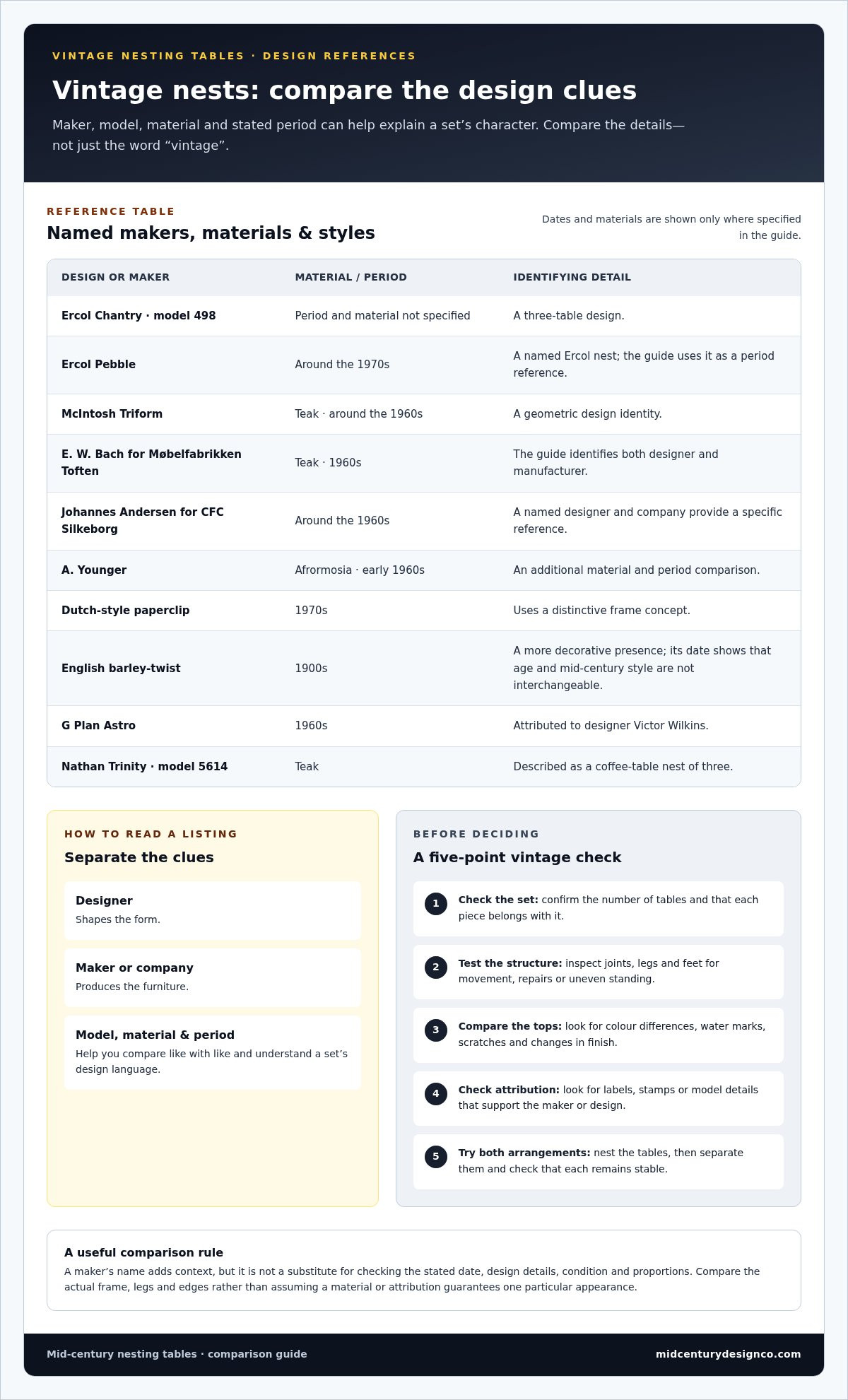
Named models give you useful reference points. The Ercol Chantry nest, model 498, is a three-table design; the Ercol Windsor is another familiar name, whilst the Ercol Pebble nest dates to around the 1970s. A McIntosh Triform teak nest from around the 1960s offers a different expression, with its geometric identity. These examples show why “vintage” alone tells you little: the maker, model and period can help explain a set’s proportions and design language.
Danish tables broaden the picture. A teak nest by E. W. Bach for Møbelfabrikken Toften dates from the 1960s, while a Johannes Andersen set for CFC Silkeborg also dates to around the 1960s. Another useful comparison is the early 1960s afrormosia nest by A. Younger. Look at how each set handles the frame, legs and edges, rather than treating teak or a Danish attribution as a guarantee of one particular appearance.
Use a practical inspection routine when assessing a vintage set:
- Match the number of tables and confirm each piece belongs with the set.
- Check the joints, legs and feet for movement, repairs or uneven standing.
- Compare the tops for colour differences, water marks, scratches and finish changes.
- Look for labels, stamps or model details that support the maker or design attribution.
- Try nesting the tables together, then separate them to see whether each remains stable.
Style can also guide the search. The 1970s Dutch-style paperclip design uses a distinctive frame concept, whilst a barley-twist nest from England, dating to the 1900s, has a more decorative presence. These contrasting examples show that age and “mid-century” style are not interchangeable. A design may suit a mid-century interior without originating in that period. Check the stated date and description carefully, and let the table’s actual form determine whether it belongs in your scheme.
To make a considered choice, shortlist sets by maker, era and silhouette, then compare their condition and proportions side by side. An Ercol Pebble, an E. W. Bach teak nest and an English barley-twist set each tell a different design story. The right fit depends on which story complements your furniture and how you’ll use the tables day to day.
Named designers and makers
A maker’s name can give a nesting table useful context, but interpret it carefully. Ercol, G Plan and Nathan are familiar names in British mid-century furniture, while Danish examples may identify both a designer and manufacturer. These details describe different roles: a designer shapes the form, while a maker or furniture company produces it. A listing that names both, such as Victor Wilkins and G Plan, gives a more specific attribution than a broad period description.
Model names and numbers can narrow the search further. The G Plan Astro nest is attributed to designer Victor Wilkins and dates to the 1960s. Nathan’s Trinity model 5614 is described as a teak coffee table nest of three. These identifiers help you compare like with like: the design, material and number of tables can be considered together, rather than relying on a maker’s name alone. Keep the model number with your notes when comparing photographs or descriptions.
Attribution wording matters. “By” makes a direct statement about authorship or manufacture; “attributed to” signals a qualified connection. “In the style of” describes resemblance, not proof that a named designer created the piece. A set described as being in the style of Henning Kjærnulf, for example, should be understood as a stylistic reference, not automatically as his work. Read the full listing before treating a designer’s name as provenance.
Use a simple comparison record for each candidate:
- Write down the stated maker, designer, model and date separately.
- Copy the exact attribution wording, including “attributed to” or “in the style of”.
- Compare the listed details with visible features, such as the frame, legs and table arrangement.
- Record what the description says about condition and any repairs.
- Keep photographs of labels, stamps or markings alongside the listing details.
Ercol offers another useful distinction between a maker and a particular model. An Ercol Windsor nest listed as dating from the 2000s is not the same proposition as a set simply described as “Ercol”. The date, model name and physical details all contribute to understanding what you’re considering. Check that those elements agree across the description and photographs; an inconsistent date or model reference deserves closer scrutiny.
A maker’s name can help narrow your search, but it shouldn’t decide for you. Compare a G Plan Astro with a Nathan Trinity by considering how each fits your room, how the tables nest and whether their condition suits everyday use. Then assess the attribution alongside the actual piece. A clear model reference can make a set easier to identify, while sound construction and appealing proportions help determine whether you’ll enjoy living with it.
Product features and storage
A nesting set offers surfaces that tuck together, but details determine how useful it is. Compare the number of tables, top shape, leg clearance and footprint when nested. A compact trio may work beside a sofa, while a broader set can spread across a seating area. Measure the largest table’s width and depth, then allow room to pull out each smaller table without blocking a walkway.
The Aspect Novani nesting set shows why individual dimensions matter. Its larger table measures 75 x 55 x 42.5 cm, while the smaller measures 60 x 40 x 50.5 cm. Those figures describe two pieces, so consider the full set rather than assuming every table has matching height or proportions. Check whether the lower table can slide beneath the larger one, and whether their legs fit without catching.
Storage is a separate feature, not an automatic benefit of nesting. Some round wooden nesting sets include hidden storage, while a traditional open nest simply provides extra tabletops. Decide what you need to store, then check how the storage is accessed and whether it remains practical when the tables are nested. A concealed compartment may suit small household items, but it won’t replace a dedicated cabinet for larger belongings.
Use this checklist when comparing features:
- Record the width, depth and height of each table, not just the largest piece.
- Check the nested footprint against the space beside your seating.
- Look at the clearance between tabletops and legs as the tables slide together.
- For hidden storage, inspect the opening, interior and access when the set is arranged.
- Consider whether rounded or square tops suit the room’s layout and nearby furniture.
Check stability as well as storage. Place each table on a level surface and press gently at different points to identify rocking. Inspect the feet and joints, especially where slim legs meet the frame. Vintage sets may show wear, so distinguish surface marks from movement that affects how a table stands. If it will hold a lamp or books, consider the usable surface area and how securely those objects will sit.
Picture a typical evening in your room. The largest table might hold a lamp, while a smaller one moves beside a chair for a drink; another can stay nested until guests arrive. This helps reveal whether easy separation matters more than concealed storage. In a small room, prioritise a compact nested footprint; for flexible entertaining, consider how the pieces work apart. Choose features you’ll actually use, not simply those that sound ingenious in a listing.
What materials and finishes are common for mid-century nest of tables?
Wood defines many mid-century nests, but the species and finish shape their character. Oak shows a pronounced grain, while teak can bring warmer, deeper tones. Elm offers another texture: an Ercol nest of three solid elm tables is described with a traditional dark finish. Compare the set in natural light, checking that the colour and grain feel consistent across the separate tops.
Oak sets can vary in scale as well as appearance. One solid oak nesting set is offered in three sizes: 17, 21 and 26 inches. That range illustrates why the word “oak” alone doesn’t establish a table’s footprint or proportions. Check whether the stated measurements refer to each table, then compare the largest top with your available floor space. A carefully chosen finish can emphasise grain without overpowering a room.
Wood isn’t the only option. A 1970s set of aluminium minimalist tables with glass tops creates a lighter, more reflective effect than a solid timber nest. Glass can make the frame more visually prominent, so inspect the joins and edges closely. Aluminium introduces a different surface and frame texture. Together, these materials show how a nesting set can retain a compact arrangement whilst shifting from warm and substantial to crisp and open.
Use this material-focused inspection when viewing a set:
- Compare the colour and grain across every tabletop, not only the largest one.
- Look for scratches, rings, cloudy patches or uneven finish on wood and glass.
- Inspect the underside and edges for changes in material or finish.
- Check metal frames for bends, loose joins or uneven contact with the floor.
- View the set beside your room’s existing wood, flooring and upholstery colours.
Finish changes how a vintage table looks in a room. Ercol’s dark-finished elm set has a different visual weight from pale oak, even before you consider its shape. A glossy surface reflects more light, while a muted finish lets the grain take the lead. Rather than matching every wood tone exactly, compare undertones and contrast. A warm tabletop can sit comfortably beside darker furniture when the surrounding palette connects them.
For a considered purchase, record the material, finish and condition separately. Note whether a listing identifies solid timber, glass or metal, then compare that description with visible edges and undersides. Look closely at the tops in daylight, and check whether marks appear to belong to the surface or finish. If you’re drawn to vintage timber character, browse vintage coffee and occasional tables to explore pieces with distinct materials and finishes.
Compare its finish with darker elm and pale oak when considering your room’s palette.
The Mid Century Design: Sideboards & Storage
The Mid Century Design Company offers complementary vintage furniture for a cohesive interior. Its Sideboards & Storage can add more substantial storage, while Coffee Tables & Occasional Tables provide further options for shaping a considered living space. These pieces are worth exploring when you want nesting tables to form part of a wider mid-century scheme.
For a dining room or bedroom, Dining Sets and Chest of Drawers offer other ways to carry a considered furniture style through the home. Start with the room’s practical needs, then look for finishes and proportions that work alongside your tables.
Explore the range at midcenturydesignco.com or contact The Mid Century Design to continue your search.
Make room for a piece with lasting character
Choosing a mid century nest of tables in the UK is an opportunity to shape how a room feels as well as how it functions. Picture the set in its intended place, then consider what should sit around it: storage to calm visual clutter or a dining setting that carries the same thoughtful design into another room. The Mid Century Design Company offers Sideboards & Storage, Dining Sets and Chest of Drawers to help create a wider interior scheme.
Let your choice reflect the way you live. A treasured vintage table can become part of a home’s rhythm, gathering books, a lamp or the small objects that make a space personal. If you’re ready to explore furniture that complements your plans, contact The Mid Century Design Co. Take the next step at your own pace, and make space for a piece that feels distinctly yours.
Frequently Asked Questions
How do vintage and modern mid-century-style nesting tables compare?
Vintage tables are original pieces from an earlier period, valued for their individual character, aged materials and signs of use. Modern mid-century-style tables are newly made to reference the period, and their appearance and finish may be more consistent. If you value history, look for a vintage set with a clear description of its age and condition. If a coordinated, contemporary finish matters most, compare modern styling instead.
What should I check when buying vintage nesting tables?
Confirm that the set includes every table described, and compare photographs of the pieces for differences in colour, shape or construction. Look for signs that one table may be a later replacement, such as a noticeably different leg profile or finish. Check that repairs and alterations are described, then keep the listing details and photographs with your purchase records. They’ll provide a useful reference if the delivered set differs from its description.
What is the typical price of mid-century nest of tables in the UK?
Prices for a mid century nest of tables UK shoppers are looking for can vary considerably depending on whether you choose an original vintage piece or a new reproduction. At The Mid Century Design Co., smaller or simpler vintage sets often start from around £150, whilst rare designer pieces or pristine restored hardwoods can command several hundred pounds or more.
Which mid-century nesting tables offer the best value for money?
Compare condition, construction and how the tables fit your space before judging value.