

Mid-Century Vanity Table Without a Mirror: A Buying Guide
A vanity doesn’t need a mirror to earn its place in a bedroom. A mid century vanity table without mirror gives you a considered spot for getting ready while leaving the wall above it free for a separate mirror, artwork or simply a little breathing room. Its appeal lies in the table itself: its proportions, storage and original vintage character.
To decide whether a mirror-free piece will suit your routine, think about how you’ll use the surface, what you need to keep close at hand and how the table will fit with your existing furniture. Its appearance matters, but so do its dimensions, drawer layout and the space needed to sit and move around it.
This guide covers the practical details to compare when choosing a mirror-free vintage dressing table, from surface area and proportions to design character. Use the measurements and checklists to narrow your options, then consider how a separate mirror and seat will complete the arrangement.
Key Takeaways
- Choosing the mirror separately lets you decide where reflection belongs in the room and how prominent it should be.
- Compare silhouette, leg shape, drawer details and material descriptions to understand each table’s character.
- Weigh dimensions, storage, surface area and intended use against your practical and aesthetic priorities.
- Measure the floor area and wall, including space for open drawers and seating, before planning the table’s position.
- Choose a mid century vanity table without mirror for its fit, function and design character, then explore original vintage dressing tables from The Mid Century Design Co.
Why choose a mid-century vanity table without a mirror?
A dressing table without an attached mirror gives you a useful surface and storage while leaving the mirror as a separate choice. It isn’t an incomplete set: the table’s position, shape and character can be considered on their own. A mid century vanity table without mirror may suit a room where an attached mirror would feel too imposing, or where you already have a favourite mirror elsewhere.
Separating the two lets you arrange the room around your needs. You might hang a dressing mirror on the wall, use a freestanding one, or leave the wall above the table clear so the furniture’s outline remains the focus. This can help you bring together furniture from different periods without making the table dictate the whole arrangement. For context on the style’s history and visual language, explore Mid-century modern design principles and history.
What makes a vanity table without a mirror different?
The table provides the working surface and whatever storage it has. The mirror is chosen and positioned separately, so don’t assume it comes with the table. With no attached glass rising above the tabletop, details such as the leg shape, drawer proportions and finish become more prominent. You can then place a separate mirror to suit the room and the way you get ready.
Who might prefer a mirror-free dressing table?
This arrangement may suit you if you already use a wall mirror or prefer a separate dressing mirror that can be angled or moved. It can also be a good option when a large attached mirror might dominate the furniture or compete with other features. In a flexible room, the table could serve as a getting-ready spot in the morning and provide a surface for occasional writing or displaying a few objects later in the day.
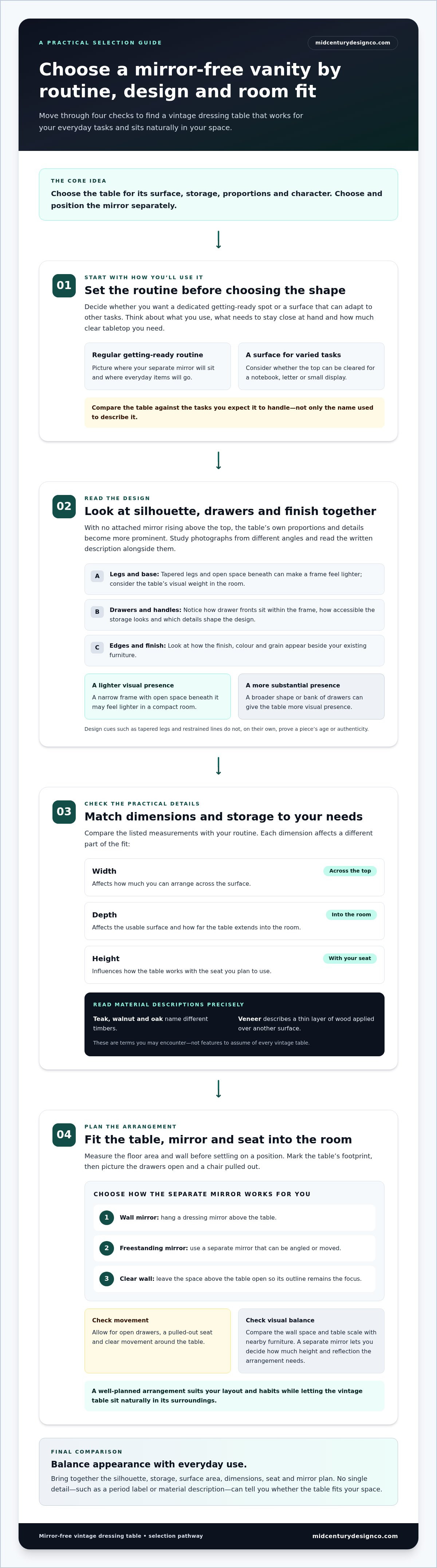
Consider whether you want a dedicated dressing area or a piece that adapts to different tasks. For a regular getting-ready routine, picture how your separate mirror will work with the table and where everyday items will sit. If the room has several uses, check whether the tabletop can be cleared for a notebook, letter or small display. Focus on the tasks you expect the table to handle, not only the name used to describe it.
Visual balance matters too. An attached mirror creates a taller focal point, while a separate one lets you decide how much height and reflection the arrangement needs. Compare the available wall space with the scale of your existing furniture. Decide whether you want a clearly defined dressing corner or a simpler surface that blends into the room. The right option should suit your layout and habits while allowing the vintage table to sit naturally in its surroundings.
How vintage design, materials and proportions shape the right choice
A mid-century label suggests a design direction, but it doesn’t tell you whether a particular table will suit your room or routine. Consider the whole piece: its outline, construction details, surface area and the relationship between its legs and drawers. A delicate-looking table may offer less storage, while a broader shape may have more visual presence. The best fit balances appearance with the way you plan to use it.
Which design details give a vintage vanity its character?
Tapered legs, restrained lines and balanced proportions are familiar design cues, but they don’t prove a piece’s age or authenticity. Look at how the drawer fronts sit within the frame, whether the handles stand out and how the edges and finish affect the overall impression. Study photographs from different angles and read the written details alongside them. Small variations can give each table its own character.
Consider visual weight as well as decorative details. A narrow frame with open space beneath it may feel lighter in a compact room, while a broad bank of drawers can give the table a more substantial presence. Neither is automatically better. Picture the silhouette beside your bed or wardrobe, and consider whether the drawer arrangement gives you convenient access to everyday items.
How do size and materials affect everyday use?
Width, depth and height each affect how a table works. Width determines how much you can arrange across the top; depth affects the usable surface and how far the table extends into the room. Height influences how it works with your seat. Compare the listed dimensions with your routine: a few essentials need less working space than several products, a hairbrush and room to set things down.
Read material descriptions precisely. Teak, walnut and oak name different timbers, while veneer describes a thin layer of wood applied over another surface. These are terms you may encounter, not features to assume of every vintage table. Colour and grain can affect how a piece looks alongside your other furniture, so consider the finish shown in the photographs as well as the written description.
- Legs and base: Consider how their shape affects the table’s visual weight and the open space beneath it.
- Drawers and handles: Look at storage, access and the details that shape the design.
- Top dimensions: Compare the surface area with what you use during your routine.
- Overall fit: Allow space for a chair, open drawers and clear movement around the table.
Measurements help turn an attractive photograph into a realistic room plan. Mark out the table’s footprint, then picture the drawers open and a chair pulled out. Check that the arrangement won’t obstruct the route through the room. Assess the finish, silhouette and practical details together: a period label or appealing material description alone can’t tell you whether the table is right for your space. To compare original pieces, explore curated vintage dressing tables from The Mid Century Design Co.
How to compare mid-century vanity tables without mirrors
Use the same questions for each listing to make comparisons easier. A mid century vanity table without mirror may look beautiful in a photograph but still be too deep for your room or lack the surface area you need. Separate practical requirements from visual preferences, then assess each table against both. This helps you avoid overlooking a poor fit because a particular silhouette catches your eye.
Which details should you compare before choosing?
Start with the stated measurements and compare them with your available space and planned seating. Look at the number and layout of the drawers, then decide whether they suit the items you want to keep nearby. Finally, study the photographs and description for details of the finish, visible wear and construction. Applying the same checklist to each piece makes the differences easier to judge.
Use the dimensions, storage and intended-use questions to establish your practical priorities. For example, you may need a table that fits a particular wall and holds a small set of daily essentials. Then rank your aesthetic preferences, such as an open outline, distinctive handles or a finish that works with your existing furniture. Treat listing details as evidence: don’t assume a feature is present just because it is common on other tables.
Is a vanity table or a desk-dressing-table form more suitable?
A vanity-led table may suit a routine centred on getting ready, particularly if you want a surface and storage for that purpose. A desk-dressing-table form may be more suitable if occasional writing or varied use matters just as much. Neither is inherently better. Compare how each shape works with your chair, belongings and habits. For more context on desk forms, explore this guide to authentic mid-century modern desks.
A table without an attached mirror isn’t necessarily unfinished. A separate mirror becomes part of the arrangement you create, chosen to suit the wall, table and way you use the space. Picture the complete setting: table, chair, mirror and clear space around them. This gives you a better sense of whether the piece works in practice and looks balanced in the room.
Plan the mirror, seating and placement before buying
A table can look perfectly proportioned in a listing and feel quite different in your room. Before choosing a mid century vanity table without mirror, plan the complete arrangement: the table’s footprint, the space needed to use it and where the separate mirror will sit. Taking a few measurements helps you picture the finished setting before you choose.
How should you measure a dressing-table space?
Begin with the intended wall and floor area, then compare those measurements with the table’s stated width, depth and height. Don’t measure only the empty space beneath the tabletop. Leave room for drawers to open, a chair to move back and enough clearance to walk past without disrupting the rest of the room.
- Measure the available area. Record the width of the wall and the floor space you can give the table. Note nearby furniture, doors and walkways.
- Map the table’s working space. Use the listed dimensions to mark its footprint. Then allow for open drawers and the space needed to sit down and stand up.
- Choose the seating. Compare the table’s stated height with a chair or stool you find comfortable, and consider whether it can be tucked in when not in use.
- Plan the mirror. Once the table and seating positions are clear, decide whether a wall-mounted or freestanding mirror will work better.
Light and sockets are also worth considering if they affect your routine. If you use an electric styling tool at the table, note where the nearest socket is and whether the layout works for you. Natural light may influence where you prefer to sit, but it doesn’t have to dictate the arrangement.
How can a separate mirror and chair complete the arrangement?
A wall-mounted mirror keeps the floor clear and can create a composed backdrop above the table. A freestanding mirror offers more flexibility and adds its own visual presence to the surface. Consider its height and position in relation to the table’s outline, the wall and your seated view. There’s no single arrangement to follow; aim for one that feels balanced and works for your routine.
Seating completes the practical and visual picture. Compare the table’s stated height with the seat, and consider whether the chair’s arms or back will fit beneath or around it. A simple seat can leave the table as the focus, while a contrasting texture or colour can add a distinct note. Either approach can work if the scale feels considered.
Look at the whole corner alongside the room’s existing furniture. Repeating a colour or material can create continuity, while a different texture can help the vintage piece stand apart. For further ideas on bringing vintage finds into a contemporary interior, explore this guide to styling mid-century modern furniture. Once you’ve mapped the space and planned the mirror and seating, explore authentic vintage dressing tables and compare them with your plan.
Find an original vintage vanity table with lasting character
Your choice comes together when a table fits the room, supports your routine and suits your taste. Keep your measurements and comparison priorities close as you explore. Dimensions and storage matter alongside silhouette, finish and individual character. Picture the separate mirror and seating as part of the complete arrangement, rather than judging the table in isolation.
What to look for when exploring original vintage dressing tables
Check each piece against the space and use you have in mind. Read its description carefully, then study the photographs for details of the finish, drawer fronts, handles and overall form. A vintage table’s age and materials contribute to its story, but don’t guarantee a particular condition. Consider the information provided about the individual piece.
Keep a short set of questions beside you as you browse:
- Do the stated dimensions work with the area you measured?
- Does the visible drawer arrangement suit what you want to store?
- Can you imagine using the surface comfortably with your chosen seating?
- Will your separate mirror sit well with the table and the room?
These questions keep the decision grounded without making it purely functional. An original vintage dressing table may have details that feel distinctive because it belongs to another time. Look for a balance: a piece that answers your practical needs while its proportions and finish bring warmth and personality to the room.
Explore a curated collection of vintage dressing tables
The Mid Century Design Co. is an independent UK specialist in curated, authentic vintage mid-century furniture, including dressing tables. Its collection focuses on original vintage pieces rather than modern reproductions. As you explore, consider how each table’s character might complement your interior and suit the way you’ll use it, from a morning routine to quieter moments in between.
Choosing a mid century vanity table without mirror is a personal decision about fit, function and visual balance. A separate mirror gives you scope to shape the arrangement around your room, while the table brings its own mid-century character. Let your measurements guide the search, then consider the details that make an individual piece feel right for your home.
Take your time as you browse the collection of original vintage furniture. Explore The Mid Century Design Co. to find a vintage dressing table that suits your space and routine.
Let the right piece shape your room
The best mid century vanity table without mirror is more than a practical surface. It can become a daily anchor, where thoughtful design meets the rhythms of getting ready, writing a note or pausing between tasks. As you browse, stay open to details you hadn’t planned on: a particular curve, handle or finish may suit your space better than the feature you first thought you needed.
Picture the table alongside your chosen mirror and seating, and consider which details make the arrangement feel personal. The Mid Century Design Co. brings together authentic vintage mid-century furniture, including dressing tables, with a focus on original pieces rather than modern reproductions. To find a piece with its own character, explore the curated collection of authentic vintage furniture.
Choose with care, then enjoy making the piece part of your home.
Frequently Asked Questions
Is a vanity table without a mirror the same as a dressing table?
Often, the terms describe similar furniture, although retailers and listings may use them differently. Both usually refer to a table with a surface for getting ready, sometimes with storage. “Without a mirror” describes the mirror arrangement, not a different kind of furniture: it means there’s no attached mirror presented with the table. You can pair it with a wall-mounted or freestanding mirror that suits your room.
Can I add a mirror to a vintage vanity table without damaging it?
Choose an arrangement that doesn’t rely on the table supporting a mirror or being altered. For example, a freestanding mirror can sit on the surface, while a wall-mounted one can be fixed independently using fittings appropriate for the wall. Don’t assume the tabletop is suitable for drilling or that its structure can bear added weight. Preserving the original finish and construction helps retain the piece’s character.
Can a mid-century vanity table without a mirror work in a small bedroom?
Yes, if its footprint and everyday use suit the room. Before choosing, mark the table’s width and depth on the floor with masking tape, then check that doors, drawers and your usual route through the bedroom remain usable. A mid century vanity table without mirror also lets you position the mirror separately instead of committing to a tall attached element. This can help create a dressing spot without visually overwhelming a compact space.
What should I check in photographs of a vintage vanity table?
Study the tabletop, drawer fronts, legs, handles and finish, and look for photographs showing the table from more than one angle. Compare what you can see with the written description, especially details about dimensions and visible wear. A close-up may reveal marks that aren’t apparent in a room view. Photographs help you assess appearance, but they can’t independently establish a piece’s age, maker or materials unless the listing states those details.
How do I clean a vintage wooden vanity table?
Begin gently by removing dust with a soft, dry cloth. Avoid abrasive pads and strong household cleaners, which may be unsuitable for a particular surface. Don’t apply water, oil or polish unless you know it’s appropriate for the finish and material. If you’re unsure whether a surface is veneered or how it has been finished, seek furniture-care advice before trying a treatment that could change its appearance.
Can a vintage vanity table without a mirror also be used as a desk?
Some tables can suit occasional writing or other light tasks, depending on their height, surface and storage. Compare the stated height with your chair and consider whether there’s enough room for the activity without moving your getting-ready essentials. A short note or letter may need little space; longer work calls for a more comfortable working position. Don’t assume every vanity will function like a dedicated desk.