

Rare and Collectible Mid Century Furniture Valuation
Age alone doesn’t make a chair or sideboard valuable. Rare and collectible mid century furniture attracts interest when its design, maker, authenticity, historical significance and condition come together, giving a piece both a compelling story and lasting appeal. Danish and Scandinavian furniture from the 1950s and 1960s is especially associated with this era’s thoughtful craftsmanship and clean, enduring forms.
It’s easy to see why rare and collectible mid-century furniture captures the imagination: it brings character into a room, but its value depends on more than appearance. This guide explains how to assess authenticity, recognise a designer or maker’s influence, and understand how originality, condition and rarity shape a piece’s appeal to collectors.
You’ll also learn why mid-century design remains sought after, what evidence can help establish a piece’s history, and how to look beyond a familiar silhouette to the details that matter. With a clearer eye for craftsmanship and provenance, you can appreciate the story behind a treasured find and consider how it might work in your home.
Key Takeaways
- Understand why age alone doesn’t determine value, and how rarity, maker, condition and completeness influence collector appeal.
- Learn which markings, paperwork and signs of a piece’s history can help support its authenticity and provenance.
- See how iconic designers such as Vladimir Kagan and Adrian Pearsall are associated with distinctive forms and collector interest.
- Explore how mid-century furniture’s post-war practicality and enduring design give pieces meaning beyond their function.
- Discover how to assess sought-after makers and designers in the UK, and what details to look for when considering a piece.
Why Mid-Century Modern Furniture Is So Valuable?
Value comes from more than age: maker, design, rarity and condition all shape collector appeal. Danish and Scandinavian furniture from the 1950s and 1960s shows how craftsmanship and enduring form can make a piece desirable.
Factors Behind Vintage Furniture Prices
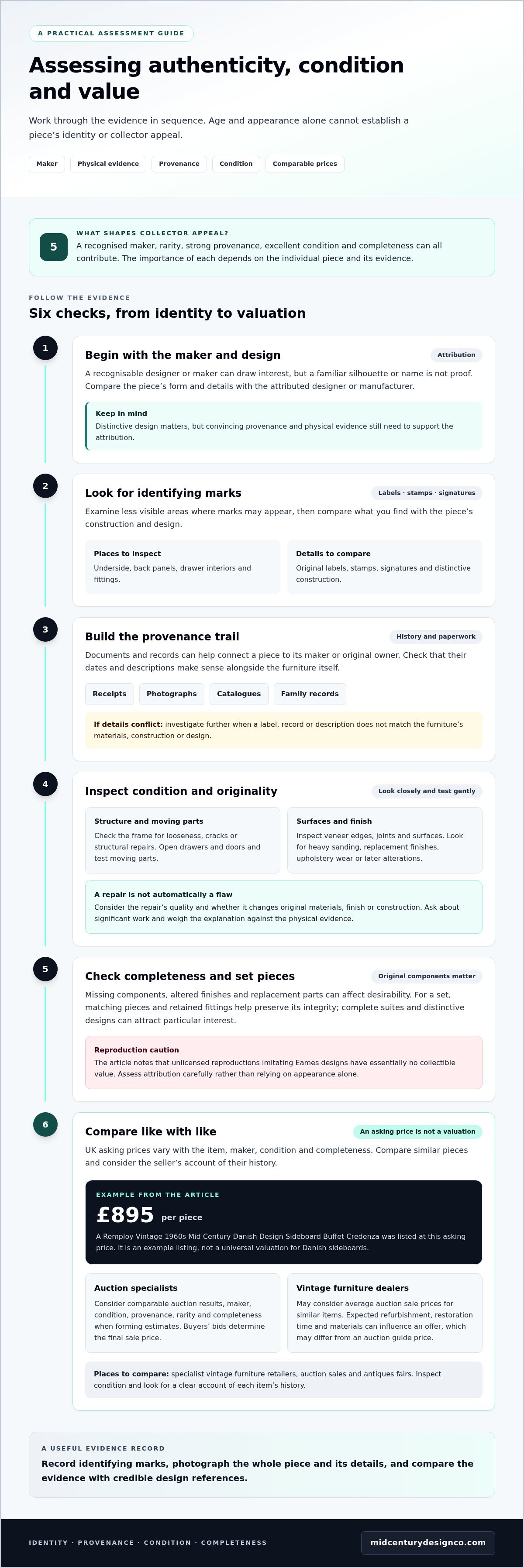
Start with the maker, then assess originality, condition and completeness. A recognisable designer can draw interest, but a rare piece without convincing provenance may be harder to evaluate. Look for original labels, distinctive construction and details consistent with the design. Repairs, missing components and altered finishes can affect desirability. For a set, matching pieces and retained fittings help preserve its integrity.
The most valuable collectible pieces tend to combine an acclaimed designer or maker, rarity, strong provenance and excellent condition. Complete suites and distinctive designs can attract particular interest, though value depends on the individual piece and its evidence of authenticity.
Current Vintage Furniture Prices
UK asking prices vary with the item, maker, condition and completeness, so compare like with like rather than relying on age alone. As a current example, a Remploy Vintage 1960s Mid Century Danish Design Sideboard Buffet Credenza is listed at £895 per piece as of 2026-10-20. An asking price is a guide to that listing, not a universal valuation for Danish sideboards.
Where can you buy rare mid-century furniture in the UK? Specialist vintage furniture retailers, auction sales and antiques fairs are places to look. Compare similar pieces, inspect their condition and consider whether the seller provides a clear account of each item’s history.
Vintage Sculptural Lighting
Lighting can carry the same artistic presence as a chair or cabinet. A vintage Italian sculptural bronze table lamp from the 1970s measures 34 cm wide, 14 cm deep and 79 cm high. Those proportions, its sculptural form and its material help explain its appeal as both a functional object and a statement piece. Check the base for inscriptions or edition markings, which can add useful context.
How should mid-century furniture be transported, cared for and insured? Measure the piece and access route first, protect corners and finishes, and secure drawers or moving parts before transport. Keep furniture away from direct heat and sunlight, use gentle cleaning suited to its material, and document its condition with photographs. For insurance, keep purchase records, provenance documents and a current valuation together, then ensure the cover reflects the item’s assessed value.
Furniture authenticity and valuation factors
Authenticity rests on evidence, not appearance alone. A familiar silhouette can be copied, while construction details, maker’s marks and provenance help establish a piece’s identity. Examine the underside, back panels, drawer interiors and fittings for original labels, stamps or signatures. Compare these details with the attributed designer or manufacturer before treating a name as proof.
A paper trail can strengthen a piece’s story. Receipts, photographs, catalogues and family records may connect an item to its original owner or maker. Check whether dates and descriptions match the furniture’s materials, construction and design. If a label conflicts with the piece’s form, investigate further rather than assuming either detail tells the whole story.
Condition affects both practical use and collector interest. Check the frame for looseness, cracks or signs of structural repair. Open drawers and doors, test moving parts, and inspect veneer edges, joints and surfaces. Look for heavy sanding or replacement finishes, and check upholstery for wear or later alterations. A repair isn’t automatically a flaw, but its quality and effect on originality matter.
How do UK auction houses value and sell mid-century furniture? Auction specialists assess comparable auction results, maker, condition, provenance, rarity and completeness when forming estimates. They catalogue the piece for sale, while buyers’ bids determine the final sale price.
For sellers, an auction estimate is not a guaranteed result. A vintage furniture dealer may also consider average auction sale prices for similar items when making an offer. Dealers commonly buy at auction expecting refurbishment before resale, so condition, restoration time and materials can influence their calculations. A dealer’s offer may not match an auction guide price.
What should buyers know about reproductions, restorations and repairs? Unlicensed reproductions imitating Eames designs have essentially no collectible value. Assess attribution carefully, and distinguish a faithful repair from a replacement that changes original materials, finish or construction. Ask about significant work, then weigh the account alongside labels, paperwork and physical evidence.
A measured approach helps. Record identifying marks, photograph the whole piece and its details, and compare the evidence with credible design references. For Danish pieces, the Danish vintage furniture selection offers a way to explore period design in person. Sound judgement comes from connecting the maker’s identity, the object’s condition and its documented history.
Vladimir Kagan and Adrian Pearsall designs
Vladimir Kagan and Adrian Pearsall created furniture recognised by collectors for its sculptural presence. Kagan’s seating often features sweeping curves and flowing silhouettes, while Pearsall’s work is associated with expressive forms and strong visual impact. Their designs show how mid-century furniture can serve as practical seating and a room’s central artistic statement. For collectors, the designer’s name is only the starting point.
Compare the overall form with documented examples attributed to Kagan or Pearsall. Examine the outline, proportions, materials and construction rather than relying on a seller’s description or resemblance alone. Curved frames and dramatic profiles can be copied. Labels, signatures, provenance records and consistent construction details help establish whether a piece belongs to the designer’s work.
Condition affects how these designs look and how readily they can be used. With Kagan seating, inspect the frame beneath the upholstery, paying attention to joints, stability and signs of structural repair. On a Pearsall piece, examine the base, supports and upholstery, including whether alterations obscure its original form. Photograph worn areas, repairs and identifying marks to support comparison with similar examples.
Valuation also depends on rarity, completeness and buyer appeal. An unusual Kagan form may attract attention, but a familiar design in exceptional condition can remain desirable. The same applies to Pearsall: assess the individual piece, not just the designer’s reputation. Original upholstery or finish can contribute to its story, while later work may affect how collectors view authenticity and condition.
For a considered purchase in the UK, use a practical sequence:
- Identify: Record the claimed designer, labels, signatures and any paperwork connected with Kagan or Pearsall.
- Compare: Match the shape, construction and materials against documented examples of the attributed design.
- Inspect: Check stability, upholstery, finish, repairs and completeness in person or through clear photographs.
- Assess: Weigh authenticity, condition, rarity and provenance together before deciding what the piece means to your collection.
These steps help distinguish an admired silhouette from a well-supported attribution. Kagan and Pearsall pieces can make a strong impression at home, yet their collector appeal rests on each object’s evidence and condition. Treat every piece as an individual design, with its own materials, history and physical character, rather than assuming every piece bearing a famous name has the same value.
These ranges offer context, not a substitute for assessing attribution, condition and provenance.
Aesthetic appeal and historical significance
Mid-century design carries a balance of utility and visual confidence. Its furniture reflects post-war practicality alongside styles associated with the 1950s, 1960s and 1970s. That history helps explain why a compact desk, expressive chair or carefully proportioned cabinet can feel relevant in a contemporary home. Collectors value not just appearance, but the design thinking embodied in each object.
The name itself came later than the furniture. “Mid-Century Modern” wasn’t used until the mid-1980s, giving a later label to designs already shaped by earlier decades. That distinction matters when tracing a piece’s story: a period object belongs to its time, whilst the language used to categorise it may have developed afterwards. Rare and collectible mid century furniture can therefore carry both a design history and a changing cultural interpretation.
Post-war practicality is evident in furniture designed for daily use. Streamlined forms, useful storage and adaptable layouts helped pieces serve real homes, not simply display rooms. A sideboard, for example, can combine generous storage with a clean horizontal profile. A dining set brings people together, while a coffee table can anchor a seating area without overwhelming it. These functions help explain the era’s continued presence in modern interiors.
Design details give that practicality its distinctive character. Notice how a chair’s frame meets its seat, how a cabinet’s doors sit within its overall form, and how the furniture’s proportions relate to the room. Tapered legs, sculptural curves or contrasting materials can change a piece’s mood. Assess these features together: a memorable outline works best when its construction and intended use also feel coherent.
- Consider the period: Connect the piece’s style with the 1950s, 1960s or 1970s context.
- Read the form: Notice how shape, materials and proportions express the designer’s approach.
- Picture its use: Consider whether the furniture’s original function still suits your room.
- Value the story: Separate the object’s historical context from the later term used to describe it.
In a British home, one well-chosen piece can bridge history and everyday life. A teak cabinet may bring warmth to a pared-back room; a sculptural chair can create a focal point among quieter furnishings. The strongest choice isn’t necessarily the most dramatic. It’s the piece whose period character, practical purpose and visual presence work together.
Which mid-century furniture designers and makers are most sought after in the UK?
British and Danish makers may both be worth considering when exploring mid-century furniture. Ercol, G-Plan and Alfred Cox appear in furniture examples, alongside Finnish designer Olli Mannermaa and Martela. These names span distinctive approaches, from practical teak storage to sculptural seating. A maker’s reputation can draw attention, but the specific design, condition and completeness still shape each item’s appeal.
Ercol’s appeal is visible in its recognisable elm furniture. The materials and adaptable forms suit everyday rooms as well as collector interiors. Compare the construction and design details of each piece rather than assuming every Ercol item has the same desirability.
G-Plan offers another useful UK reference point. Its examples show how the maker’s name appears across different furniture types. Check each piece’s condition and completeness before comparing its asking price with another listing.
Its practical storage and clear mid-century character make it a useful example for buyers comparing British furniture. Check drawer movement, veneer, handles and overall stability. These details help distinguish a well-preserved example from one whose appearance masks wear or later changes.
Danish and Scandinavian furniture also has a strong place in the collecting conversation. Pieces from the 1950s and 1960s are valued for considered proportions and thoughtful material use. A Danish maker’s name can be an important clue, but attribution should match the furniture itself. Look for coherent construction, labels or other evidence, then compare the design with documented examples.
International names also appear in UK listings. Treat a design association carefully: it alone doesn’t establish a piece’s maker or provenance.
Use maker names as a starting point, not a verdict. Compare matching furniture types, finishes and condition, then consider how a design works in your home. For a closer look at Danish pieces, explore Danish vintage furniture and consider which forms suit your space.
The Mid Century Design: Sideboards & Storage
The Mid Century Design Company helps you bring period character into your home through its selection of vintage furniture. If you’re looking for a practical statement piece, explore Sideboards & Storage, including Danish furniture that pairs useful storage with considered design.
Choose according to how the piece will serve your room. A sideboard can anchor a dining space, while a chest of drawers brings storage to a bedroom. Dining Sets and Coffee Tables & Occasional Tables offer other ways to introduce mid-century forms into everyday living. Consider the scale, function and visual character that best suit your interior.
Explore the vintage collection at The Mid Century Design Company to find a piece that suits your home.
Choose a Piece That Feels Meaningful
A considered purchase can do more than complete a room. It can bring a distinctive design story into everyday life, creating a lasting connection to the makers and ideas that shaped mid-century interiors. As you explore rare and collectible mid-century furniture, consider the piece you’ll enjoy living with, not simply the name attached to it.
The Mid Century Design Co. offers Sideboards & Storage, Dining Sets and Chest of Drawers for homes seeking vintage character and practical purpose. Look to a piece’s proportions, materials and presence to find one that feels at home in your space and reflects your taste.
Contact The Mid Century Design Co. to continue exploring vintage furniture for your home. A thoughtful choice can make the past feel beautifully present.
Frequently Asked Questions
What to Look For When Shopping for Mid-Century Collector’s Items?
Begin with the piece’s proportions, materials and intended use, then check whether it suits your room. Measure the space and access route before arranging collection or delivery. Ask for clear photographs of the front, back, underside and any marks, especially when viewing remotely. Compare the details with examples of the same design, and keep notes on condition, paperwork and seller descriptions so you can weigh the evidence together.
What makes mid-century furniture rare and collectible?
Rarity may come from a limited design, an unusual variant or fewer surviving examples in good condition. Collector interest can grow when a piece also has a distinctive design, a credible maker attribution and a clear history. Rare and collectible mid-century furniture is not simply old furniture: a scarce item with major alterations may attract less interest than a familiar design with strong provenance and its original character intact.
How much does authentic mid-century furniture cost in the UK?
There’s no single UK price: maker, design, condition, completeness and sale setting all affect the figure. These are examples of asking prices, not a general valuation or proof of a completed sale. Compare like-for-like pieces before judging an individual listing.
How can you identify authentic mid-century furniture and maker marks?
Look beyond the presence of a label and assess whether its placement, wording and appearance suit the furniture. Compare the mark with reliable examples attributed to that maker, then consider whether the construction and design details tell a consistent story. Retailer labels can indicate where an item was sold, rather than who designed or made it. Treat attribution as a conclusion drawn from several matching clues.
How can you check the condition and provenance of vintage furniture?
Ask for close photographs of joints, undersides, drawer interiors and repaired areas, then compare them with the seller’s description. To assess provenance, build a simple timeline from ownership records, receipts, photographs or correspondence. Note which document supports each part of the account. If details conflict, record the discrepancy and consider how it affects your understanding before deciding.
What factors affect mid-century furniture resale value?
Resale value reflects buyer interest in the particular design, its maker, condition, originality and completeness. A matching dining set may appeal differently from a single chair, while extensive alterations can affect desirability. The selling route matters too: an auction estimate, a dealer’s offer and a retail asking price describe different contexts. Keep purchase records and photographs to help document the item if you later sell it.