

Styling a Vintage Sideboard for a Dining Room: A 2026 Guide
What if the best-dressed sideboard in your dining room were also the most useful? A vintage piece can bring warmth, history and a natural focal point to the room, but styling a vintage sideboard for dining room life takes more than arranging a few treasured objects on its surface.
You may be weighing how many objects to display, whether the wood and proportions work with your existing furniture, or where serving dishes will go when guests arrive. Start with the sideboard’s character, then balance display with the practical routines of a meal.
This guide sets out how to create a considered arrangement with varied heights, complementary shapes and room to breathe, while keeping the surface ready to serve from. You’ll learn how to work with the piece’s period character, choose art or a mirror as an anchor, and make space for useful touches and personal objects. The result can feel collected rather than crowded: a welcoming focal point that earns its place at every gathering.
Key Takeaways
- Let the sideboard’s character anchor the room, and consider how its scale and finish relate to the dining table and chairs.
- For styling a vintage sideboard for dining room life, build the display in stages: choose an anchor, vary the heights and shapes, then edit for balance.
- Connect the sideboard to the room with colour and texture, rather than relying on a perfectly matched palette.
- Keep everyday dining in mind by leaving space for serving and using closed storage for essentials.
- Finish with a personal detail, then check that the arrangement feels calm, useful and connected to the rest of the room.
Why a vintage sideboard can anchor a dining room
A distinctive vintage sideboard can feel like the soul of a dining room, but its age, proportions or strong wood grain may seem difficult to balance with a table and chairs. You don’t need every piece to match. Give the sideboard a clear role, then let simpler surroundings make space for its form and material to stand out.
A sideboard does two jobs at once. It draws the eye, adding visual weight and a sense of history, while providing a practical surface and storage for dining essentials. Its presence can help a dining area feel composed, especially when the table is the main gathering point and the surrounding walls are quiet. For broader context on the history and function of sideboards, consider how this furniture has long brought display and dining-room use together.
A well-styled dining-room sideboard is useful focal-point furniture: a characterful piece that gives the room a centre of gravity without getting in the way of a meal. That balance matters. Styling a vintage sideboard for dining room life should begin with how the room works, not with a search for ornaments.
Start with the room’s rhythm, not the ornaments
Notice how people enter the room, where they walk, and how they gather around the table. The sideboard might sit along a wall opposite the table, beside it, or in another position that suits the room’s shape. There’s no single correct layout. The key is to keep it connected to the dining area without interrupting the room’s flow.
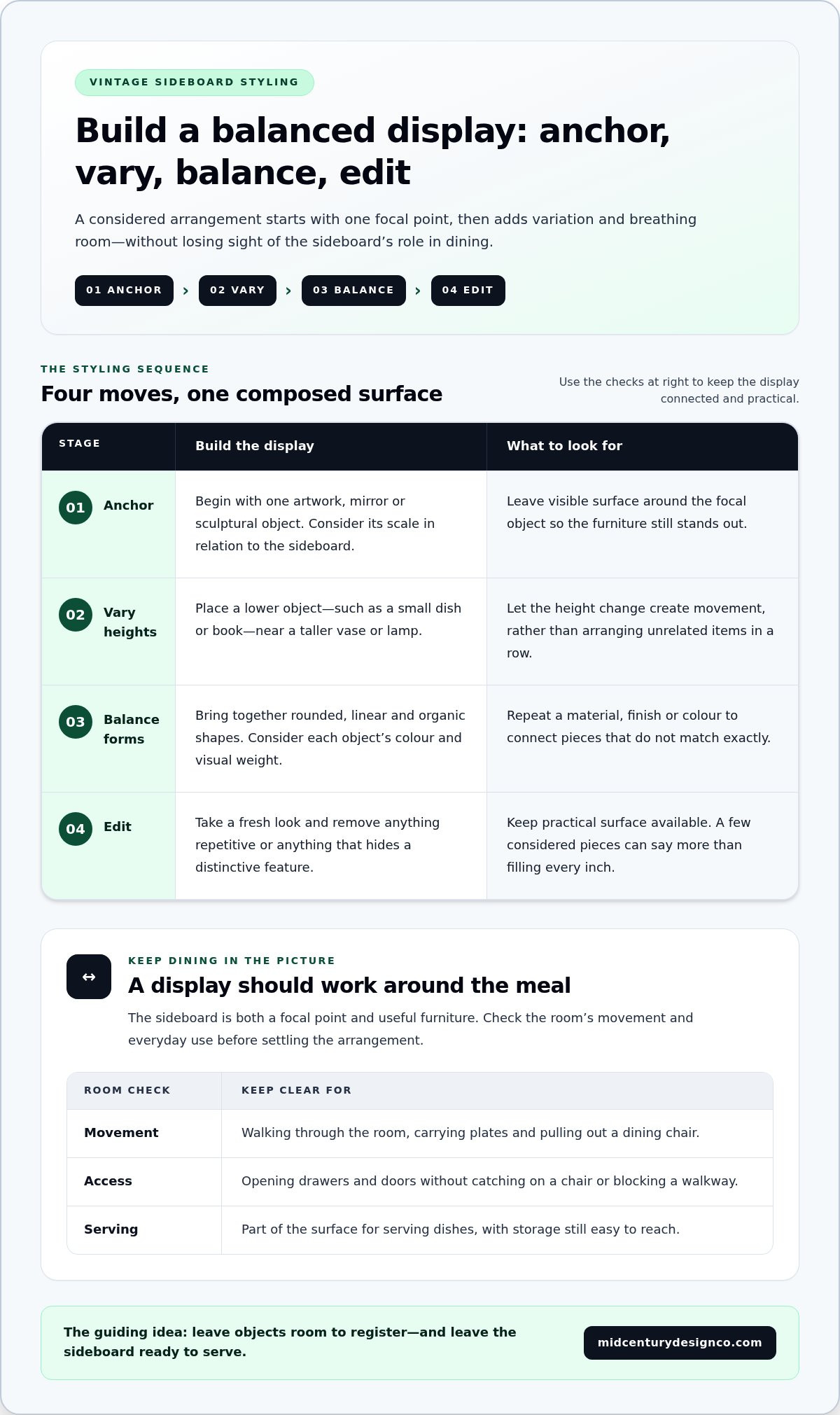
Picture carrying plates from the kitchen, pulling out a dining chair or opening a drawer to reach napkins. Can you move comfortably? Do doors and drawers open without catching on a chair or blocking a walkway? Leave enough clear space for these everyday movements, and keep part of the surface available for serving dishes. A beautiful arrangement is less successful if it makes the storage awkward to reach.
Let the sideboard’s character set the mood
Before adding anything, look closely at the piece. A long, low silhouette may feel calm and architectural; visible grain can bring warmth and movement; tapered legs, sculptural handles or a substantial base each contribute to its character. Consider its visual weight, too. A broad, dark piece will naturally command more attention than a lighter, more delicate design.
Let those details guide the atmosphere. Clean lines and restrained styling can honour a streamlined mid-century form, while a more decorative piece may suit a softer, more collected arrangement. You don’t need to recreate the period throughout the room. Simpler chairs, plain walls or a pared-back table can provide contrast, allowing the vintage furniture to stand out without making the room feel like a set. For more on recognising period details and craftsmanship, explore this authentic mid-century sideboard guide.
Think of the sideboard as your starting point, not a backdrop to cover. Once its position and character feel right, build a display that complements it while leaving some breathing room.
Build a balanced sideboard display with height, shape and space
A composed display doesn’t need a long list of ornaments. It needs a clear starting point, some variation and enough restraint for the sideboard to remain visible. For styling a vintage sideboard for dining room use, follow a simple sequence: anchor, vary the heights, balance the forms, then edit. It works whether your piece has a broad, low profile or a more upright presence.
Empty space gives objects room to register, separates their outlines and helps the whole display feel composed.
The sideboard has a long history as both practical dining furniture and a surface for display; A brief history of the sideboard offers useful context for this balance between purpose and presentation. Let that dual role guide your choices: the arrangement should feel considered, not crowded.
- Choose an anchor. Start with one artwork, mirror or sculptural object that gives the arrangement a focal point. Consider its scale in relation to the sideboard, and leave visible surface around it so the furniture still stands out.
- Add varied heights. Place a lower object, such as a small dish or book, near a taller vase or lamp. The change in height creates movement without making the display feel like a row of unrelated items.
- Balance the forms. Look for a relationship between rounded, linear and organic shapes, and consider each object’s colour and visual weight. A shared material, finish or colour can connect pieces that don’t match exactly.
- Edit with fresh eyes. Remove anything that feels repetitive, hides a distinctive feature of the sideboard or leaves no practical surface. A few considered pieces often say more than filling every inch.
Choose one focal object and layer around it
Let the anchor establish the mood, then build around it rather than competing with it. A mirror can bring light and reflection; artwork can introduce colour; a sculptural object can echo the furniture’s contours. Add a shorter piece and a taller one nearby, adjusting their positions until the group feels connected. Repeating a material or hue, perhaps in a frame and a ceramic vessel, creates cohesion without making the arrangement too uniform.
Use asymmetry without making the arrangement feel lopsided
Balance doesn’t require matching objects at either end. A substantial lamp on one side might sit comfortably beside a smaller cluster of books and a vase on the other, because the grouping has comparable visual weight. Mix curved and straight outlines, or pair a solid object with something visually lighter. Step back and look from the dining table and the room entrance. A display that works close up should also read clearly across the room.
Leave breathing room around the focal object and between groups. The display should complement the sideboard’s grain, handles and silhouette, not conceal them. If you’re considering a piece with distinctive proportions and character, browse the vintage sideboards to see how different forms might work in your room.
Choose objects and colour that complement a vintage sideboard
The right colours and materials can connect a sideboard to its dining room without requiring every object to match. Begin with the piece itself: note whether its wood looks golden, reddish, pale or deep, and whether its finish is visually quiet or richly figured. Then choose a palette that either harmonises with that character or creates a deliberate contrast. Styling a vintage sideboard for dining room life is less about following a strict formula than choosing details that feel at ease together.
These three approaches can help you choose a direction. Treat them as starting points, not rules:
| Desired effect | Suitable object qualities | Styling consideration |
|---|---|---|
| Warm and inviting | Cream or earthy-toned ceramics, natural linen, greenery | Repeat a warm note, but leave the wood visible. |
| Quiet and restrained | Simple shapes, soft neutrals, clear or lightly tinted glass | Use changes in texture to keep a subtle palette from feeling flat. |
| Distinctive contrast | A considered accent colour, reflective glass or a sculptural form | Choose one or two stronger notes so the display still feels connected. |
Work with teak, oak and other visible wood tones
Wood can look different depending on what surrounds it. A soft, warm wall colour or linen runner may bring out golden notes in teak, whilst a cooler, quieter background can make the grain appear more defined. The sideboard doesn’t need to match the dining table or chairs exactly. Nearby wood tones can sit comfortably together when their shapes, finishes or surrounding colours provide a link. Look at the room in daylight and after dark, as the same finish may appear different as the light changes.
Try colour samples and textiles in the room before settling on a palette. Hold them near the sideboard and view them from the dining table, rather than judging each shade in isolation. This helps you decide whether the wood should blend into its setting or become a more pronounced feature.
Mix decorative materials with a light touch
Use texture to add dimension. Smooth ceramics can sit beside the gleam of glass; a woven piece or folded linen can soften harder surfaces, while greenery introduces an organic outline. For styling ideas on bringing woven accents and botanical arrangements into dining spaces, tableterrain.com offers practical inspiration on elevating displays with organic texture. Choose each object for its shape, surface or personal meaning, not simply because it reflects a passing trend. One treasured vessel may say more than several accessories chosen only to fill space.
Keep the mix easy to read. If the sideboard has a strong grain, pair it with a few quieter surfaces; if its finish is more understated, a tactile ceramic or woven accent can add interest. The aim is contrast with cohesion. A repeated colour or material can tie unlike pieces together, while some variation keeps the arrangement from feeling overly matched.
Make sideboard styling work for serving and everyday dining
A sideboard should be ready for more than admiration. On an ordinary evening, it might hold napkins and glassware; when guests arrive, it can provide space for serving dishes or drinks. Style for both occasions by keeping decorative objects separate from the practical area you need at mealtimes. The display can feel intentional without turning the surface into an obstacle.
Keep the surface useful between meals
Decide which objects belong on the sideboard permanently and which come out only at mealtimes. Keep the display to one area, leaving a deliberate landing space beside it rather than placing objects edge to edge. If you regularly use table linen, coasters or serving pieces, store them in an accessible drawer or cupboard so they’re close at hand but out of sight.
Think about how the surface serves your usual routine. A clear patch can hold plates before dinner, a jug and glasses during a gathering, or a small drinks arrangement when friends visit. The useful area doesn’t need to take up the whole sideboard; it simply needs to be easy to reclaim without dismantling the display.
Adapt the display when hosting
Before serving, move delicate or decorative objects away from the landing area and place them somewhere stable, out of the way of guests and passing plates. If several small pieces need shifting, gather them on a tray where it suits the arrangement. This keeps the change orderly and gives you one manageable group to return to the sideboard afterwards.
A simple reset can become part of setting the table:
- Clear the space you’ll need for food, drinks or glassware.
- Move fragile ornaments to a safe, stable spot, grouping small pieces together if helpful.
- Bring serving items out from storage and arrange them where they’re easy to reach.
- After the meal, return dining essentials to their usual storage and restore the display.
This routine keeps the sideboard adaptable without requiring a new arrangement for every occasion. It makes styling a vintage sideboard for dining room use a practical choice, not just a decorative exercise.
The rest of the dining room can support the same easy rhythm. If you’re bringing together a vintage sideboard and a table setting, explore these ideas for retro dining tables and chairs as part of a coherent room. For a characterful piece that works between gatherings, explore vintage sideboards.
Finish the dining room with a vintage sideboard that feels personal
The final edit is less about adding one more object and more about seeing the whole room clearly. A sideboard can bring a quiet sense of history, but it should still feel at home beside the dining table and remain ready for everyday use. Check the display as a complete composition, from its visual balance to the space left for serving.
Before calling it finished, consider four things: can you see the sideboard’s shape and material; is there breathing room between objects; can you use the surface and storage easily; and does the piece feel connected to the table and chairs? These checks bring styling a vintage sideboard for dining room life back to its purpose: creating a focal point that belongs in the room, rather than a display that asks the room to revolve around it.
Edit the arrangement from across the room
Look at the sideboard from the dining table, then from the room’s main approach. The first view shows how it sits within the meal setting; the second reveals the impression it makes as you enter. If the objects compete with the furniture’s outline or hide a striking detail, remove one and look again. Check the balance with the table set, too, since plates, glasses and a centrepiece can change the room’s visual weight.
Keep the useful area visible, even when the table is laid. Space for a serving dish or jug helps the sideboard remain part of the meal, while accessible storage keeps everyday essentials close without putting everything on show. The display needn’t be perfectly symmetrical; it simply needs to feel settled from more than one viewpoint.
Make the display unmistakably yours
A personal touch gives the arrangement warmth. It might be a small piece collected on a meaningful journey, a family photograph or artwork that brings a favourite colour into the room. Give it space to be noticed rather than surrounding it with so many accessories that its significance disappears. The aim is a considered glimpse of the people who live here, not a shelf crowded with keepsakes.
Let the arrangement change as the room does. In one season, a simple branch or fresh greenery might feel right; at another time, you may want a treasured object to take its place. Keep the sideboard useful as routines shift, and don’t be afraid to return to a quieter display.
- Balance: Does the display feel visually settled?
- Breathing room: Can you still see the sideboard’s character?
- Use: Is there space to serve and storage within easy reach?
- Connection: Does the sideboard feel at ease with the dining table?
An authentic vintage sideboard brings individual character and a sense of history into everyday life, not only on special occasions. If you’re imagining how that might take shape in your dining room, explore vintage sideboards for inspiration, then let the piece you choose guide a room that feels useful, personal and quietly distinctive.
Let the room grow around a piece you love
A dining room doesn’t need to feel finished all at once. Let it evolve around the furniture and objects that make everyday meals more personal, and allow the sideboard’s character to become part of that story. The best approach to styling a vintage sideboard for dining room living is one you can adjust as your routines, tastes and table settings change.
If you’re considering a sideboard as the next defining piece in your room, look for one whose shape and presence feel right to you. The Mid Century Design Co. curates authentic vintage mid-century modern furniture, including sideboards and dining furniture, with individual character and history.
Explore our curated vintage sideboards and find a piece to help make your dining room feel more distinctly yours. Start with what speaks to you, then let the room take shape around it.
Frequently Asked Questions
What should I avoid putting on a vintage sideboard?
Avoid unstable, excessively heavy or easily spilled items that could create a hazard or distract from the furniture. For example, a tall, narrow ornament near the edge may be knocked by someone carrying a dish, while an open flame is unsuitable beside fabric or paper decorations. Keep food and drinks on serving ware rather than directly on the surface, and leave handles and doors unobstructed so the sideboard remains easy to use.
Can I put a lamp on a vintage dining-room sideboard?
Yes, a lamp can add a gentle pool of light and make the dining room feel welcoming after dark. Choose one that sits securely and looks in proportion to the sideboard, rather than hiding its most distinctive details. Before settling on a position, check that the cable can reach a socket without crossing a walkway, and that the lamp won’t interfere with opening doors or placing dishes for a meal.
How do I style a sideboard beneath a window?
Keep the window’s function in mind: leave curtains or blinds free to open, and avoid placing tall objects where they interrupt the view or block useful daylight. A low arrangement can work well beneath a sill, with a small group of objects kept to one side rather than spread across the full width. If the window is opened regularly, make sure the display can’t be caught by the window treatment or disturbed as you reach for the handle.
How often should I change my sideboard styling?
There’s no set schedule; change it whenever the arrangement stops feeling useful or you’d like a different mood. A small adjustment, such as swapping a framed print or moving a vase, can refresh the display without starting again. You might also reconsider it before hosting, after changing the room’s table linen, or when a new object has personal meaning. Keep the pieces you enjoy, and let the rest return to storage.
Can I mix modern accessories with a vintage sideboard?
Yes, a modern accessory can give a vintage sideboard a fresh, lived-in feel. Try a contemporary glass vessel beside a more sculptural vintage object, or pair a simple modern frame with the warmth of the wood. The contrast works best when there’s a point of connection, such as a shared colour, shape or material. Choose pieces that suit the room and your taste, rather than adding modern objects simply to follow a trend.
Should the dining table and sideboard be made from the same wood?
No, matching wood isn’t essential. A teak sideboard can sit comfortably with a table in another wood tone if the overall room feels considered. Look for a relationship in the grain, warmth or finish, then use a linking detail, such as a shared colour in the chairs or table linen. If you’re unsure, view the pieces together in the room’s natural and evening light before deciding whether the contrast feels harmonious.
How can I make a small dining room feel less cluttered around a sideboard?
Keep the floor and walking route clear first, especially around chair backs and the path to the door. Choose a focused display rather than several small clusters, and use the sideboard’s enclosed storage for items that don’t need to be seen. A mirror or artwork hung above the furniture can draw the eye upwards, whilst a restrained colour palette helps the room feel visually settled. Leave the surface easy to clear for serving.
Ready to find a characterful piece for your dining room? Explore our curated vintage sideboards.