

Teak vs Rosewood in Vintage Furniture: How to Choose
The darker, more dramatic piece isn’t automatically the better choice. In teak vs rosewood in vintage furniture, the right decision comes from looking beyond colour to the grain, construction and condition of the whole piece. Teak often has a warm, quietly varied appearance; rosewood can show striking contrasts and pronounced grain. However, photographs and finishes can make both difficult to judge.
If a listing simply names a timber, it’s natural to wonder how certain that identification is, or whether the visible surface is solid wood, veneer or a later alteration. Those details matter as much as the wood’s character, especially when you’re choosing furniture to use every day.
This guide explains how to compare teak and rosewood using visible features without relying on colour alone. It also covers what to ask sellers and inspect before buying, so you can weigh each piece on its own merits and choose vintage furniture that feels at home in your room.
Key Takeaways
- For teak vs rosewood in vintage furniture, compare the individual piece’s appearance, condition and supporting evidence rather than assuming one timber is inherently superior.
- Rosewood can refer to several different woods, so a listing’s label may need clarification before you rely on it.
- Use colour and grain as clues, not proof. Maker information or documented provenance can offer stronger support for an identification.
- Ask for clear photographs of the top, edges, interior, back and any labels or marks to help assess the wood and spot possible veneer or alterations.
- Confirm the description, inspect the construction and condition, then choose the piece whose character and form suit your room.
Teak vs Rosewood in Vintage Furniture: What Is the Real Difference?
Choose the piece, not a supposed ranking of its timber. In teak vs rosewood in vintage furniture, appearance may draw you in, but the condition and evidence behind the seller’s description matter just as much. A well-made piece with a surface and form you love may suit your home better than a timber name that sounds more prestigious.
Teak usually refers to timber from Tectona grandis. Rosewood, by contrast, is a broad common name used for several different woods, often from the Dalbergia genus. The label alone doesn’t tell you exactly which species was used, or whether the visible surface is solid timber or veneer.
What does teak look like in vintage furniture?
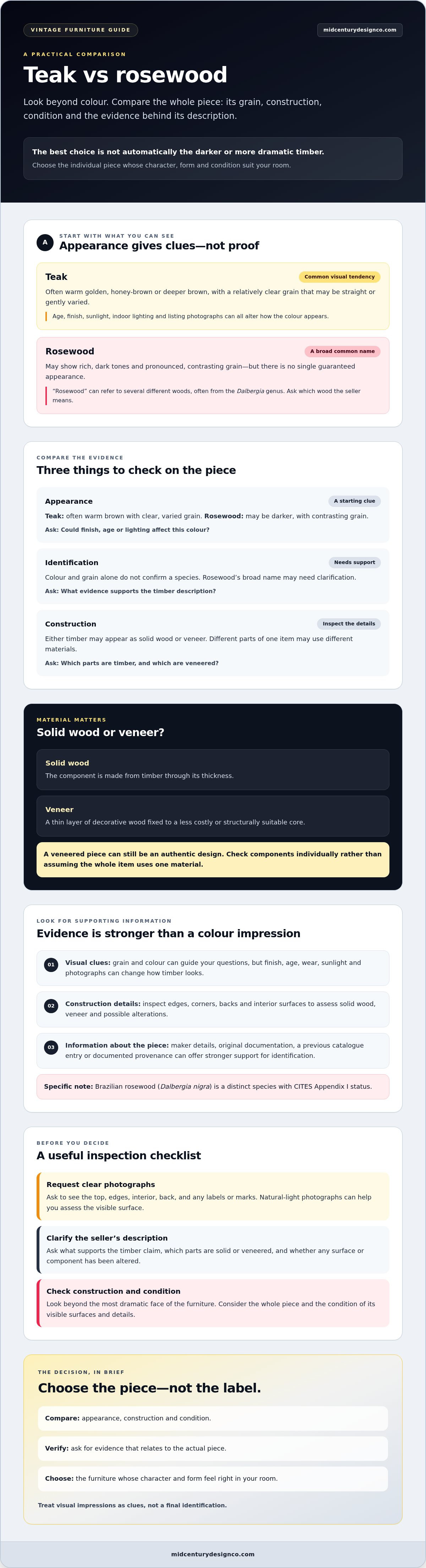
Teak is often associated with warm golden, honey-brown or deeper brown tones and a relatively clear grain, which may appear straight or gently varied. These are tendencies, not proof of species. Age and finish can deepen or alter the colour. Sunlight may change how a surface looks, while indoor lighting and listing photographs can shift its apparent warmth. A teak sideboard, for example, may look quite different in a room than it does in a bright photograph.
What does rosewood mean on a vintage furniture listing?
Rosewood has no single guaranteed appearance. Species, cut, finish and construction all influence the result, though some examples show rich, dark tones and pronounced, contrasting grain. Brazilian rosewood, Dalbergia nigra, is one distinct species with a CITES Appendix I status. If a listing identifies rosewood, ask what supports that description, such as maker information, original documentation or a previous catalogue entry.
Use visual impressions to guide your questions, not to settle the identification. Look at the whole piece and ask whether the seller can explain the material claim and distinguish solid wood from veneer.
| Consideration | Teak | Rosewood | Buyer question |
|---|---|---|---|
| Appearance | Often warm brown with a clear, varied grain | May be darker, with contrasting grain | Could the finish, age or lighting affect this colour? |
| Identification | Colour and grain aren’t conclusive | The name can refer to different woods | What evidence supports the timber description? |
| Construction | May appear as solid wood or veneer | May appear as solid wood or veneer | Which parts are timber, and which are veneered? |
These distinctions offer a starting point, not a verdict. Next, consider the visible clues alongside the piece’s construction and any supporting information.
How to Identify Teak and Rosewood Beyond Colour and Grain
A photograph can suggest what a piece is made from, but it can’t prove the species. In teak vs rosewood in vintage furniture, colour and grain are only starting clues. Finish, age, wear, lighting and image editing can all change how timber appears, so treat a convincing-looking surface as a reason to investigate, not a final answer.
Can you identify vintage wood from grain and colour alone?
No single feature confirms a wood species. Grain patterns can vary within the same type of timber, while darkened finishes or uneven exposure to sunlight may make a surface look unlike its original colour. Ask for photographs taken in natural light, then compare the visible surface with construction details and information the seller can provide. For background on teak’s physical properties, consult the Wood Database’s technical specifications for teak.
Stronger support may come from documentation that relates to the actual piece, such as a maker’s record, a previous catalogue description or documented provenance. A label can be useful, but check that it belongs to the furniture and supports the specific material claim. If the evidence is incomplete, a careful description would be “possibly teak” or “seller-described as rosewood”, rather than a firm identification based on an image alone.
How do veneer and solid wood affect identification?
Solid wood means the component is made from timber through its thickness. Veneer is a thin layer of decorative wood fixed to a less costly or structurally suitable core. Both can be found in vintage furniture, and a veneered piece can still be an authentic design. Different parts of one item may also use different materials: a cabinet could have a veneered front, solid edging and an interior made from another timber.
Look closely at edges, corners, backs and interior surfaces. A repeated grain pattern across a broad panel, a visible layer at a chipped edge or a change in material inside a drawer may help you understand the construction, but none is conclusive on its own. Ask the seller which parts are believed to be solid and which are veneered, then request close, clear photographs of details that aren’t visible.
For a broader sense of how original materials and construction appear across vintage designs, browse the curated vintage furniture collection. Use it as a comparison point, not proof of a particular piece’s species.
Teak vs Rosewood: Which Vintage Furniture Suits Your Home?
The best choice is the piece that belongs in your room and suits the way you’ll use it. In teak vs rosewood in vintage furniture, a timber’s reputation should come after the object’s actual colour, grain, form and condition. Two pieces described with the same wood name can have very different presence, depending on their design, finish and history.
Which wood works with your room and existing furniture?
Judge the individual piece in the light it will live in. A warm-toned surface may bring a sense of ease to a pale room, while a darker, more contrasting grain could become a focal point among quieter furnishings. Neither is a fixed rule: the balance depends on your palette, natural light and preferred atmosphere.
Consider the whole silhouette, too. A broad sideboard with a strong grain makes a different impression from a slender cabinet, even if both use similar timber. Compare the finish with nearby woods, flooring and textiles. If possible, view the furniture in person. If you’re buying from photographs, ask for images in natural light and avoid judging colour from a single edited image.
Is teak or rosewood automatically the better vintage buy?
No. The label doesn’t tell you whether a particular item is well made, in sound condition or right for daily use. For a dining table or frequently used storage piece, consider the state of the top, joints, doors and drawers, and whether the form suits its purpose. Visible wear can be part of a piece’s history, but check whether it affects function or is more than you’re comfortable living with.
Weigh the design, construction, condition and evidence for the material description together. If rosewood is named, ask what supports that identification and whether any relevant paperwork accompanies the piece. PBS offers background on Understanding Rosewood Regulations. Treat it as general context, and check current UK requirements if the wood’s identity has implications for a transaction.
To see how different forms and finishes might sit in your home, explore the current curated vintage furniture collection, without assuming a particular timber will be available.
What to Check Before Buying Teak or Rosewood Vintage Furniture
A careful enquiry can reveal as much as a listing photograph. Use this checklist to separate what’s visible, what the seller knows and what still needs confirming. In teak vs rosewood in vintage furniture, assess the wood description and the furniture’s condition as separate questions. Uncertainty about the species doesn’t automatically mean a piece is unsound, and a confident label doesn’t establish its condition.
- Request a complete set of photographs. Ask for clear images of the top, front, sides, edges, back and interior, plus close-ups of the grain, joins, areas of wear, labels and maker’s marks. For cabinets or drawers, ask to see the inside and any surfaces hidden during normal use.
- Clarify the material description. Ask what evidence supports the teak or rosewood identification. Is it based on maker information, a catalogue description, paperwork or visual assessment? If the seller isn’t certain, ask them to describe it that way rather than present a guess as fact.
- Ask about construction. Find out which parts are believed to be solid timber, which are veneered, and whether the piece combines different materials. Close views of edges and backs may help you assess this, though photographs alone can’t always settle it.
- Check condition and repairs. Ask directly about warping, lifting or damaged veneer, loose joints, sticking doors or drawers, and previous alterations. Request close-ups of affected areas and an explanation of known repairs.
- Ask about provenance and marks. If the seller mentions a maker, date or history, ask what supports that account and whether relevant documents are available. Treat labels and paperwork as useful clues to check, not automatic proof of every detail.
Judge the object, not just the timber
At a viewing, inspect the structure separately from the wood identification. Check whether the piece stands evenly, whether doors and drawers operate as expected, and whether joints or panels show movement or damage. Surface wear may be acceptable to you; instability or an alteration that affects how you’ll use the furniture may not be.
Notice how the seller handles uncertainty. A clear distinction between confirmed details and estimates gives you a more useful basis for deciding than an unsupported, definite-sounding label. If a listing makes claims about a protected species or legal status, don’t rely on the wording alone. Check current authoritative guidance for the specific wood and transaction.
Keep your notes and photographs together so you can compare candidates calmly, rather than being swayed by a striking finish or a prestigious-sounding name. For a considered starting point, browse the curated vintage furniture collection and apply the same questions to any piece that catches your eye.
Choosing an Authentic Vintage Piece: From Comparison to Confident Purchase
A confident choice comes from a clear sequence, not a snap judgement about timber. First, check how the seller describes the wood and what supports that description. Next, inspect the construction and visible details, then assess the condition independently. Only then weigh your preference for the piece’s colour, grain and character.
What if the wood species cannot be confirmed?
Uncertainty isn’t proof that a piece has been misdescribed or isn’t an authentic vintage design. It’s a reason to ask what the seller knows, request supporting information and check that the condition is clearly explained. If the species remains uncertain, consider whether you’d still want the furniture for its design, form and presence in your home. A transparent description that distinguishes confirmed details from an estimate gives you a sounder basis for deciding than a guess presented as fact.
That distinction matters in teak vs rosewood in vintage furniture: the material can shape your appreciation, but it isn’t the only measure of an object’s merit. Give particular care to claims about maker, date or provenance, and consider whether the available evidence relates to this specific piece.
How does the piece fit into a mid-century interior?
Look beyond the timber name to the furniture’s scale, silhouette and practical role. A sideboard needs to suit the wall and offer the storage you’ll use; a coffee table should sit comfortably within reach of the seating around it. The piece’s proportions and finish can help it feel at home in a room, whether it becomes a focal point or quietly complements other furniture.
Guides to authentic mid-century sideboards and buying vintage Danish coffee tables can offer further ideas for assessing these forms. Consider how each piece’s shape, scale and use might work in your own space.
Make your final choice by balancing honest material information, sound condition, original design and the character that appeals to you. The right piece doesn’t need a definitive wood label to earn a place in your home, provided you understand what is known and what remains uncertain. Browse the curated vintage furniture collection for inspiration, without assuming a particular timber is currently available.
Choose the Vintage Piece That Feels Right at Home
The clearest lesson from teak vs rosewood in vintage furniture is to look beyond the timber’s reputation. Colour and grain can guide your eye, but they can’t confirm a species on their own. Ask what evidence supports the description, check whether the piece is solid wood, veneer or a mix, and assess its construction and condition separately.
Then consider the whole object: its form, finish, practical use and the character it will bring to your room. A transparent description and a design you genuinely love can matter more than a definitive wood label.
The Mid Century Design Co. curates authentic vintage mid-century furniture, including Danish furniture and pieces across several categories. Browse the curated vintage furniture collection for inspiration, then take your time finding a piece that feels at home in your space.
Frequently Asked Questions
Is teak better than rosewood for vintage furniture?
No, neither is automatically better. In teak vs rosewood in vintage furniture, the stronger choice depends on the individual piece’s design, condition, confirmed material and your preferences. Consider its construction and any available provenance alongside the seller’s description and visible appearance. A well-suited design in sound condition may be a better fit for your home than a piece chosen simply because its wood is thought to be more prestigious.
Can you tell teak from rosewood by colour alone?
No, colour alone can’t reliably confirm a wood species. Finish, age, lighting and photography can all affect how a surface appears, and rosewood is a common name for more than one wood. Grain and construction can offer clues, but they aren’t conclusive tests. If you’re viewing a listing online, ask for clear photographs and supporting details, such as maker information or provenance, rather than making a firm identification from an image.
What does rosewood mean in vintage furniture?
Rosewood is a common name used for several different woods, not one definitive species or appearance. The exact meaning of a listing’s description depends on what the seller knows about the piece and what evidence is available. Ask whether the identification comes from maker information, documentation or visual assessment. Don’t assume that a dark colour or dramatic grain pattern confirms rosewood; those features can prompt a question, but they aren’t proof.
Is vintage teak furniture usually solid wood?
Not necessarily. A vintage piece may use solid timber, veneer or a combination, and different components can be constructed differently. Veneer is a thin layer of decorative wood attached to a core; its presence doesn’t automatically mean the furniture is a reproduction or poorly made. Check the edges, back and interior where visible, and ask the seller which parts are believed to be solid and which are veneered.
How can I check whether a vintage furniture listing describes the wood accurately?
Compare the listing’s description with close-up photographs, visible construction, labels or marks, and any available provenance. Ask the seller how the material was identified and whether the piece includes veneer, solid timber or mixed construction. Treat colour and grain as clues rather than confirmation. Clear, consistent answers about the wood, condition and any alterations help you judge what’s known and what remains uncertain.
Which is easier to match with a mid-century interior, teak or rosewood?
Neither is universally easier to match, since colour and grain vary between individual pieces, finishes and photographs. Compare the actual furniture with your room’s light, palette and existing materials. Consider its silhouette and scale as well as its timber: a piece’s shape can influence the room just as much as its surface. Choose the candidate that feels balanced in your home, rather than following a fixed design rule.
Should I avoid buying vintage furniture if the wood species is uncertain?
No, uncertainty alone doesn’t make a piece unsuitable, but you should understand which details are confirmed. Ask about construction, condition, repairs and provenance, then decide whether the design still appeals without a definitive species label. Consider whether the seller’s description is transparent and whether the piece suits your needs. An honest qualification is more useful than a confident claim without supporting evidence, and gives you a clearer basis for deciding.