

The Curated Lounge: A Guide to Authentic Mid Century Modern Living Room Furniture
The most beautiful living rooms aren't bought from a glossy catalogue; they're curated over time through a series of meaningful, storied discoveries. You've likely felt the pull toward the clean lines and organic warmth of mid century modern living room furniture, only to be met with a sea of flat-pack replicas that feel hollow and disposable. It's a common frustration to seek the rich grain of authentic teak or the precision of Danish joinery, only to worry about overpaying for a piece that lacks the soul of a true original.
We believe that your home should be a sanctuary of functional art, not a collection of temporary fixtures. This guide will empower you to look past the surface and identify the hallmarks of genuine mid-century craftsmanship, ensuring your investment holds its value and character for a lifetime. We'll explore how to spot quality wood grains, understand the nuances of iconic design, and style your space with authentic pieces that grow more beautiful with every passing year.
Key Takeaways
- Learn how to distinguish authentic mid century modern living room furniture from mass-produced copies by recognising the specific eras and design philosophies that define the movement.
- Master the art of identifying high-quality wood grains, from the oil-rich warmth of teak to the striking patterns of rosewood found in genuine Danish pieces.
- Discover the functional elegance of the Staples Ladderax system and how its modular design offers a timeless solution for vertical storage in the modern British home.
- Adopt a slow living approach to curation, focusing on singular statement pieces like a vintage coffee table to create a space with genuine soul and character.
- Understand why investing in original vintage furniture is a sustainable choice that offers superior longevity and value compared to modern flat-pack alternatives.
The Soul of the Space: Defining Authentic Mid Century Modern Living Room Furniture
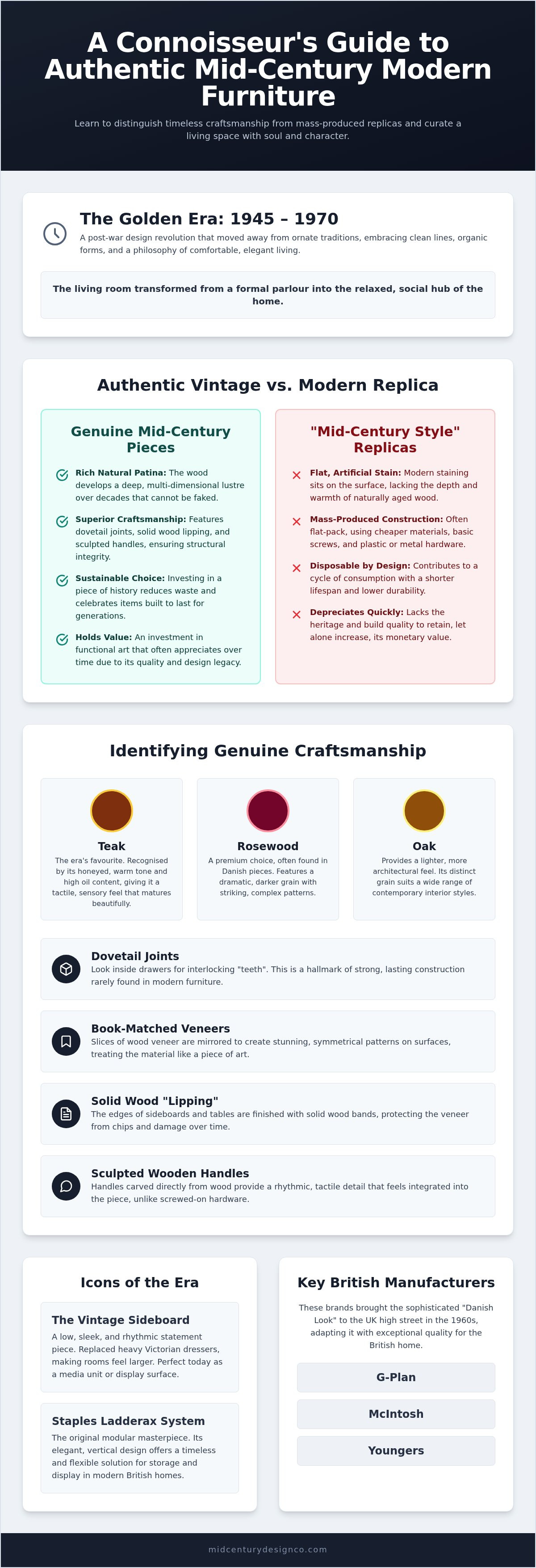
To understand Mid-century modern design is to appreciate a specific window of optimism between 1945 and 1970. During these decades, designers moved away from the heavy, ornate traditions of the past to embrace a future that felt light, airy, and profoundly human. The living room sat at the very centre of this revolution. It transitioned from a formal, stiff parlour into a relaxed hub for social connection and family life. When we discuss mid century modern living room furniture, we aren't just talking about chairs and tables; we're talking about a philosophy of living that prioritised comfort without sacrificing elegance.
You'll often see modern retailers use the term "mid-century style" to describe mass-produced pieces with tapered legs. These reproductions often lack the weight, texture, and history of authentic vintage items. An original piece carries the narrative of its era, showing the grain of wood that has matured over sixty years. Choosing original mid century modern living room furniture means investing in a legacy rather than a temporary trend. Ultimately, mid-century modern design represents a marriage of organic forms, industrial materials, and democratic design.
The Anchor of the Room: The Vintage Sideboard
In the contemporary UK home, the vintage sideboard has become the ultimate statement of intent. It replaced the towering, dark Victorian dressers that once dominated British dining rooms. These new credenzas were low, sleek, and crafted from warm teak. They offered a rhythmic horizontal line that made rooms feel larger and more grounded. Today, they serve as the perfect media unit, hiding away routers and cables whilst providing a tactile surface for a record player or a curated collection of ceramics.
Key Designers and the Golden Era of British Manufacture
The 1960s marked a golden age for British manufacturing as brands like G-Plan, McIntosh, and Youngers brought the sophisticated "Danish Look" to the UK high street. This wasn't merely a copy of Scandinavian trends; it was a high-quality adaptation that suited the British architectural scale. Craftsmen utilised solid wood and expert joinery that remains the benchmark for durability today. Unlike modern flat-pack alternatives, these pieces were built to be cherished for generations, surviving house moves and changing fashions with effortless grace. It is this marriage of utility and soul that makes the era so enduringly popular amongst collectors today.
Teak, Rosewood, and Rhythmic Lines: Identifying Genuine Craftsmanship
Authentic mid century modern living room furniture is defined by the materials that bring it to life. Teak was the undisputed favourite of the era. It possesses a high natural oil content that gives it a honeyed, sensory warmth. It isn't just a colour; it's a feeling under the fingertips. This timber doesn't just age. It matures, developing a deep, luminous patina that modern artificial staining simply cannot replicate. When you run your hand across a vintage surface, you're touching decades of history preserved in grain.
Whilst teak dominates the landscape, rosewood offers a more dramatic, darker grain often found in premium Danish pieces. Oak variants provide a lighter, more architectural feel that suits many contemporary homes. This era was a pinnacle for Modernism in design and architecture, where the material itself was celebrated as the primary decoration. To find the "soul" of a piece, you must look at the joinery. Solid wood "lipping" on the edges of sideboards ensures longevity, protecting the delicate veneer from the bumps of daily life. Book-matched veneers, where timber slices are mirrored to create symmetrical patterns, demonstrate a level of craftsmanship that treats furniture as functional art. Inside, you should find dove-tail joints in the drawers. These interlocking teeth are a hallmark of structural integrity. Sculpted wooden handles, often carved directly into the drawer fronts or door frames, provide a rhythmic, tactile detail that mass-produced plastic handles can never match.
The Art of the Wood Grain
A natural patina is a story told in wood. Unlike modern stains that sit flat on the surface, vintage patina is deep and multi-dimensional. Every growth ring is unique, shaped by the specific environment where the tree once stood. The tactile experience is equally vital. A hand-finished oiled surface feels organic and warm, whilst modern plastic lacquers feel cold and impersonal. If you're looking for these specific details, you can explore our latest collection of authentic Danish furniture to find a piece that resonates with your space.
Legs and Framework: The Floating Aesthetic
The iconic tapered leg is the unmistakable silhouette of the era. By lifting the bulk of the furniture off the ground, designers created a "floating" look that makes even the smallest UK living room feel airy and spacious. Identifying original solid wood frames is key. Whilst "hairpin" legs have their place in industrial styles, the sculpted wooden base of a 1960s credenza offers a more sophisticated, architectural weight. This design philosophy allows these substantial pieces to sit harmoniously amongst modern décor without overwhelming the room. It creates a sense of lightness that is essential for a curated, uncluttered home.
Modular Mastery: Staples Ladderax and the Art of Vertical Storage
If the sideboard is the anchor of the room, the Staples Ladderax system is its architectural soul. Designed by Robert Heal in 1964 for Staples of Cricklewood, this modular marvel redefined how we perceive mid century modern living room furniture in the United Kingdom. It moved away from the static, heavy bookcases of the past. Instead, it introduced a rhythmic, vertical language that allowed homeowners to build their own sanctuary. The genius of the "ladder" system lies in its simplicity. Steel or wooden uprights support a series of interchangeable components, allowing the furniture to grow and evolve alongside your life.
It was revolutionary for the modern British home. For the first time, storage could be tailored to specific needs, whether that meant a drop-down bureau for a hidden office nook or a deep cabinet for a television. This versatility makes it the perfect solution for contemporary living rooms that must serve multiple purposes. It transforms a blank wall into a textured, functional gallery that organises your life without cluttering your floor space.
Building Your System: Gold, Black, or White?
The character of your system often begins with the choice of uprights. Gold ladders offer a touch of mid-century glamour, whilst black provides a sharp, industrial contrast that highlights the sensory warmth of the teak shelves. White uprights create a minimalist, ethereal feel that blends into lighter walls. Mixing these with glass-fronted display units allows you to showcase cherished ceramics whilst keeping them protected. In the current UK market, original Ladderax components are highly sought after. They represent a sound investment, as their modular nature means you can always add or reconfigure pieces as your collection grows.
Installation and Flexibility
Modular shelving is the ultimate choice for those who love to re-organise their environment. The system relies on a clever arrangement of hooks and rails that slot into the ladders. This creates a secure, gravity-defying look that feels remarkably light. When styling your system, aim for a balance of weight and breathability. Place heavier cabinets at the base to ground the piece. Use the upper shelves for a curated mix of books, trailing greenery, and sculptural objects. This layering of textures ensures your mid century modern living room furniture feels lived-in and soulful rather than like a sterile showroom display.
Curating a Sanctuary: How to Style and Organise Your Vintage Treasures
Creating a home that feels both timeless and personal requires a departure from the showroom mentality. Instead of purchasing an entire suite of matching items, the most successful interiors embrace a "Slow Living" philosophy. This involves selecting a single, high-quality statement piece and allowing the rest of the room to evolve around it. When you choose authentic mid century modern living room furniture, you're introducing a strong personality into your home. The goal is to complement that character, not to overwhelm it with competing styles.
A common challenge in modern UK homes is balancing historical pieces with contemporary technology. A vintage sideboard provides the perfect organic counterpoint to the sleek, cold surface of a television. By placing a large piece of abstract contemporary art above the sideboard or flanking the screen with sculptural ceramics, you draw the eye away from the black mirror of the tech and back toward the sensory warmth of the wood. This mix of old and new creates a layered, lived-in feel that feels intentional rather than accidental. Earthy pops of colour, such as mustard yellows, burnt oranges, or moss greens, can be introduced through textiles to echo the vibrant spirit of the 1960s whilst keeping the palette grounded.
The Statement Coffee Table
Centring your living space often begins with the choice of a coffee table. A long, elegant "surfboard" teak table provides a sense of direction and flow, whilst a set of tiled nesting tables offers versatility for smaller gatherings. Position your table to encourage conversation, ensuring there is enough negative space around it to move freely. These pieces are more than just surfaces; they are functional sculptures. To protect the vintage finish from daily use, consider using felt-backed coasters or a light application of teak oil to maintain its lustre. You can browse our curated collection of coffee tables and occasional tables to find a piece that speaks to your aesthetic.
Lighting and Textiles
Lighting is the final, essential layer in curating your sanctuary. A well-placed floor lamp can cast a soft glow that highlights the rhythmic lines of a Danish sideboard or the intricate grain of a rosewood cabinet. Textiles play a similar role. A neutral, textured rug provides a soft foundation that allows the clean legs of your mid century modern living room furniture to stand out. Remember that space is as important as the objects themselves. By letting your furniture "breathe" and avoiding the temptation to fill every corner, you create a room that feels calm, curated, and profoundly soulful.
Investing in History: Why Original Vintage Surpasses Modern Reproductions
Time is the ultimate judge of quality. In an era of disposable, flat-pack solutions, choosing authentic mid century modern living room furniture is an act of rebellion against the temporary. When you bring a sixty-year-old chest of drawers into your home, you aren't just buying a storage solution; you're acquiring a piece of history that has already proven its endurance. These items were constructed during a period when materials were plentiful and craftsmanship was a point of pride. A piece that has survived six decades of family life is likely to survive another six, provided it is treated with the respect it deserves.
The sustainability factor is perhaps the most compelling reason to choose vintage. Buying original pieces is the most eco-friendly way to furnish a home, as it requires no new timber, no industrial manufacturing, and no carbon-heavy international shipping from modern factories. Beyond the environmental benefits, there is a clear financial logic. Whilst high-street reproductions depreciate the moment they enter your home, authentic mid-century pieces often appreciate in value. They are limited resources; they aren't making any more 1960s Danish teak sideboards. As an expert friend would advise, it's better to buy one exceptional piece every year than to fill a room with low-quality copies all at once. Building a collection takes patience, but the result is a home with genuine soul.
The Myth of the High-Street "Retro"
It is easy to be seduced by the "retro" labels found in modern catalogues, but the differences are profound. High-street copies often utilise paper-wrapped particle board or thin, artificial veneers that lack the depth and sensory warmth of real timber. Authentic mid century modern living room furniture uses high-quality wood veneers over solid frames, allowing the grain to wrap around edges seamlessly. You can spot a copy by looking for repeating grain patterns; nature never repeats itself so perfectly. An original piece carries a narrative, a slight patina of age, and a weight that modern mass-produced items simply cannot replicate. It's the difference between a photocopy and an original painting.
Your Journey with The Mid Century Design Co.
As passionate curators, rather than mere retailers, The Mid Century Design Co. understands that every sideboard or Ladderax system we source must have a spirit that resonates with a modern interior. We specialise in identifying the finest examples of the era, ensuring that every item in our national collection meets a benchmark of quality and historical significance. Choosing a specialist means you're supported by knowledge and a shared love for the era's design philosophy. We invite you to discover our latest curated collection of authentic vintage furniture and find the next chapter of your home's story.
A Legacy of Design Within Your Own Four Walls
Your journey toward a curated home is an invitation to slow down. It's about appreciating the artistry of a bygone era. By choosing authentic mid century modern living room furniture, you're doing more than just filling a room; you're preserving a narrative of quality and intentionality. We've explored how the rich grain of teak and the modular brilliance of Staples Ladderax systems can transform a space. These pieces don't just sit in a room. They ground it with a sense of history and enduring value that modern copies simply cannot mimic.
As specialists in original Danish and British vintage, we take pride in sourcing items that carry this unique spirit. We offer national UK delivery on all our investment-grade pieces to ensure your discovery arrives safely at your door. Browse our curated collection of authentic mid-century modern furniture and begin the rewarding process of building a home with soul. Your perfect living room is waiting to be discovered, one storied piece at a time.
Frequently Asked Questions
How can I tell if a mid-century sideboard is an original or a reproduction?
You can identify an original piece by examining the joinery and looking for manufacturer stamps or labels inside drawers. Authentic mid century modern living room furniture often features dovetail joints and high-quality wood veneers over solid frames. Modern reproductions typically use paper-wrapped particle board, which feels lighter and less substantial. The wood grain on an original item will be deep and unique, showing a natural patina that took decades to develop.
Is teak furniture difficult to maintain in a modern living room?
Teak is surprisingly easy to care for thanks to its high natural oil content. A simple application of high-quality teak oil once or twice a year is usually enough to maintain its sensory warmth and lustre. It's best to keep your furniture away from direct sunlight and radiators to prevent the timber from drying out. Using coasters and wiping up spills immediately will ensure the surface remains beautiful for years to come.
What is the difference between British and Danish mid-century modern furniture?
Danish furniture is typically more sculptural and organic, often utilising premium timbers like rosewood. British makers, such as G-Plan and McIntosh, adapted this "Danish Look" for the UK market, creating pieces that were robust and functional whilst maintaining sleek lines. Whilst Danish designs are often considered more artistic, British manufacturing from the 1960s is widely respected for its exceptional structural durability and timeless appeal in modern homes.
Why is Staples Ladderax so popular for living room storage?
The Staples Ladderax system is prized for its modular flexibility and vertical design. It allows you to create a bespoke storage solution that utilises wall height, which is essential for keeping British living rooms feeling spacious and uncluttered. Because the components are interchangeable, you can easily re-organise your shelves, bureaus, and cabinets as your needs change. It offers a rhythmic, architectural beauty that organises your life without overwhelming the floor space.
Can I mix different wood types, like teak and oak, in the same room?
Mixing wood types like teak and oak is a wonderful way to add texture and character to your home. This approach follows the "Slow Living" philosophy, where individual pieces are chosen for their soul rather than as part of a matching set. By ensuring your mid century modern living room furniture shares similar silhouettes or leg styles, you can create a harmonious space that feels curated and personal rather than a showroom replica.
How do I protect my vintage coffee table from heat and water marks?
Protecting your vintage coffee table requires a few simple, preventative habits. Always use felt-backed coasters and heat mats to shield the wood grain from moisture and high temperatures. If you do notice a faint water mark, a light buffing with fine wire wool followed by a fresh coat of teak oil can often work wonders. Regular oiling helps to build a protective barrier, ensuring the timber remains resilient against the demands of daily life.
Is original mid-century furniture a good financial investment?
Original mid-century furniture is a sound financial investment because it is a finite resource that often appreciates over time. Unlike mass-produced modern items that lose value immediately, authentic vintage pieces are increasingly sought after by collectors and interior designers. By investing in high-quality items with exceptional joinery and grain patterns, you're acquiring functional art that retains its value and offers far better longevity than any flat-pack alternative.
Do you deliver authentic vintage furniture across the UK?
We offer a dedicated national delivery service across the UK from our West Sussex gallery. Every piece of furniture is handled with the utmost care, ensuring that its historical narrative and physical condition are preserved during the journey. Whether you're in a city flat or a country cottage, we ensure your chosen treasures arrive safely and are placed exactly where you envision them within your sanctuary.