

Vintage Danish Sideboard Buying Guide: Investing in Mid Century Mastery
A vintage Danish sideboard is less a piece of furniture and more a functional sculpture. It anchors the narrative of an entire room. It's a sentiment many design enthusiasts share, yet the search for the perfect piece often comes with a shadow of doubt. You likely crave the warmth of honey-toned teak and the whisper of history that lives within authentic mid-century craftsmanship, but the fear of accidentally purchasing a modern reproduction is real. It's easy to feel lost amongst varying wood types and a sea of designer names you're told to memorise.
I understand that desire for a home that feels curated rather than just furnished. This guide will help you identify, evaluate, and style an authentic vintage Danish sideboard to bring timeless craftsmanship into your living space. We'll examine the hallmarks of quality joinery, decipher the legacy of iconic designers, and provide practical advice on placing these storied objects within a modern home. By the end, you'll have the confidence to invest in a piece of design history that appreciates in value and brings a soulful, lasting presence to your sanctuary.
Key Takeaways
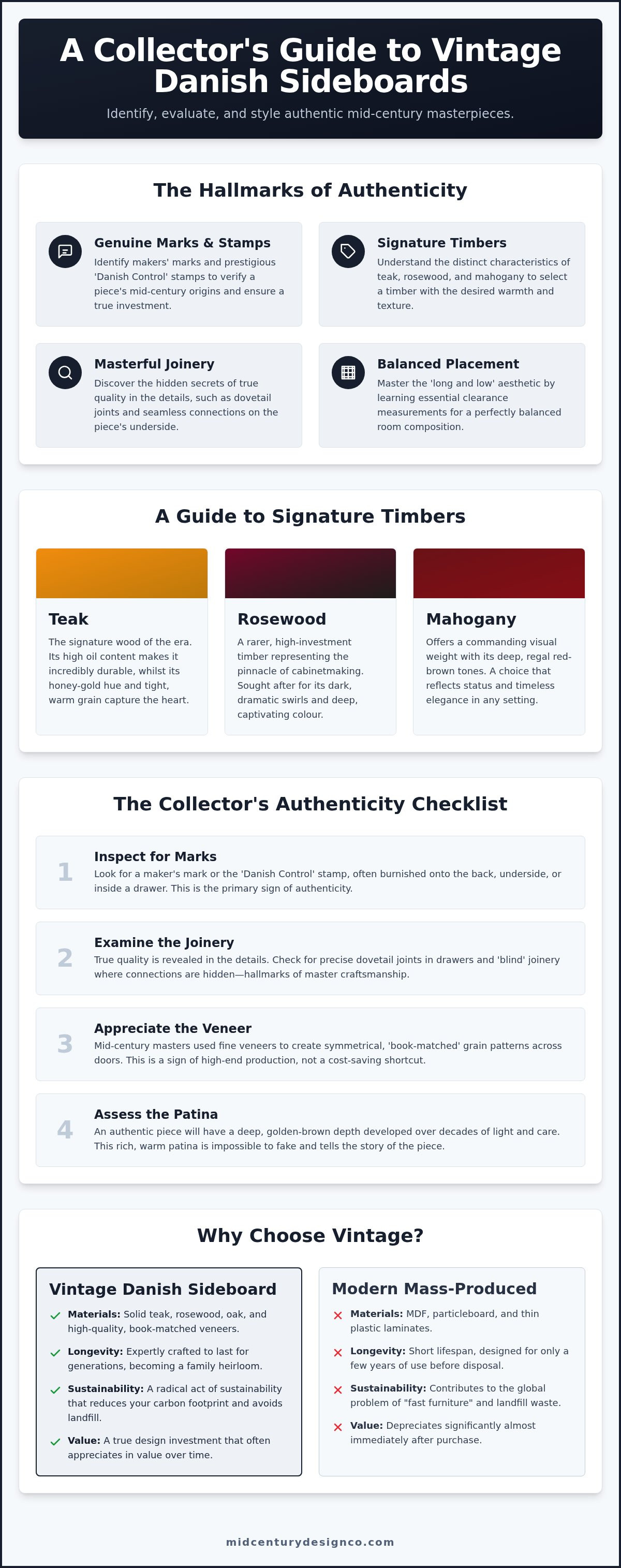
- Identify genuine makers' marks and the prestigious "Danish Control" stamps to ensure your investment is a true piece of mid-century history.
- Understand the distinct characteristics of teak, rosewood, and mahogany to select a timber that brings the desired warmth and texture to your space.
- Discover the secrets hidden on the underside of a vintage Danish sideboard that reveal the true quality and soul of its original joinery.
- Master the "long and low" aesthetic by learning the essential clearance measurements and placement tips for a perfectly balanced room.
- Learn how to pair your sideboard with the ideal dining suite to create a cohesive, curated environment that celebrates authentic design.
The Timeless Allure of a Vintage Danish Sideboard
Between the 1940s and the late 1960s, a quiet revolution in timber and form transformed the domestic landscape. This era, often celebrated as the "Golden Age" of design, birthed a philosophy where utility and beauty danced in perfect alignment. At the heart of this movement sits the vintage Danish sideboard. It's more than a cabinet. It's a foundational anchor that defines the rhythm of a mid-century interior. While other pieces might provide accents, the sideboard offers a vast, sweeping surface of grain and history, bridging the divide between practical storage and high-calibre fine art. It provides a sanctuary for your most cherished objects whilst standing as a masterpiece in its own right.
A Legacy of Functional Minimalism
The Danish Modern movement was born from a desire to honour the human experience. Designers like Hans Wegner and Borge Mogensen rejected the heavy, ornate clutter of the Victorian era. They favoured light, airy silhouettes that allowed a room to breathe. The philosophy was simple: form follows function. Every tapered leg and recessed handle had a purpose. There was no room for unnecessary decoration. By prioritising the grain of the wood and the precision of the joinery, these masters created pieces that felt organic and alive. Choosing an original piece means you're bringing that specific, intentional history into your home. It's an invitation to appreciate the subtle curves and the warmth of timber that has been carefully shaped by hand. These designers didn't just build furniture; they crafted a new way of living that prioritised clarity and calm.
Why Vintage is a Sustainable Choice
In a world increasingly weary of "fast furniture," investing in an authentic vintage Danish sideboard is a radical act of sustainability. Contemporary mass-produced items often rely on MDF and short-lived materials that inevitably end up in landfill within a few years. In contrast, a vintage piece was built to last for generations. The use of solid teak, oak, and high-quality veneers ensures a longevity that modern reproductions simply cannot match. By sourcing an existing historical piece, you're significantly reducing your carbon footprint and avoiding the environmental cost of new manufacturing. It's a key component of the "slow living" movement. It's about choosing quality over quantity and surrounding yourself with objects that possess a genuine soul. These pieces don't just occupy space; they tell a story of resilience and craftsmanship that only improves with age. They represent a commitment to a curated, thoughtful home environment where every object has earned its place through its history and its enduring beauty.
Understanding the Craftsmanship: Teak, Rosewood, and Mastery
To run your hand across a vintage Danish sideboard is to touch a legacy of tactile warmth. Teak became the signature wood of the mid-century era for a reason. Its high natural oil content makes it incredibly durable, but it's the honey-gold hue and tight grain that truly capture the heart. Whilst teak is the most recognisable choice, collectors often seek out the dark, dramatic swirls of Brazilian rosewood or the deep, regal tones of mahogany. These rarer timbers represent the high-water mark of furniture investment. They offer a visual weight that commands attention in any contemporary setting. Every piece tells a story through its timber choice, reflecting the status and intent of the original cabinetmaker.
There's a common misconception that veneer is a modern shortcut for quality. In the context of mid-century mastery, the opposite is true. Master craftsmen used fine veneers to create patterns that solid wood simply cannot achieve. By slicing thin layers of a single log, they could "book-match" the grain, creating symmetrical, mirror-image patterns across the doors of a sideboard. This level of precision is showcased in Designmuseum Danmark's 'Danish Modern' exhibition, where the focus is on how these techniques elevated furniture to functional art. Look for dovetail joints in the drawers and "blind" joinery where the connections are hidden from view. These are the silent signatures of a piece built to last for generations.
The Character of the Grain
The soul of a vintage piece lies in its patina. This golden-brown depth only develops over decades of light and care. You can't fake it. When evaluating a piece, consider the finish. An oil finish feels organic and textured, allowing you to feel the wood's spirit. A lacquer finish provides a more resilient, polished sheen. Both have their merits, but the tactile experience of oiled teak is often what draws people to the vintage Danish sideboard. If you feel ready to explore these textures firsthand, our curated collection of Danish furniture offers a tactile connection to this storied past.
Iconic Danish Designers to Look For
Names like Gunni Omann and Nils Jonsson represent the architectural peak of the era. Omann's work, particularly through Omann Jun, is defined by sharp precision and sculpted, organic handles that seem to grow directly from the wood. Nils Jonsson's "Trento" series for Hugo Troeds is equally revered. It's a masterclass in balance, featuring slender legs and perfectly proportioned sliding doors. These designers didn't just create storage. They sculpted silhouettes that remain as relevant today as they were in 1960. They prioritized the human experience, ensuring every drawer slide and door hinge moved with effortless grace.
The Collector’s Checklist: Identifying Authenticity and Quality
Identifying an authentic vintage Danish sideboard requires a discerning eye and a willingness to look beyond the surface. It's a tactile investigation. Start with the weight. Authentic pieces from the 1950s and 60s feel remarkably substantial. This isn't just about bulk. It's the result of high-density teak and solid timber internal frames. If a piece feels suspiciously light, it's likely a modern reproduction using hollow-core materials. You should also examine the hardware with care. Original brass hinges possess a soft, aged lustre, whilst sculpted wooden pulls should feel seamlessly integrated into the door's silhouette. Magnetic catches on authentic pieces are often encased in plastic that has aged to a creamy yellow, a small but significant detail that points to its historical narrative.
Don't forget to look underneath. The underside of a sideboard reveals the hidden truth of its construction. You should see solid wood supports and perhaps the remnants of an original paper label. If the underside is finished in a cheap, white laminate or rough-hewn plywood, it's a clear warning sign. Authentic Danish pieces were treated with respect, even in the places you weren't meant to see. This commitment to quality ensures the piece remains a functional part of your home for decades.
Makers Marks and Labels
Look inside the top drawer or on the rear panel for a heat-stamped logo. The most coveted mark is the "Danish Furniture Makers’ Quality Control" seal, a circular or triangular stamp that guaranteed a specific standard of excellence. According to The Journal of Antiques and Collectibles' guide to Danish Modern, these marks were essential for pieces destined for export. However, don't dismiss a piece simply because it's unmarked. Some of the finest cabinetmakers worked in small workshops and didn't always label their creations. In these cases, the quality of the joinery and the "book-matched" grain we discussed earlier must speak for itself. A lack of a label isn't always a lack of heritage.
Assessing Condition and Restoration
A healthy patina is a badge of honour. It's a gentle, golden glow that only time can produce. You should distinguish this from actual damage, such as deep scratches or heavy water rings that have penetrated the veneer. Be particularly wary of "franken-furniture." This occurs when original legs have been replaced with modern, generic hairpins or mismatched tapered feet. The proportions of a vintage Danish sideboard are delicate. Any alteration to the base ruins the intended silhouette and devalues the piece. This is exactly why we avoid modern reproductions in favour of original mid century furniture pieces. Genuine items possess a structural integrity and a design language that replicas simply can't mimic. They carry the spirit of their era, offering a soulfulness that a factory-fresh copy can never replicate.
Sizing and Placement: Finding the Perfect Piece for Your Space
The physical presence of a vintage Danish sideboard is often what anchors a room, yet its success depends entirely on the dialogue it has with the surrounding space. It isn't merely about finding a wall long enough to accommodate the timber. You must consider the practical choreography of the room. A common mistake is neglecting the sweep of the doors or the extension of internal drawers. To ensure a comfortable flow, you need at least 60cm of clearance in front of the unit. This allows for easy access without disrupting the movement of people through the space, ensuring the piece remains a functional joy rather than a beautiful obstacle.
The "long and low" aesthetic is a hallmark of mid-century mastery. These pieces are designed to draw the eye horizontally, which creates an illusion of greater breadth in narrower British dining rooms. By keeping the silhouette below eye level, you allow the wall above to remain open and airy. This prevents a large piece of furniture from feeling overbearing. When integrating these rich teak or rosewood tones amongst contemporary furniture, don't feel pressured to match every timber. A vintage piece often works best when it stands as a soulful contrast to modern, neutral palettes. The warmth of aged wood provides a necessary counterpoint to the cool surfaces of glass or polished concrete.
Proportions and Room Flow
Choosing the right silhouette is a matter of architectural balance. A "tallboy" style sideboard offers significant storage in a compact footprint, making it ideal for smaller alcoves or hallways. However, a traditional low sideboard serves as an excellent zone divider in open-plan living. It can sit behind a sofa to create a physical boundary without blocking light or sightlines. Ensure the height of your sideboard complements your dining table; typically, they should be of a similar height to maintain a clean, continuous horizon across the room. This alignment creates a sense of calm and order that is central to the Danish design philosophy.
Styling the Surface
The vast surface of a sideboard is a canvas for personal expression. Follow the "rule of three" when arranging objects. Grouping vintage ceramics, glassware, or books in odd numbers creates a visual rhythm that feels intentional rather than cluttered. If you're using your piece as a media unit, the low profile is perfect for a modern television. It positions the screen at the ideal viewing height whilst the internal cabinets hide unsightly cables and technology. To complete the look, hang a large piece of art or a mirror approximately 20cm above the sideboard to ground the furniture within the room's vertical space. This creates a cohesive "vignette" that feels like a curated gallery display.
Finding a piece that fits your home's unique proportions is a journey of discovery. If you're ready to transform your living space, browse our latest arrivals of authentic Danish sideboards to find a storied piece that perfectly suits your environment.
Completing the Narrative: From Sideboards to the Perfect Dining Suite
The dining room is a theatre of social connection. If the vintage Danish sideboard is the stage, then the dining table is the leading actor. Together, they form the "power couple" of interior design, creating a narrative that extends beyond simple utility. A sideboard provides the quiet, elegant backdrop for the vibrant energy of a dinner party. It transitions the space from a mere storage area into a sanctuary for social gathering. When you invest in a piece of mid-century mastery, you're setting a standard for the rest of your home. It's essential that your dining table honours that same level of craftsmanship, ensuring that the room feels like a single, cohesive thought. You don't want a masterpiece of joinery sitting next to a table that lacks a similar soul.
Choosing between matching wood grains and intentional eclecticism is where your personal story begins. Some collectors prefer the serene uniformity of a matched teak suite. Others find beauty in the contrast between a dark rosewood sideboard and a lighter oak table. Both approaches are valid, provided there is a shared commitment to quality. The goal is to create a space that feels curated over time. It should look like a collection of discoveries rather than a showroom floor. It's about the soul of the objects and how they interact with the light and life of your home.
Creating a Cohesive Dining Space
Finding the right balance is an art. Whilst a teak vintage Danish sideboard often feels most at home next to a teak table, the key to success lies in the visual rhythm. Look for the repetition of tapered legs or the shared language of organic, sculpted curves. This continuity allows the eye to travel across the room without interruption. As your "expert friend" in this journey, I encourage you to look for pieces that share a spirit. A sideboard with architectural precision deserves a table that celebrates the same honesty of material and form. This alignment is what transforms a house into a sanctuary-like home, where every object reflects your appreciation for history and design.
Explore Our Curated Collection
Creating a soulful environment is a process of discovery. Once you've found the anchor for your room, the next step is to find its perfect partner. We invite you to explore our latest acquisitions, each hand-selected for its character and historical weight. Our selection of tables is curated to complement the icons of the 1950s and 60s, ensuring your dining suite feels balanced and intentional. Whether you seek a grand extending table for large gatherings or a more intimate circular design, our collection is built on the same principles of longevity and craftsmanship. Discover our full collection of vintage dining tables to complete your room and begin the next chapter of your home's narrative.
Begin Your Curated Design Journey
Investing in a vintage Danish sideboard is a commitment to a more intentional way of living. It's about choosing an object with a soul, a history, and a level of craftsmanship that modern replicas simply can't mirror. We've explored how to identify authentic hallmarks, from "Danish Control" stamps to the precision of book-matched veneers. We've also considered how these foundational pieces anchor a room's narrative, especially when paired with the right social setting. As specialists based in West Sussex, we focus exclusively on original mid-century icons. We believe in the longevity of authentic timber and the stories it carries.
Whether you're just beginning your collection or looking to complete a curated dining space, we're here to help. We offer national delivery across the UK, ensuring your discovery arrives safely at your door. Every piece in our gallery has been hand-selected for its character and enduring quality. Browse our hand-picked collection of vintage dining tables to find the perfect partner for your sideboard. Your home is a sanctuary that deserves pieces with a genuine heritage. We look forward to helping you find the next chapter in your design story.
Frequently Asked Questions
How can I tell if a Danish sideboard is authentic?
Look for specific makers' marks or the circular "Danish Control" stamp, which was a hallmark of quality for exported pieces. You should also examine the construction details; authentic items feature solid wood frames, substantial weight, and precision joinery such as dovetail joints in the drawers. If the underside reveals cheap laminate or the piece feels suspiciously light, it's likely a modern reproduction.
Is teak or rosewood better for a vintage sideboard?
Neither timber is inherently better, but they offer distinct aesthetic and investment profiles. Teak is the quintessential choice, beloved for its warm, honey-toned grain and natural durability. Rosewood is rarer and more dramatic, often featuring deep, dark swirls that command a higher price amongst collectors due to its scarcity and striking visual impact.
How do I maintain the finish on an original 1960s teak sideboard?
Replenish the wood's natural oils once or twice a year using a high-quality teak oil applied with a soft, lint-free cloth. You should avoid modern aerosol waxes or silicone-based sprays, as these can create a dull build-up over time. Keep your furniture away from direct radiators and harsh sunlight to prevent the timber from drying out or losing its rich colour.
What is the average size of a mid-century Danish sideboard?
Most pieces range from 150cm to 240cm in length, though "tallboy" versions offer more vertical storage for compact spaces. A standard vintage Danish sideboard usually stands between 70cm and 80cm high. It's vital to measure your room carefully, ensuring you have at least 60cm of clearance in front of the unit to allow doors and drawers to open fully.
Do vintage Danish sideboards hold their value over time?
Original pieces are widely regarded as appreciating assets because their supply is finite whilst global demand continues to grow. Unlike mass-produced modern furniture, an authentic vintage Danish sideboard by a noted designer or cabinetmaker often increases in value. They're seen as functional investments that bring both beauty and financial security to a curated home.
Can I use a vintage sideboard as a TV stand?
Their long, low profiles are perfectly suited for modern televisions, placing the screen at an ideal viewing height. The internal cabinets are excellent for concealing media devices and cables, allowing the furniture to remain the focal point of the room. Just ensure the weight of your screen is evenly distributed to protect the vintage veneer.
What is the difference between a British and a Danish mid-century sideboard?
Danish designs typically focus on more minimalist, organic silhouettes with recessed handles and very slender, tapered legs. British makers like G-Plan were heavily influenced by these styles but often used slightly heavier proportions or different construction methods. Danish craftsmanship is generally celebrated for its more refined, "blind" joinery and superior timber selection.
Should I buy a restored or an "original condition" vintage piece?
The choice hinges on whether you value a pristine finish or a storied patina. A professionally restored piece ensures the wood is protected and the mechanisms work perfectly, making it ready for immediate use. Original condition pieces appeal to those who love the "lived-in" character of history, though they may require more careful maintenance to preserve their spirit.