

Vintage Double Wardrobe with Internal Mirror: A Buyer's Guide
What if the wardrobe that looks perfect in a photograph is awkward to live with? A vintage double wardrobe with internal mirror can bring quiet character to a bedroom, but its appeal rests on more than handsome doors or an aged finish. The mirror needs to be secure and useful, the storage must suit your routine, and the proportions have to work in the room.
It’s easy to see why these pieces catch the eye: an original wardrobe offers practical storage and a sense of history that new furniture can’t quite reproduce. Yet photographs rarely reveal everything, from the depth of shelves to the condition of hinges and the clearance needed to open the doors.
This guide will help you assess the mirror, internal layout, signs of age and overall condition, then measure your bedroom and access route before choosing. You’ll learn to distinguish characterful wear from details that deserve closer attention, and consider how a distinctive vintage piece can sit comfortably within a modern interior.
Key Takeaways
- Consider what an internal mirror adds to a vintage double wardrobe and whether its position suits everyday use.
- Look beyond the reflection for signs of damage or looseness that photographs may not show clearly.
- Compare the internal storage and design details with your routine and bedroom style.
- Measure the wardrobe space, door swing and route into the room, including obstructions such as skirting boards.
- Explore how authentic vintage furniture can bring practical storage and a distinctive sense of history to an interior.
Why choose a vintage double wardrobe with an internal mirror?
A double wardrobe offers full-width storage, while an internal mirror adds a practical dressing surface without putting a reflective feature on the outside. The mirror is mounted on the inside of a door, so it comes into view when you open the wardrobe. This can be a useful balance of everyday function and visual calm.
Because it stays concealed when the doors are shut, an internal mirror won’t become another prominent feature on a wall or reflect light across the room all day. That can suit a bedroom where you want furniture, textiles and artwork to share the attention.
A built-in mirror turns the wardrobe door into a dressing space; a separate dressing mirror claims a place of its own in the room. The distinction is simple, but it can influence both daily use and how much visual space the furniture occupies.
What makes an internal mirror useful day to day?
Opening the wardrobe door brings the mirror into reach while you choose clothes. Its position matters: a mirror mounted too low, too high or at an awkward angle may be less useful, and the door’s swing affects how easily you can stand in front of it. Consider where the door can open and whether the mirror will face a comfortable spot rather than a wall or other obstruction.
A mirror can brighten a room, but it needn’t be visible all the time to be useful. Keeping it inside offers a more discreet option if you prefer a restful, less reflective bedroom. Think about your routine, too: a quick outfit check may call for a different position from a mirror used while getting dressed from head to toe.
Why does vintage character matter in a bedroom?
An original vintage wardrobe brings more than storage. Its materials, construction and signs of age can lend a room a sense of history, while variations in grain, colour or finish give the piece an individual presence. These details aren’t automatically flaws, although the wardrobe’s condition still deserves careful attention.
A double wardrobe is substantial, so it naturally becomes a focal point. Balance its presence with simpler bedding, lighting or surrounding furniture, allowing its form and craftsmanship to stand out without making the bedroom feel like a period display. For a related perspective on bringing vintage pieces into a lived-in home, How to Style Mid Century Modern Furniture: Debunking the Museum Myth explores how characterful design can feel welcoming rather than overly formal.
The history behind the furniture adds another layer to its appeal. The History of the Wardrobe traces how this familiar storage piece developed over time, offering context for appreciating an older example. A vintage double wardrobe with internal mirror can therefore serve two purposes: practical storage for daily life and a distinctive object with a past.
How to assess the mirror, doors and internal storage
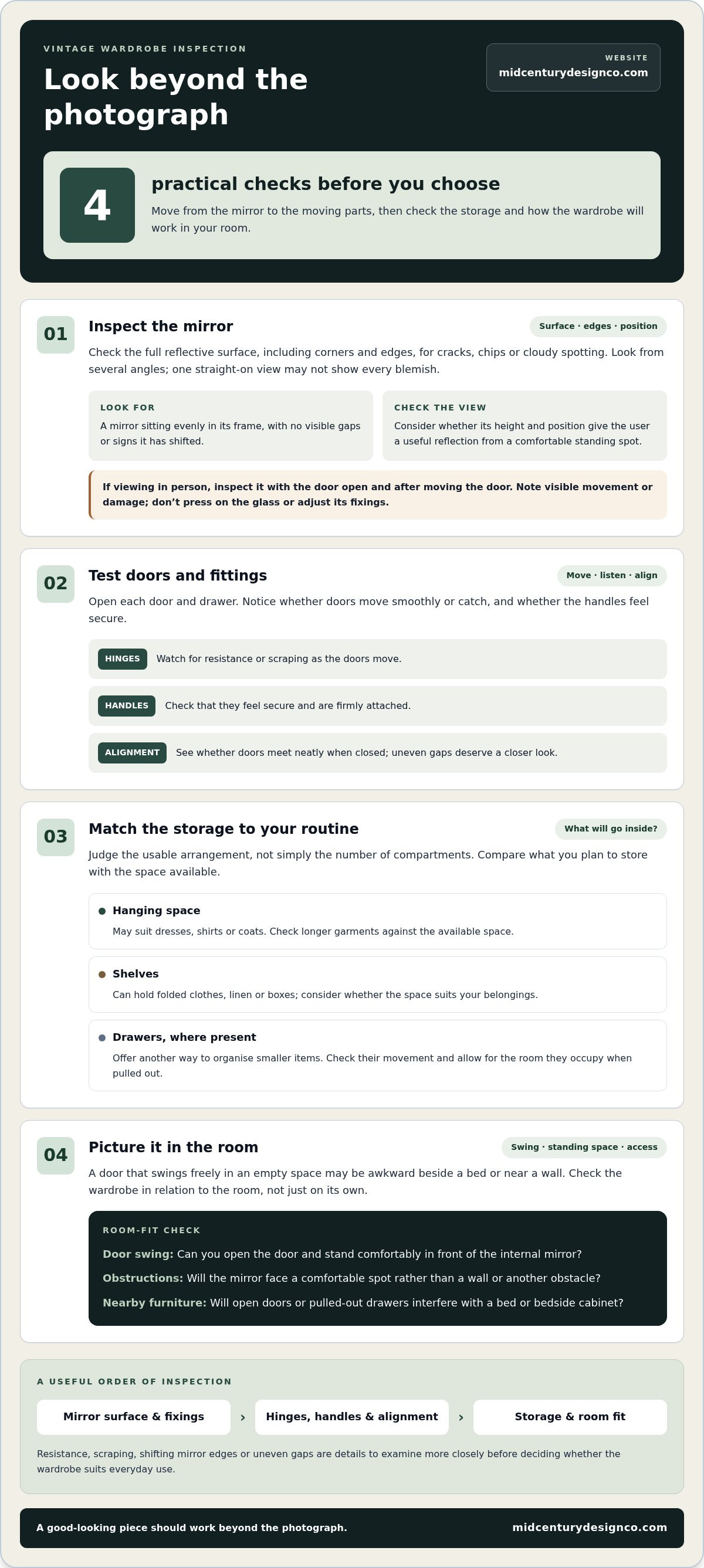
A wardrobe can look immaculate in a photograph and still have details that affect everyday use. Reflections may disguise marks, while the camera angle can hide a chipped corner or a door that sits out of line. Look beyond the overall impression: inspect the mirror and its fixings, test the moving parts, then consider whether the interior suits the way you store and organise belongings.
Inspect the mirror’s surface and fixings, test the hinges and handles, and check the door alignment before judging the storage. This sequence takes you from appearance to practical condition without overlooking details that can be hard to spot at first glance.
What should you look for in the internal mirror?
Examine the whole reflective surface, including the corners and edges, for cracks, chips or cloudy spotting. View it from several angles rather than relying on one straight-on photograph, since changes in light and reflection can conceal blemishes. Check whether the mirror sits evenly in its frame and look for visible gaps or signs that it has shifted. Its height and position should also work for the person who’ll use it.
If viewing in person, open the door fully and inspect the mirror before and after moving it. Don’t press on the glass or try to adjust its fixings. Instead, note any visible movement, gaps or damage, and consider whether the reflection gives a useful view from a comfortable standing position.
How can you judge whether the storage suits you?
Look at the usable arrangement, not just the number of compartments. Hanging space may suit dresses, shirts or coats, while shelves can hold folded clothes, linen or boxes. Drawers, where present, offer another way to organise smaller items. Compare the interior with what you plan to store, and check longer garments or bulky belongings against the space available.
Open each door and drawer to see how the wardrobe behaves in use. Notice whether the doors move smoothly or catch, whether they align when closed, and whether the handles feel secure. Resistance, scraping or uneven gaps merit a closer look. Allow for the space each open door and pulled-out drawer occupies, particularly if the wardrobe will sit near a bed or other furniture.
Consider door movement in relation to the room, not just the wardrobe itself. A door that swings freely in an empty space may be awkward to use beside a bedside cabinet or close to a wall. Check that the doors meet neatly when shut and that the handles are firmly attached. These observations help you decide whether the wardrobe will work in your daily routine, not simply look appealing in a listing.
For a considered starting point, explore curated authentic vintage wardrobes and compare each piece’s visible details with your storage needs.
Which vintage double wardrobe style and layout will suit your room?
Start with the room you want to create, not simply the wardrobe that makes the strongest first impression. Restrained mid-century forms often use balanced proportions, clean lines and materials with natural character. More decorative antique silhouettes, such as Victorian or Edwardian examples, may have elaborate outlines or ornamental details. These are distinct design languages, and a mirror inside a door doesn’t establish a wardrobe’s age or style.
Look at the whole piece: the shape of the doors, the proportions of the frame, the finish and the visible grain. Warm, clearly grained wood can bring depth and presence, while a lighter or more uniform finish may feel quieter against pale walls. The effect depends on the room around the wardrobe as much as the piece itself.
How do mid-century and more decorative wardrobes differ?
Mid-century design tends towards clarity of line, carefully judged proportions and materials that contribute visual interest without extensive ornament. More decorative antique forms can make a stronger formal statement through their silhouette and detailing. Individual pieces vary, so don’t assign a date or maker from appearance alone. Consider which character feels at home with your existing furniture, and whether you want the wardrobe to blend in or become a focal point.
| Style direction | Visual character | Room effect | Storage priorities |
|---|---|---|---|
| Restrained mid-century | Clean lines, balanced proportions and expressive material or grain | Can bring warmth and definition without relying on heavy ornament | Choose the interior according to your mix of hanging, shelving and drawer storage |
| More decorative antique | A pronounced silhouette and more ornamental detail | May read as a prominent, traditional focal point | Look past the exterior and assess the usable arrangement inside |
How should the wardrobe relate to the rest of the room?
Consider its visual weight beside the bed and bedside furniture, as well as the floor space left around it. A broad, dark-toned piece may feel imposing in a compact room, while a lighter finish can soften its presence. Repeating a wood tone elsewhere creates continuity; contrasting tones can give the wardrobe definition. Either approach works best when it feels deliberate.
Think in terms of a shared design language rather than matching every item. The grain, lines or finish of a wardrobe might relate to a bedside cabinet, dressing table or chest of drawers without copying it exactly. The Mid Century Design Co.’s The Definitive Guide to Authentic Mid Century Modern Sideboards explores how vintage storage can share visual cues across different pieces, helping a bedroom feel collected rather than uniform.
Let the layout guide your choice, too. If you rely on long garments, hanging space may matter more than extra shelves. If folded clothing is central to your routine, the balance may be different. A vintage double wardrobe with internal mirror should make sense both as part of the room’s composition and as storage you can use comfortably every day.
How to measure and inspect a vintage double wardrobe before buying
A wardrobe needs to work in the room and make the journey into it. Measure both before choosing: an elegant piece can prove impractical if its doors cannot open fully or it won’t pass a narrow turn on the way upstairs.
Measure the wardrobe’s footprint, open-door clearance and entire access route. Fitting the room is only half the task.
Which measurements matter before choosing a wardrobe?
Use this sequence to compare the piece with your bedroom and the route to it:
- Measure the intended space. Record the available width, depth and height, including ceiling clearance. Check for sloping ceilings or other features that could obstruct the top of the wardrobe.
- Account for fixed details. Skirting boards can prevent a wardrobe from sitting flush against a wall. Include radiators, sockets, light switches and nearby furniture in your plan, and consider whether the wardrobe would block access to them.
- Allow for the doors to open. Check how much floor space both doors need to swing out and whether a bed, bedside cabinet or wall will get in the way. Include the space you need to stand in front of the wardrobe comfortably.
- Check the route into the room. Measure doorways and narrow openings, then consider hallways, stairs, landings and tight turns. A piece that fits the bedroom may still be difficult to manoeuvre through the house.
- Compare exterior and interior dimensions. Use the wardrobe’s overall height, width and depth to check its fit, then compare the usable interior with what you plan to store. External measurements alone don’t show how much hanging or shelf space is available.
Keep your measurements alongside the wardrobe’s listed dimensions so you can compare them directly. Don’t estimate size from a photograph taken at an angle; use the measurements and allow for the room’s actual clearances.
What should an in-person or photograph inspection cover?
Take a systematic look from top to bottom. Examine the frame and interior surfaces for visible damage, then inspect the mirror and its edges, hinges, handles and door alignment. Open the doors and drawers, where present, to see how they move and whether anything catches. In photographs, compare several views for signs of shifting, uneven gaps or damage, while remembering that reflections and camera angles can obscure detail.
Set your requirements before comparing pieces: write down the maximum external dimensions, the interior storage you need and any access constraints. Use that list to narrow your search instead of being guided by appearance alone. For a vintage double wardrobe with internal mirror that suits your room and routine, explore curated vintage furniture from The Mid Century Design Co.
Explore authentic vintage wardrobes with The Mid Century Design Co.
The right wardrobe brings several considerations together: a mirror in usable condition, an interior that supports your daily routine, a design that feels at home in the bedroom and dimensions that work in the space. With a vintage double wardrobe with internal mirror, appearance is only part of the decision. The piece should also be practical to open, organise and live with.
The Mid Century Design Co. is an independent UK specialist in curated, authentic vintage mid-century furniture, including wardrobes. The collection focuses on original vintage furniture, valued for its design and character. Each piece has its own history, so a thoughtful choice means considering both what draws you to it and how it will serve your home.
What to prioritise when choosing an original vintage piece
Keep your essential requirements clear as you compare wardrobes. Consider whether the mirror’s position and visible condition suit its intended use, whether the interior offers the right balance of hanging space and shelves, and whether the overall dimensions and door swing fit your room. Then weigh the piece’s visual character against the atmosphere you want to create.
Age can leave marks that contribute to a wardrobe’s individuality, such as gentle wear to a finish or variations in the grain. Look more closely at damage or movement that could affect practical use, including a loose-looking mirror, doors that don’t align or fittings that resist movement. The distinction isn’t simply between perfect and imperfect, but between character you appreciate and condition that compromises function.
Find a wardrobe with character and purpose
Original vintage furniture brings function and history together. The material, craftsmanship and details give a wardrobe individual presence, while its storage continues to serve an everyday purpose. A piece chosen with care can bring warmth to a bedroom without overwhelming it, sitting comfortably alongside contemporary furnishings, treasured objects and the routines of home.
Before deciding, return to the practical questions: can you use the mirror comfortably, does the storage suit what you own, and will the wardrobe fit both the room and the route into it? If the answers sit well alongside the design you’re drawn to, you’re closer to choosing a piece with purpose as well as character.
Explore the curated vintage furniture collection from The Mid Century Design Co. as you consider an original piece for your home. Take your measurements and priorities with you as you browse, and let condition, storage, design and room fit guide your choice.
Make space for a piece with a story
Picture the bedroom you want to wake up in. A vintage double wardrobe with internal mirror can become a quiet anchor in the room, bringing individuality without requiring every surrounding piece to belong to the same period. Consider the atmosphere you want to create, then look for an original that feels at ease within it.
The Mid Century Design Co. specialises in curated, authentic vintage mid-century furniture, including wardrobes and Danish furniture. Original pieces bring history into the home through their materials, forms and details, making them a thoughtful alternative to furniture chosen for appearance alone.
Explore the curated vintage furniture collection and imagine how an individual vintage piece might find its place in your bedroom. A clear sense of what you need can help you choose furniture that serves your home and continues to bring you pleasure.
Frequently Asked Questions
Can a wardrobe mirror be fitted inside a vintage wardrobe?
Some vintage wardrobes have an internal mirror, while others don’t; the arrangement depends on the individual piece. A mirror fixed to the inside of a door is part of the wardrobe’s design, unlike a separate mirror placed elsewhere in the room. For a vintage double wardrobe with internal mirror, study photographs of the open doors and interior details before deciding. Don’t assume a wardrobe without a mirror can be modified.
How do I measure a double wardrobe for my bedroom?
Measure the available width, height and depth, then check how skirting boards, nearby furniture and ceiling clearance affect the space. Mark the wardrobe’s footprint on the floor with removable tape to visualise its scale, and allow for both doors to open. Separately measure the route through the home, including doorways, hallways and stair turns. The bedroom measurements show where it will sit; access measurements show whether it can get there.
Will an internal mirror make a small bedroom look bigger?
An internal mirror can be useful without creating a broad reflective surface across the room, but it isn’t a guaranteed way to make a bedroom feel larger. Its effect depends on the mirror’s size and position, the light, and what appears in its reflection when the door is open. In a compact room, consider whether opening the wardrobe gives you a useful view or reflects a cluttered corner, and choose according to how you’ll use it.
What should I check for damage on a vintage wardrobe mirror?
Inspect the entire surface, including the corners and edges, for cracks, chips, spotting or other visible deterioration. Check whether the mirror appears secure in its frame, then notice whether the door hangs evenly as it moves. A listing photograph may hide marks through reflection or angle, so compare different views or inspect the wardrobe in person where possible. Age-related signs don’t automatically make a piece unusable, but damage deserves attention.
Can a vintage double wardrobe be moved through a narrow doorway?
It depends on the wardrobe’s dimensions, construction and route into the room. Measure the narrowest doorway, hallway section and stair turn, as well as ceiling clearance along the route, then compare these with the actual piece. A tight turn can be more limiting than a doorway’s width alone. Don’t assume the wardrobe can be dismantled; plan around its construction and access route before arranging its move.
How do I care for an internal mirror in a vintage wardrobe?
Use a soft cloth and gentle, non-abrasive cleaning, taking care around the mirror’s edges and frame. Don’t let cleaning liquid pool along the edges or run onto surrounding materials, which may respond differently from the glass. The frame and finish may need a more cautious approach than the reflective surface, so avoid vigorous rubbing and use methods suited to the materials. Regular, light care helps keep the mirror presentable.
Are vintage double wardrobes with mirrors always mid-century pieces?
No. Mirrored double wardrobes appear across different periods and design styles, including antique French, Victorian and Edwardian examples. An internal mirror alone doesn’t identify a wardrobe’s age or design movement. Consider its proportions, construction and decorative details together, and treat any proposed date as something that needs supporting evidence. This helps you appreciate the piece’s character without assigning it a specific period or maker based on one feature.