

Vintage Furniture vs Reproduction: The Soul of Authentic Mid-Century Design
What if the 'new' sideboard sitting in your digital basket is actually costing you more in the long run than a sixty-year-old Danish original? It's easy to feel tempted by the immediate glow of a modern reproduction. They look the part on a backlit screen, and the price often feels like a convenient shortcut to a certain aesthetic. Yet, the choice between vintage furniture vs reproduction is rarely about age alone; it's about the very soul of your home.
You've likely felt that nagging worry about the flimsy durability of 'fast furniture', or perhaps you're confused by why prices for seemingly similar teak chests vary so wildly across the UK market. We believe your living space should feel like a curated gallery of your life, not a flat-packed showroom floor. This article helps you discover why authentic mid-century pieces offer a depth of character, heirloom quality, and genuine investment value that modern copies simply cannot replicate. We'll explore the hallmarks of true craftsmanship and the quiet joy of owning a piece with a story, giving you the confidence to choose furniture that truly lasts a lifetime.
Key Takeaways
- Learn to distinguish between the enduring spirit of authentic mid-century pieces and the shallow mimicry of modern copies.
- Discover the tactile superiority of traditional joinery and solid teak veneers that ensure vintage items outlast the flimsy construction of "fast furniture".
- Understand the financial impact of vintage furniture vs reproduction choices, specifically how originals serve as circular economy assets while replicas lose significant value instantly.
- Master the art of identification by examining maker's marks from iconic brands like McIntosh and G-Plan or performing the essential "Underside Test".
- Explore how to curate a home that feels collected rather than merely furnished by choosing pieces with a documented history and a unique soul.
Defining the Divide: Vintage Furniture vs Reproduction
To understand the true weight of a piece, one must first look beyond the polished surface. The distinction between vintage furniture vs reproduction isn't merely a matter of age. It's a fundamental difference in intent. For the discerning homeowner, an original piece represents a moment in time captured through wood and joinery. It's a tangible link to a design philosophy that prioritised longevity over the fleeting convenience of mass production. Whilst a modern copy might mimic the silhouette, it often fails to capture the quiet authority of the original.
In the world of curated interiors, "vintage" specifically refers to the golden era of design spanning roughly 1950 to 1979. This period, famously known as Mid-century modern, was a time when furniture was treated as functional art. Designers like Ib Kofod-Larsen or Victor Wilkins weren't just creating seating or storage; they were reimagining how we live. Reproductions, by contrast, are modern attempts to bottle this lightning. They are typically manufactured in high volumes, often sacrificing the "slow furniture" ethos for a lower price point and immediate availability.
The 100-Year Rule vs the Vintage Reality
Traditionalists often cling to the rigid "100-year rule" to define an antique. However, mid-century pieces have become the "new antiques" for the modern British collector. They carry a specific, era-specific provenance that makes them highly desirable in the UK market. You don't need a century of history to appreciate the architectural lines of a Danish sideboard or the ingenious flexibility of a Staples Ladderax system. These pieces have already stood the test of time, proving their durability through decades of daily use. They are survivors of a disposable age, and their "vintage" status is a badge of honour that modern replicas simply haven't earned.
The Rise of the "Mid-Century Style" Replica
Step into any high-street furniture shop and you'll likely find "inspired" pieces. They have the tapered legs. They have the warm wood tones. Yet, a "style" is never a substitute for a story. These faux icons often lack the tactile weight and sensory warmth of an original teak chest or dining set. Choosing a replica might fill a gap in a room, but it rarely fills the soul of a home. There's a subtle aesthetic pitfall in the "catalogue look" of new furniture; it feels temporary. An original piece, with its unique grain patterns and slight, graceful patination, ensures your home feels like a personal sanctuary rather than a showroom floor.
The Craftsmanship Gap: Materials and Longevity
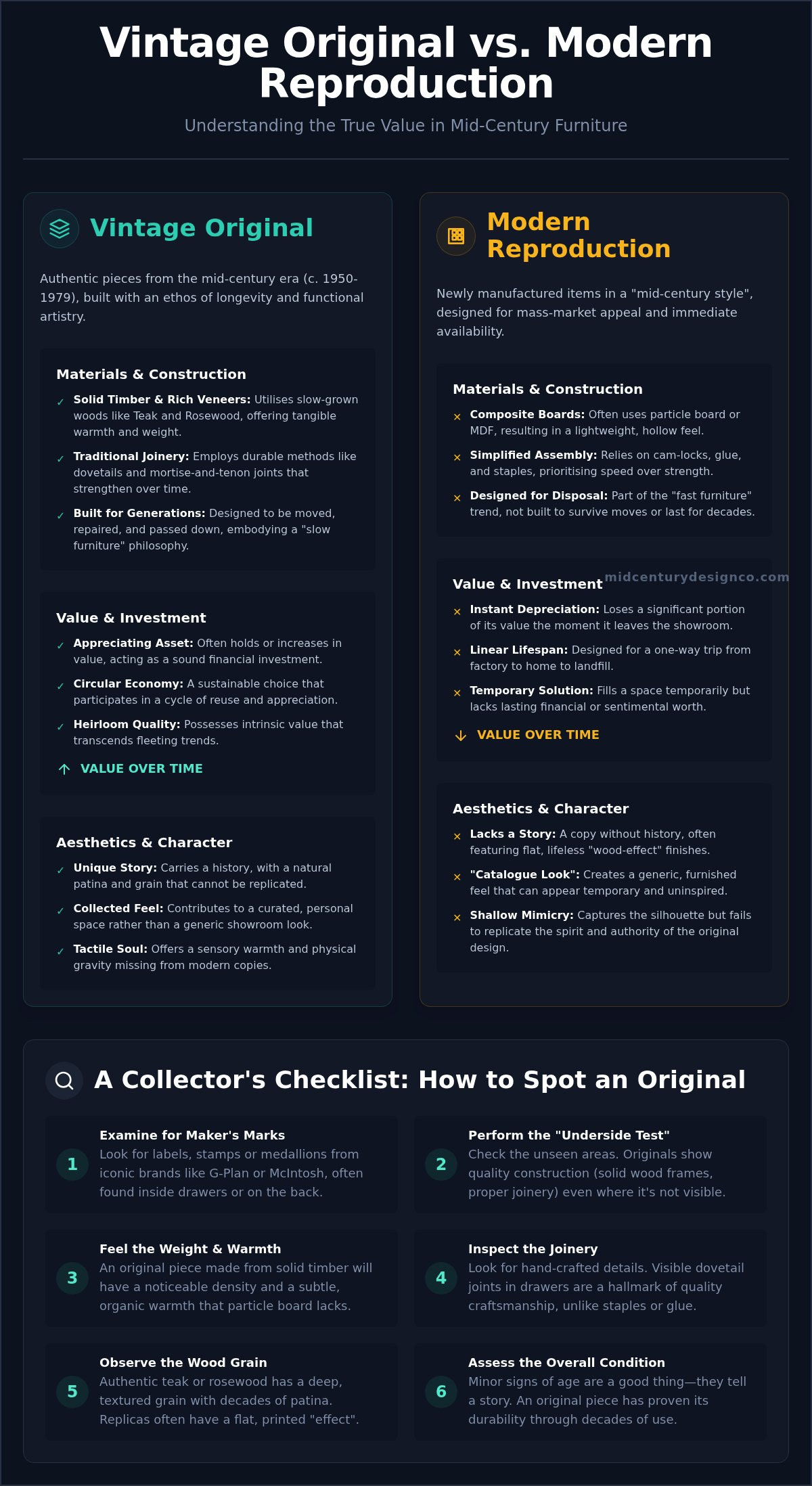
Touch the surface. You'll feel a temperature, a subtle, organic warmth that modern composite boards cannot replicate. When weighing up vintage furniture vs reproduction, the tactile experience is your first clue. A 1960s sideboard possesses a physical gravity. It sits firmly on the floor, rooted by the density of slow-grown timber and substantial frames. Modern replicas often rely on lightweight particle board, which feels hollow and vibrates when a door is shut. This isn't just about luxury; it's about structural permanence.
The true divide lies hidden within the joints. Mid-century craftsmen utilised dovetails and mortise-and-tenon joinery to create bonds that actually strengthen as the wood breathes over time. Conversely, mass-produced reproductions frequently use cam-locks, glue, and staples. These are designed for the speed of the assembly line rather than the endurance of the home. Whilst a modern piece might struggle to survive a single house move, an original vintage chest of drawers was built to be dismantled, moved, and, if necessary, expertly repaired. It is furniture designed for generations, not for the landfill.
Teak, Rosewood, and the Grain of History
There is a visible depth of colour in aged tropical hardwoods that no modern stain can mimic. Authentic Danish furniture often showcases the rich, honeyed hues of teak or the dramatic, dark swirls of rosewood. These timbers have spent decades developing a natural patina. Modern "teak-effect" finishes often look flat and lifeless because they lack this history. They are merely a photograph of wood printed onto a substrate, whereas an original surface invites the hand to linger on its unique, textured grain.
Modular Mastery: The Staples Ladderax Example
The engineering precision of original 1960s modular systems remains unmatched. Take the Staples Ladderax system. Its structural integrity relies on the clever tension between steel uprights and solid wooden cabinets. Modern modular shelving often lacks this refined balance, feeling rickety when fully loaded. Authentic components offer a versatility that allows them to evolve amongst changing interiors without losing their poise. If you're ready to experience this quality firsthand, you might explore our curated selection of authentic sideboards and storage.
The Financials of Design: Investment vs Depreciation
The moment a modern reproduction crosses the threshold of your home, its financial story takes a sharp, downward turn. It's a phenomenon often called the "Zero Value" trap. In the comparison of vintage furniture vs reproduction, the numbers tell a stark tale. A high-street replica typically loses up to 70% of its retail value the second the delivery van pulls away. It is an expense, not an acquisition. By contrast, an original mid-century piece behaves more like a fine wine or a blue-chip stock. It is a circular economy asset that has already survived its initial period of depreciation decades ago.
Choosing original design means your capital isn't vanishing; it's being stored in teak, rosewood, and steel. Whilst "fast furniture" is destined for a short life followed by a trip to the local tip, authentic pieces continue to see rising demand across the UK market. This is particularly true for documented items. Current market data suggests that clear provenance can increase the value of a vintage piece by 15% to 40%. You aren't just buying a place to sit or a surface for your lamp. You're participating in a heritage market that rewards quality and history.
Value Retention of Mid-Century Icons
A vintage teak sideboard doesn't just hold its utility; it often appreciates whilst being used. Pieces from renowned British makers or iconic Danish designers have become "investment grade" furniture. They act as a hedge against the ephemeral nature of fast-fashion trends. The resale market for Staples Ladderax systems and Danish sideboards remains incredibly buoyant in the UK. If you decide to change your interior style in five years, you'll likely find that your authentic mid-century investment has maintained, or even increased, its worth. It's a rare joy to own something that pays you back in both daily beauty and long-term equity.
The Environmental Cost of the Replica
Sustainability is often discussed, but rarely practiced as effectively as it is through the purchase of vintage. The greenest furniture is, quite simply, the piece that has already been made. Modern reproductions often carry a heavy carbon footprint, involving global shipping routes and resource-heavy manufacturing processes. Many are built with a five-year lifespan in mind. Authentic vintage has already served for fifty years and is prepared for fifty more. By avoiding the landfill and choosing the 50-year lifecycle of an original, you're making the ultimate commitment to a slower, more intentional way of living.
How to Spot the Difference: A Collector’s Checklist
Identifying the authentic heart of a piece requires a detective's eye and a curator's touch. When you're weighing up vintage furniture vs reproduction, the smallest details often speak the loudest. Start with the maker's marks. Look for the iconic gold G-Plan stamp tucked inside a drawer or the elegant, paper McIntosh label. These aren't just logos; they're signatures of a specific manufacturing heritage. A modern replica might copy the silhouette, but it rarely dares to forge the history.
Don't be afraid to get low. The "Underside Test" is perhaps the most revealing step for any collector. Whilst the front of a chest of drawers might look convincing, the hidden parts tell the real story. Authentic mid-century pieces typically feature solid timber frames or high-grade plywood backs. In contrast, modern reproductions often hide thin, stapled hardboard or flimsy MDF where they think you won't look. The hardware provides another clue. Feel the weight of the handles. Original brass has a cool, substantial presence and a natural, uneven patination that artificial distressing simply cannot replicate.
The Evidence in the Grain
Authentic mid-century design celebrated the natural architecture of wood. Look for book-matched veneers, where the grain pattern is mirrored across cabinet doors to create a symmetrical, flowing visual. Modern digital-print wood effects often look flat and repetitive. They lack the iridescent quality of real teak or rosewood, which seems to change depth as you move around the room. An original surface responds to decades of British sunlight, developing a mellow, honeyed glow that no factory-applied finish can mimic.
Joinery and Construction Clues
Open the drawers and inspect the runners. You should see signs of honest use and evidence of hand-finished joinery. Authentic sideboards often feature solid wood lipping, which is a thick edge of timber that protects the veneer and allows for graceful ageing. Look closely at the fixings. Pieces from the early 1960s often utilised slotted screws rather than the ubiquitous cross-head screws found in modern flat-pack items. If you want to ensure your next acquisition is a genuine piece of history, you can view our authenticated collection of original Danish and British furniture.
Curating a Home with Soul: The Mid Century Design Co. Philosophy
A home is a living narrative. It's the physical manifestation of your taste, your travels, and your values. At The Mid Century Design Co., we believe that this narrative is weakened by the inclusion of mimicry. This is why we hold a steadfast commitment to the debate of vintage furniture vs reproduction by exclusively curating original pieces. We don't just sell furniture; we facilitate a connection with the past. There is a profound, quiet joy in finding a piece with a documented history. It might be a McIntosh sideboard that once anchored a British dining room in 1964 or a Danish dining set that has witnessed decades of family celebrations. These stories are etched into the wood, providing a depth of character that a brand-new replica can never possess.
Creating a "collected" home is an intentional act. It's about moving away from the "decorated" look that feels like it was plucked entirely from a single season's catalogue. By mixing authentic vintage amongst contemporary décor, you create a space that feels layered and timeless. A sleek, modern sofa becomes far more interesting when paired with a textured coffee table or a versatile Staples Ladderax system. This contrast highlights the best of both worlds, allowing the historical weight of the vintage piece to ground the airiness of the modern. It's the difference between a house that looks like a showroom and a home that feels like a sanctuary.
Our Curation Process
Our selection process is rigorous and deeply personal. We look for more than just a recognisable name. We select pieces based on their visual impact and structural integrity, ensuring that each item is ready for another fifty years of service. Our focus remains on the icons of British and Danish design, from the sculptural elegance of teak sideboards to the modular brilliance of storage systems. We aim to preserve the "spirit" of the object. This means respecting its history whilst ensuring it meets the functional needs of a modern UK home. We act as the bridge between a forgotten workshop in 1950s Copenhagen and your personal living space.
Your Journey to Authenticity
Beginning a collection doesn't require an overnight transformation. It often starts with a single, resonant choice. Perhaps it's a statement sideboard to anchor your living room or a set of dining chairs that invite long, lingering conversations. There is a lasting satisfaction in owning a piece of design history. It's the knowledge that you've chosen quality over convenience and soul over a silhouette. If you're ready to move beyond the temporary and embrace the enduring, we invite you to explore our latest collection of authentic vintage furniture. Your home deserves a story worth telling.
Investing in a Legacy of Design
Choosing between vintage furniture vs reproduction is ultimately a decision about what kind of legacy you want to build within your four walls. You've seen how the tactile warmth of solid teak and the structural integrity of traditional joinery create a piece that lasts for generations. Beyond the physical, original mid-century items serve as a hedge against the disposable nature of modern retail, offering a circular economy asset that retains its financial and aesthetic worth. It's about more than just filling a room; it's about curating a sanctuary that reflects a deep appreciation for history and craftsmanship.
As specialists in authentic Staples Ladderax systems and original-only inventory, we're here to help you find that perfect, character-filled piece. We offer nationwide UK delivery on our curated selection of Danish and British furniture, ensuring your next acquisition arrives with its soul intact. You can view our curated gallery of authentic mid-century furniture to discover items that have been expertly selected for their unique spirit and enduring quality.
Your home is the most important gallery you'll ever curate. Take your time, trust your eye for quality, and enjoy the discovery of a piece that truly speaks to you.
Frequently Asked Questions
Is vintage furniture always better quality than new furniture?
Vintage mid-century pieces typically offer superior structural integrity because they were built using slow furniture principles. Unlike modern high-street reproductions that rely on composite boards and glue, originals feature solid wood lipping and traditional joinery. These methods ensure a lifespan of decades rather than years. Whilst exceptionally high-end modern bespoke furniture exists, the average vintage piece will significantly outlast most contemporary equivalents found in retail showrooms today.
How can I tell if my mid-century sideboard is an original or a reproduction?
Identifying the difference in the vintage furniture vs reproduction debate often begins with maker's marks or paper labels from iconic brands like G-Plan or McIntosh. You should also perform an "Underside Test" to check for solid timber frames and plywood rather than modern stapled hardboard. Look for evidence of hand-finished joinery and original brass hardware. Modern copies often feel lighter and lack the tactile depth of aged, book-matched teak veneers.
Why is authentic Danish furniture more expensive than British vintage?
Danish furniture often commands a premium due to the exceptionally high standards of craftsmanship and the global prestige of its designers. Makers in Denmark pioneered the minimalist aesthetic using rare tropical hardwoods like rosewood and high-grade teak. Whilst British manufacturers adopted these styles, the original Danish pieces were often produced in smaller workshops with more intricate, hand-sculpted details. This scarcity and historical significance keep their value high amongst international collectors.
Does a little damage or wear ruin the value of vintage furniture?
Minor surface wear often enhances the character and soul of a piece, serving as a testament to its long history. Collectors generally value an original finish with a natural patina over a piece that has been over-restored and lost its period feel. Whilst deep structural cracks or missing veneers can impact the price, gentle signs of use are expected. These nuances distinguish a lived-in heirloom from a sterile, factory-new reproduction.
Is Staples Ladderax still being made, or are they all vintage?
The original Staples Ladderax systems were manufactured by Staples of Cricklewood during the 1960s and 1970s and are now exclusively vintage items. Whilst modern modular shelving systems exist, they often lack the structural precision and material quality of the original steel uprights and solid teak cabinets. Authentic Ladderax components remain highly sought after in the UK because they offer a unique modular flexibility that modern copies struggle to replicate without feeling rickety.
Can I use vintage furniture in a high-traffic family home?
Authentic mid-century furniture is remarkably resilient and well-suited to the rigours of a busy family home. These pieces were originally designed for daily use using durable hardwoods and robust joinery techniques that have already survived fifty years. Unlike modern fast furniture that may wobble or break under pressure, a solid teak dining set or sideboard can handle the demands of modern life whilst only becoming more beautiful with age and use.
Is it worth buying vintage furniture as a financial investment?
Investing in original mid-century pieces is a sound financial decision because they act as circular economy assets. When considering vintage furniture vs reproduction, the financial divide is clear; new copies lose value instantly whilst originals often appreciate. Documented provenance from renowned designers can increase a piece's value by 15% to 40%. You're essentially storing your capital in a beautiful, functional asset that resists the depreciation of modern trends.