

An Expert Buying Guide to Vintage Danish Dining Chairs in the UK: Finding Soul and Substance
A chair is never just a place to sit; it's a silent witness to a thousand shared meals and quiet morning coffees. Why settle for a mass-produced replica that lacks history when you could own the authentic vintage Danish dining chairs UK collectors prize as functional sculpture? You likely appreciate the frustration of searching for furniture that feels substantial, only to find flimsy reproductions that fail to hold their value or their structural integrity. It's a common worry, especially when you're trying to distinguish between a genuine Niels Moller and a clever imitation.
This guide will empower you to source pieces that are both soulfully beautiful and structurally sound. We'll show you how to identify the hallmarks of mid-century craftsmanship, from the warmth of honey oak to the precision of hand-woven paper cord. You'll learn to navigate the nuances of wood grains and fire safety regulations, giving you the confidence to curate a dining space that feels personal, timeless, and deeply British. From evaluating wobbly joints to matching tones in your home, we've gathered the expertise you need to find furniture with true substance.
Key Takeaways
- Learn how to move beyond disposable furniture by investing in authentic mid-century pieces that offer both a unique historical narrative and lasting value.
- Master the subtle art of identifying vintage Danish dining chairs UK enthusiasts cherish, focusing on the tactile warmth of teak and the precision of Nordic silhouettes.
- Discover the essential "Wobble Test" and other expert inspection techniques to ensure the structural integrity and genuine joinery of your vintage finds.
- Gain the confidence to curate a characterful home by expertly balancing wood grains and mixing different chair styles for a sophisticated, eclectic aesthetic.
Beyond Utility: Why Vintage Danish Dining Chairs are a British Design Essential
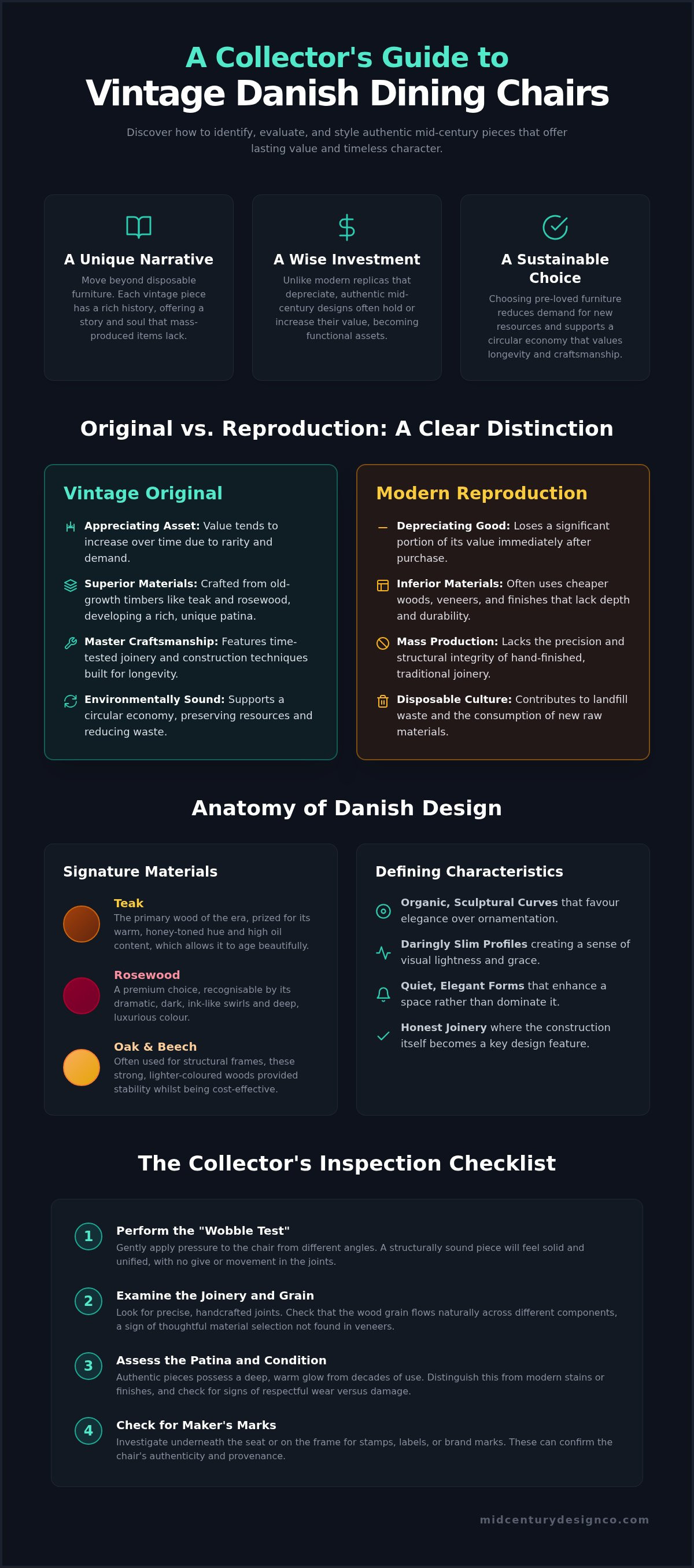
A home is a collection of stories. For many British homeowners, the shift away from the disposable culture of fast furniture has led to a deeper appreciation for objects that possess history and weight. Authentic vintage Danish dining chairs UK collectors seek out aren't just seating; they are the soul of the room. They represent a narrative of mid-century optimism and a commitment to quality that transcends seasonal trends. Whilst modern alternatives often feel hollow and temporary, a chair from the Danish modern era carries the tactile warmth of aged teak and rosewood. This patina, earned over decades of use, creates a sensory experience that no factory finish can replicate.
Original mid-century design remains the favourite choice for contemporary UK interiors because it balances minimalism with character. These chairs provide a visual lightness that suits modern apartments, yet they possess a structural honesty that feels grounded. They don't just occupy space; they enhance it with their organic silhouettes and expressive curves.
The Investment Value of Mid-Century Authenticity
Originality pays. Choosing original vintage pieces is a decision rooted in financial wisdom. Unlike modern reproductions, which depreciate the moment they are unboxed, genuine mid-century designs tend to hold or even increase their value over time. You're participating in a finite market. Because these pieces are no longer mass-produced, their rarity makes them a form of functional art. A set of chairs by a noted designer isn't just a purchase; it's an asset. You're investing in a piece of design history that retains its integrity and appeal for future generations.
A Sustainable Choice for the Modern UK Home
Preservation is the ultimate green choice. In an era where environmental impact is a primary concern, choosing pre-loved furniture is a meaningful act of conservation. Every vintage chair integrated into a home represents a victory for sustainability. These pieces were crafted using high-quality timber and superior joinery techniques that put modern flat-pack alternatives to shame. By opting for original craftsmanship, you're reducing the demand for new resources and celebrating the longevity of master-built furniture. Consider these benefits:
- Preservation of old-growth timbers that are no longer commercially available.
- Elimination of the carbon footprint associated with modern manufacturing and global shipping.
- Support for a circular economy that values longevity over planned obsolescence.
Ultimately, a dining room filled with authentic vintage design reflects a personal value system. It's a choice that prioritises quality, character, and the preservation of our shared design heritage. It creates a sanctuary that feels curated rather than merely furnished. To complement the organic textures of your furniture, adding contemporary wall art from WallscapeStudioArt can help tie the entire room together.
The Anatomy of Danish Design: Materials, Silhouettes, and Soul
Authentic design is a language of form and material. When sourcing vintage Danish dining chairs UK homes deserve, understanding the physical "anatomy" of these pieces is vital. Unlike the industrial rigidity often seen in mid-century American furniture, Danish design prioritises the organic. It's a philosophy where every curve serves a purpose. This era was defined by a rejection of the ornate in favour of a quiet, sculptural elegance that feels as fresh today as it did seventy years ago. Every joint and taper tells a story of intentionality.
There's a fascinating dialogue between Nordic and British makers. While Danish pieces often lean into extreme minimalism, British contemporaries like G-Plan or McIntosh adapted these lines into more robust forms for the UK market. Both share a commitment to craftsmanship, but the Danish "soul" often lies in its daringly slim profiles and sculptural joinery. It's this balance of strength and grace that makes these chairs so enduring. They possess a visual lightness that allows them to float within a room rather than dominate it.
Mastering Materials: Teak, Rosewood, and Oak
Teak was the undisputed protagonist of the mid-century era. Its high oil content and warm, honey-toned hue allowed it to age beautifully, developing a rich patina that modern veneers can't match. In premium pieces, you'll recognise the dramatic, ink-like swirls of vintage rosewood. It's a wood that commands attention. Interestingly, many designers used oak or beech for the hidden structural frames, reserving the more expensive teak for the visible "show" wood. This clever use of materials ensured both structural integrity and aesthetic perfection. Identifying authentic vintage Danish dining chairs UK wide requires looking for these honest material choices and varied grain patterns.
Iconic Silhouettes and Sculptural Forms
The "Organic Modern" movement defined this period. Chairs were designed to mirror the natural curves of the human body, resulting in silhouettes like the Spade Back or the elegant Ladder Back. Tapered "cigar" legs are another hallmark, providing a sense of visual lightness that makes even a large set feel unobtrusive. As highlighted by Designmuseum Danmark, this era was marked by a revolutionary approach to how we inhabit our homes. It was a shift towards furniture that felt human-centric. This sculptural quality creates a powerful synergy when you pair these seats with a retro dining table and chairs UK collectors often seek. If you're ready to find your own piece of history, you can browse our hand-picked collection of authentic chairs to find the perfect fit for your space.
The Collector’s Inspection: How to Evaluate Quality and Condition
Authenticity is felt as much as it is seen. When you're hunting for vintage Danish dining chairs UK wide, your hands are your most reliable tools. Begin your evaluation with the "Wobble Test". Place a hand on the backrest and apply gentle, alternating pressure. A slight movement might only suggest a need for professional regluing, but a significant lurch often signals failed joinery that has been neglected for years. You're looking for a piece that feels like a single, unified object rather than a collection of loose parts. A well-maintained chair should feel sturdy and resolute, ready for another half-century of service.
True mid-century craftsmanship relies on the mortise and tenon joint. These interlocking wooden elements provide strength without the need for unsightly modern screws or brackets. If you see metal plates or chunky screws holding a frame together, it’s a sign of a crude repair that compromises the chair's soul and value. Distinguish between the soft, golden glow of a well-oiled surface and the white, cloudy "blooming" caused by dampness. A healthy patina is a badge of honour; deep water rings are scars that require expert attention to rectify.
Structural Integrity and Joinery
Examine the stretchers with a keen eye. These horizontal bars between the legs are the unsung heroes of stability, and they should be seated firmly without visible gaps or dried glue residue. Flip the chair over to inspect the underside. This hidden space often reveals the chair's true heritage through the "Danish Control" stamp or the scorched mark of a specific factory. These marks of provenance are vital when validating the vintage Danish dining chairs UK collectors prize. Remember, a slightly aged patina with minor surface marks tells a story of use and is far more desirable than a thick, high-gloss refinish that smothers the natural grain and robs the wood of its character.
Upholstery and Seating Comfort
Vintage foam has a finite lifespan. If the seat feels crunchy or sags directly to the frame, the internal padding has likely perished over the decades. This isn't a deal-breaker, but it's a factor to consider in your overall investment. Look for original wool fabrics or the iconic Danish papercord. Papercord is remarkably resilient, but you should check for broken strands or heavy staining that might suggest a lack of care. For a British dinner party that lingers into the late hours, comfort is non-negotiable. The "sit" must match the aesthetic. An authentic chair should support the body with the same grace it brings to the room, ensuring your guests feel as good as the space looks.
If you're looking to supplement your vintage finds with high-quality contemporary pieces, Acacia Home offers a range of seating that can help you achieve a balanced and comfortable dining space.
Curating Your Space: Styling Vintage Chairs Amongst Contemporary Interiors
Styling is an act of translation. It's the process of taking historical objects and giving them a modern voice within your home. When you introduce vintage Danish dining chairs UK collectors have cherished for decades into a contemporary room, you aren't just adding furniture; you're creating a dialogue between eras. The secret to a successful interior lies in avoiding the "showroom" look. Your dining area should feel like a curated sanctuary, where every piece has a reason for being there. It's about finding harmony in the unexpected.
One of the most common concerns is balancing different wood grains. You don't need a perfectly matched set to achieve a sophisticated look. In fact, a slight variation in timber can add depth and character. If you're pairing your seating with a mid century modern sideboard, look for a shared undertone. A teak chair and a rosewood cabinet can coexist beautifully if they both possess that signature mid-century warmth. Use a large, textured rug to anchor the set, providing a neutral ground that allows the sculptural legs of the chairs to stand out without overwhelming the floor space.
Mixing and Matching with Confidence
The "Common Thread" rule is your most reliable tool for an eclectic mix. To make a mismatched set feel intentional, ensure the chairs share at least one trait: the same material, a similar seat height, or a consistent design era. This creates a rhythmic flow around the table. You might also consider the "Host Chair" approach, where the two chairs at the head and foot of the table are slightly more imposing or different in style. This adds a layer of formality and visual interest. It's a simple way to style mid century modern furniture naturally, making the space feel lived-in rather than staged.
Lighting and Proportions
Proportion is the silent partner of good design. In smaller UK dining rooms, the slim silhouettes of Danish chairs are a blessing. Their "see-through" quality prevents the room from feeling cluttered. However, you must consider the relationship between the chair and the table apron. Always measure the distance from the floor to the underside of the table to ensure there is ample legroom for your guests. Pair these low-slung forms with a bold pendant light hanging at the centre of the table. This creates a dramatic focal point that draws the eye upward, balancing the horizontal lines of the seating. If you're ready to start your curation, explore our range of authentic dining chairs to find your next statement piece.
Standout Selections: Discovering The Mid Century Design Co. Collection
A collection with soul. At The Mid Century Design Co., we believe that every piece of furniture should possess a narrative that resonates within the walls of your home. Our approach is that of a passionate curator rather than a high-volume retailer. We hand-pick each item, ensuring it meets our rigorous standards for craftsmanship and original condition. When you explore our selection of vintage Danish dining chairs UK collectors admire, you're discovering objects that bridge the gap between historical importance and modern utility. We prioritise pieces that have been sympathetically maintained, preserving the spirit of the mid-century era for the discerning British homeowner.
Our inventory is a celebration of both Nordic minimalism and robust British ingenuity. We focus heavily on authentic Danish teak and rosewood, alongside iconic UK makers who defined a generation of design. These aren't mere reproductions; they are the genuine articles, each possessing the tactile warmth and structural honesty we have explored in this guide. By acting as a bridge between the past and your present, we help you find furniture that acts as functional art.
Featured Danish and British Designs
The Erik Buch for O.D Møbler set, priced at £1150.0, stands as a pinnacle of Danish excellence. Its organic curves and refined joinery offer a masterclass in the "slow living" aesthetic. For those who appreciate classic British craftsmanship, we frequently feature iconic Ercol Windsor sets and Plank tables, noted for their solid elm and beech construction. If you seek a more dramatic, authoritative statement, the Arne Jacobsen Fritz Hansen Oxford Highback chairs provide a sculptural silhouette that commands any room. These pieces represent the very best of their era, offering a level of detail that mass-produced modern furniture simply cannot achieve.
Begin Your Collection Today
Creating a sanctuary-like home should be an inspiring journey, not a logistical burden. We've refined our process to support collectors across the country. You can browse our latest arrivals online from the comfort of your own space, lingering over detailed descriptions and high-resolution imagery. Our national UK delivery service ensures that even large dining sets or substantial sideboards arrive safely at your door, handled with the care that such significant objects deserve. Whether you're starting your first collection or adding to a lifetime of discoveries, we're here as your expert partner. We invite you to browse our exclusive collection of vintage dining chairs and find the piece that speaks to your home's unique story.
Bringing Design History Home: Your Next Chapter in Curation
Choosing a chair is a commitment to a particular way of living. By prioritising substance over the ephemeral, you're creating a home that feels gathered and intentional. You now possess the tools to evaluate structural integrity and appreciate the tactile nuances of aged timber. Whether it's the sculptural grace of a rosewood frame or the quiet reliability of a teak ladder back, these pieces offer a narrative that modern replicas simply can't match. You're no longer just furnishing a room; you're preserving a legacy of master-built design.
Finding the right vintage Danish dining chairs UK wide requires a discerning eye and a trusted partner. At The Mid Century Design Co., we specialise exclusively in original vintage pieces, focusing on the rich grains of authentic teak and rosewood. With our national UK delivery service, your chosen set will arrive with its history intact and its future ready to begin in your dining room. It's time to move beyond the mass-produced and embrace furniture with a soul. Explore our curated collection of authentic vintage dining chairs and find the perfect foundation for your next shared meal.
Frequently Asked Questions
How can I tell if a mid-century Danish chair is an original or a reproduction?
Look for authentic "Danish Control" stamps or burnt-in makers' marks. Genuine mid-century pieces use high-quality solid hardwoods or thick veneers rather than the flimsy materials found in modern replicas. Check the joinery; original chairs rely on interlocking wood joints instead of modern metal brackets. At The Mid Century Design Co., we exclusively curate original vintage pieces to ensure every chair possesses the soul and substance that reproductions simply cannot mimic.
What is the best way to clean and maintain vintage teak dining chairs?
Maintain the warmth of teak by dusting regularly with a soft, dry cloth. For a deeper clean, use a damp cloth with a mild, pH-neutral soap; always dry the surface immediately to prevent water marks. Apply a high-quality teak oil once or twice a year to nourish the wood and enhance its natural patina. Avoid silicone-based sprays or harsh chemicals, as these can build up and dull the historic finish of your furniture.
Do all my dining chairs need to match to look good in a mid-century home?
No, your chairs don't need to match perfectly to create a sophisticated interior. An eclectic mix can feel more personal and curated. The key is to find a common thread, such as a similar wood tone or a consistent backrest height, to provide visual cohesion. Mixing different styles of vintage Danish dining chairs UK collectors love adds a layer of narrative and depth to your dining room, moving away from a predictable showroom aesthetic.
Are vintage dining chairs sturdy enough for everyday use by a family?
Yes, authentic mid-century chairs were built with exceptional structural integrity designed to last for generations. Master-built joints, like the mortise and tenon, provide far more stability than modern flat-pack alternatives. Hardwoods such as teak and oak are incredibly resilient to the rigours of everyday family life. Whilst they are antiques, their functional design was always intended for daily use, making them a practical and sustainable choice for a busy British home.
How do I identify a makers mark on a vintage Danish chair?
You will typically find a makers mark on the underside of the seat frame or along the inner stretchers. These can take the form of a paper label, a stamped ink mark, or a burnt-in logo. Look for the "Danish Control" emblem, which was a mark of quality used by premium Danish workshops. These marks confirm the provenance and designer of the piece, which is essential for ensuring the longevity and investment value of your collection.
What should I look for when buying vintage dining chairs online in the UK?
Prioritise specialist retailers who provide detailed, high-resolution photographs from multiple angles, including the underside and joinery. A reputable seller will offer a transparent description of the chair's condition, noting any historical repairs or patina. Ensure they offer a reliable national delivery service across the UK to handle these delicate items with care. Buying vintage Danish dining chairs UK online is a safe process when you partner with a curator who values original craftsmanship over volume.
Can I mix different wood types, like teak and oak, in my dining room?
Mixing teak and oak is actually a hallmark of classic Danish design. Many mid-century designers used oak for the structural legs and frames whilst reserving the richer teak for the seat and backrest. This contrast highlights the sculptural form of the chair and adds visual interest to your dining set. In a modern dining room, this interplay of light and dark woods creates a warm, layered look that feels organic rather than forced.
Why are some vintage Danish dining chairs significantly more expensive than others?
Value is driven by a combination of designer provenance, rarity, and material. A set of chairs designed by a master like Niels Moller or Hans Wegner will command a higher price than an anonymous workshop piece. Materials like rosewood are significantly rarer and more expensive than teak or beech. Rarity also plays a part; finding a large, matching set of eight or ten chairs in original condition is much harder than sourcing a single, standalone seat.