

How to Style Mid Century Modern Furniture: Debunking the Museum Myth
A home should be a living narrative, not a static gallery frozen in 1955. It's a common worry that introducing a vintage teak sideboard or a sculptural armchair might accidentally transform your lounge into a rigid period piece. You want the soul of the era without the suffocating museum look that feels too precious to touch. Learning how to style mid century modern furniture is about more than just matching wood grains; it's about creating a dialogue between the craftsmanship of the past and the comfort of your current lifestyle.
In this guide, you'll discover how to seamlessly integrate authentic vintage pieces into a contemporary setting without creating a pastiche. We'll explore the art of anchoring a room with a singular, storied desk or sideboard, and provide the confidence to mix different wood tones and eras with ease. You don't need a matching set to find harmony. By the end, you'll have the knowledge to distinguish high-quality heritage pieces from overpriced imitations, ensuring your home feels curated, soulful, and entirely yours.
Key Takeaways
- Shed the fear of the "museum look" by discovering how to blend mid-century silhouettes with contemporary textures for a home that feels soulful and personal.
- Learn to appreciate the "structural poetry" of original teak and rosewood grains, identifying the depth of patina that only authentic vintage pieces possess.
- Master how to style mid century modern furniture by using the "high-low" method, pairing a storied vintage sideboard with modern art to create a sophisticated focal point.
- Explore the versatility of the Staples Ladderax system, a modular icon that offers both vertical drama and practical storage for modern British living.
- Embrace sustainability by choosing high-quality 1960s joinery, investing in the enduring spirit of an object rather than the fleeting utility of a reproduction.
The Myth of the "Period Room": Why You Should Not Decorate in a Vacuum
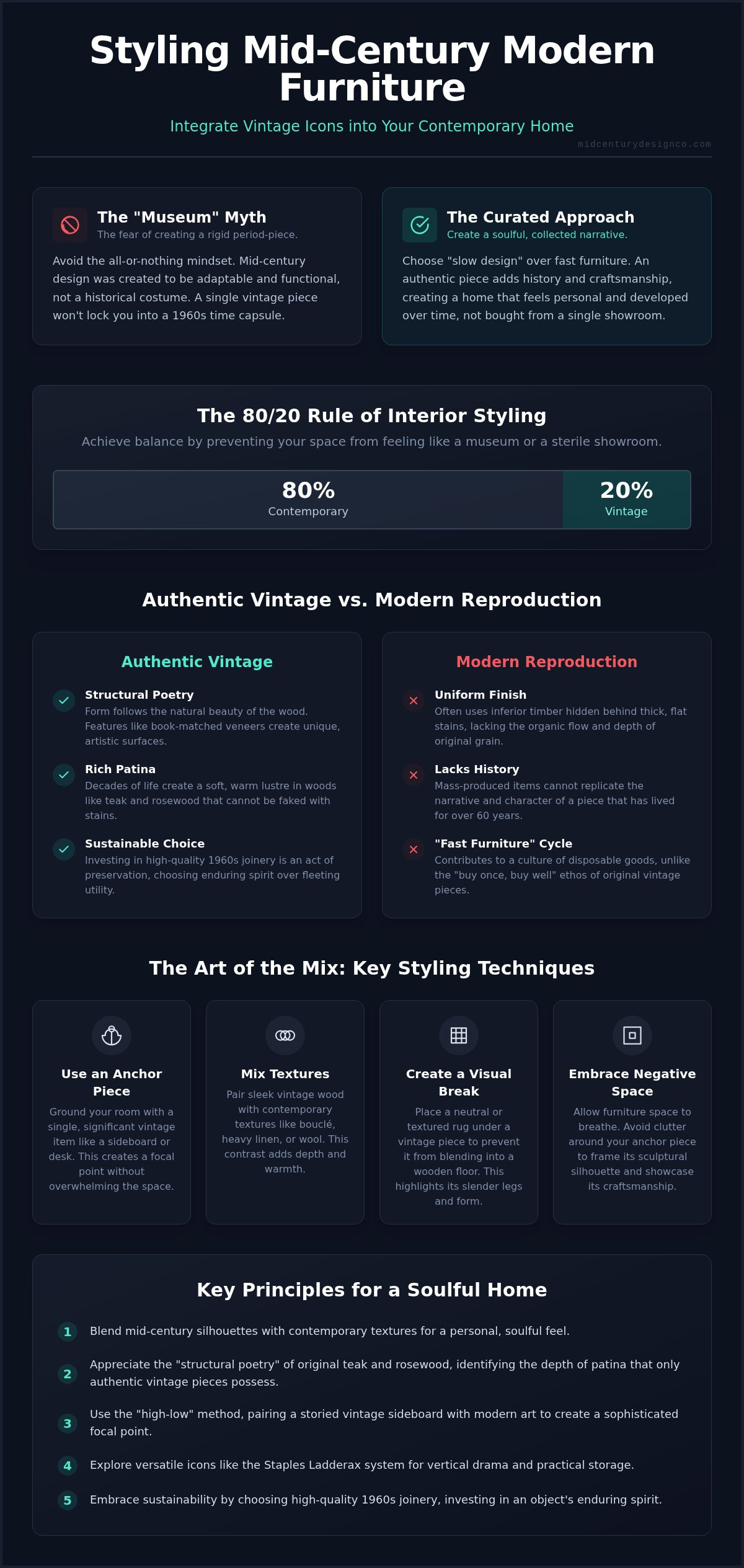
The "Museum Myth" is a persistent barrier for many homeowners. It's the nagging fear that buying a single authentic piece requires a total commitment to a 1960s time capsule. This all-or-nothing mindset suggests that unless you have the period-correct wallpaper and atomic-age lighting, a vintage piece will look out of place. In reality, Mid-century modern design was never intended to be static or rigid. It was born from a desire for adaptability, functionality, and clean lines that could evolve with the inhabitant. The designers of the era were looking forward, not backward; their work was meant to be the "modern" solution for any contemporary space.
Choosing "slow design" over the impulsive rush of fast-furniture allows your home to breathe. A vintage piece carries a narrative, a history of craftsmanship that modern flat-pack items simply cannot replicate. By selecting one significant "anchor" piece, you ground the room in quality without surrendering to a historical costume. This approach creates a home that feels collected over time, reflecting a personal journey rather than a single trip to a showroom. It's about finding the soul in the object and allowing it to speak amongst your modern belongings.
Breaking the "All-or-Nothing" Rule
You don't need a house full of teak to make a statement. Introducing a single vintage teak sideboard into a modern, minimalist lounge creates an immediate point of interest. The organic warmth of the wood provides a necessary counterpoint to the sharp, often cool-toned angles of 21st-century architecture. To truly master how to style mid century modern furniture, you must allow these pieces space to breathe. Avoid cluttering the surrounding area. Negative space acts as a frame, highlighting the sculptural silhouette of the furniture and allowing its craftsmanship to take centre stage.
The 80/20 Rule of Interior Styling
A curated home often follows a simple ratio: 80% contemporary and 20% authentic vintage. This balance prevents the space from feeling like a second-hand shop whilst ensuring it doesn't feel like a sterile showroom. When considering how to style mid century modern furniture, look at the textures. Pair the sleek, polished surface of a teak coffee table with the tactile comfort of a contemporary bouclé sofa—you might explore Kartell K-Waiting sofa for a design that bridges these eras—or heavy linen curtains. Modern lighting plays a crucial role here too. A sleek, contemporary floor lamp can cast a warm glow that accentuates the rich grain of vintage wood, bridging the gap between decades with effortless grace.
Mid-century design is often celebrated for its geometry, but its true genius lies in "structural poetry." This is the philosophy where the form of a piece is dictated by the inherent beauty of the material itself. Unlike mass-produced modern furniture that hides inferior timber behind thick, uniform stains, original pieces celebrate the organic life of the wood. In authentic Danish vintage sideboards, you'll often find "book-matched" veneers. This meticulous technique involves slicing a single piece of wood and opening it like a book, creating a symmetrical, mirrored grain pattern that flows across doors and drawers. It's a level of artistry that transforms a simple storage unit into a living canvas.
When considering how to style mid century modern furniture, the most common pitfall is the "wood-on-wood" trap. Placing a teak sideboard directly onto a dark oak floor can cause the pieces to bleed into one another, muting their visual impact. To avoid this, introduce a contrasting rug. A neutral wool rug or a contemporary textured piece provides a visual "break," allowing the slender, tapered legs of the furniture to stand out. This simple layer ensures the structural details remain visible rather than camouflaged amongst the floorboards.
Teak, Rosewood, and the Power of Patina
Vintage teak possesses a honey-toned warmth that modern reproductions simply cannot mimic. Over sixty years, the wood develops a patina, a soft lustre earned through light and life. This warmth is the perfect foil for the "Cool Grey" or sage green palettes popular in modern British homes. Rosewood offers a deeper, more dramatic alternative with its dark, expressive streaks. These grains aren't just patterns; they are the soul of the piece. Celebrating original finishes preserves the narrative of the object, adding a layer of historical weight to your lounge.
Mixing Wood Tones Without the Chaos
There's a persistent myth that all wood in a room must match. In reality, a curated home thrives on variety. You can mix teak, oak, and walnut if you have a "bridge" piece. A vintage Danish coffee table often serves as this central anchor, its mid-toned grain pulling together darker rosewood storage units and lighter flooring. This creates a layered, intentional look rather than a flat, coordinated set. If you're ready to find your own anchor, you might browse our curated collection to find that perfect tonal bridge for your space.
Learning how to style mid century modern furniture is ultimately about balance. By understanding the grain and respecting the material, you create a room that feels grounded and sophisticated. It isn't about matching colours; it's about harmonising the natural spirit of the wood.
Vintage vs. Reproduction: Debunking the "Good Enough" Quality Myth
When considering how to style mid century modern furniture, it's tempting to opt for a modern reproduction that promises the same aesthetic for a lower price. This is the "Good Enough" myth. A reproduction is essentially a photocopy of a design; it captures the silhouette but misses the substance. Whilst a new, mass-market sideboard might look the part from across the room, it lacks the tactile weight and structural integrity of an original. Beyond the physical, there is the "Investment Myth" to consider. Modern reproductions depreciate instantly, much like a new car. Authentic vintage pieces are assets that hold their value, often increasing as high-quality timber like teak and rosewood becomes scarcer.
Choosing vintage is also the most sustainable choice for a British home. Every time you rescue a 1960s chest of drawers, you're preventing the carbon cost of new manufacturing and the inevitable waste of flat-pack furniture that eventually ends up in a landfill. It's a commitment to quality that transcends fleeting trends. The feel of original Danish cabinetry, with its smooth, hand-finished surfaces and substantial weight, provides a sensory experience that no modern reproduction can replicate.
The Longevity of Craftsmanship
The reason original mid-century furniture pieces have already lasted sixty years is no accident. It's the result of superior joinery. When you inspect an original, look for dovetailed drawers and solid wood edges. Modern reproductions often use "iron-on" banding that peels away after a few years of use. Vintage cabinetry was built to be used, moved, and cherished. These hallmarks of quality ensure that your investment will likely last another sixty years, outliving several generations of modern alternatives.
Why Reproductions Lack "Soul"
There is a phenomenon known as the "uncanny valley" in furniture design. New MCM-style pieces often feel slightly "off" in a contemporary room because their proportions are simplified for mass production. They lack the spirit and narrative of an object that has witnessed decades of history. If you're trying to explain the value of vintage to a sceptical partner, focus on this soul. An original piece isn't just a place to put your television; it's a piece of functional art. It brings a sense of permanence and character that a flat-pack box simply cannot provide. Mastering how to style mid century modern furniture begins with choosing pieces that have a story worth telling.
The Art of the Mix: Styling Techniques for the Contemporary Home
Achieving a sophisticated balance in a contemporary home requires a departure from rigid coordination. The "High-Low" styling method is particularly effective here. By pairing a significant investment, such as a vintage teak sideboard, with accessible modern art or personal photographs, you strip away the formality of the piece. This approach makes the furniture feel integrated rather than exhibited. When considering how to style mid century modern furniture, think about the colour palette. Whilst the 1960s were known for bold primaries, a modern interpretation leans towards earthy tones. Terracotta, sage green, and deep teal provide a grounded backdrop that allows the warm wood grains to glow.
The shift towards home working offers a unique opportunity to blend utility with heritage. A mid-century modern desk can transform a spare corner into a productive sanctuary. Unlike modern office furniture that often feels clinical, a vintage desk brings a sense of purpose and history to your routine. Complement the workspace with an original floor lamp. Use it to create pools of light that soften the edges of the room, drawing the eye to the craftsmanship of the wood surface whilst providing focused illumination for your tasks.
Softening the Lines with Textiles
Mid-century furniture is defined by its clean, often sharp geometry. To prevent a room from feeling too clinical, you must introduce soft, tactile elements. Use organic shapes in rugs to provide a visual counterpoint to the linear profile of a vintage coffee table. Heavy weaves, sheepskins, and velvet cushions add the necessary warmth that balances the cool surfaces of wood and metal. Incorporating greenery is another classic technique. The architectural leaves of a Swiss Cheese Plant (Monstera) offer a natural synergy with mid-century design, their wild shapes breaking up the structured lines of the furniture.
The "Curated Surface" Technique
Surface styling is where many struggle, yet it's the final layer that makes a house feel like a home. Follow the "Rule of Three" when arranging objects on a sideboard or desk. Grouping items in odd numbers creates a more natural, less staged appearance. Mix heights by placing a tall ceramic vase next to a medium-sized stack of books and a low brass tray. This creates vertical interest and prevents the surface from looking flat. Remember that a mid-century modern cocktail table requires a lighter touch than a standard coffee table. Because these pieces are often lower and more sculptural, they benefit from a minimalist arrangement that doesn't obscure their form. If you're looking to start your own curated collection, explore our latest arrivals to find a piece that resonates with your personal style.
Mastering how to style mid century modern furniture is a journey of discovery. It's about respecting the history of the object whilst ensuring it serves your modern life, creating a space that feels both timeless and fresh.
Investing in Icons: Anchoring Your Space with Staples Ladderax and Sideboards
The final step in mastering how to style mid century modern furniture is selecting the foundational pieces that define a room's purpose. These are the icons that command attention whilst providing essential utility. A Staples Ladderax shelving unit is perhaps the most versatile choice for the modern British home. Often described as the "Swiss Army Knife" of mid-century design, its modular nature allows it to evolve with your needs. Whether you require a home office, a floor-to-ceiling library, or a sophisticated drinks station, the Ladderax system adapts effortlessly to your lifestyle.
Modular systems are particularly effective in smaller UK living spaces where floor area is at a premium. Because the system is "open," it adds significant vertical drama without the visual weight of a solid bookcase. You can mix teak shelves with black or white metal ladders to create an industrial-mid-century hybrid look that feels fresh and intentional. This transparency keeps the room feeling airy whilst providing ample storage for your most treasured objects, books, and ceramics.
The Versatility of Staples Ladderax
The beauty of Ladderax lies in its customisation. You can organise components to suit your specific routine, perhaps placing a desk bureau at the centre or a glass-fronted cabinet for displaying delicate glassware. By utilising the vertical space, you free up the floor, making even a compact lounge feel more expansive. It's a functional art piece that changes as your collection grows, ensuring your home never feels static or finished in a rigid, museum-like way.
The Sideboard as a Statement
Whilst originally designed for dining rooms, the long, low profile of a Danish sideboard has found a second life as the ultimate media unit. It provides the perfect base for a wall-mounted TV, grounding the screen and hiding the clutter of modern technology. The "hidden storage" behind sliding doors or tambour fronts allows you to maintain a minimalist aesthetic, tucking away cables and consoles whilst keeping the focus on the rich, honey-toned grain of the wood.
In the dining area, a retro dining table and chairs creates an immediate sense of occasion. It isn't just about eating; it's about the soul of the gathering and the narrative of the objects around you. One authentic, high-quality piece is always better than a house full of flat-pack imitations. If you're looking for guidance on how to style mid century modern furniture to suit your unique space, investing in these foundational icons is the most rewarding place to start.
Creating Your Curated Sanctuary
Styling mid-century furniture isn't about replicating a showroom from 1960. It's about the dialogue between decades. By understanding how to style mid century modern furniture through the "High-Low" method and the 80/20 rule, you create a space that feels intentional rather than accidental. Authentic vintage pieces, with their rich teak grains and hand-finished joinery, offer a soul that modern reproductions simply cannot duplicate. They're sustainable investments that ground a contemporary home in quality and history.
Whether you're anchoring a room with a sculptural sideboard or organising your life with a modular Staples Ladderax system, the goal is a home that breathes. We specialise in original Staples Ladderax systems and high-quality Danish design, offering only authentic vintage pieces with no modern reproductions. Your home should be a reflection of your personal journey, curated with objects that matter. Discover our curated collection of authentic vintage mid-century furniture and begin the journey of transforming your space into a sanctuary of timeless craftsmanship.
Frequently Asked Questions
Is mid-century modern furniture still in style for 2026?
Mid-century modern remains a foundational design language rather than a fleeting trend. In 2026, the aesthetic is evolving away from cool Scandi tones toward warmer, richer wood grains like teak and rosewood. Understanding how to style mid century modern furniture in this context means embracing its enduring popularity and focus on quality. It provides a soulful base that adapts easily to changing fashions, ensuring your investment feels as relevant now as it did sixty years ago.
How can I tell if a piece of mid-century furniture is an original or a reproduction?
Authenticity is often revealed in the finer details of craftsmanship. Original pieces typically feature dovetailed drawers, solid wood edges, and high-quality veneers that follow the natural grain. Modern reproductions frequently rely on "iron-on" banding and simplified joinery that lacks the tactile weight of the 1960s. Checking for maker’s marks or stamps from designers like McIntosh or G-Plan is also a reliable way to distinguish heritage pieces from modern lookalikes.
Does all my furniture need to be mid-century modern to look good?
A room filled exclusively with one era can feel like a static museum display. The most sophisticated homes mix styles to create a curated narrative. Following an 80/20 ratio, where twenty percent of your space is dedicated to vintage anchors, allows the furniture to breathe. This approach prevents a rigid period-piece pastiche and ensures your home feels personal and evolved rather than a historical recreation amongst your modern belongings.
How do I care for the teak wood on my vintage furniture?
Teak is a resilient timber that benefits from simple, consistent care. Regular dusting with a soft cloth prevents build-up, whilst a light application of high-quality teak oil once or twice a year maintains its honey-toned lustre. It's vital to keep pieces away from direct heat sources or prolonged sunlight, which can cause the wood to dry or fade. With these small gestures, the patina will only deepen and improve over time.
Can I mix mid-century modern with other interior styles like Industrial or Scandi?
The clean lines of mid-century design act as a perfect bridge between various aesthetics. Its organic warmth softens the raw, metallic edges of industrial styling, whilst its structural clarity complements the minimalism of Scandi interiors. Learning how to style mid century modern furniture amongst these different worlds is about finding common ground through texture and material. A teak sideboard provides the necessary soul to balance more clinical, contemporary elements.
What is the best way to style a mid-century sideboard in a small living room?
In compact spaces, the long, low profile of a sideboard is a strategic asset. It provides significant storage whilst keeping the upper half of the wall clear, which creates an illusion of height. Avoid cluttering the surface; instead, use the "Rule of Three" to arrange a few meaningful objects. This minimalist approach ensures the piece remains a focal point without overwhelming the room’s proportions or blocking valuable natural light.
Why is authentic vintage furniture more expensive than modern lookalikes?
The price of authentic vintage reflects the superior quality of materials and the skill of original cabinetmakers. Pieces from the 1950s and 60s often used slow-grown teak and rosewood that are now rare and protected. Unlike mass-produced lookalikes that depreciate instantly, these heritage items hold or increase their value over time. You are investing in a piece of functional history that was built to last for several generations.
Is Staples Ladderax shelving easy to install in a modern UK home?
Staples Ladderax is remarkably adaptable to modern UK homes due to its modular design. The system relies on metal uprights that lean or fix to the wall, supporting shelves and cabinets that can be organised at any height. This flexibility makes it ideal for rooms with awkward alcoves or varying ceiling heights. It’s a straightforward installation process that allows you to create a bespoke storage solution without the permanence of built-in furniture.