

How to Choose a Vintage Mid Century Dining Set: A Curated Sourcing Guide
A dining table isn't just a surface for meals; it's the heartbeat of a home, a functional sculpture that carries the whispers of sixty years of conversation. You've likely felt the pull of a genuine vintage mid century dining set, drawn to that honeyed teak glow or the sculptural sweep of a Danish-inspired chair. It's a desire for something with a narrative, yet the fear of accidentally bringing home a modern reproduction disguised as a relic often halts the journey before it truly begins.
We understand that choosing the right piece involves more than just an eye for beauty. Whilst the search can feel daunting, you want the confidence to distinguish between a mass-produced replica and a genuine investment piece crafted by British or Danish masters. This curated guide will teach you how to evaluate timber types, appreciate the rich colour of teak, and master the nuances of 1960s dimensions. We'll even cover the fire safety regulations for post-1950 furniture to ensure your home remains safe. By the end, you'll have a clear framework for selecting a set that brings historical soul and timeless quality to your personal sanctuary.
Key Takeaways
- Learn to identify authentic craftsmanship by inspecting joinery and maker's signatures, ensuring your chosen piece is a genuine historical icon rather than a contemporary replica.
- Navigate the nuances of the UK market with confidence, discovering the specific questions to ask dealers regarding a piece's provenance and original spirit.
- Master the practicalities of scale by measuring for a vintage mid century dining set whilst allowing for the fluid movement required in modern open-plan rooms.
- Distinguish between various timber types and extension mechanisms to find a table that balances everyday utility with the sculptural beauty of the 1960s.
- Understand the gentle art of preservation, using heritage-focused care techniques to protect the honeyed patina and material integrity of your investment.
The Allure of the Hearth: Why Choose an Original Mid Century Dining Set?
The dining room was once a formal, sequestered space. In the post-war era, walls came down. The Mid-century modern design movement redefined the home as a fluid, social landscape where the kitchen and living areas merged. Central to this revolution was the vintage mid century dining set. These pieces weren't just furniture; they were the architectural anchors of a new way of living. Clean, tapered legs and organic, sweeping curves replaced the heavy, ornate clutter of previous generations, creating an aesthetic that balanced industrial precision with a soft, human touch.
Choosing an original set is a radical act of preservation. Modern reproductions often lack the material integrity of their ancestors, using thin veneers and composite cores that can't withstand the passage of time. A genuine 1960s piece has already survived decades of family life. It carries a specific weight and a sensory warmth that factory-fresh copies simply cannot replicate. By sourcing vintage, you're opting out of the "fast furniture" cycle, choosing a sustainable path that honours existing resources and masterful craftsmanship. It is a choice that prioritises the soul of an object over the convenience of the new.
The Narrative of Teak and Rosewood
Teak became the darling of the era, particularly amongst Danish designers, for its high oil content and incredible durability. It's a wood that breathes. Over sixty years, it develops a deep, honeyed patina that glows under evening light. For those seeking something even more singular, rosewood offers a darker, more dramatic grain with a sophisticated, liquid-like finish. These timbers were selected for their longevity and their ability to bring a touch of the natural world indoors, creating a sanctuary that feels both grounded and elevated. Unlike modern stains, the character of aged wood is earned, not applied.
British vs. Danish Design Philosophies
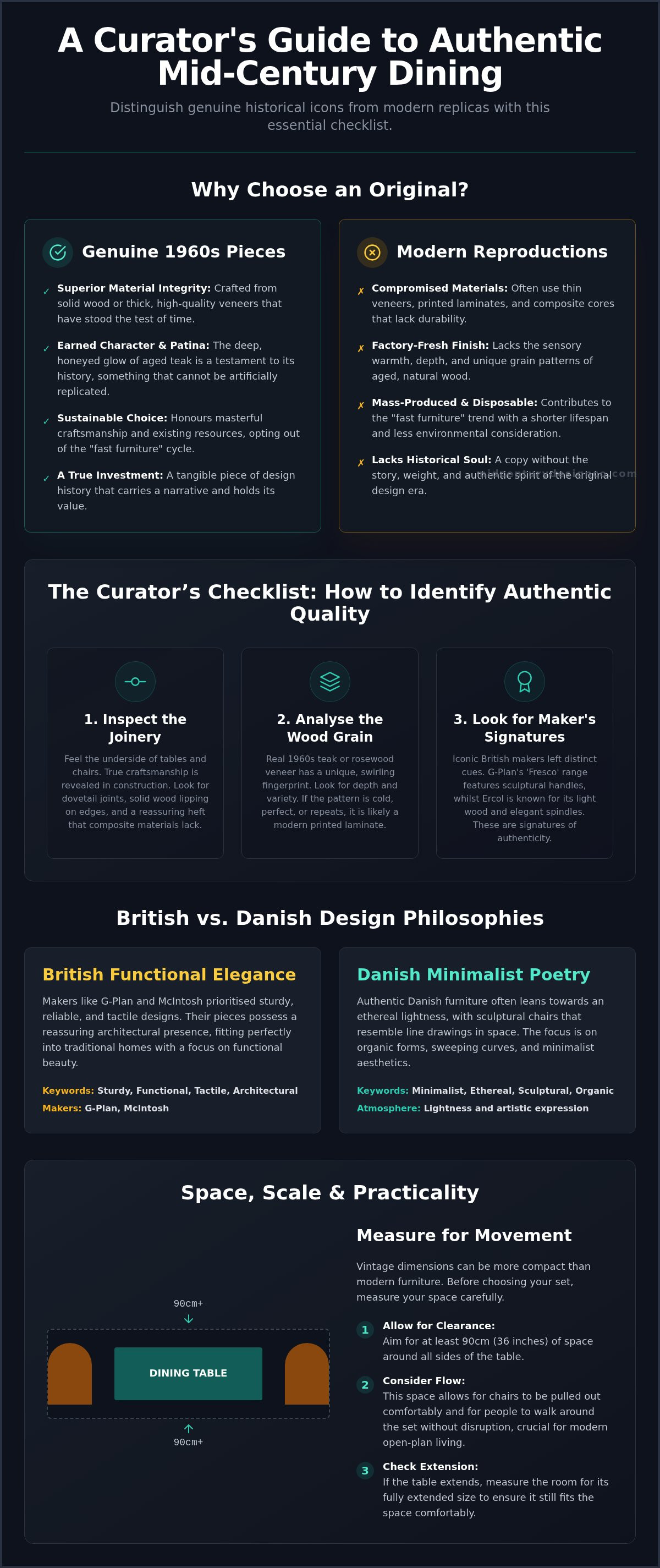
The choice between British and Danish sets often comes down to the atmosphere you wish to cultivate. British makers like G-Plan and McIntosh focused on a sturdy, functional elegance. Their designs are reliable, tactile, and possess a reassuring architectural presence that fits perfectly into the traditional British home. In contrast, authentic Danish furniture often leans towards minimalist poetry, with chairs that look like line drawings in space. Whether you prefer the robust charm of a British teak table or the ethereal lightness of a Danish set, each brings a unique spirit to your interior colour palette. A vintage mid century dining set acts as the soul of the room, inviting you to linger long after the meal has ended.
The Curator’s Checklist: How to Identify Authentic Vintage Quality
Identifying true authenticity requires a keen eye for the silent details that modern mass production simply cannot replicate. When you first approach a vintage mid century dining set, your instinct should be to touch. Feel the underside of the table and the interior edges of the chairs. True craftsmanship reveals itself in the joinery. Look for dovetail joints in the construction or the solid wood lipping on table edges. These elements aren't merely decorative; they are the structural signatures of a piece built to survive another half-century. Unlike modern replicas that often rely on cam-locks and hidden glue, these original sets were engineered with a physical integrity you can feel in their weight. An authentic teak table possesses a reassuring heft that composite materials fail to mimic.
The visual narrative of the wood grain is equally telling. Real teak or rosewood veneer from the 1960s has a depth, movement, and variety that printed laminates find impossible to capture. Laminate is repetitive and cold. Real wood grain is a unique fingerprint, showing the life of the tree through its swirling patterns and subtle shifts in tone. If the grain seems too perfect or repeats every few inches, it is likely a modern reproduction. To truly appreciate these tactile differences, you might explore our curated selection of dining sets where the material soul of each piece is preserved.
Spotting the Icons: G-Plan, Ercol, and McIntosh
Each major British maker left behind specific design cues that act as a map for the collector. G-Plan pieces from the "Fresco" range are famous for their integrated, sculptural wooden handles, whilst the earlier "Brandon" range is defined by its light oak finishes and elegant, splayed legs. Look inside drawers or under table tops for the iconic gold embossed stamp or the later red and white labels. Ercol is perhaps the most recognisable due to its unique marriage of elm and beech. The "Quaker" chair, with its tall arched back, and the "Butterfly" chair, with its steam-bent curves, showcase a level of wood manipulation that remains breathtaking. McIntosh of Kirkcaldy sets are prized for their clean, architectural lines and clever internal storage for extension leaves.
Evaluating Condition Without Restoration
We believe there is a profound beauty in a "charming patina" that a sterile, over-restored piece lacks. A few faint ring marks or a slight deepening of the wood's colour tell a story of decades of shared meals. Avoid sets that have been "dipped" in harsh chemical strippers, as this process kills the wood's natural spirit and leaves the surface looking chalky. Instead, prioritise sets with their original finish intact. Always test the extension mechanisms. A McIntosh or G-Plan table should glide open with a smooth, rhythmic behaviour, revealing a butterfly leaf that fits perfectly without force. This mechanical grace is a hallmark of a well-maintained original.
Space and Scale: Selecting the Right Configuration for Your Home
Choosing a vintage mid century dining set involves a delicate dance between aesthetic desire and the physical reality of your room. It's easy to fall in love with the sculptural sweep of a six-seater table, yet you must consider the "push-back" space required for chairs. To ensure a fluid, comfortable environment, allow at least 90cm of clearance between the table edge and the nearest wall or sideboard. This ensures that movement remains rhythmic and unhindered, preventing your dining area from feeling cramped or cluttered. Measuring the footprint is vital; you aren't just buying a table, you're organising the flow of your daily life.
The genius of mid-century design lies in its adaptability. Many sets feature ingenious extending mechanisms that allow you to transition from intimate family dinners to larger gatherings. Butterfly leaves are a marvel of 1960s engineering, folding away neatly beneath the table top when not in use. In contrast, draw leaves, often found in Danish designs, slide out from the ends to provide a seamless extension. When selecting your set, always verify the "knee room" by sitting at the table with the chairs provided. Some vintage chairs have higher seats than their modern counterparts, and you want to ensure the ergonomic relationship between the seat and the table apron is sound.
Round Tables and Social Flow
Circular sets are the masters of the compact British home. Pieces like the iconic G-Plan "Roundette" were specifically designed for smaller spaces, featuring chairs with curved backs that tuck entirely under the table rim. This creates a tidy, unified silhouette when the set isn't in use. A central pedestal base is a particularly thoughtful choice, as it eliminates the awkward clashing of legs amongst guests. Styling a round vintage mid century dining set helps to soften the sharp, linear angles of a modern room, creating a social centre that feels inclusive and warm.
Rectangular Sets for the Grand Host
For those who love to entertain on a larger scale, a rectangular teak set offers a sense of architectural grandeur. These longer tables work beautifully when paired with a matching teak sideboard, which helps to anchor the set within a multi-functional room. To manage the visual weight of an eight-seater table, look for designs featuring splayed or tapered legs. These slender supports create a sense of lightness and air, allowing the eye to travel beneath the furniture. It ensures that even a substantial piece feels like a graceful addition to your sanctuary rather than an overwhelming presence.
Sourcing Your Set: A Guide to the UK Vintage Market
Sourcing a vintage mid century dining set is a pursuit of character that requires moving beyond the surface. Whilst high-street "retro" shops might offer the right silhouette, they often lack the deep historical knowledge required to verify a piece's true lineage. A specialist curator acts as a bridge between the past and your home. They provide a sanctuary for objects that have been selected for their material integrity and aesthetic merit. When you speak with a dealer, ask about the provenance. Did the set belong to a single family since the 1960s? Has it undergone any structural repairs? A transparent specialist will welcome these questions, viewing them as a shared appreciation for the object's history rather than a mere transaction.
Logistics are the silent partner in a successful acquisition. Moving a sixty-year-old teak table across the country requires more than just a van; it demands historical respect. We ensure that national UK delivery is handled with the same care used to select the piece, protecting the delicate honeyed patina and slender legs from the stresses of transit. From a financial perspective, an original set is a remarkably smart investment. Unlike new high-street furniture that depreciates the moment it enters your home, authentic mid-century pieces tend to hold or even increase in value. You're paying for timber quality and design pedigree that's no longer achievable at these price points in modern manufacturing.
The Value of Specialist Curation
We focus on original pieces that haven't lost their narrative through aggressive, soul-destroying restoration. A curated inventory saves you the exhausting hunt through dusty warehouses whilst guaranteeing that every joint and surface is exactly as the maker intended. This expertise is particularly vital when sourcing Danish dining chairs UK collectors prize, where the subtle tension between form and function must be perfectly preserved. By trusting a specialist, you ensure the "soul" of the set remains intact.
Building Your Collection Over Time
There's a distinct joy in the "slow find". You might start with a singular table and wait months to discover the chairs that share its specific design language. This patient approach allows your home to evolve naturally. Integrating your dining set with other vintage teak furniture UK homes often feature creates a cohesive, layered environment that feels collected rather than decorated. Settling for an inferior piece today only delays the satisfaction of finding the right one tomorrow. To begin your own journey of discovery, we invite you to view our latest curated dining sets and find a piece with a story worth telling.
Creating a Sanctuary: Styling and Caring for Your Vintage Set
Caring for a vintage mid century dining set is less about maintenance and more about a gentle stewardship. These pieces have already weathered decades of use. They don't require the aggressive chemical treatments often marketed for modern, mass-produced furniture. A simple, daily ritual of wiping the surface with a soft, slightly damp lint-free cloth is usually sufficient to preserve that iconic, honeyed glow. Avoid silicone-based polish sprays at all costs. They create a stubborn, plastic-like film that suffocates the wood's natural breath and obscures the grain. Instead, embrace the patina. If the timber feels particularly dry after a long British winter, a light application of high-quality teak oil can restore its lustre, but remember that the goal is to honour the history, not to erase it.
Styling your set is where the narrative truly comes alive. We often suggest the "Expert Friend" approach, which involves balancing the historical weight of teak with the vibrant energy of contemporary life. Surround your table with lush, architectural plants like a Monstera or a Fiddle Leaf Fig. Their deep greens provide a stunning organic contrast to the warm timber tones. On the walls, modern abstract art or minimalist photography prevents the room from feeling like a museum piece. By mixing eras, you ground the furniture in the present whilst respecting its past. This creates a sanctuary that feels curated, personal, and profoundly soulful. It's a space where a vintage mid century dining set becomes a legacy piece, ready to be passed down amongst generations.
The Art of the Tabletop
Let the wood grain be the protagonist of your dining experience. When dressing your table, choose natural linens in muted, earthy tones that complement rather than compete with the timber. Hand-thrown ceramics with tactile glazes add a layer of sensory warmth that matches the era's appreciation for craftsmanship. Frame the entire scene with a statement pendant light. A sculptural lamp hung low over the table centres the room, casting a soft, intentional glow that invites guests to linger. This deliberate arrangement reflects a "slow living" philosophy, where every meal is treated with the same respect as the furniture itself.
The Mid Century Design Co. Promise
Our dedication goes beyond simple retail. We are curators of history, committed to sourcing only the most evocative and authentic pieces for our UK clients. We believe that furniture with a past provides a more soulful foundation for your future. Every table and chair in our collection has been selected for its spirit, its story, and its ability to transform a house into a sanctuary. We invite you to explore our current collection of authentic dining sets and discover a piece that will anchor your home for years to come.
Centring Your Home with a Piece of History
Selecting the perfect vintage mid century dining set is a journey of discovery that transcends simple furniture shopping. It's about finding a piece with the material integrity to anchor your home for decades. You now possess the tools to identify the silent marks of quality, from the rhythmic glide of a McIntosh extension leaf to the honeyed patina of G-Plan teak. By prioritising authenticity over mass-produced replicas, you're choosing a sustainable legacy that honours the poetic narrative of the 1960s.
As specialists in authentic, non-reproduction furniture, we take pride in bridging the gap between the past and your modern space. Our inventory consists of expertly selected British and Danish icons, each chosen for its singular spirit and enduring craftsmanship. We invite you to discover our curated collection of authentic vintage dining sets, all available with national UK delivery. Your search for a piece with genuine "soul" begins with a single discovery. We're here to help you find the table where your own family's history will be written.
Frequently Asked Questions
How can I tell if a mid-century dining table is solid wood or veneer?
Inspect the edges of the table top and the grain pattern to distinguish between the two. Most high-quality tables from this era use a thick timber veneer over a stable core to prevent warping, which is a sign of superior engineering rather than a lack of quality. If you see a distinct line where the top grain meets a solid wood "lipping" on the edge, it's a veneered piece. Solid wood is typically reserved for the legs, frame, and these protective outer edges.
What are the most famous British mid-century furniture brands to look for?
G-Plan, Ercol, and McIntosh are the definitive names that defined the British mid-century aesthetic. G-Plan is celebrated for its accessible "Fresco" and "Brandon" ranges, whilst Ercol is iconic for its use of steam-bent beech and elm. McIntosh of Kirkcaldy remains a favourite for those who appreciate architectural lines and clever internal storage. Other notable makers include A.H. McIntosh, Younger, and Austinsuite, each offering a unique take on the era's functional elegance.
Is it okay to mix different wood types, like teak and oak, in one dining room?
Mixing wood types is a wonderful way to create a home that feels curated rather than staged. Teak and oak share a warm, organic spirit that allows them to live harmoniously in the same space. The secret is to maintain a consistent design language, such as splayed legs or minimalist silhouettes, to tie the pieces together. Using a mix of timbers prevents your room from looking like a flat showroom and adds a layer of sophisticated character.
How do I care for an original 1960s teak dining table to ensure it lasts?
Daily care involves nothing more than a soft cloth slightly dampened with water to remove dust and spills. You should avoid silicone-based polish sprays entirely, as they create a dull, sticky build-up that masks the wood's natural beauty. Apply a high-quality teak oil once or twice a year to nourish the timber and maintain its glow. Always use heat mats and coasters to protect your vintage mid century dining set from white heat rings and water marks.
Why is Danish mid-century furniture often more expensive than British sets?
Danish pieces often command a premium because they were frequently produced in smaller workshops with a higher degree of hand-finishing. Designers like Hans Wegner and Arne Jacobsen prioritised sculptural complexity and used rarer materials like solid teak or rosewood. Whilst British manufacturers like G-Plan successfully brought the aesthetic to the masses through efficient production, Danish furniture was often positioned as a high-end luxury export, leading to its enduring status as a blue-chip investment.
What should I look for when inspecting the chairs of a vintage dining set?
Focus on the structural integrity of the joints and the condition of the timber. Give each chair a gentle shake to ensure the frame is "tight" and hasn't developed excessive play in the joints over the decades. Check the underside for original maker's marks and ensure the wood hasn't been "dipped" or over-sanded, which can thin the delicate tapered legs. If the upholstery is original, verify that it's in good repair or factor in the cost of professional recovering.
Can I use a vintage dining set for everyday family meals, or is it too fragile?
These sets are incredibly robust and were built to be the functional heart of a busy family home. Unlike modern furniture made from composite boards, a vintage mid century dining set features seasoned hardwoods and traditional joinery that actually thrives with regular use. As long as you use table mats and avoid harsh cleaning chemicals, your set will easily withstand the rigours of daily breakfasts and evening homework whilst continuing to gain a beautiful patina.
How do I know if a vintage dining set will fit in a modern, smaller UK home?
Mid-century designers were masters of space-saving, as they were creating furniture for the smaller footprints of post-war British housing. Many tables feature "Roundette" designs or "butterfly" extension leaves that fold away, making them more adaptable than modern, bulky alternatives. Measure your room carefully, allowing for a 90cm clearance around the table for movement. The slender, tapered legs of the 1960s era also create a sense of visual lightness, making a room feel more open and airy.