

How to Identify Vintage Danish Furniture: A Practical Collector’s Guide
A handsome teak sideboard can look unmistakably Danish at first glance, yet good looks alone don’t prove its age or origin. If you’re wondering how to identify vintage danish furniture, look beyond the wood and silhouette: later pieces and reproductions can echo the same warm tones and graceful lines, while genuine vintage furniture may have no clear label or paperwork.
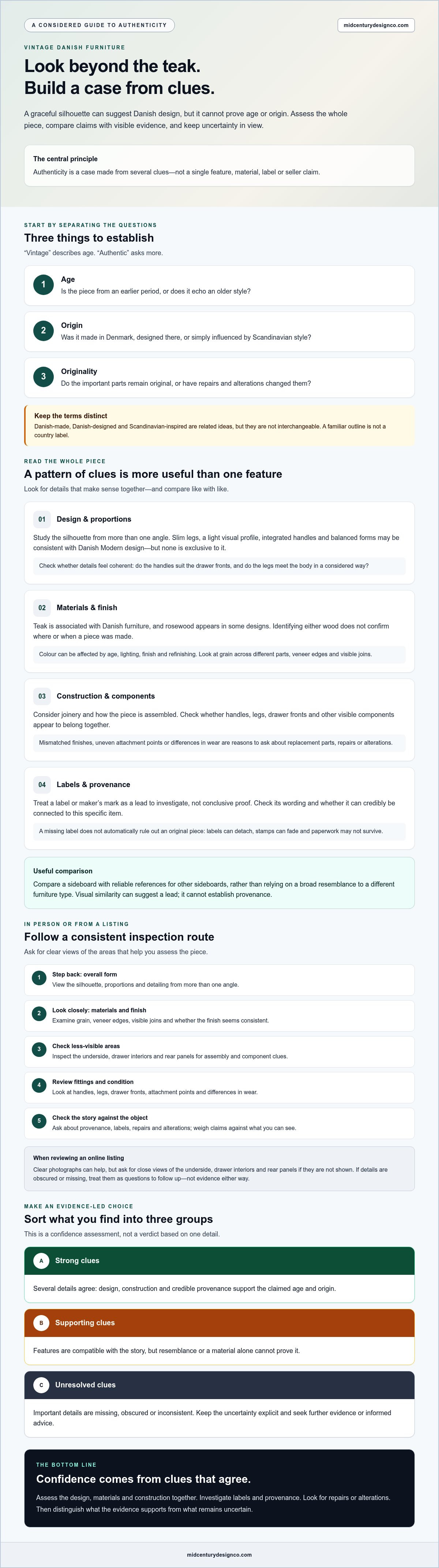
Authenticity is a case built from several clues, not a single Danish-looking feature. Assess the design, materials and construction, then weigh any provenance and seller claims against what you can see. Whether you’re viewing a piece in person or studying an online listing, check its underside, interior and fittings, and ask about repairs or alterations. The aim is a more confident choice, with a clear distinction between what’s supported by evidence and what remains uncertain.
Key Takeaways
- Separate Danish-made furniture from Danish-inspired design, and treat age, origin and originality as distinct questions.
- To learn how to identify vintage danish furniture, assess its silhouette, proportions, materials, joinery and finish together; teak alone isn’t proof.
- Use labels and maker’s marks as leads to investigate, then compare claims with reliable references and supporting evidence.
- Follow a consistent inspection sequence, whether viewing a piece in person or studying an online listing, and look closely for repairs or alterations.
- Group findings into strong, supporting and unresolved clues so you can decide whether to proceed, request better documentation or seek informed advice.
What Does “Vintage Danish Furniture” Actually Mean?
Vintage Danish furniture is furniture made in Denmark in an earlier period, whose design, construction and materials support that origin and age. This is a useful working definition, not a claim that every piece has a documented maker or an undisputed date. “Vintage” describes age; “authentic” asks more: where the piece was made, when, and whether its important parts remain original.
That distinction matters because a graceful profile can evoke Danish design without the furniture having been made in Denmark. Teak, tapered legs and a clean Scandinavian silhouette may offer clues, but none establishes provenance on its own.
Danish origin, Danish design and Scandinavian style
Country of manufacture and design influence are related, but they aren’t interchangeable. A piece may have been designed in Denmark and made elsewhere, or produced in Denmark in a style shared across northern Europe. “Danish Modern” refers to a design context, not a guarantee of Danish manufacture. For historical background on the movement and its design principles, see Danish Modern.
Scandinavian traditions also share qualities such as restrained forms and an emphasis on practical use. Danish, Swedish and other regionally influenced furniture can therefore look closely related. When assessing how to identify vintage danish furniture, consider the maker and manufacturing evidence alongside the design. Don’t treat a familiar outline as a country label.
Why one identifying feature is never enough
Popular shapes and materials can reappear in later furniture, while restoration or alteration may change the appearance of an older piece. Teak is associated with Danish mid-century furniture, but its presence alone doesn’t prove when or where an item was made. The same caution applies to slender legs, sculptural handles and a warm wood finish. Look for a pattern of clues that agree with one another.
A missing label doesn’t automatically rule out an original piece. Labels can become detached, stamps can fade and paperwork may not have survived. Conversely, a label is a starting point for research, not conclusive proof. Check its wording and whether it can be credibly connected to the specific item.
Think of identification as a confidence assessment. Compatible design details, construction and credible provenance can strengthen a case, while gaps may leave questions unresolved. That doesn’t make the furniture’s craftsmanship or appeal less real; it means its history should be described with care. The checks below help you weigh what’s visible against what can be verified.
Which Design Details Can Help Identify Vintage Danish Furniture?
A piece’s design is most revealing when its details make sense together. Consider the overall silhouette, the balance of its proportions, the quality of its joinery and the character of its finish. One elegant feature might catch your eye, but the relationship between several features is more useful when assessing how to identify vintage danish furniture.
Silhouette, proportions and considered detailing
Look at the furniture from more than one angle. Slim legs, a light visual profile, integrated handles and carefully balanced forms may be consistent with Danish Modern design, but none is exclusive to it. Check whether the detailing feels coherent: do the handles suit the drawer fronts, and do the legs meet the body in a considered way?
Compare the piece with reliable references for the same furniture type and claimed period. For example, compare a sideboard with other sideboards, not just with a chair that shares a broad mid-century look. Collector-focused guidance such as Identifying Danish Modern furniture can provide context, but a visual comparison is a starting point for investigation, not a verdict.
A design resemblance can suggest a lead, but it cannot establish provenance.
Wood, veneer and the details of construction
Teak is associated with Danish furniture, and rosewood also appears in some designs, but identifying either wood doesn’t confirm a piece’s country of manufacture. Colour can be misleading: age, lighting, finish and refinishing all affect how timber appears. Look at the grain across different parts, and check whether veneer edges and visible joins seem consistent with the form and construction.
Clear photographs can help, but ask for close views of the underside, drawer interiors and rear panels if they aren’t shown. These less visible areas may reveal how the piece is assembled and whether its components appear consistent. A photograph may not show the details clearly, so treat obscured or missing views as questions to follow up, not evidence either way.
Original construction, repairs and modifications
Check whether handles, legs, drawer fronts and other visible components appear to belong together. Mismatched finishes, uneven attachment points or differences in wear may prompt questions about replacement parts or later changes, but they don’t prove a piece is inauthentic. Wear can be uneven, and a refinished surface may conceal earlier detail. Ask what has been repaired or altered, then compare the answer with what you can see.
Note both supporting details and uncertainties. Browsing carefully curated Danish vintage furniture can give you examples to study, but each item’s maker, date and provenance still need to be considered on their own evidence.
How Can You Check a Danish Maker, Label or Provenance Claim?
A label, stamp or compelling family story can point towards a piece’s history, but each claim needs to be checked against the furniture and other evidence. A consistent process helps separate what’s documented from what’s suggested, making it easier to judge how much confidence to place in a seller’s description.
What a label or maker’s mark can, and cannot, tell you
Photograph any mark clearly, including its position on the furniture, then transcribe every visible word, number and symbol. Don’t rely on a cropped image or a quick search result. Compare the mark with credible references, ideally sources that explain its use and the period in which it appeared. A mark may help identify a maker or manufacturer, but it doesn’t automatically verify the item’s date, country of manufacture or originality.
No mark? That doesn’t settle the matter either. Labels can be lost, become illegible or never have been present, so their absence is not proof that a piece is inauthentic. Treat unclear or missing evidence as an open question while you investigate other clues.
Building a provenance trail from reliable sources
For anyone asking how to identify vintage danish furniture, provenance is best approached as a sequence rather than a single decisive test. Record the exact claim first, including the named maker, date, place of manufacture and any design attribution. Then:
- Inspect the evidence. Photograph marks and details, and ask the seller what supports each part of the description.
- Request records. Ask whether they hold ownership history, original paperwork or documentation from a previous sale. Note what is available and what is based on recollection.
- Compare references. Look for period catalogues, advertisements or other credible primary sources that show the same maker or a closely matching design. Compare specific details, not just the overall appearance.
- Qualify your conclusion. Separate documented facts from informed opinion and unverified attribution. If a date or maker can’t be confirmed, describe it as uncertain rather than presenting it as established.
Original advertisements and catalogues can be especially useful because they offer period evidence of how a design was presented. Still, a visual match doesn’t prove the piece in front of you is the same model, or that it was made in the claimed place or year. Look for distinctive details that align, and note any differences.
Before repeating a specific attribution, verify the maker, date, country of manufacture and interpretation of any mark against reliable sources. A careful conclusion may be “consistent with” a particular attribution rather than definitive. That measured language preserves the story without asking the evidence to say more than it can.
What Should You Inspect Before Buying a Vintage Danish Piece?
Use the same inspection sequence whether you’re studying an online listing or standing beside the furniture. The aim isn’t to demand immaculate condition; it’s to understand what’s original, what may have changed and which claims still need evidence. These practical checks put what you’ve learned about how to identify vintage danish furniture to work when you’re considering a purchase.
Questions to ask a seller before viewing or committing
Ask what supports the stated maker, date and country of manufacture. Request details of known repairs, replacement parts, refinishing or other alterations. If the listing relies on a label or distinctive construction detail, ask for a clear close-up rather than another styled room photograph. A seller’s answers can clarify the history, but distinguish documented information from recollection or opinion.
A considered check of condition and originality
Use this sequence to organise your inspection:
- Review the whole piece. Check its overall form and note whether the photographs show every side, including the back and underside.
- Examine the construction. Ask for close views of joints, drawer interiors, door fittings and any label or stamp. Look for details that appear inconsistent, such as fittings with a different finish or attachment.
- Check how it functions. If viewing in person, open drawers and doors gently and observe whether they move as expected. Note anything loose, stiff or misaligned, without assuming that it proves a particular age or origin.
- Record condition and changes. Look for damage, repairs, refinished areas or replaced components. Ask about anything uncertain, and compare the answer with visible details.
- Separate your findings. Write down condition concerns separately from questions about attribution and provenance. A repair may affect originality or condition, but doesn’t by itself settle where or when the piece was made.
For an online listing, request photographs of the underside, rear panels, drawer interiors, joints, marks and any damage, all in good light. If a seller can’t provide a view, treat that detail as unverified rather than filling the gap with an assumption. For furniture-specific pointers, see this guide to vintage Danish coffee tables.
Consider both the furniture’s character and its evidence. To explore carefully curated vintage Danish furniture, browse the available pieces and assess each item on its own details.
How to Make a Confident, Evidence-Led Choice
A sound decision doesn’t depend on finding one perfect clue. Bring the evidence together, note where it agrees and be candid about what remains unknown. That’s the practical heart of how to identify vintage danish furniture: form a considered view from the piece itself, its construction and the history that can be supported.
A simple confidence check before deciding
Before you commit, write down your findings under four headings:
- Claimed origin: What maker, date and country of manufacture are stated, and what evidence supports each detail?
- Design: Do the form and detailing appear consistent with the claimed design and period?
- Construction: Do the visible materials, joins and components seem coherent, allowing for any disclosed repairs or alterations?
- Provenance: Is the history supported by paperwork or reliable references, or does it rest mainly on a seller’s account?
Then sort the clues into three groups: strong evidence that directly supports a claim; supporting details that fit but don’t prove it; and unresolved questions. A mark that matches a credible reference may be strong evidence for a maker, while a similar silhouette may only support a design attribution. An appealing description repeated across listings isn’t independent verification.
If important details conflict or can’t be checked, pause. Ask for clearer photographs or documentation, and consider speaking with a suitably informed specialist if the attribution matters to your decision. Whether you’re buying for a particular designer, period or simply the pleasure of living with a well-made piece, decide which uncertainties you’re comfortable accepting. Some furniture remains difficult to attribute conclusively, and an honest “unconfirmed” is more useful than false certainty.
Finding original vintage Danish furniture to explore
Specialist curation can be a helpful starting point: it brings original vintage furniture together for considered browsing, while leaving room to assess each piece on its own evidence. The Mid Century Design Co. curates and sells original vintage furniture, including Danish pieces. Curation can help you discover pieces, but it doesn’t mean every item comes with complete provenance or a definitive attribution.
If you’d like to explore, take your time with the curated Danish furniture selection. Read each description and review the available details, then carry the same thoughtful questions into your next decision.
Let the Evidence Guide Your Next Find
Learning how to identify vintage danish furniture means looking beyond a handsome silhouette. Weigh design and construction details together, check maker and provenance claims against reliable evidence, and keep condition or repairs separate from questions of origin. A label can help, but no single clue tells the whole story.
Some pieces will have a well-supported history; others may remain difficult to attribute with certainty. Note what’s verified, what’s plausible and what you’d still like to know. This measured approach helps you choose with confidence, while leaving room to appreciate the warmth, craftsmanship and character that first drew you to a piece.
The Mid Century Design Co. specialises in original vintage mid-century furniture, including Danish furniture, sideboards, dining furniture, desks and storage. If you’re ready to explore, browse our curated vintage Danish furniture and take your time finding a piece that feels at home in your space.
Frequently Asked Questions
How can you tell if Danish furniture is vintage?
Assess its design, construction, materials and provenance together, rather than relying on one feature. Compare the piece with reliable references for its claimed maker and period, inspect joins and components, and look for supporting documentation or marks. “Vintage” describes age, but there isn’t a universal age threshold that proves a piece is Danish or authentic. If evidence is incomplete, distinguish what’s verified from what remains uncertain.
Does teak mean a piece of furniture is Danish?
No, teak alone doesn’t establish Danish origin. It was used in Danish furniture, but the wood also appears in furniture made elsewhere and in later designs. Lighting, finishes, refinishing and age can change its colour, so appearance isn’t a reliable way to identify wood on its own. Consider the grain, construction, design details and provenance evidence together before drawing conclusions about where or when a piece was made.
Can vintage Danish furniture be authentic if it has no label?
Yes. A missing label doesn’t automatically rule out an authentic vintage piece; labels may have detached, faded or never been present. Look instead at the combined evidence, including construction, design, materials and any ownership or sales history. If a maker or date is claimed, ask what supports it and compare the details with credible references. Without enough evidence, it’s sensible to leave the attribution open rather than assume certainty.
How do I check whether a Danish furniture maker’s mark is genuine?
Photograph the mark clearly, including where it appears on the furniture, and transcribe every visible word, number and symbol. Compare it with credible references that explain the mark, rather than relying on a similar image found online. Check whether the mark fits the claimed maker and period, and whether the furniture’s other details support the same story. A mark is a useful research lead, not conclusive proof by itself.
What should I look for when buying vintage Danish furniture online?
Ask for clear photographs of the whole piece, its underside, rear, drawer interiors, joints, fittings, marks and any damage. Request the evidence behind claims about maker, date and country of manufacture, and ask about repairs, replacements or refinishing. Check whether the drawers and doors appear consistent with the construction, and note details that photographs don’t show clearly. Treat missing views as unanswered questions, not proof of authenticity or inauthenticity.
Are Danish Modern furniture and Scandinavian furniture the same thing?
No. Danish Modern refers to a design tradition associated with Denmark, while Scandinavian furniture is a broader term that can encompass design from neighbouring Nordic countries. Their work may share qualities such as restrained forms and practical detailing, so visual style alone may not identify a country of manufacture. A Danish Modern appearance can guide further research, but check the maker, production history and supporting evidence before describing a piece as made in Denmark.