

Tapered Leg Furniture: A Guide to Authentic Mid-Century Design in the UK
A visual palette cleanser. The heavy, imposing silhouettes of pre-war Britain did not just fade away; they were lifted by the elegant rise of the tapered leg. This single design choice transformed cluttered rooms into airy, modern sanctuaries that felt light enough to breathe. You've likely felt the magnetic pull of tapered leg furniture vintage UK enthusiasts seek out, yet perhaps you hesitate. It's natural to worry whether those slender, delicate limbs can still support a busy household or if a piece is merely a modern reproduction masquerading as a mid-century icon.
We understand that choosing furniture is about more than utility; it's about finding the soul of a space. You deserve to feel confident that your investment carries the genuine narrative of 1960s craftsmanship. In this guide, we'll journey through the history of the taper, teaching you to spot the authentic joinery of makers like G Plan and McIntosh whilst assessing the structural integrity of vintage wood. You'll learn to distinguish between a hollow imitation and a piece of functional art, ensuring your home becomes a curated sanctuary of British design history.
Key Takeaways
- Understand how the tapered leg acted as a visual palette cleanser, shifting British homes from heavy pre-war styles to light-filled, modern sanctuaries.
- Learn to identify the warm, deep patina of teak and rosewood that distinguishes genuine tapered leg furniture vintage UK collectors prize from pale, modern imitations.
- Master the art of spotting authentic mid-century joinery, such as dovetail construction, to ensure the structural integrity of those iconic slender limbs.
- Discover why investing in original pieces from makers like G Plan or McIntosh offers a sustainable alternative that holds its value amongst design enthusiasts.
- Envision how the specific geometry of tapered legs creates a sense of space and flow, making them a perfect fit for the dimensions of modern UK homes.
The Elegance of the Taper: Why Mid-Century Design Embraced the Slender Silhouette
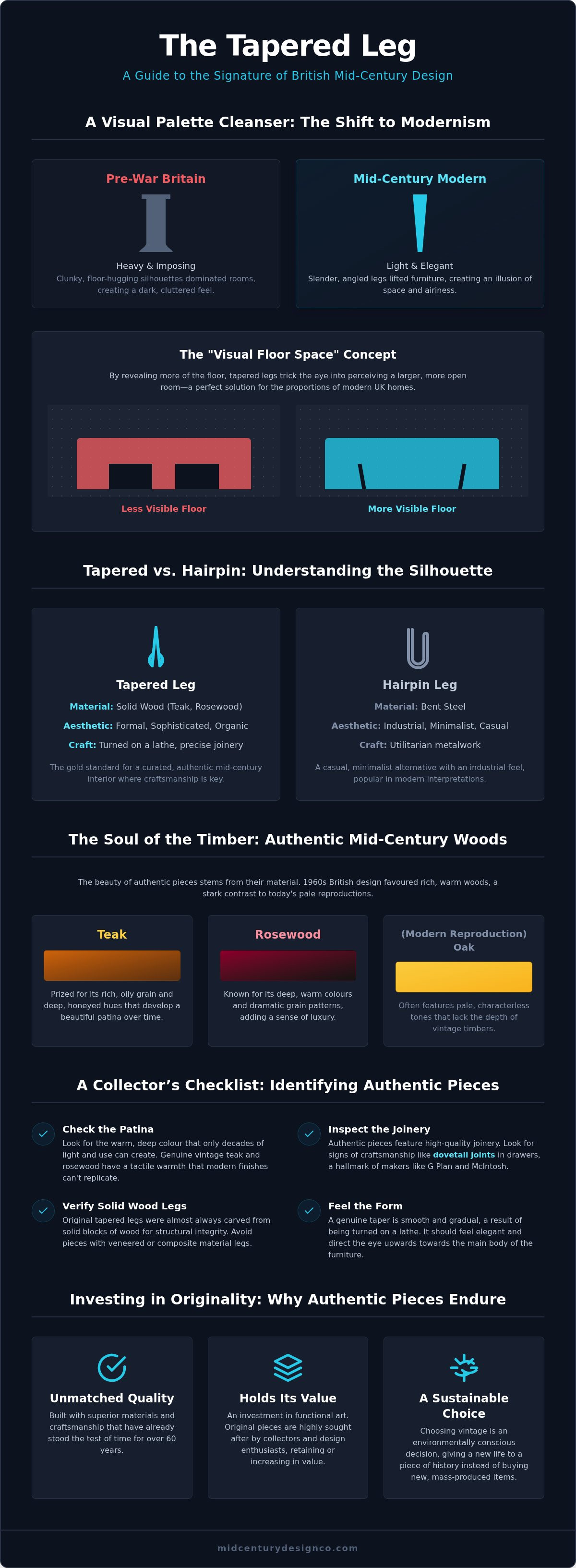
The tapered leg serves as the definitive signature of an era. It represents the exact moment furniture stopped hugging the floor and started to float. As a hallmark of the Mid-century modern design movement, this silhouette was born from a desire to shed the visual weight of the past. For decades, British homes were occupied by heavy, dark Victorian and Edwardian pieces that felt rooted in the shadows. The arrival of the 1950s changed the narrative entirely. Designers began to prioritise light, air, and a sense of boundless optimism. They traded the clunky, turned legs of the previous generation for slender, angled supports that pointed towards a brighter future.
This shift was not merely about fashion; it was a response to the changing landscape of post-war Britain. The 1940s were defined by the Utility Furniture Scheme, a period of strict rationing where designs were chunky, functional, and devoid of flourish. When these restrictions finally lifted, the exuberance of the 1950s and 60s took hold. People wanted homes that felt spacious and energetic. The "visual floor space" concept became the designer’s secret weapon. By narrowing the leg as it approaches the ground, tapered leg furniture vintage UK collectors adore creates an illusion of roominess. You see more of the floor, which tricks the eye into perceiving a larger area. It's a vital consideration for the smaller proportions of UK flats and terrace houses.
The Aesthetic Purpose of Tapering
A taper does more than support a weight; it directs the soul of the piece. The narrowing line naturally draws your eye upwards, focusing your attention on the rich wood grain of a teak tabletop or the warm patina of a rosewood sideboard. This upward energy was heavily influenced by the Atomic Age. Silhouettes began to mimic the sleek, aerodynamic lines of rockets and satellites, bringing a sense of movement to static objects. In the context of tapered leg furniture vintage UK homes often feature, this design choice ensures that even a large dining table feels delicate rather than dominant. It allows light to flow underneath and around the piece, turning a functional object into a sculptural element that breathes within your sanctuary.
Tapered vs. Hairpin: Understanding the Difference
While both styles celebrate the minimalist ethos, they speak different languages. Tapered legs represent a more formal, sophisticated approach to woodcraft. They require precise joinery and a deep understanding of timber strength, as the wood must remain structurally sound despite its diminishing diameter. It's the choice for a refined, curated interior where craftsmanship is the primary narrative. Hairpin legs, conversely, offer an industrial, minimalist alternative. Made from bent steel, they feel more casual and utilitarian. If you're seeking a piece with historical weight and a tactile, organic spirit, the wooden tapered silhouette remains the gold standard for authentic mid-century living.
Materials and Craftsmanship: The Soul of British and Danish Vintage
To understand the soul of a piece, one must look first to the timber. During the 1960s, the British market was dominated by Teak and Rosewood, woods chosen for their rich, oily grains and deep, honeyed hues. This is a stark contrast to the pale, often characterless tones of modern Oak reproductions found on the high street today. Authentic tapered leg furniture vintage UK collectors seek out possesses a depth of colour and a tactile warmth that only decades of careful use and natural light can produce. These materials were the perfect canvas for Modernist design principles, which demanded that an object’s beauty should stem directly from its material and form rather than applied ornament.
The physical creation of these legs relied on the "turned" process. Master craftsmen used lathes to sculpt solid blocks of wood into those iconic, diminishing points. Unlike modern mass-produced items that often use veneers or composite materials, original mid-century legs were almost always solid wood. This was a necessity for structural integrity. A slender, tapered leg must be exceptionally strong to support the weight of a heavy sideboard or a dining table. When you run your hand down a genuine vintage leg, you can feel the subtle, smooth transition of the grain, a testament to the artisan's skill. If you're looking for such quality, you might enjoy browsing our curated selection of dining sets and sideboards.
The Danish Influence on UK Tapered Design
British designers didn't work in a vacuum. The Nordic movement, led by figures like Hans Wegner, fundamentally reshaped the UK aesthetic. Danish design prioritised a "floating" look, often achieved by setting tapered legs onto a recessed base frame. This creates a gap between the floor and the body of the furniture, making even the most substantial chest of drawers appear weightless. You can explore this specific aesthetic further in An Elegant Guide to Buying Vintage Danish Coffee Tables.
British Makers: G Plan, McIntosh, and Younger
UK brands quickly adapted these Nordic traits to suit British sensibilities. These makers are essential for any collector to recognise:
- G Plan: Their famous "Danish" range is perhaps the most recognisable, featuring elegantly slender legs that defined the mid-century living room.
- McIntosh: This maker utilised tapering to elevate their long, sleek sideboards, often adding brass ferrules or "caps" to the feet for a touch of refined glamour.
- Younger: Known for high-quality, solid wood construction, their pieces often feature a more understated, sophisticated taper.
These small details, like the addition of brass ferrules, weren't just decorative; they protected the wood from moisture and added a refined finish that distinguished high-end British craftsmanship from more modest, mass-market alternatives.
Iconic Tapered Leg Furniture: From Sideboards to Dining Sets
The silhouette of a room is defined by how it meets the floor. In the History of Mid-Century Modern design, the shift towards tapered legs allowed furniture to occupy space without dominating it. Nowhere is this more evident than in the sideboard. A long, teak sideboard is perhaps the quintessential example of tapered leg furniture vintage UK collectors prize. It provides vast storage whilst appearing remarkably light, balanced on four slender points that create a sense of architectural grace. This "hovering" effect isn't limited to storage; it extends to wardrobes and chests of drawers, transforming heavy bedroom essentials into elegant statements that let light travel through the room.
Occasional pieces, such as coffee and side tables, offer a more delicate charm. These smaller items often feature more dramatic tapers, sometimes angled outwards to provide stability whilst maintaining a refined profile. They act as the jewellery of the living room, adding texture and historical weight without the bulk of traditional furniture. By choosing original pieces, you're not just buying a table; you're preserving a narrative of 1960s British craftsmanship that mass-produced alternatives simply can't replicate.
The Mid-Century Sideboard as a Statement Piece
The modern appeal of the sideboard lies in its horizontal purity. Because the body sits high on tapered legs, the piece feels like a curated gallery plinth rather than a heavy cupboard. For a deeper look at these icons, explore The Definitive Guide to Authentic Mid Century Modern Sideboards. When styling your lounge, use the space beneath the sideboard to maintain an airy feel. Avoid cluttering the floor nearby; instead, let the tapered legs stand as a focal point, perhaps paired with a vibrant wool rug that contrasts with the deep, honeyed tones of the teak grain.
Dining with Tapered Elegance
In the dining room, tapering serves a practical purpose alongside its aesthetic beauty. Tapered legs on dining chairs and tables provide significantly more legroom, removing the clunky obstacles found in traditional designs. This creates a clutter-free environment that encourages movement and conversation. We discuss this further in our guide on Retro Dining Table and Chairs UK: The Allure of Authentic Mid-Century Design. To achieve a cohesive look, seek out sets where the leg profile of the chairs mirrors the angle and timber of the table, creating a rhythmic harmony across your dining space that feels intentional and sophisticated.
Identifying Authentic Vintage Tapered Legs: A Collector’s Checklist
Finding a genuine piece involves more than a quick glance. It requires a quiet, methodical inspection of the finer details. When searching for the tapered leg furniture vintage UK collectors covet, start where the leg meets the frame. Authentic mid-century construction often avoids the visible, crude screws found in modern flat-pack items. Instead, look for elegant joinery or internal threaded bolts that disappear into the timber. If you're examining a sideboard or chest of drawers, pull the drawers out. You should see dovetail joints, a hallmark of durability that modern stapled or glued alternatives cannot match.
The wood itself tells a story. Examine the grain for a deep, honeyed patina that only fifty years of existence can create. Modern reproductions often use a thin veneer over an MDF core, which feels light and sounds hollow when tapped. A genuine vintage piece has a satisfying weight and a surface that feels organic and warm. Don't be deterred by the "patina of age." Subtle, honest wear, such as faint ring marks or slight variations in colour, are often the best indicators of a piece's history and soul. Look for maker's marks, such as the iconic gold embossed G Plan stamp or a McIntosh label inside a top drawer, to confirm the item's heritage.
Originality vs. Reproduction
The high street is currently flooded with "MCM-style" items that mimic the silhouette but lack the spirit. These pieces often use pale oak or stained pine, which lacks the oily richness of 1960s teak. Authentic wood feels substantial; it possesses a density that provides a sense of permanence. To avoid the risk of low-quality copies, it's essential to buy from a reputable curator who understands provenance. If you want to ensure your investment is a genuine piece of design history, browse our collection of authentic vintage furniture.
Structural Integrity in Slender Designs
While the legs may appear delicate, they should never feel fragile. Perform a gentle "wobble" test. The joints should remain firm without any significant movement. In dining chairs, look for a "stretcher" bar, the horizontal support running between the legs. This was a common feature in high-quality UK designs to ensure the thin, tapered limbs could withstand the rigours of daily use. These original construction methods were designed to last a lifetime, unlike the disposable nature of modern furniture. When the joinery is sound, these slender silhouettes are remarkably resilient, carrying the weight of the past into your future home.
Investing in Originality: Why Authentic Pieces Outlast Modern Copies
Choosing a piece of tapered leg furniture vintage UK enthusiasts seek is more than a simple purchase. It's an act of preservation. In an era where 10 million items of furniture are discarded in the UK each year, opting for a genuine mid-century icon is a powerful statement for sustainability. These pieces weren't designed for a single season or a temporary trend; they were built with a lifespan of centuries in mind. Whilst modern high-street alternatives often rely on disposable materials, original 1960s craftsmanship utilised solid timbers and traditional joinery that only grow more beautiful with time. They possess a narrative and a weight that a flat-pack box can never replicate.
Investing in authenticity also makes sound financial sense. A 2025-2026 study of antiques shipped across the UK highlighted that furniture is the most valuable category in the second-hand market, with an average individual value of £800. Unlike mass-produced reproductions that lose most of their worth the moment they leave the showroom, authentic mid-century pieces tend to hold or even increase their value amongst collectors. You're not just buying a sideboard or a table; you're acquiring a piece of functional art that carries the soul of British design history into your home. Starting your collection with a single, well-chosen tapered leg piece can transform the energy of a room, providing a timeless anchor for your personal style.
The Curated Home vs. The Catalog Home
There is a profound difference between a house filled with catalog furniture and a sanctuary that feels curated. A curated home tells a story through textures, grains, and silhouettes that have lived through decades. By mixing the clean, architectural lines of tapered legs with contemporary fabrics or bold, modern colours, you create a space that feels layered and intentional. This aesthetic works particularly well in home offices, where a slender profile keeps the environment feeling organised and inspired. If you're looking to introduce this look to your workspace, you might find our guide on How to Source and Style an Authentic Mid Century Modern Desk in the UK particularly useful.
Your Next Discovery at The Mid Century Design Co.
Finding the perfect piece requires an eye for detail and a passion for provenance. At The Mid Century Design Co., we act as your expert partner in this journey, sourcing only the finest authentic examples of British and Danish design. We focus on the integrity of the wood, the precision of the taper, and the history of the maker, ensuring that every item we offer is a genuine icon. Buying from a dedicated specialist provides the peace of mind that your furniture is structurally sound and historically significant. We invite you to linger over our discoveries and envision how these storied objects can elevate your daily life. Explore our latest curated collection of authentic tapered leg furniture and find the next chapter for your home.
Embracing the Timeless Silhouette in Your Home
The tapered silhouette is more than a mere design flourish; it's a testament to a movement that prioritised light, air, and the inherent beauty of natural timber. By understanding the nuances of joinery and the storied history of makers like G Plan and McIntosh, you're now equipped to distinguish genuine craftsmanship from temporary trends. Authentic tapered leg furniture vintage UK collectors cherish offers a longevity that modern imitations simply can't match. It's a sustainable investment in the soul of your space, ensuring your furniture remains as relevant in fifty years as it was in the 1960s.
At The Mid Century Design Co., we believe your sanctuary deserves pieces with a narrative. We offer exclusively original vintage pieces, each expertly curated for its design integrity and physical quality. Whether you're seeking a statement sideboard or a refined dining set, our collection brings the best of mid-century modernism directly to your door with national UK delivery on every item. We invite you to browse our curated collection of authentic vintage furniture and discover a piece of history that resonates with your personal style. Your journey toward a more intentional, curated home begins with a single, elegant discovery.
Frequently Asked Questions
Is tapered leg furniture sturdy enough for heavy use?
Yes, original 1960s pieces are remarkably sturdy because they were engineered with solid wood and traditional joinery. While the silhouette is slender, the density of timber like teak ensures these legs can support substantial weight, such as a fully laden sideboard. Always check for a "stretcher" bar on chairs, which provides additional lateral support for the rigours of daily use.
How can I tell if a tapered leg is made of solid teak or just a veneer?
Genuine mid-century tapered legs are almost exclusively crafted from solid wood rather than veneer. Because the tapering process involves turning the wood on a lathe, a veneer would simply peel away during production. You can verify this by checking for a continuous grain pattern that follows the curve of the taper, a detail that defines the tapered leg furniture vintage UK collectors prize.
What is the best way to clean and maintain vintage tapered legs?
A gentle dusting with a soft microfibre cloth is the first step in maintaining the warm patina of your vintage pieces. For deeper nourishment, apply a high-quality teak oil or beeswax every six months to prevent the timber from drying out. Avoid modern aerosol sprays, as they can leave a silicone residue that masks the natural soul and character of the wood.
Why do some mid-century legs have brass caps or ferules?
Brass caps, or ferrules, were designed to protect the delicate wooden feet from moisture during floor cleaning whilst adding a touch of refined glamour. These details were often found on higher-end British pieces from the late 1950s and early 1960s. They serve as a wonderful indicator of quality, showing that the maker prioritised both longevity and visual impact in their design.
Can I mix different styles of tapered leg furniture in one room?
Mixing different styles of tapered legs creates a sophisticated, curated atmosphere that avoids the flat look of a showroom set. The key is to harmonise the wood tones, such as pairing a teak coffee table with rosewood dining chairs. This approach allows each piece to tell its own story whilst maintaining a rhythmic, intentional flow throughout your home sanctuary.
What should I look for when buying a vintage sideboard with tapered legs?
Inspect the structural integrity of the joints where the legs meet the main body of the sideboard. You should look for firm, wobble-free connections and the presence of original internal bolts or dowels. Verify the authenticity by searching for a maker's mark, such as a McIntosh or G Plan label, which guarantees the piece's historical weight and narrative spirit.
Are tapered legs a feature of both British and Danish mid-century design?
Tapering is a fundamental element of both British and Danish mid-century modernism. While Danish designers often favoured a more organic, "floating" look with recessed bases, British makers adapted these Nordic principles to suit the proportions of UK homes. Both traditions utilised the taper to create a sense of weightlessness and architectural elegance that defines tapered leg furniture vintage UK enthusiasts seek.
How do I identify a G Plan tapered leg piece from the 1960s?
Look for the iconic gold embossed stamp, often found inside a drawer or on the underside of the piece. G Plan pieces from the 1960s, particularly the "Danish" range, feature exceptionally refined, slender tapers that narrow to a delicate point. The wood should have a consistent, honeyed teak finish that feels smooth to the touch, reflecting the brand's commitment to high-end craftsmanship.