

The Allure of the Authentic Mid Century Side Table: A Curator’s Guide to Vintage Icons
A mass-produced replica might fill a physical gap in your living room, but it will never hold a conversation. You've likely felt the exhaustion of sifting through "retro-style" listings, only to be met with flimsy veneers and soulless joinery that loses its charm, and its value, the moment it leaves the showroom. It's a frustrating search for something that feels permanent, weighted, and storied. We understand that desire for a home filled with objects that carry a narrative rather than just a price tag.
In this guide, you'll discover why an original mid century side table is far more than a convenient surface for a lamp; it's a finite piece of design history that grows in character whilst anchoring your space with genuine soul. We'll explore the hallmarks of authentic 1950s and 60s craftsmanship, identifying the rich teak and rosewood grains that define the era. You'll learn how to spot the signatures of iconic designers and understand the investment potential of furniture that acts as functional art. This journey will provide you with the expertise to choose a piece that doesn't just occupy space, but transforms your home into a curated sanctuary of British and Danish excellence.
Key Takeaways
- Understand the "form follows function" philosophy that gives an original mid century side table its enduring soul and historical significance.
- Identify the hallmark silhouettes of British design icons, including the sculptural curves and tapered legs favoured by makers like G-Plan and McIntosh.
- Learn to distinguish between the warm, tactile nature of vintage teak and the rare, dramatic grain patterns found in high-end rosewood pieces.
- Gain the confidence to authenticate vintage finds by inspecting traditional joinery and locating original stamps, foil labels, or maker's marks.
- Discover why original furniture from the 1950s and 60s is a finite resource that offers superior long-term investment value compared to modern alternatives.
The Unsung Hero of the Interior: What Defines an Original Mid Century Side Table?
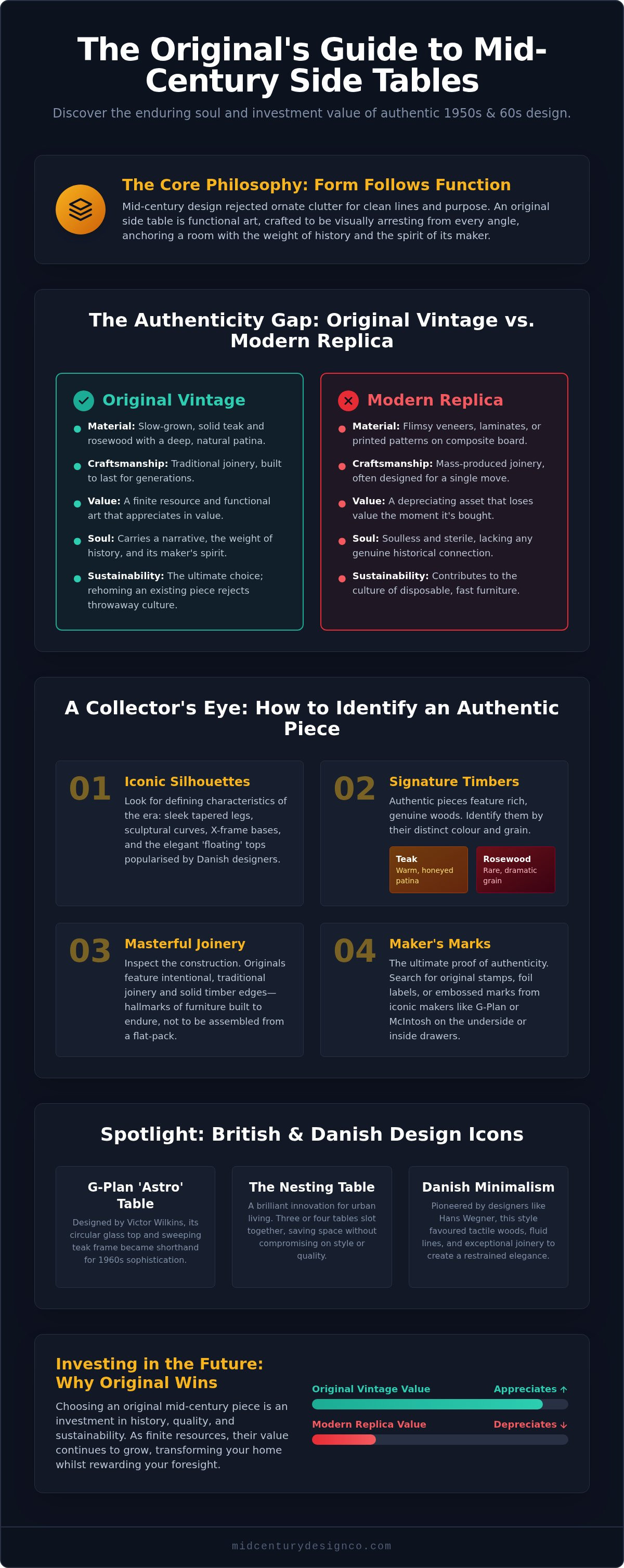
The mid-century modern movement, spanning roughly from 1945 to 1975, wasn't merely a trend; it was a radical shift in how we inhabit our homes. At its heart lay the principle that form must follow function. This era rejected the heavy, ornate clutter of the past in favour of clean lines and purposeful design. A mid century side table from this period is a masterclass in this philosophy. It's a versatile, occasional piece that does more than hold a drink or a book. It anchors the room. It acts as a bridge between furniture and sculpture. We call this functional art because these pieces were crafted to be visually arresting from every conceivable angle, ensuring they look as beautiful from the back as they do from the front. Whilst a modern replica feels sterile and temporary, an original piece carries the weight of history and the spirit of its maker.
The Philosophy of MCM Design
Post-war designers were driven by a profound sense of optimism. They embraced organic shapes and sleek, tapered legs to create a sense of lightness and air. This was structural poetry in small-scale furniture. Unlike modern flat-pack alternatives designed for a single move, these tables were built to endure for generations. The joinery is intentional. The proportions are balanced. Every curve serves a purpose, reflecting a time when furniture was an investment in a better, more organised way of living. These tables weren't just mass-produced; they were thoughtfully engineered to solve the problems of modern urban life, fitting perfectly into the smaller footprints of post-war housing whilst maintaining a sense of grandeur and aesthetic poise.
Vintage vs. Reproduction: The Authenticity Gap
There is a palpable difference between an original vintage piece and a high-street reproduction. It begins with the timber. An original mid century side table often features slow-grown teak or rosewood, materials that have developed a deep, honeyed patina over six decades. This warmth is impossible to replicate in a factory. Whilst modern "style" pieces rely on thin, fragile laminates or printed patterns, authentic icons utilise thick, genuine wood veneers and solid timber edges. Choosing original vintage isn't just an aesthetic preference; it's the ultimate sustainable choice. By rehoming a piece that already exists, you're rejecting the throwaway culture of modern retail and choosing a legacy of quality that has already stood the test of time. You're not just buying a table; you're preserving a fragment of design history that will continue to appreciate in both beauty and value.
Iconic Silhouettes: Examples of Mid Century Craftsmanship
The silhouette of a vintage piece is its most defining characteristic. It's the first thing that captures the eye and the last thing that leaves an impression. From the playful, three-legged tripod "picket" designs to the architectural stability of sculptural "X-frame" bases, the diversity of the era is staggering. A mid century side table isn't just a flat surface; it's a study in geometry and balance. In the UK, this period was dominated by the visionary output of G-Plan and McIntosh, firms that successfully translated high-concept European modernism for the British home with remarkable precision.
Icons like the "Astro" and "Spider" occasional tables, designed by Victor Wilkins for G-Plan, became shorthand for 1960s sophistication. These pieces, with their circular glass inserts and sweeping teak frames, offered a sense of transparency and flow that helped smaller rooms feel significantly more spacious. For those navigating the constraints of urban living, the "nesting table" was a revelation. It's a brilliant innovation where three or four tables slot perfectly beneath one another, ready to be deployed for guests and tucked away just as quickly to reclaim floor space. Each table in a nest was crafted with the same attention to detail as a standalone piece, ensuring a cohesive look regardless of how they were arranged.
Danish Modern Influence
The Danish approach favoured a more restrained, minimalist elegance. You'll often see "floating" tops that appear to hover weightlessly above the frame, a detail that requires exceptional joinery to achieve. Designers like Hans Wegner and Grete Jalk pioneered this aesthetic, focusing on the tactile quality of the wood and the fluidity of the line. Their work set a global standard for Nordic craftsmanship, a theme we explore in depth within our Danish desk UK guide.
British Manufacturing Excellence
British makers brought their own distinct flavour to the movement, blending industrial efficiency with artisanal flourishes. The "Fresco" range by G-Plan and the "Sierra" series by McIntosh are perhaps the most celebrated examples. These designs are characterised by solid teak pull handles and the iconic "cigar" leg, a tapered form that narrows towards the floor to create a sense of poised elegance. These pieces were often part of a wider design language, intended to sit alongside mid century modern sideboards to create a unified, harmonious living space. If you're looking to begin your own collection, you might enjoy browsing our current selection of authentic coffee and occasional tables to find a piece that resonates with your home's unique spirit.
Materiality and Patina: The Warmth of Original Timber
The tactile experience of an original piece is where its narrative truly begins. When you run your hand across the surface of an authentic mid century side table, you aren't just touching wood; you're feeling decades of history. Teak was the undisputed sovereign of the era. Its high natural oil content and incredibly tight grain made it the ideal medium for the sleek, organic forms of the period. It's resilient. It's warm. Over sixty years, this timber doesn't just age; it mellows into a deep, honeyed glow that no modern factory finish can replicate.
Whilst teak offered a golden warmth, rosewood provided the drama. It was the choice for high-end, executive pieces. The grain of vintage rosewood is a landscape of dark, sweeping lines and rich, chocolatey depths. It's rare. It's striking. Because of modern environmental protections, these original pieces represent a finite resource of a timber that's now strictly controlled. This creates a sense of "patina" that goes beyond mere surface wear. It's the story of the wood as it has lived amongst families, absorbing light and life to create a character that is entirely unique to that specific table.
The Art of the Veneer
In the vintage market, the word "veneer" is a badge of honour. It shouldn't be confused with the paper-thin, plastic-feeling laminates found in today's high-street shops. For mid-century craftsmen, veneering was a sophisticated technique used to showcase the most beautiful grain patterns. They used thick, historic veneers to create "book-matched" designs. This is where two consecutive slices of wood are laid side-by-side to create a mirrored, symmetrical pattern that looks like an open book. It's a mark of extreme skill. When you look at the edge of an original table, you'll often see solid wood banding that protects the veneer, a detail that ensures the piece remains robust enough for another sixty years of use.
Beyond the Wood: Glass and Tile Accents
As the movement evolved into the 1970s, designers introduced new textures to break up timber-heavy interiors. Smoked glass became a staple for "cocktail" side tables, adding a layer of moody, translucent depth. Ceramic tiles were another brilliant innovation, often found in vibrant oranges or earthy browns. These materials offered several benefits for the modern home:
- Durability: Tile tops are naturally resistant to heat and moisture, ideal for resting a hot tea or a cold glass.
- Visual Contrast: The cold, smooth surface of glass or ceramic provides a striking counterpoint to the organic warmth of teak.
- Ease of Care: These surfaces are incredibly simple to wipe clean, making them perfect for high-traffic areas.
This blend of materials ensures that a mid century side table remains a focal point of colour and texture whilst serving as a hard-working piece of functional art.
The Collector’s Eye: How to Identify an Authentic Piece
Identifying an authentic mid century side table requires a shift in perspective. You aren't searching for the sterile perfection of a factory floor; you're looking for the tangible evidence of a human hand and a specific era of manufacturing. It begins with the joinery. Authentic pieces from the 1950s and 60s utilised traditional techniques like dovetail joints in drawers and thick, solid wood edge-banding to protect the veneer. These details weren't just for show. They were functional choices that have allowed these objects to survive for over half a century whilst maintaining their structural integrity.
Always check beneath the tabletop or inside the drawers for a "Maker's Mark". This might be a faded gold stamp from G-Plan, a metallic McIntosh medallion, or a simple foil label. Even without a mark, the weight and balance of a piece speak volumes. Genuine teak and rosewood are dense, heavy timbers. An original table will feel grounded and stable. A modern imitation often feels surprisingly light and hollow due to its chipboard core. Finally, analyse the hardware. Original pieces often feature brass-tipped "socks" on the legs or unique slot-head screws. If you find Allen key bolts or plastic components hidden in the frame, you're looking at a contemporary reproduction.
Spotting the "Red Flags" of Modern Replicas
Modern "style" items are often betrayed by their materials. Look for "too-perfect" grain patterns that repeat across the surface; this is a clear sign of printed laminate rather than natural wood. In an original piece, the grain is as unique as a fingerprint. Examine the edges closely. If you see a thin, peeling strip of plastic instead of solid wood banding, it's a modern replica. These items lack the historical weight and sensory warmth of an original, and they'll never hold their value in the way a vintage icon does.
Condition vs. Character
We often encourage collectors to embrace the "well-loved" patina of a vintage find. A slight mellowing of the wood or a faint ring mark from a long-forgotten gathering adds to the spirit and narrative of the object. These aren't flaws; they're proof of authenticity and a life well-lived. Structural damage like loose joints or deep splits in the timber should be avoided, but minor cosmetic signs of age are part of the charm. If you're ready to find a piece with its own story, you can browse our curated collection of authentic vintage furniture to see these details for yourself. Trust your senses. The smell of aged wood, the coolness of original brass, and the steady weight of the frame all combine to tell a story that a replica simply cannot mimic.
Investing in the Future: Why Original Vintage Wins
Investing in an original mid century side table is a decision that rewards both the eye and the bank balance. While high-street furniture often loses a staggering amount of its value the moment it leaves the shop, authentic vintage pieces represent a stable, often appreciating, market. These aren't just objects; they're finite resources. They aren't making any more 1962 teak tables, and as the global appreciation for mid-century modernism grows, these original icons become increasingly sought after. Choosing vintage is also a profound act of environmental stewardship. In a world of fast furniture and landfill-bound chipboard, buying an existing piece is the ultimate form of recycling, supporting a circular economy that values longevity over convenience.
The Financial Logic of Vintage
The financial logic is clear. A curated mid century side table acts as a portable asset that you can enjoy daily. If your lifestyle changes, a well-maintained G-Plan or McIntosh piece is far easier to re-sell than a generic modern replica. By following the "buy once, buy well" philosophy, you're stepping away from the exhausting cycle of replacement. You're acquiring a piece of functional art that has already survived sixty years and is perfectly prepared to survive another sixty. Even a single authentic side table can transform a room, acting as a sophisticated anchor that lends credibility and soul to more affordable, contemporary surroundings. It provides a focal point that suggests a refined eye for quality, effortlessly elevating the aesthetic of the entire space.
Creating a Sanctuary with Soul
Creating a home that feels truly yours is about more than matching colours or following trends. It's about the narrative of your space. Furniture with a history helps create an interior that feels collected rather than merely decorated. It's the difference between a house and a sanctuary. When you choose an original piece, you're inviting a fragment of the past into your daily life, creating a bridge between eras. If you're looking for smaller-scale inspiration to begin your journey, we invite you to browse our current collection of original vintage bedside cabinets. Each piece we curate is a testament to an era of optimism and enduring quality.
Explore our latest curated finds at The Mid Century Design Co. and discover the perfect vintage icon to elevate your living space with purpose and soul.
Elevate Your Space with a Piece of Design History
Embracing the past is a powerful way to define your future interior. By choosing an original mid century side table, you're rejecting the transient nature of modern trends in favour of something permanent and deeply soulful. We've explored the tactile warmth of aged teak and the architectural precision of iconic British and Danish silhouettes. These pieces aren't just furniture; they're functional art that holds its value whilst telling a story of post-war optimism and artisanal skill.
At The Mid Century Design Co., we believe your home should be a curated sanctuary. Each piece in our collection is hand-selected for its unique character and exceptional craftsmanship by passionate specialists. We're dedicated to helping you find original vintage icons that anchor your space with purpose. With national UK delivery available, your next investment-grade discovery is closer than you think.
Discover our curated collection of authentic mid-century side tables
Your journey to a more intentional home begins with a single, storied object.
Frequently Asked Questions
How can I tell if a mid century side table is real teak or just a walnut stain?
You can distinguish real teak from a walnut stain by examining the depth of the grain and the weight of the timber. Real teak possesses a high natural oil content and a tight, distinctive grain that creates a warm, honeyed glow. A stain merely sits on the surface, often appearing flat or muddy when viewed in natural light. If you scratch a hidden area, authentic teak will reveal consistent colour throughout the wood.
Are original 1960s sideboards and side tables a good financial investment in the UK?
Original 1960s furniture represents a finite resource, making it an excellent financial investment for UK homeowners. Unlike modern high-street items that depreciate instantly, a well-chosen mid century side table or sideboard often appreciates as demand for authentic craftsmanship grows. These pieces are increasingly viewed as portable assets. They offer a unique combination of historical significance and functional art that maintains a strong resale market amongst collectors.
What is the best way to clean and maintain an original vintage teak tabletop?
Maintaining an original teak tabletop requires a gentle touch and a rejection of harsh chemical sprays. Simply use a soft, damp lint-free cloth for daily dusting to preserve the wood's natural character. To restore its lustre, apply a high-quality teak oil or Danish oil once or twice a year. This nourishes the fibres and enhances the deep, golden patina that has developed over decades, ensuring the timber remains supple.
Why are Danish side tables usually more expensive than British-made ones?
Danish pieces often command higher prices due to their smaller production runs and the global reputation of Nordic designers. Whilst British makers like G-Plan were masters of high-quality mass production, Danish workshops frequently utilised rarer timbers like Brazilian rosewood. The level of hand-finishing in Danish furniture is often more intensive. This creates a level of sculptural refinement that collectors across the world are willing to pay a premium for.
Can I mix different wood tones, like teak and oak, in a mid-century themed room?
Mixing wood tones is a brilliant way to add texture and depth to a room. Combining the golden warmth of a mid century side table with the lighter hues of oak creates a space that feels collected and organic rather than showroom-perfect. The secret lies in ensuring the pieces share a similar design language. Look for clean lines or tapered legs to provide a sense of visual harmony across different timber species.
Do original mid-century tables always have a maker’s mark or label?
Original pieces do not always retain their maker’s marks or foil labels. Over sixty years, paper stickers often peel away and stamps can fade into the grain. Whilst a mark provides instant certainty, the absence of one doesn't mean the piece isn't authentic. Expert collectors focus on the quality of the joinery, the weight of the timber, and the specific silhouettes that define the era’s most celebrated manufacturers.
Is it better to buy a restored vintage table or one in its original "untouched" condition?
Choosing between restored and untouched condition depends on your personal appreciation for history. A restored table offers immediate utility and a flawless finish, whilst an untouched piece retains the raw narrative of its previous lives. Many collectors prefer a light, sympathetic clean that preserves the authentic patina. This approach respects the spirit of the object, allowing minor signs of age to act as proof of its vintage heritage.