

The Ultimate Guide to Sourcing an Authentic Danish Desk in the UK
A mass-produced desk is often little more than a temporary placeholder, a cold surface that loses value the moment it leaves the showroom. You likely feel that your workspace should offer something deeper; a sense of history and a connection to an era when furniture was crafted with an artist’s eye. Finding an authentic Danish desk UK wide can feel like a daunting pursuit, especially when you’re trying to distinguish a genuine 1960s masterpiece from a clever modern imitation.
It’s natural to worry about whether a vintage piece can handle the weight of a modern monitor or if that rich, organic grain is truly rosewood or merely a surface-level stain. You want a sanctuary that inspires your best work whilst acting as a tangible investment. This guide is designed to be your expert companion in that journey. We’ll walk through the specific markers of mid-century craftsmanship, from the hidden maker’s marks to the sculptural logic of the joinery. You’ll discover how to evaluate wood types and, ultimately, how to select a piece that brings soul to your home office and retains its value for decades to come.
Key Takeaways
- Learn to spot the hallmarks of 1960s craftsmanship, such as precision dovetail joinery and authentic "Made in Denmark" stamps, to ensure your piece is a genuine original.
- Distinguish between the warm, golden hues of teak and the deep, dramatic grain of rosewood to find the material that best reflects your personal style.
- Explore iconic profiles, including the sculptural floating top, to find a Danish desk UK interiors can accommodate, regardless of your room’s dimensions.
- Understand why original vintage furniture is a superior environmental choice and a robust financial investment compared to mass-produced modern reproductions.
- Discover how to integrate these mid-century masterpieces into a contemporary workspace, ensuring your home office remains both functional and soulfully curated.
The Allure of the Danish Desk: A UK Perspective on Mid-Century Craftsmanship
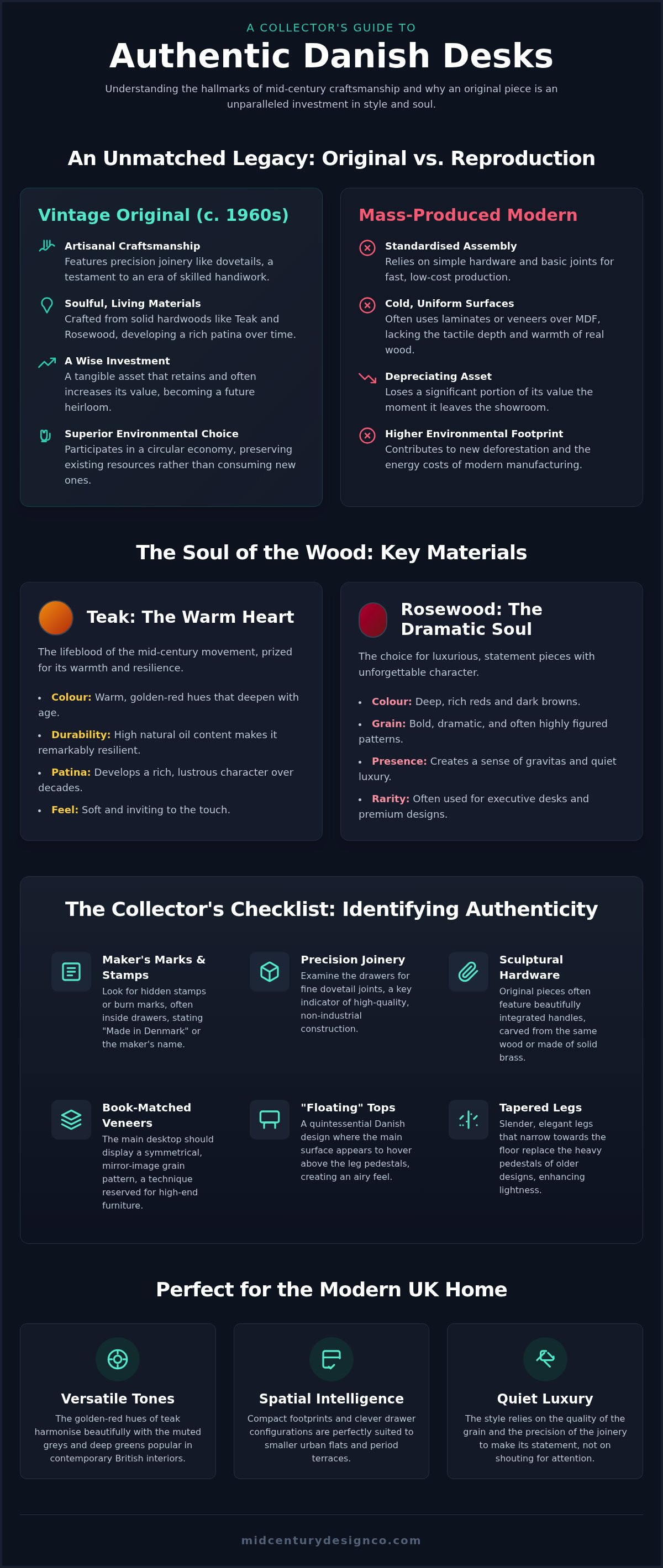
A genuine Danish desk is far more than a surface for a laptop. It's a masterclass in organic minimalism. This movement, which flourished in the 1950s and 60s, treated wood as a living medium. The result was furniture that felt soft to the touch and easy on the eye. When you run your hand across an original teak surface, you aren't just touching timber; you're feeling decades of careful oiling and craftsmanship. This "soul" is precisely what's missing from modern, mass-produced alternatives. For anyone sourcing a Danish desk UK wide, this tactile connection is often the first thing they notice.
The Danish modern design movement redefined the relationship between a worker and their tools. It moved away from the idea of the office as a place of cold industry. Instead, it positioned the workspace as a sanctuary for creativity. In the UK, these pieces became staples of sophisticated homes because they offered a bridge between traditional warmth and modern efficiency. They don't impose on a room. They invite you into it.
The 1960s Golden Era of Danish Design
Designers like Svend Åge Madsen and Kai Kristiansen were at the forefront of a workspace revolution. They replaced the heavy, floor-length pedestals of the Victorian era with tapered legs and "floating" surfaces. This shift changed everything. A desk was no longer a dark, imposing block that anchored a room in gloom. Instead, it became a light, airy silhouette that allowed light to pass underneath and around it. This transparency makes even the most modest UK study feel expansive. This era remains the pinnacle for collectors because it represents a perfect balance of sculptural beauty and daily utility.
Why the UK Home Still Embraces Scandinavian Modernism
British architecture often presents a unique challenge: rooms that are rich in character but modest in size. The compact footprint of a vintage Danish desk UK homes can accommodate is a significant advantage. These pieces were designed for efficiency without sacrificing elegance. There are several reasons why this style remains a favourite amongst UK homeowners:
- Versatile Tones: The golden-red hues of teak harmonise beautifully with the muted greys and deep forest greens popular in contemporary British palettes.
- Spatial Intelligence: Clever drawer configurations and slim profiles suit smaller urban flats and period terraces alike.
- Quiet Luxury: It's a style that doesn't scream for attention. It relies on the quality of the grain and the precision of the joinery to make its statement.
Investing in an original piece is about more than just aesthetics. It's about bringing a sense of calm and history into your home. A vintage desk doesn't just hold your computer; it holds a narrative of design heritage that continues to inspire decades after it was first carved.
Teak, Rosewood, and Soul: Understanding the Materials of Original Danish Desks
The choice of timber defines the spirit of a Danish desk UK collectors cherish. It isn't merely a structural decision. It's an emotional one. While modern office furniture often relies on cold, uniform laminates, original 1960s pieces offer a tactile depth that only decades of growth can produce. Touching a vintage desk provides a grounding experience, connecting you to the natural world whilst you work. Finding an authentic Danish desk UK buyers can trust often begins with understanding these two primary timbers.
Choosing vintage is the most sophisticated form of environmental stewardship. By sourcing an existing piece, you're preserving the hardwoods used sixty years ago rather than contributing to new deforestation. It's a circular economy of beauty. These materials were selected for their longevity, ensuring that a piece bought today will likely outlast its owner.
The Warmth of Teak Grain
Teak was the lifeblood of the mid-century movement. Its high oil content makes it remarkably resilient, allowing it to age with a grace that few other materials can match. Over the years, the wood develops a rich patina, a deepening of its golden-red hue that serves as a record of its history. When inspecting a piece, look for book-matched veneers on the desktop where the grain patterns mirror each other with architectural precision. The surface of a teak desk feels alive under the soft glow of a desk lamp, radiating a honeyed warmth that softens the edges of a long afternoon.
Exotic Rosewood: The Height of Sophistication
For those seeking a more dramatic statement, rosewood is the ultimate expression of executive luxury. Its grain is more volatile and expressive than teak, featuring dark, ink-like swirls against a chocolate background. These pieces are held in high regard by institutions like the Victoria and Albert Museum furniture collection for their rarity and visual impact. Rosewood desks often represent the pinnacle of a designer's portfolio, intended for rooms where the furniture is expected to do the talking.
Because of its scarcity, rosewood is considered investment grade. It's vital to ensure any piece you acquire complies with CITES regulations; authentic vintage items made before 1947 or those with clear provenance are the gold standard. These desks don't just furnish a room. They command it. If you're ready to find a piece with this level of character, you might explore our current selection of curated office furniture to see these grains in person. Each piece tells a story of the forest and the workshop, waiting to become part of your own narrative.
Comparing Iconic Profiles: From Floating Tops to Executive Statues
The silhouette of a Danish desk UK collectors seek out is often what first captures the heart. It’s a geometry of grace. While the choice of timber provides the warmth, the profile defines how the piece interacts with your room's light and volume. These designs aren't accidental. They're the result of a scholarly analysis of Danish Modern principles that prioritised the human experience within a space. Every curve and angle serves a purpose, ensuring the furniture feels as good to use as it does to admire.
For those with a dedicated office, the executive desk offers a commanding presence. These double-pedestal designs provide ample storage and a sense of architectural permanence. It’s the "statue" of the collection. Often finished on the back, these pieces are meant to stand in the centre of a room rather than being hidden against a wall. The choice of leg style further influences this mood. Tapered 'cigar' legs offer a delicate, mid-century lightness that makes even a large desk feel nimble. In contrast, sled bases provide a more grounded, modernist aesthetic. They feel solid. They feel deliberate.
The Magic of the Floating Top
The floating top is perhaps the most celebrated silhouette in Scandi design. By separating the desktop from the drawer units using small wooden or brass spacers, designers achieved a weightless "hovering" effect. This structural ingenuity isn't just a visual trick; it allows light to flow through the piece, preventing it from feeling heavy in a smaller UK study. It creates a sense of airiness that modern reproductions rarely replicate. To complete the ensemble, you might pair with a vintage teak office chair to maintain that cohesive, sculptural aesthetic.
The Versatile Danish Bureau
In many British homes, a separate office is a luxury. This is where the Danish bureau excels. These pieces are masterclasses in space-saving engineering, combining a chest of drawers, a display cabinet, and a workspace into one elegant footprint. The pull-out or drop-down desktop is the secret. It allows you to transform a living room corner into a productive hub in seconds, then hide the clutter away when the workday ends. It’s a functional art form that respects the constraints of modern living whilst offering the soul of a 1960s original. For a Danish desk UK buyers can use in multi-functional spaces, the bureau is an unrivalled solution.
The Collector’s Checklist: Identifying Authentic 1960s Danish Designs
Finding a genuine Danish desk UK wide involves more than just admiring a sleek silhouette. It requires a tactile investigation. When you approach a piece, start with its physical presence. Authentic mid-century desks possess a surprising heft. They were constructed using substantial solid woods or thick, high-quality veneers over sturdy cores. If a desk feels light or hollow, it's likely a modern reproduction using inferior chipboard. This "weight test" is your first line of defence against poorly made imitations.
Next, look where others don't. Tilt the desk or crawl beneath it to inspect the underside of the frame and the desktop. On an original 1960s piece, the wood underneath will show its age differently than the polished top. You'll often see a drier, paler texture or even the original markings from the timber yard. This natural oxidation is impossible to fake convincingly. It's a quiet testament to the decades the piece has already survived.
Dovetails and Finger Joints
The drawers of a Danish desk are often where the highest level of artistry is hidden. High-quality mid-century pieces almost always feature dovetail or finger joints. These interlocking wedges of wood aren't just decorative; they provide incredible structural integrity. Hand-cut joints from the earlier part of the era might show tiny, charming irregularities, whilst machine-cut joints from the late 1960s will be perfectly uniform but still vastly superior to modern staples or glue. Joinery is the silent signature of a Danish craftsman, whispering of a time when furniture was intended to endure for generations. If you see plastic runners or simple butt joints, it's a clear sign the piece lacks the heritage you're seeking.
Maker's Marks and Stamps
While not every piece was signed, many of the finest examples carry a mark of their origin. Look inside the top drawers or on the underside of the main frame for "Made in Denmark" heat stamps or gold foil labels from manufacturers like Fritz Hansen or Sibast. Another vital mark is the "Danish Control" logo, a distinctive circular or triangular stamp. This was an industry-led initiative to ensure that furniture intended for export met the highest standards of Danish design and material quality. Even if a label is missing, a distinctive handle shape or a specific leg attachment can often be traced back to a specific designer with a bit of research. For those ready to begin their collection with confidence, you can browse our authenticated range of Danish office furniture to see these hallmarks in person.
Curating Your Workspace: Why an Original Vintage Desk Surpasses Modern Reproductions
Choosing a Danish desk UK buyers can pass down through generations is an act of curation rather than mere consumption. A modern reproduction might mimic the silhouette, but it lacks the structural integrity and financial resilience of an original. Whilst a new, flat-pack desk begins its journey toward a landfill the moment it's assembled, a 1960s vintage piece is investment grade. These desks often appreciate in value; they're functional assets that have stood the test of time and market trends. Investing in heritage means your money isn't lost to depreciation but held in the grain of the wood.
Beyond the balance sheet, there’s the matter of soul. A vintage desk carries the quiet marks of its history, a softening of the edges and a depth of colour that no factory finish can replicate. It’s a narrative you can feel. When you sit at an original piece, you aren't just working; you're participating in a design legacy. There are several qualities that set an original apart:
- Tactile History: The unique patina developed over sixty years of use.
- Structural Weight: The presence of high-quality timber that feels solid and permanent.
- Finite Beauty: The knowledge that your piece is a genuine slice of 1960s history, not a mass-produced copy.
The Sustainable Choice for UK Interiors
Collectors often speak of a 'buy once, buy well' philosophy. In an age of fast furniture, choosing an original teak or rosewood piece is the most eco-conscious decision a homeowner can make. You aren't just buying wood; you're preventing 60-year-old craftsmanship from being replaced by carbon-heavy new production. It's the ultimate form of recycling. To see how these pieces settle into a modern home, you might learn how to style vintage furniture to create a layered look that feels both fresh and timeless.
Modern Functionality in a Vintage Form
One common concern is whether a 1960s Danish desk UK professionals use today can accommodate a 21st-century workflow. Surprisingly, the ergonomics of the era are often superior to modern standards. The standard height of these desks pairs beautifully with contemporary office chairs, providing a comfortable posture for long hours at a screen. You don't have to sacrifice your health for your aesthetic.
Cable management requires a gentle touch. Rather than drilling into the timber, use weighted cable blocks or adhesive clips tucked behind the frame to keep your workspace tidy without compromising the wood’s integrity. This blend of vintage soul and modern tech creates a workspace that doesn't just function but truly inspires. We invite you to explore the wider Danish furniture collection at The Mid Century Design Co. to find the perfect companion pieces for your curated sanctuary.
Investing in a Legacy of Design
A workspace is more than just a place of utility; it's a sanctuary where your best ideas should feel at home. By choosing an authentic 1960s piece, you're moving beyond the cycle of fast furniture and into a world of lasting value. You now know that the soul of a genuine Danish desk UK collectors love lies in the rich grain of teak or rosewood and the silent precision of hand-finished joinery. These desks don't just hold your technology; they ground your room in a narrative of mid-century elegance and environmental responsibility.
Finding the perfect piece is a journey of discovery. Whether you're drawn to the weightless grace of a floating top or the commanding presence of a double-pedestal executive desk, the right choice will serve as a functional investment for decades. At The Mid Century Design Co., we're passionate collectors first. Our pieces are expertly curated to ensure that authenticity is guaranteed. We never deal in reproductions, and we offer nationwide UK delivery to help you bring a piece of design history into your home.
We invite you to explore our curated collection of authentic Danish desks and find the silhouette that speaks to your space. Your future workspace is waiting for its heritage.
Frequently Asked Questions
Is a vintage Danish desk a good investment for a UK home?
Original mid-century pieces have historically appreciated as the supply of high-quality vintage timber dwindles. Unlike modern mass-produced furniture that loses value immediately, a well-maintained Danish desk UK buyers acquire today often acts as a tangible asset. It is an investment in both aesthetic pleasure and financial stability, provided the piece is a genuine 1960s original rather than a contemporary reproduction.
How can I tell the difference between solid teak and teak veneer?
Examine the edges and the grain transition closely. On solid teak, the grain pattern continues seamlessly around the corner of the wood. On veneer, you will often see a very thin line where the decorative surface meets the core material. Most high-end Danish designers used a combination of solid wood for legs and exquisite veneers for desktops to prevent warping whilst showcasing the most dramatic grain patterns.
What should I look for to ensure a Danish desk is authentic?
Check for the "Danish Control" stamp or maker's labels tucked inside the top drawers. Authentic pieces also showcase superior joinery like dovetails and finger joints rather than modern staples or glue. The weight of the piece is another telltale sign; genuine vintage desks are surprisingly heavy due to the density of the woods used. Avoid anything that feels light or uses plastic components in the runners.
Do vintage Danish desks come with locks and original keys?
Many original designs featured locking drawers for privacy, but original keys are frequently lost over the decades. It is common to find pieces where the locks remain perfectly functional but require a replacement skeleton key. If a desk still possesses its original brass key, it adds a layer of charm and historical completeness to the piece. This small detail often reflects the meticulous care given by previous owners.
How do I maintain and clean a 1960s teak desk?
Use a soft, dry cloth for daily dusting and a high-quality teak oil once or twice a year to nourish the wood. Avoid modern aerosol polishes that contain silicone, as these build up a sticky residue and mask the natural grain. If the timber looks thirsty, a light application of oil will restore its golden-red glow and protect the surface from moisture, ensuring the patina continues to develop beautifully.
Are Danish desks large enough for modern dual-monitor setups?
Executive-style models and larger floating-top designs are perfectly suited for modern technology. Whilst compact bureaus are better for single laptops, a standard Danish desk UK professionals use often measures between 130cm and 150cm in width. This provides ample space for a dual-monitor setup without overcrowding the sculptural desktop. Always measure your monitor base footprint before committing to a specific vintage profile to ensure a comfortable fit.
What is the difference between Danish and British mid-century furniture?
Danish furniture is typically characterised by more organic, sculptural lines and a lighter visual weight. British mid-century pieces, whilst often excellent, tend to be slightly more robust and conventional in their form. Danish designers pushed the boundaries of timber, creating "floating" effects and tapered legs that give the furniture a sense of movement. This artistic daring distinguishes it from the sturdier, more traditional British counterparts of the same era.
Why is rosewood more expensive than teak for vintage desks?
Rosewood is more expensive because of its extreme rarity and the complexity of its expressive grain. It was traditionally reserved for high-end executive commissions, making it much harder to find on the vintage market today. Its dramatic, dark swirls offer a level of visual prestige that teak, with its more uniform honeyed tones, cannot match. This scarcity and luxury status command a higher price amongst serious collectors and design enthusiasts.