

The Expert Guide to Buying Vintage Modular Shelving in the UK
A home should be more than a collection of objects; it should be a living narrative of your taste and history. In the pursuit of a curated sanctuary, few pieces offer the same structural poetry as vintage modular shelving UK collectors have come to prize. You likely appreciate the airy, architectural lines of a mid-century system, yet the transition from admirer to owner often feels fraught with complexity. It’s easy to feel overwhelmed by the cryptic language of bays, ladders, and stringers, or the nagging worry that a found treasure might arrive incomplete and unusable.
This guide demystifies the process of acquiring these iconic designs, focusing on the enduring legacy of Staples Ladderax and the warmth of authentic Danish teak. You’ll discover how to distinguish between genuine mid-century veneers and modern imitations, ensuring your choice is a lasting investment rather than a fleeting purchase. We will walk through the essential steps of measuring your space with precision and planning a configuration that evolves with your life. By the end, you’ll have the confidence to curate a functional masterpiece that brings both order and soul to your interior.
Key Takeaways
- Distinguish between British Staples Ladderax and Danish wall-mounted systems to choose a structure that perfectly complements your home's architecture.
- Decode the terminology of "bays" and "ladders" so you can plan a bespoke layout that's both functional and visually balanced.
- Gain the expertise to identify authentic markings when browsing vintage modular shelving UK listings; it's essential for securing an investment-grade piece.
- Discover the critical difference between a system in good vintage condition and one that's lost its structural integrity or original soul.
- Understand why investing in an original mid-century system is a savvy financial and environmental choice; these pieces often appreciate in value whilst adding character to your home.
Why Vintage Modular Shelving is the Soul of the Mid-Century Home
A home should be a reflection of your personal narrative, a sanctuary where every object tells a story of craftsmanship and intent. In the mid-century era, domestic life underwent a radical transformation as the heavy, static mahogany of the Victorian age gave way to a lighter, more ethereal aesthetic. This shift was driven by a desire for air and light, leading to the birth of the "floating" wall system. Modular shelving is a system of interchangeable components supported by a skeletal frame. For those sourcing vintage modular shelving UK wide, the appeal lies in this marriage of form and function. These systems use the sensory warmth of teak and rosewood to create a tactile experience that modern, flat-pack alternatives simply cannot replicate. They remain the gold standard for British interior designers today because they provide a structural spine for a room without ever feeling overbearing.
The Versatility of the Modular Concept
Post-war life required flexibility. As 1960s families grew, their furniture needed to evolve alongside them. The beauty of the modular system lies in its remarkable adaptability. You can effortlessly integrate a drop-down bureau for a discreet workspace, a record cabinet for a burgeoning vinyl collection, or simple open shelving for a curated display of ceramics. For the typical UK home where space is often at a premium, the "open-back" design is a revelation. It allows the wall colour to breathe through the frame, preventing the room from feeling closed in. It creates a sense of depth and transparency that makes even the most compact living room feel expansive and organised.
A Sustainable Choice for the Modern Collector
Choosing vintage modular shelving UK is an act of quiet rebellion against the culture of the disposable. The Danish design movement prioritised material integrity and longevity, ensuring that these pieces would survive for decades. Unlike modern veneers that often peel or chip under pressure, solid wood and high-quality vintage finishes develop a rich, soulful patina over time. Buying an original system is a commitment to reducing your carbon footprint whilst acquiring a genuine asset. You are investing in a finite piece of history that holds its historical weight and financial value. These systems weren't built for a single season; they were crafted to be the enduring heart of a home, passing from one generation to the next with their spirit entirely intact.
Understanding the Icons: Staples Ladderax vs. Danish Wall Systems
The choice between a British icon and a Scandinavian masterpiece often defines the spirit of a room. Whilst both offer the adaptability discussed earlier, their physical presence tells a different story. For many sourcing vintage modular shelving UK homes require, the decision rests between the structural clarity of the Staples Ladderax system and the organic, floating elegance of Danish wall units. One offers an industrial, architectural framework. The other provides a seamless, wooden embrace of the wall itself. At The Mid Century Design Co., we specialise in both, acting as curators for these storied systems that bridge the gap between utility and art.
The Staples Ladderax System: A British Masterpiece
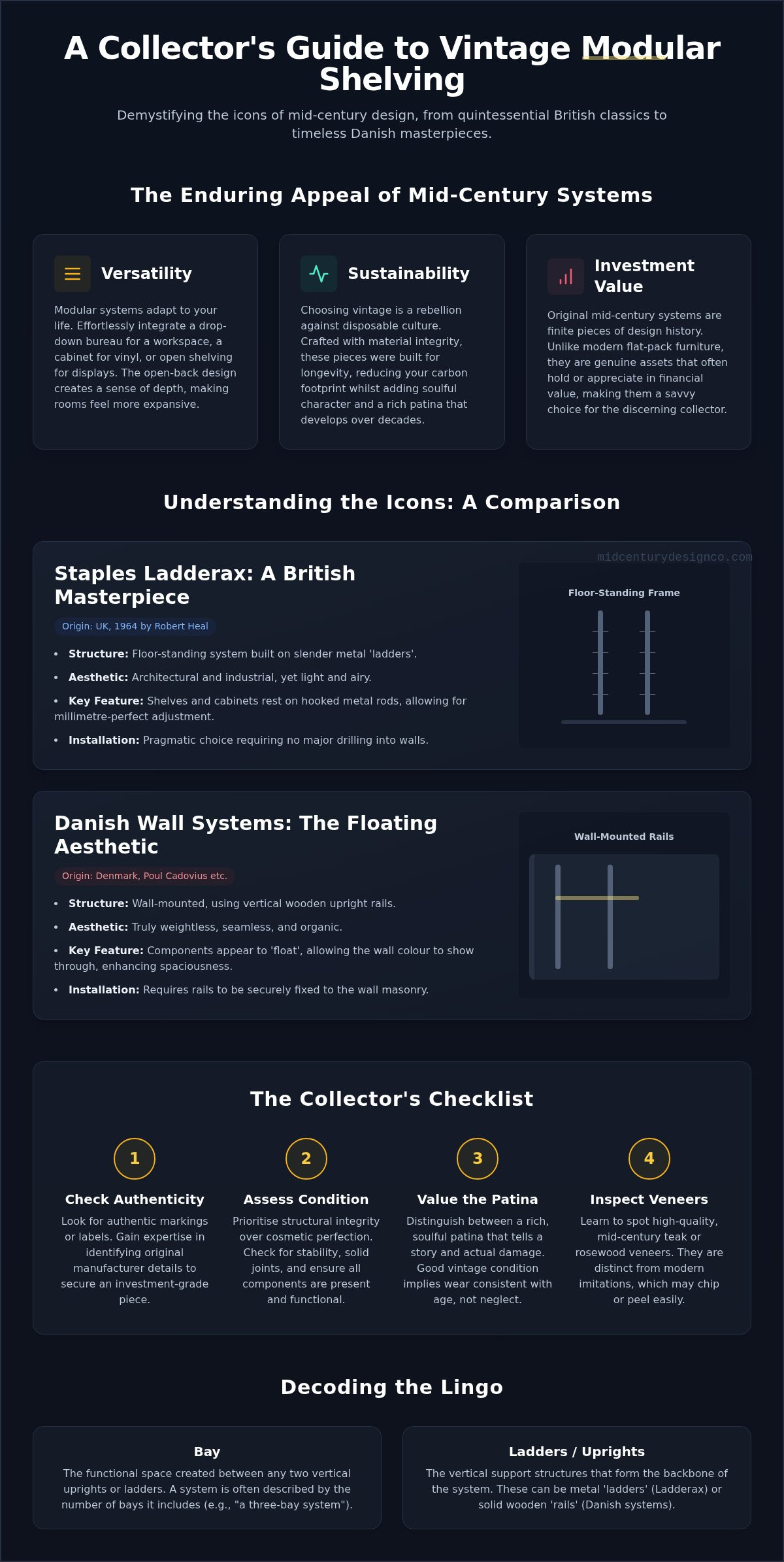
Designed by Robert Heal in 1964 for Staples of Cricklewood, Ladderax remains a triumph of British industrial design. Its signature lies in the slender metal ladders, typically finished in black, white, or a luxurious gold. These uprights allow for an incredible degree of customisation. The system uses hooked metal rods that sit across the rungs, enabling millimetre-perfect positioning for shelves and cabinets. It's a design that feels both sturdy and remarkably light. We frequently source and stock Staples Ladderax systems with diverse configurations, from deep bureaus to glazed display cabinets. Its floor-standing nature makes it a versatile choice for those who prefer not to drill extensively into their masonry. It’s a pragmatic yet beautiful solution for the modern collector who values British heritage.
Danish Modern Shelving: The Floating Aesthetic
In contrast, Danish systems by designers such as Poul Cadovius or Kai Kristiansen lean into a truly weightless look. These units rely on wooden upright rails that are fixed directly to the wall. This removes the need for floor supports entirely. The result is a "floating" effect that showcases the exquisite grain of teak or rosewood. These systems act as a rich, textured backdrop for your most cherished objects. However, they do demand a higher level of precision during installation. You must ensure the rails are perfectly vertical and the wall is capable of bearing the load. If you're looking for a piece that integrates into the very fabric of your home, our curated collection of Danish furniture offers several examples of this refined Scandinavian craft. Each piece carries the soul of its maker, inviting you to linger on the warmth of the wood and the narrative of its history.
Designing Your Space: Bays, Ladders, and Component Selection
The architecture of a room begins with a single line. In the world of vintage modular shelving UK enthusiasts adore, that line is the upright ladder. To envision your system, you must first master the logic of the "bay". A single bay is the space created between two upright ladders. If you wish to expand, a second bay requires only one additional ladder; three ladders create two bays, and four ladders create three. This shared support system is the secret to the airy, interconnected look that defines mid-century design. It allows a large-scale storage solution to feel light and integrated rather than bulky.
Before you fall in love with a specific configuration, reach for a tape measure. British homes, with their charmingly irregular skirting boards and varying ceiling heights, require a meticulous approach. You must ensure your ladders will clear the skirting board or sit flush against the wall. Measure the height of your room twice. If you are opting for floor-standing ladders that lean, allow for the slight angle of the frame. It's these finer details that ensure a piece feels like it was designed specifically for your sanctuary.
Visual harmony is equally vital for a curated home. A system feels grounded when you place "heavy" elements, like deep bureaus or record cabinets, at the base. This anchors the piece and provides structural stability. Reserve the upper rungs for "light" shelves or glass-fronted cabinets. This creates an upward flow of energy, drawing the eye towards your favourite ceramics or books without making the system feel top-heavy or overbearing.
Choosing Your Components
The true joy of modularity is the ability to tailor the system to your lifestyle. A bureau is a master of disguise. It offers a dedicated home office during the day and folds away to hide the clutter of modern life by evening. For the vinyl collector, the record cabinet is a soulful necessity. Its deeper dimensions provide the perfect cradle for an LP collection, keeping the weight low and the aesthetic sharp. You might choose solid teak sliding doors to hide essentials, or opt for glass-fronted units to display heirloom pieces whilst protecting them from dust. Each component should serve a purpose in your daily ritual.
Floor-Standing vs. Wall-Mounted
Understanding the mechanical difference between these supports is crucial for a successful installation. Floor-standing ladders offer a sense of nomadic freedom. They distribute the majority of the weight through the floor, making them easier to move between rooms and requiring fewer wall fixings. This makes them a popular choice for those who enjoy rearranging their space. Wall-mounted rails, however, offer a pure, architectural impact. They strip away the floor supports to create a "floating" effect that is undeniably sophisticated and modern.
Safety must remain a priority in your design. Regardless of the style, these systems are designed to carry significant weight, yet they are only as secure as their fixings. Wall-mounted rails transfer their entire load to the wall, requiring heavy-duty anchors into solid masonry or studs. Even floor ladders require a safety screw at the top to prevent tipping. By respecting the weight limits and the integrity of your walls, you ensure your investment remains a safe and beautiful part of your home for decades to come.
The Collector’s Checklist: Authenticity, Condition, and Patina
Developing a curator's eye is a journey of discovery. To secure the best vintage modular shelving UK collectors prize, you must learn to read the subtle language of the wood and the metal. Authenticity is found in the details. Staples Ladderax systems often carry a discreet gold stamp on the underside of shelves or tucked within the cabinet drawers, serving as a signature of authenticity. Look closely at the construction; the way the metal rods hook over the rungs should feel intentional and precise. If you spot non-original screws or crude DIY repairs, it’s a sign that the system’s structural integrity may have been compromised over the decades.
There is a profound difference between a piece that is damaged and one that has lived. We often describe pieces as being in "good vintage condition," which celebrates the soul of the object. A slight darkening of the teak where a lamp once stood or a faint, singular ring mark is not a defect; it is patina. These character marks add historical weight and value, telling the story of a home's past. However, you must be wary of structural warning signs. Bowed shelves, caused by sixty years of heavy book loads, are difficult to rectify and can make a system look tired and unstable. Always check that the ladders stand true and the cabinets sit flush within their frames.
Identifying Wood Types and Finishes
The choice of timber defines the sensory warmth of your sanctuary. Teak is the most celebrated mid-century choice, offering a honey-coloured glow that softens modern interiors. Rosewood provides a more dramatic alternative, featuring deep, swirling grains that command attention. When inspecting a system, look for book-matched veneers on the cabinet doors. This technique mirrors the grain pattern across the front, creating a symmetrical work of art from the natural wood. Authentic vintage teak furniture should be cleaned only with specialist oils, never harsh chemicals. Preserving the original finish ensures the piece continues to breathe and age gracefully in your home.
Hardware and Stability
The mechanics of a modular system are its lifeblood. The metal support rods are essential; you must ensure every rod is present and unbent, as a single missing component can render an entire bay unusable. Examine the feet of floor-standing ladders for their original levelling screws. These allow you to compensate for the slight undulations of period floors, ensuring your display remains perfectly level. Don't forget the small details that complete the narrative. Original brass keys for bureaus and locking cabinets are highly prized, as they preserve both the utility and the aesthetic charm of the piece. To find a system that meets these exacting standards, we invite you to explore our curated collection of authentic modular systems today.
Investing in History: Why an Original System Outlasts Modern Alternatives
Choosing an authentic piece of history is a decision that transcends simple interior design. When you acquire vintage modular shelving UK collectors have preserved for decades, you aren't just buying storage; you're securing a tangible asset. Unlike modern mass-produced furniture that begins to lose its value the moment it leaves the showroom, original mid-century systems often appreciate. They occupy a rare space where utility meets fine art. Every shelf and cabinet carries the soul of a piece that has lived through sixty years of history, bearing a narrative that no factory-fresh reproduction can ever hope to emulate.
The beauty of the modular philosophy is that it doesn't demand a complete transformation of your home overnight. You can begin your journey with a single, elegant bay. Perhaps it starts as a simple display for your most cherished volumes or a quiet corner for a record player. Over time, as your collection grows or your needs evolve, you can source additional ladders and components to expand the system. This gradual curation allows your home to grow organically, ensuring every addition is intentional and deeply personal. It's an invitation to become a custodian of design, building a bespoke sanctuary that is uniquely yours.
The Pitfalls of Modern Reproductions
It's tempting to consider modern "mid-century style" alternatives, yet these often fail to meet the exacting standards of the originals. Modern reproductions frequently rely on cam-locks, plastic brackets, and particle board that lacks the true weight-bearing capacity required for a substantial library. In contrast, original systems showcase superior joinery. You'll find solid wood edges and precise dovetail joints that have remained stable for over half a century. There is also the matter of the secondary market. A modern imitation has almost no resale value, whereas an authentic system remains a sought-after treasure for future generations of collectors.
Building Your Bespoke System
Envisioning your own configuration is a creative ritual. You might imagine a sprawling wall-to-wall library or a compact, multi-functional desk unit tucked into a sunlit alcove. To create a truly cohesive aesthetic, our mid century modern sideboards can often be paired with modular shelving to ground the room with a consistent timber tone. This layering of textures and forms creates a sense of established history and visual weight. We invite you to linger over our curated collection of vintage bookcases and shelving to find the perfect starting piece. Your journey toward a more soulful, organised home begins with the discovery of a single, perfect bay that speaks to your spirit.
Crafting Your Curated Sanctuary
Mastering the nuances of vintage modular shelving UK collectors prize is the first step toward transforming your living space into a gallery of functional art. You now understand the structural logic of the bay system and the critical difference between a piece with soulful patina and one with structural damage. Whether you choose the industrial clarity of Staples Ladderax or the floating grace of a Danish wall unit, you are investing in a legacy of craftsmanship that modern alternatives cannot mirror. Every piece tells a story.
At The Mid Century Design Co., we act as your expert friend and curator. We specialise in authentic Staples Ladderax systems, ensuring every component is expertly vetted for quality and character. With nationwide delivery across the UK, your chosen piece will arrive ready to breathe new life into your interior. We invite you to browse our curated collection of authentic vintage bookcases and modular systems to find the cornerstone of your home's narrative. Your journey into the heart of mid-century design starts with a single, perfect discovery.
Frequently Asked Questions
Is Staples Ladderax easy to assemble at home?
Staples Ladderax is remarkably straightforward to assemble because it relies on a clever, tool-free mechanical design. The shelves and cabinets are held in place by hooked metal rods that rest across the rungs of the ladders. You simply hook the rods at your desired height and slide the component into place. It's a pragmatic system that allows you to reconfigure your layout as your collection grows or your lifestyle changes.
Can I add new components to an existing vintage Ladderax system?
You can certainly expand your system by adding original components, provided they share the same depth as your existing ladders. Staples produced units in standard depths, typically 20cm or 35cm, so ensuring a match is essential for structural harmony. This modularity is why vintage modular shelving UK collectors often start with a single bay and gradually integrate additional bureaus or cabinets to create a more expansive, bespoke wall system over time.
How much weight can a vintage modular shelf actually hold?
These systems were engineered for substantial domestic use, often supporting large libraries of books or heavy hi-fi equipment. Whilst a single teak shelf can comfortably hold a full row of hardbacks, you should always distribute the heaviest items across the lower sections of the system. This lowers the centre of gravity and ensures the structural integrity of the ladders remains uncompromised. Always avoid overloading the very top rungs to maintain visual and physical balance.
Do I need to fix floor-standing Ladderax units to the wall?
Safety is paramount, so you must always secure floor-standing units to the wall using the dedicated fixing holes at the top of the ladders. Whilst the floor supports the majority of the weight, these top fixings prevent the system from tipping forward. This is especially important in homes with uneven period floors or where heavy cabinets are placed higher up. A single screw into a solid wall or stud provides the necessary peace of mind.
What is the difference between teak and rosewood modular shelving?
The difference is primarily aesthetic and sensory. Teak offers a golden, honey-toned warmth that creates a soft, inviting atmosphere amongst modern decor. Rosewood is more dramatic, featuring deep, dark, and often swirling grain patterns that make a bold architectural statement. Both timbers were favoured during the mid-century era for their longevity and material integrity. Your choice should reflect the existing timber tones in your home and the specific mood you wish to cultivate.
How can I tell if a modular system is an original or a reproduction?
Authenticity is revealed through the quality of the joinery and the specific hardware used. Original systems, such as those we curate at The Mid Century Design Co., feature solid wood edges and often carry a manufacturer's gold stamp or label. You should look for the characteristic hooked metal rods and avoid any units that use modern cam-locks or plastic brackets. Original vintage pieces possess a soulful patina and historical weight that modern reproductions simply cannot replicate.
Can I mix different wood types within one modular shelving unit?
Whilst most collectors prefer the cohesive look of a single wood type, mixing timbers can create a truly unique, curated aesthetic. You might pair teak shelves with a rosewood bureau to highlight a specific workspace or display area. The key is to ensure the components are from the same manufacturer, such as Staples, so they fit the ladder rungs precisely. This approach adds a layered narrative to your vintage modular shelving UK configuration, reflecting a more personal, evolved interior.
What should I do if my vintage shelving unit has missing support rods?
You should always seek out original replacement rods rather than attempting a DIY fix with modern hardware. The specific gauge and hook shape of the original Staples rods are essential for the system’s stability and safety. Using incorrect substitutes can lead to shelf slippage or damage to the ladder rungs. We recommend checking with specialist vintage dealers who often hold spare original components to ensure your system remains structurally sound and entirely authentic.