

The Expert Vintage Sideboard Buying Guide: Sourcing Authentic Mid-Century Design in the UK
Functional art. A sculptural anchor. A truly authentic mid-century sideboard is far more than a storage solution; it is a curated investment that carries the quiet soul of twentieth-century design within its timber. This vintage sideboard buying guide UK addresses the common fear of accidentally acquiring a modern reproduction or misjudging the quality of a maker's joinery. You likely recognise the distinct warmth of a well-aged teak grain, yet the search for genuine heritage often brings uncertainty regarding price, provenance, and the practicalities of delivery.
We'll help you transform that hesitation into confidence. You'll discover how to distinguish between British and Danish craftsmanship, identify the hallmarks of prestigious makers, and assess the structural integrity of these storied pieces. We'll explore the subtle differences between wood types and provide the practical knowledge needed to house these heavy, long-form icons. By the end, you'll be prepared to source a piece of history that brings timeless character to your living space whilst retaining its value as a functional work of art.
Key Takeaways
- Understand the transition from formal dining buffets to the low-slung, horizontal credenzas that define the modern living room.
- Learn to contrast the robust luxury of British makers like G-Plan with the minimalist, sculptural elegance found in Danish design.
- This vintage sideboard buying guide UK reveals how to identify genuine 1960s craftsmanship, ensuring you avoid the pitfalls of modern reproductions.
- Discover the essential measuring techniques for navigating tight UK hallways and corners with these substantial, long-form pieces.
- Recognise why investing in an original maker's piece ensures your furniture retains its soul, character, and financial value over time.
The Anatomy of an Icon: Why the Mid-Century Sideboard Endures
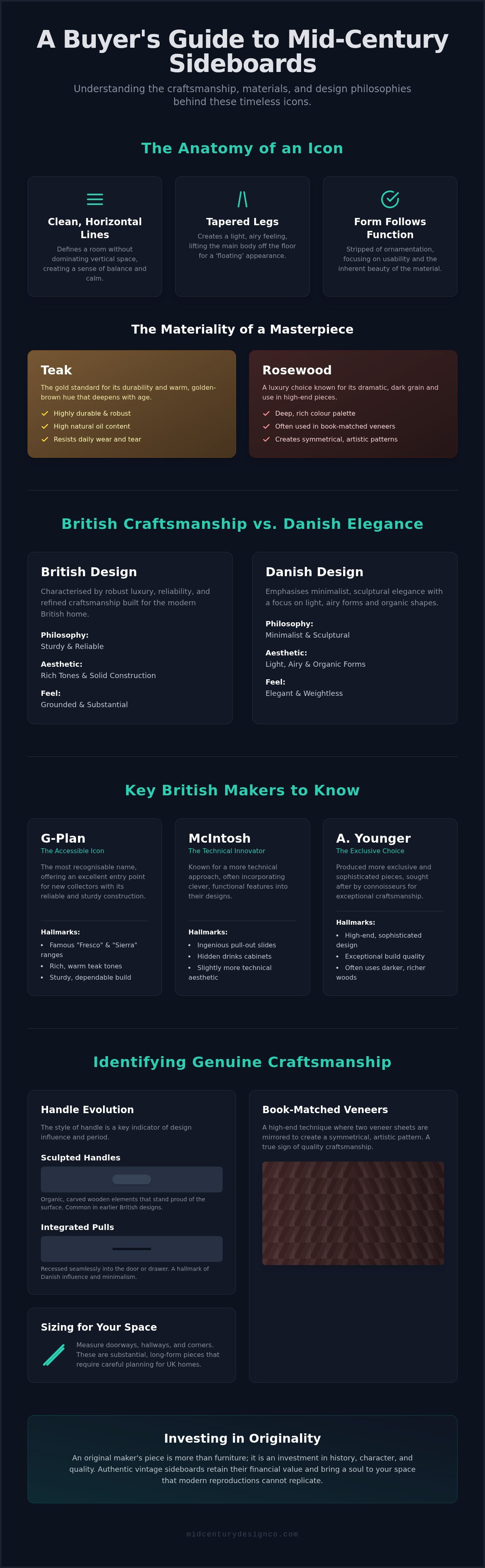
Clean lines. Tapered legs. The mid-century sideboard is a horizontal masterpiece that defines a room without dominating its vertical space. It represents a radical departure from the heavy, dark, and imposing furniture of the Victorian and Edwardian eras. This vintage sideboard buying guide UK helps you appreciate that these pieces are not merely storage units; they are sculptural anchors that bring a sense of balance and calm to a contemporary interior.
Historically, the sideboard underwent a significant transformation during the post-war era. It evolved from a formal dining room "buffet" into the versatile "credenza" we cherish today. This shift was deeply influenced by the broader Mid-century modern design movement, which championed the philosophy of "form following function". In the 1950s and 60s, designers stripped away unnecessary ornamentation, focusing instead on organic shapes and the inherent beauty of the materials. The result was a piece of furniture that felt light, airy, and remarkably modern, even sixty years after its creation.
The Materiality of Vintage Teak and Rosewood
Teak became the gold standard for British and Scandinavian furniture during this period. It is a remarkable timber, prized for its durability and high natural oil content, which ensures the wood remains supple and resistant to the rigours of daily life. The sensory warmth of a teak grain is unmistakable. It glows with a golden-brown hue that deepens over time. For those seeking a higher tier of luxury, rosewood offers a more dramatic, darker narrative. High-end makers often employed book-matched rosewood veneers. This technique involves mirroring two adjacent sheets of wood to create a symmetrical, kaleidoscopic pattern that turns a furniture front into a work of art. These vintage pieces rely on high-quality veneers and solid wood edges, providing a longevity that modern chipboard alternatives simply cannot match.
Functional Art: From Media Unit to Hallway Centrepiece
The versatility of the mid-century sideboard is perhaps its greatest strength. Its low-slung profile makes it an ideal media unit for the modern home. It sits at a comfortable height for a television whilst providing ample space to hide consoles, cables, and routers behind elegant sliding doors. In open-plan UK homes, a long sideboard serves as a sophisticated room divider. It defines the boundary between a dining area and a lounge without obstructing the flow of light or conversation. There is a distinct "slow living" appeal to these storied objects. Choosing an original piece encourages a more intentional approach to decorating, inviting you to appreciate the narrative and craftsmanship of an item that has already survived decades of use and remains as relevant as ever. To further enhance this curated aesthetic, you might explore Limited Edition Prints from Ilkaa's Fine Art Gallery & Atelier to find photography that shares this commitment to authentic expression.
Design reflects a philosophy of living. When exploring the mid-century era, you will encounter two distinct schools of thought that shaped the British home: the robust, accessible luxury of homegrown manufacturers and the minimalist, sculptural elegance of the Nordic masters. This vintage sideboard buying guide UK helps you navigate these nuances, ensuring you choose a piece that resonates with your personal aesthetic. Whilst both styles share a commitment to quality, their silhouettes and details tell very different stories of post-war optimism.
The 1960s saw a profound Danish Modern influence on the UK market. British manufacturers, inspired by the light and airy designs emerging from Scandinavia, began to move away from heavy, traditional forms. You can see this evolution in the transition from "sculpted" handles, which are organic, carved wooden elements, to "integrated" pulls that are recessed seamlessly into the door fronts. To understand the historical significance of these shifts, one can explore the Victoria and Albert Museum's furniture collection, which documents how these designs redefined the modern domestic landscape.
The British Heavyweights: G-Plan, McIntosh, and Younger
British makers offered a sense of reliability and refined craftsmanship. G-Plan remains the most recognisable name, with their "Fresco" and "Sierra" ranges serving as excellent entry points for new collectors. These pieces are celebrated for their rich teak tones and sturdy construction. McIntosh of Kirkcaldy, however, took a slightly more technical approach. Their sideboards often featured ingenious "pull-out" slides for drinks or serving, hidden within the frame. For those seeking something more exclusive, A. Younger produced sophisticated, often under-appreciated designs that utilised high-quality solid wood edges and sleek, understated lines. If you are looking to begin your journey, you might view our curated selection of British sideboards to find a piece with true heritage.
The Nordic Nuance: Sourcing Authentic Danish Sideboards
Danish design is often characterised by its ethereal quality. Designers like Gunni Omann or HP Hansen focused on tapered, spindle-like legs and "floating" tops, where the cabinet appears to hover slightly above its base. This creates a sense of weightlessness that is rare in furniture of such scale. When sourcing, look for the "Danish Control" stamp, a mark of authenticity that guaranteed the piece met rigorous national standards for materials and construction. Whilst teak is common, Danish rosewood sideboards are considered the investment-grade "holy grails" of the market. Their deep, dark grains and kaleidoscopic patterns provide a dramatic visual impact that retains its financial value amongst serious collectors.
The Collector’s Eye: Assessing Authenticity and Condition Online
Sourcing the perfect piece amongst a sea of digital listings requires a discerning eye. This vintage sideboard buying guide UK focuses on the tactile and visual cues that separate a storied original from a hollow imitation. When you look at a screen, you aren't just looking for a shape; you are looking for the evidence of a life lived. Authentic 1960s craftsmanship is often hidden in plain sight, found in the subtle depth of the timber and the precision of the joinery.
The "patina of time" is a narrative written directly onto the wood. Whilst many seek a flawless surface, a perfect, uniform finish on a sixty-year-old piece can sometimes be a red flag. It might suggest a heavy-handed modern intervention that has stripped away the original character. Instead, look for "ghosting". This occurs when a hutch top or a decorative object has sat in the same spot for decades, leaving a darker, protected silhouette against the sun-bleached teak. This natural variation is a clear indicator of age. To truly appreciate why these materials were chosen, one can refer to the National Design Academy's history of Mid-Century Modern, which outlines the era's dedication to honest materiality and enduring form.
Spotting the Signs of a Modern Reproduction
Modern "mid-century style" copies often lack the physical weight and soul of the originals. Examine photos of the underside or the back panels closely. Authentic vintage pieces show natural oxidation; the wood should look aged and slightly dusty, not like fresh, pale plywood. Look for cam-locks, silver screws, or plastic shelf supports. These are tell-tale signs of mass-produced, flat-packed furniture. Genuine mid-century design relied on permanent, high-quality joinery like dovetail drawer fronts and solid wood edgings that allow for soft, rounded corners. If a piece feels suspiciously lightweight in its description, it likely lacks the solid core of a true vintage icon.
A Checklist for Condition and Integrity
When buying online, door alignment is a critical factor. A sagging door can indicate structural warping or worn hinges that are difficult to replace. Ask for a description of the drawer runners. They should operate smoothly, without the gritty resistance of failing wood-on-wood tracks. Look for "ring marks" or deep scratches that penetrate the veneer. Minor surface marks often add a layer of charm, but deep damage affects the "soul" of the grain. A specialist curator ensures a piece is home-ready, balancing the need for a clean aesthetic with a deep respect for the item's historical integrity. This ensures your investment arrives with its narrative intact and its structure sound.
Sourcing and Sizing: Finding the Perfect Piece for Your UK Home
The "long and low" silhouette is the defining characteristic of mid-century storage. While this horizontal profile creates a sense of space, it presents unique challenges for the typical UK home. This vintage sideboard buying guide UK helps you navigate the physical realities of housing these substantial icons. Measuring the final resting place is only the first step; you must also map the journey from the front door to its permanent sanctuary.
Narrow hallways and tight corners in traditional terrace houses can be unforgiving for a seven-foot McIntosh or a grand Danish unit. You must measure the "pivot" point, where the piece must turn from a corridor into a room. These are solid, unyielding structures that do not disassemble. Large pieces, particularly those exceeding two metres in length, also carry significant weight. If your home has older timber floorboards, consider the placement relative to the floor joists to ensure long-term stability and prevent sagging over time. Buying from a national UK specialist ensures your piece is handled by dedicated furniture couriers who understand these logistical nuances and the fragility of original veneers.
Proportions and Placement in Modern Interiors
Choosing between a compact three-door unit and a grand four-door statement is a matter of architectural balance. A unit around 150cm in length acts as a versatile companion in a dining nook or entrance hall. Conversely, a larger piece becomes the room's primary anchor. It's essential to leave "breathing space" around the unit. The tapered legs are designed to allow light to pass underneath, which maintains a sense of flow and prevents the furniture from feeling like a heavy, static block against the wall.
The Logistics of Online Sourcing
High-resolution photography is your most valuable tool when sourcing from a distance. It allows you to trace the flow of the grain and identify the unique spirit of the timber. A specialist curator provides a detailed narrative of the piece, highlighting characterful flaws such as minor sun-fading or historic repairs that add to its provenance. This transparency is vital for building trust. For further advice on curating your living space, you might explore The Collector’s Guide to Buying a Vintage Coffee Table Online in the UK. To find your next investment, view our current selection of authentic mid-century sideboards with national UK delivery.
Investing in Originality: Why Authentic Vintage Outperforms Reproductions
Choosing an original mid-century piece is a deliberate act of rejection. It's a refusal to participate in the "fast furniture" cycle of rapid consumption and eventual waste. This vintage sideboard buying guide UK emphasises the "buy once, buy well" philosophy that has defined the most curated British homes for decades. When you acquire an authentic piece, you aren't just buying furniture; you are securing a slice of design history that carries its own narrative and soul.
The environmental impact of this choice is profound. Authentic vintage is the ultimate expression of the circular economy. By rescuing a piece of history, you prevent the carbon cost of new manufacturing and the eventual landfill burden of modern chipboard reproductions. An original sideboard also serves as a captivating conversation starter amongst guests. They aren't just drawn to its form; they are drawn to its spirit, its age, and the craftsmanship that has allowed it to remain beautiful whilst surviving decades of use. This appreciation for original expression often extends to the walls, where a bold piece from Fringe can perfectly offset the warm, organic tones of vintage timber.
The Financial Wisdom of Authentic Vintage
New furniture often loses half its value the moment it crosses your threshold. In contrast, authentic mid-century sideboards from iconic makers like McIntosh or Danish designers have shown steady appreciation over the last decade. They've become a stable alternative investment. The supply of these original pieces is finite and dwindling, which naturally drives future value. An authentic teak or rosewood sideboard is an asset that you can enjoy daily, knowing that its rarity only increases its historical and financial weight.
Creating a Sanctuary with Soul
There is a deep psychological benefit to surrounding yourself with objects that possess historical weight. A vintage sideboard creates a sense of permanence and calm, acting as a grounded foundation for your personal sanctuary. These pieces pair exquisitely with contemporary art, where the warm timber grains provide a textured contrast to modern canvases. This juxtaposition creates a curated look that feels both timeless and deeply personal. To begin your journey, you may explore our latest curated collection of authentic mid century modern sideboards to find the piece that speaks to your home's narrative.
Curating Your Own Piece of Design History
Securing a mid-century sideboard is about more than just filling a space; it's about inviting a narrative of twentieth-century excellence into your home. This vintage sideboard buying guide UK has explored the distinct silhouettes of British and Danish masters, the practicalities of sizing for your floor plan, and the enduring financial value of original teak and rosewood. By prioritising authentic craftsmanship over modern reproductions, you ensure that your furniture remains a timeless anchor that retains its soul and character for decades to come.
Whether you're drawn to the robust luxury of a McIntosh or the sculptural weightlessness of a Danish icon, the journey to finding the perfect piece is one of discovery. We invite you to discover our latest curated collection of authentic vintage sideboards. Each item in our gallery is an expertly curated original piece, chosen for its historical integrity and sensory warmth. With our specialist national UK delivery, your chosen design icon will arrive safely, ready to transform your living space into a sanctuary of storied design. We look forward to helping you find a piece that truly resonates with your home’s unique spirit.
Frequently Asked Questions
How much should I expect to pay for a vintage teak sideboard in the UK?
Market prices vary based on the maker, timber, and rarity of the design. General market data suggests that smaller, mass-produced pieces might start under £750, whilst exceptional examples from prestigious Danish or British designers can exceed £5,000. Rare rosewood models often command a significant premium. This vintage sideboard buying guide UK suggests viewing your purchase as an investment, as authentic pieces from iconic makers typically retain or increase their financial value.
Can I use a vintage sideboard as a TV stand for a large screen?
The horizontal, low-slung profile of mid-century furniture is perfectly suited for modern large-screen televisions. It places the screen at an ergonomic eye level whilst offering ample internal storage for media devices, consoles, and cables. You should ensure the weight is distributed evenly across the top surface, particularly for 7-foot or 8-foot units, to prevent any long-term stress on the original timber frame or tapered legs.
How do I care for the wood grain on my mid-century sideboard?
Preserving the sensory warmth of teak or rosewood is a simple but essential task. Dust regularly with a soft, dry lint-free cloth and apply a high-quality teak oil once or twice a year to nourish the grain. You should avoid placing your piece in direct sunlight or next to a radiator, as extreme heat can cause the timber to shrink. Always use coasters to prevent permanent ring marks on the veneer.
What is the difference between a sideboard and a credenza?
These terms are often used interchangeably in the mid-century modern context. Historically, a sideboard was a taller piece for a formal dining room, whilst a credenza was lower and often used in offices or living spaces. Mid-century designers favoured the low-slung credenza aesthetic, creating the sleek, horizontal storage icons we now commonly call sideboards. Both serve as a functional, sculptural anchor for contemporary UK interiors and open-plan homes.
Are vintage sideboards made of solid wood or veneer?
Most high-end mid-century sideboards utilise a combination of both materials. Designers frequently used exquisite teak or rosewood veneers over stable plywood or solid wood frames to achieve beautiful, consistent grain patterns. Authentic pieces are distinguished by their solid wood edgings and handles, which allow for the sculpted, organic shapes that define the era. This construction method ensures the piece remains stable and resistant to warping over many decades.
How do I know if a G-Plan sideboard is authentic?
Look for the iconic gold maker's stamp typically found inside a drawer or on the back panel. G-Plan pieces, particularly from the Fresco or Sierra ranges, are also identifiable by their distinctive sculpted handles and high-quality joinery. Authentic items will feel substantial and well-balanced. If a piece lacks a visible label, check for the specific design hallmarks of E. Gomme, the manufacturer behind the G-Plan brand, to verify its provenance.
What should I look for in the joinery of a 1960s piece?
Examine the drawer fronts for traditional dovetail joints. This technique is a hallmark of 1960s craftsmanship and ensures the drawers remain structurally sound for a lifetime. You should also check for solid wood edgings on the top and sides of the unit. These details allowed designers to create soft, rounded corners that don't reveal the underlying frame, a feature that modern, mass-produced chipboard reproductions simply cannot replicate.
Is it better to buy a restored sideboard or one in original condition?
We believe in the "patina of time" and the historical integrity of a piece. Whilst some prefer a factory-fresh look, an original vintage sideboard carries a soul and narrative that heavy restoration can sometimes strip away. Choosing a piece in excellent original condition ensures you are investing in a true slice of history. A specialist curator focuses on finding items that have been cherished, ensuring they are home-ready whilst maintaining their character.