

The Collector’s Guide to Buying a Vintage Coffee Table Online in the UK
Could a single piece of furniture redefine the entire atmosphere of your home whilst quietly appreciating in value? For the discerning collector, the search for a vintage coffee table UK collectors treasure is about more than just finding a place to rest a book. It's an intentional pursuit of soul, craftsmanship, and a narrative that mass-produced items simply cannot replicate.
You likely understand the frustration of sifting through endless listings, worried that a supposed mid-century gem might be a clever mass-produced imitation or that a fragile glass-topped piece won't survive the journey to your living room. It's natural to feel a sense of hesitation when you're investing in a piece of design history. You want the reassurance that the teak is genuine, the designer is verified, and the delivery process is as refined as the furniture itself.
This guide provides the clarity you need to master the online market with the confidence of a seasoned curator. We'll show you how to identify authentic era-specific details and evaluate the condition of rare finds from the country's leading specialists. By the end, you'll know exactly how to secure a timeless investment that brings both beauty and heritage into your sanctuary.
Key Takeaways
- Understand why the mid-20th-century design era provides the most enduring and investment-worthy centrepieces for a modern British home.
- Learn to recognise the sculptural silhouettes and material hallmarks of iconic makers, from the organic curves of G Plan to the refined minimalism of Danish teak.
- Master a professional checklist for evaluating online listings, ensuring your chosen vintage coffee table UK find is an authentic original rather than a modern imitation.
- Discover why specialist furniture couriers are essential for protecting fragile vintage surfaces and how to prepare your space for a seamless delivery experience.
- Gain confidence in prioritising original condition over restoration to preserve the historical integrity and future resale value of your furniture.
Sourcing an Authentic Vintage Coffee Table in the UK
A living room without a coffee table often feels adrift. It's the anchoring centrepiece, the silent facilitator of morning coffees and evening conversations. When searching for a vintage coffee table UK homes truly deserve, you're looking for more than a surface. You're seeking a piece of the mid-20th-century design explosion, an era where British and Scandinavian designers reimagined the home as a space of light, utility, and organic form.
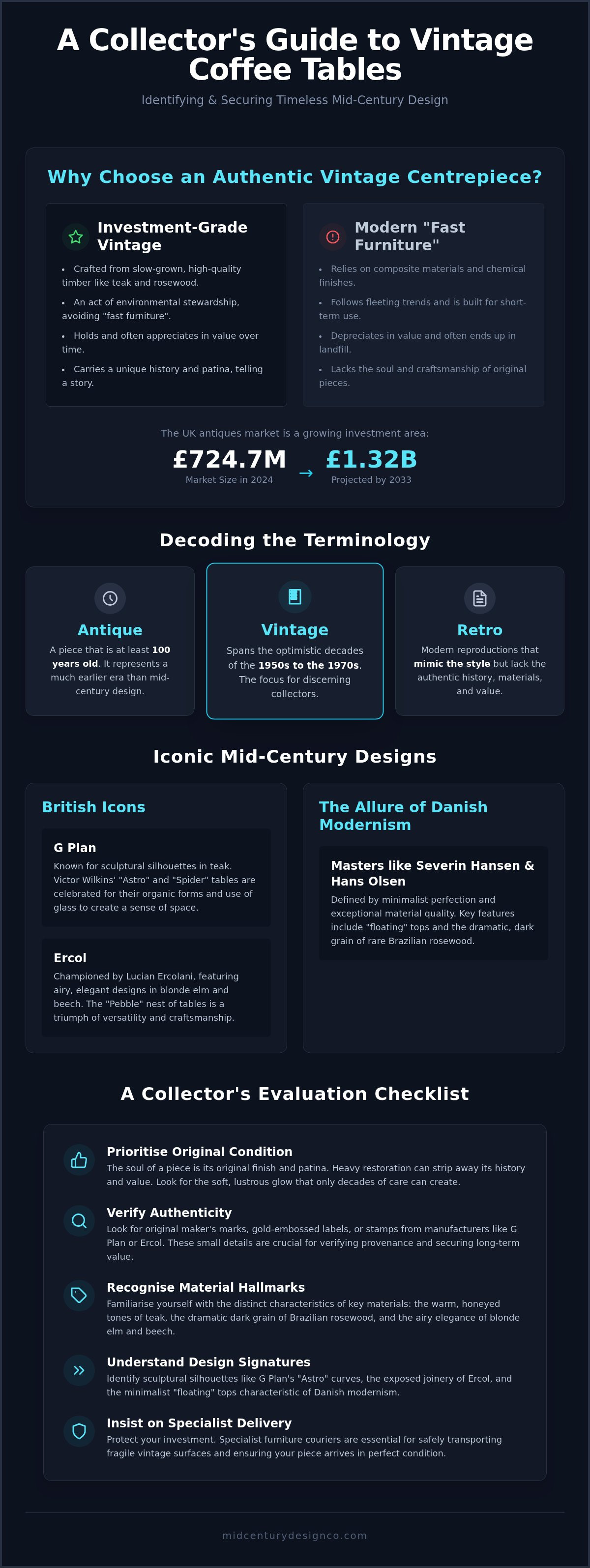
Choosing pre-loved timber isn't just an aesthetic choice; it's an act of environmental stewardship. Modern "fast furniture" relies on composite materials and fleeting trends that eventually end up in landfill. In contrast, investment-grade vintage pieces are crafted from slow-grown teak, rosewood, and elm, woods that carry a weight and sensory warmth impossible to mass-produce today. With the UK antiques market projected to grow from £724.7 million in 2024 to approximately £1.32 billion by 2033, your purchase is a functional asset that likely appreciates whilst it serves your home.
The Difference Between Vintage, Retro, and Antique
Terminology matters for the serious collector. While an antique must be at least one hundred years old, the mid-century vintage era typically spans the optimistic decades of the 1950s to the 1970s. Don't be misled by the term "retro," which is frequently used to describe modern reproductions that mimic the style but lack the history. Authentic vintage pieces carry the physical evidence of their era. Look for original maker's marks or gold-embossed labels from manufacturers like G Plan or Ercol. These small details verify provenance and secure the furniture's long-term value.
Why Original Condition Trumps Restoration
We believe the soul of a piece resides in its original finish. A vintage table should tell a story through its patina, that soft, lustrous glow that timber develops over half a century of use. Heavy restoration often involves stripping away this history and replacing it with modern polyurethane, which can look plastic and cold. Original teak oils and wax finishes age gracefully. They allow the wood to breathe and deepen in colour over time. By choosing original condition, you're preserving the designer's intent and the piece's historical integrity for the next generation.
Iconic Designs: From G Plan Astro to Danish Teak
The mid-century era was defined by a shift from heavy, dark Victorian remnants to furniture that breathed. At the heart of this movement was a material hierarchy that still dictates value today. Teak remains the undisputed favourite for its warm, honeyed tones and resilient nature. However, for those seeking the pinnacle of rarity, Brazilian rosewood offers a dramatic, dark grain that feels like a piece of abstract art. These materials weren't just chosen for durability; they were selected to bring a sense of the natural world indoors, creating a sanctuary within the post-war home.
British Icons: G Plan and Ercol
G Plan's "Astro" table, designed by Victor Wilkins, is perhaps the most recognisable silhouette in the world of the vintage coffee table UK market. Its circular frame and glass insert were revolutionary, allowing light to pass through and making small living rooms feel significantly more spacious. The "Spider" table took this sculptural ambition further, using sweeping, curved legs that resemble a work of modern art. These pieces were designed to be viewed from every angle, celebrating the intersection of geometry and organic form.
In contrast to the darker teak of G Plan, Lucian Ercolani’s Ercol designs brought the airy elegance of blonde elm and beech into British homes. Lucian Ercolani pioneered the use of steam-bent wood and exposed wedge-and-tenon joinery to create furniture that was both lightweight and exceptionally durable. The "Pebble" nest of tables remains a triumph of versatility, providing three distinct surfaces that tuck away neatly when space is at a premium. Each piece from this era carries a quiet authority, a testament to a time when furniture was built to last for generations.
The Allure of Danish Modernism
Whilst British makers were excelling, the influence of Scandinavia was transformative. Masters like Severin Hansen and Hans Olsen championed a minimalist perfection that redefined the living room. You can explore this aesthetic further in our vintage Danish coffee tables guide. These pieces often feature "floating" tops, where a small gap between the frame and the surface creates an illusion of weightlessness. This design choice reflected a broader desire to make furniture appear as though it were hovering, defying the traditional bulk of wooden furniture.
Danish design prioritised the natural beauty of the wood grain above all else. Instead of ornate carvings, designers relied on the exquisite patterns of book-matched veneers to provide visual interest. This philosophy heavily influenced the UK market in the late 1950s, leading to a hybrid style that combined British sturdiness with Nordic grace. Finding the right vintage coffee table UK collectors adore requires an eye for these specific maker's marks. If you're ready to find a piece that resonates with your personal style, you can browse our curated collection of authentic originals.
Evaluating Quality When You Buy Vintage Furniture Online
Scrutinising a listing for a vintage coffee table UK collectors covet involves more than just a cursory glance at the photographs. It requires a methodical approach to identifying both character and structural integrity. Start with the legs. Tapered legs are a signature of the 1960s, but they must be structurally sound. Ask the seller specifically about "wobble" or past repairs to the joints. A table that isn't sturdy loses its functional purpose, regardless of its aesthetic appeal. Look closely at the photos for any signs of "blushing," which is a milky cloudiness in the finish caused by moisture that may require professional attention.
When reading condition reports, learn to interpret the language of age. Ring marks and sun-fading are frequently mentioned. A faint ring mark is a sign of a piece that has been at the centre of a home, whilst significant sun-fading can actually highlight the beautiful grain of the teak. However, you must distinguish between high-quality teak veneer and modern laminate. Laminate is a plastic reproduction that feels cold and looks repetitive. Genuine veneer has a sensory warmth and a unique grain that changes as the light hits it from different angles, offering a depth that no modern imitation can match.
Identifying Maker’s Marks and Labels
Provenance is the cornerstone of any serious collection. Look for the gold G Plan stamp, usually found on the underside of the frame, or the iconic metallic Ercol badge. These marks verify that the piece was produced during the height of the mid-century movement. Whilst labels can sometimes fall off over sixty years, their presence adds a layer of historical certainty and financial value. You should also look for the "Danish Control" stamps found on authentic Danish modern furniture, which served as a government-backed seal of quality for exported goods and remains a gold standard for collectors today.
Understanding Timber and Grain Patterns
The way timber is used tells you everything about the piece's origin. Master craftsmen often used "book-matched" veneers, where two slices of wood from the same log are laid side-by-side to create a mirrored grain pattern. This level of detail is a hallmark of the 1950s and 60s. Check the edges of the table for solid timber "lipping." This thick border of solid wood protects the thinner veneer and allows for the rounded, organic edges that define the era. This combination of solid wood and veneer wasn't a cost-cutting measure. It was a deliberate choice to achieve the dramatic grain patterns that make these tables so evocative and unique amongst modern alternatives.
Logistics and Care: Getting Your Centrepiece Home
The transition from a digital gallery to a physical centrepiece in your home is a delicate phase that requires intentionality. When you've invested in a vintage coffee table UK specialists have curated, the final journey to your living room shouldn't be left to chance. Preparing your space involves more than just clearing a footprint on the rug. You must consider the flow of movement around the piece, ensuring there is ample room for legs and light. A sculptural G Plan or Ercol table needs breathing room to truly sing and function as the anchor of your seating arrangement.
Safe National Delivery in the UK
Standard parcel networks are designed for volume and speed, not the preservation of fifty-year-old teak. This is why we insist on specialist furniture couriers who understand the fragility of vintage joinery and glass inserts. The industry gold standard is blanket-wrapping. This method involves swaddling the piece in thick, protective fabric and securing it within the van to prevent any movement during transit. Effective communication between the curator, the courier, and yourself ensures a seamless experience. Upon arrival, take a moment to inspect the table before the courier leaves. Check the edges for any new scuffs and ensure the structural integrity remains exactly as described in the condition report.
Maintaining the Soul of the Wood
Owning a piece of design history invites a "slow living" approach to maintenance. Your table's best friends are high-quality coasters and a soft, lint-free cloth for regular dusting. We recommend avoiding modern aerosol polishes at all costs. These often contain silicone, which creates a synthetic build-up that can suffocate the timber and make future conservation difficult. Instead, nourish the wood with a high-quality teak oil or a natural beeswax every six to twelve months. This simple ritual preserves the deep, honeyed glow of the grain and ensures the timber remains supple.
Positioning is equally vital. Whilst these pieces were built to endure, prolonged exposure to direct sunlight from south-facing windows can cause the wood to dry out or fade unevenly. A slight adjustment in placement can protect your investment for decades. If you are looking to start your journey with a piece that has been handled with this level of care from the start, you can view our current collection of coffee tables and occasional tables. Taking these small steps ensures your table doesn't just sit in your room, but thrives as a living part of your home's narrative.
Curating Your Sanctuary with The Mid Century Design Co.
At The Mid Century Design Co., we believe a home should be a collection of stories rather than a showroom of mass-produced objects. We are collectors first and retailers second. This distinction is vital. It means every piece we acquire is chosen for its soul, its narrative, and its ability to transform a room into a sanctuary. When you're searching for a vintage coffee table UK collectors can trust, you aren't just buying furniture. You're investing in functional art that has already stood the test of time and is prepared to do so for another fifty years.
Our philosophy is rooted in a deep respect for the original designer's intent. We prioritise originality over restoration. Whilst others might strip away the history of a piece to make it look "new," we celebrate the gentle patina and the authentic finish that only decades of careful use can produce. This commitment ensures that your coffee table retains its historical value and sensory warmth. We often curate these centrepieces to harmonise with other significant investments, such as our mid century modern sideboards, creating a cohesive aesthetic that feels both curated and lived-in.
A Personal Approach to Vintage Curation
Every item in our West Sussex-based collection is hand-selected. We look for structural poetry, unique grain patterns, and that unmistakable quality that defined the "Golden Era" of the 1950s and 60s. We don't believe in hidden defects or vague descriptions. Our commitment to transparency means providing detailed condition reports for every piece we offer. Whether it's a rare Danish teak surface or a British elm classic, we want you to feel the same confidence in the piece as we did when we first discovered it. We act as your expert friend, sharing the joy of a find rather than simply completing a transaction.
Completing the Look
Creating a truly balanced interior often requires a layered approach to vintage sourcing. A sculptural coffee table finds its perfect companion when paired with the modular elegance of Staples Ladderax shelving units, allowing you to build a room that feels intentional and architectural. Sourcing multiple pieces from a single trusted curator ensures a consistent standard of quality and a shared design language throughout your home. It's a journey of discovery that begins with a single, beautiful object and ends with a space that reflects your personal history. We invite you to Explore our latest curated collection of vintage coffee tables and find the next chapter for your home's story.
Elevating Your Home with Design History
Finding the perfect vintage coffee table UK collectors desire is a journey of patience and discernment. It's about recognising the difference between a mass-produced imitation and a piece of functional art that carries the soul of the 1960s. By focusing on original condition, verifying maker's marks, and understanding the nuances of timber like teak and rosewood, you ensure your home remains a sanctuary of authentic style. These pieces don't just fill a space. They anchor a room with history and intent.
At The Mid Century Design Co., we specialise in 100% authentic 1960s Danish and British design. We never sell reproductions. Our national UK delivery service uses expert furniture couriers to ensure your centrepiece arrives in the same beautiful condition it left our gallery. We invite you to Browse Our Curated Collection of Authentic Vintage Coffee Tables and discover a piece that truly resonates with your space. Your next investment in design history is waiting to be discovered, ready to bring warmth and character to your home for many years to come.
Frequently Asked Questions
Is it safe to buy a vintage coffee table online without seeing it first?
Yes, provided you purchase from a specialist curator who provides high-resolution photography and transparent condition reports. Professional dealers vet every piece for structural integrity and authenticity, offering a level of security that general marketplaces cannot match. National delivery via expert furniture couriers ensures your investment is handled with the care it deserves. It is about finding a partner who values the object's narrative as much as you do.
How can I tell if a mid-century coffee table is made of real teak?
Real teak is distinguished by its tight, straight grain and a warm, honey-toned hue that deepens beautifully over time. Unlike modern laminates, teak veneer has a sensory depth and a natural, slightly oily feel when touched. You should also check the edges for solid teak lipping, a thick border of wood that protects the veneer. This material was the cornerstone of the design explosion across the UK and Scandinavia during the 1960s.
What is the average price for an authentic G Plan coffee table in the UK?
The price for an authentic G Plan coffee table varies significantly based on the specific model and its original condition. Iconic designs like the Astro or Spider tables are highly sought after by collectors, making them a more substantial investment than generic mid-century pieces. Whilst market rates fluctuate, these tables are widely considered functional assets that tend to appreciate in value as the global supply of original, high-quality 1960s furniture continues to diminish.
Do vintage coffee tables hold their value as an investment?
Original mid-century pieces are increasingly viewed as investment-grade assets for the modern home. Unlike mass-produced furniture that loses value immediately, a vintage coffee table UK collectors treasure often appreciates over time. The UK antiques market is projected to reach £1.32 billion by 2033, driven by a growing desire for sustainability and heritage. Owning an original piece is a sophisticated way to secure a slice of design history that retains its financial weight.
How do I identify a genuine Danish coffee table?
Look for clean, minimalist lines and characteristic "floating" tops that create a sense of weightlessness. Genuine Danish pieces often bear a "Danish Control" stamp or a specific maker's mark from masters such as Severin Hansen or Hans Olsen. The use of exquisite wood grains as the primary decorative element is a hallmark of this style. These tables represent a marriage of Nordic grace and exceptional craftsmanship that defined the mid-century era.
What should I do if my vintage table has a water ring mark?
A faint water ring mark is often a superficial blemish on the original wax or oil finish rather than the wood itself. You can often diminish these marks using a soft cloth and high-quality furniture wax, working gently with the grain. Don't use harsh chemicals or modern aerosol polishes. If the mark is deep, it becomes part of the piece's unique patina, telling the story of its half-century at the heart of a home.
How often should I oil my vintage teak coffee table?
Nourishing the timber every six to twelve months is usually sufficient to maintain its deep, lustrous glow. Use a high-quality teak oil or natural beeswax to keep the wood supple and prevent it from drying out. This simple ritual is a key part of the "slow living" aesthetic, allowing you to linger over the nuances of the grain whilst ensuring the piece remains a vibrant, healthy part of your sanctuary for decades.
Why should I choose an original vintage piece over a modern reproduction?
An original piece possesses a soul and historical weight that modern reproductions simply cannot replicate. Reproductions often use inferior materials and lack the precise, era-specific joinery of the 1950s and 60s. By choosing a vintage coffee table UK find, you're opting for sustainability and genuine craftsmanship. It is the difference between a fleeting utility and a work of functional art that serves as a beautiful, enduring investment for your personal space.