

What Style of Furniture Has Tapered Legs? A Mid-Century Guide
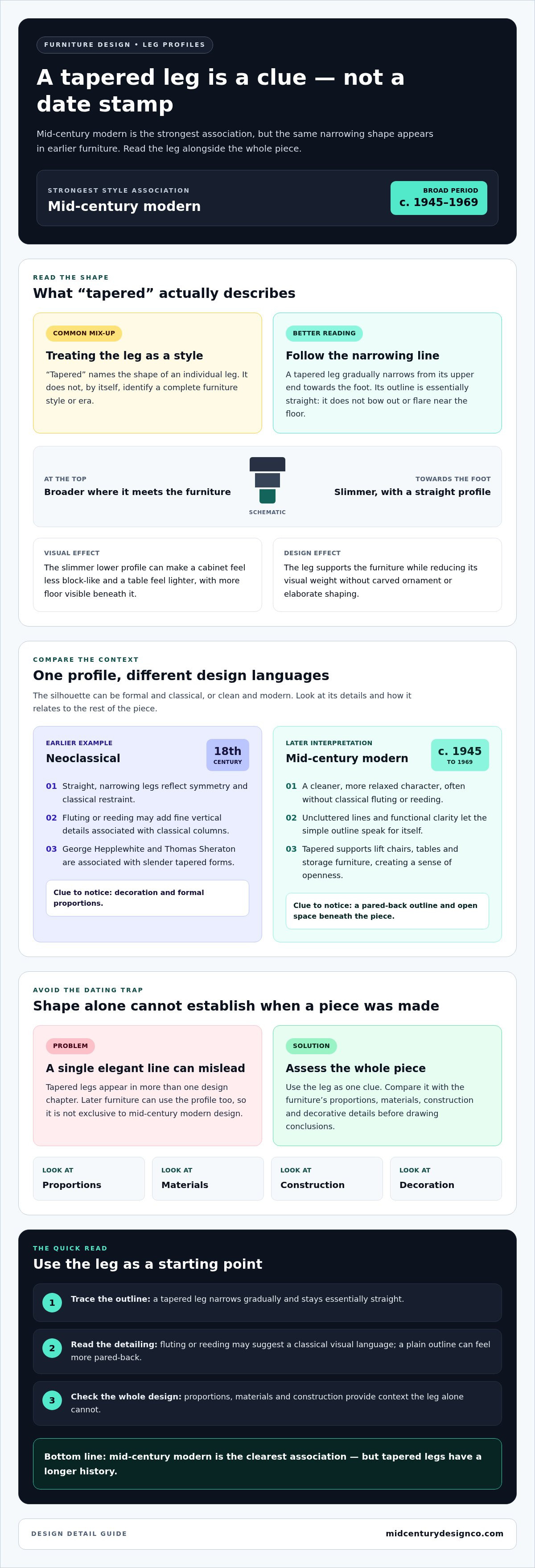
Tapered legs are a shape, not a style, although they’re most closely associated with mid-century modern furniture. So, what style of furniture has tapered legs? Mid-century modern is the clearest answer, with its clean lines and lifted, airy silhouettes. But the same narrowing profile appeared in earlier furniture too, so a leg alone can’t tell you exactly when a piece was made.
If you’ve spotted tapered legs on a vintage table or sideboard, you’re noticing a useful design clue. It’s easy to confuse tapered legs with ones that angle outwards, sweep into a curve or have turned details. Look at how each leg narrows, where it sits and how it relates to the rest of the furniture to tell these features apart.
This guide explores why tapered legs became a mid-century hallmark, how to distinguish them from similar silhouettes and where else they appear, including Neoclassical furniture. You’ll learn how to assess the detail alongside a piece’s proportions, materials and construction, and how tapered legs can work in a room today.
Key Takeaways
- For what style of furniture has tapered legs, mid-century modern is the strongest association, but the leg shape appears in earlier designs too.
- Compare a leg’s outline and direction of movement to distinguish tapered, splayed, saber and turned profiles.
- Use leg shape as one clue when assessing vintage furniture, alongside its proportions, materials and construction.
- Tapered legs can bring visual lightness to dining, living and working spaces by leaving more floor visible beneath furniture.
- Hand-picked genuine vintage furniture is an eco-friendly choice, with original character and design built to last.
What style of furniture has tapered legs? The short answer
Mid-century modern furniture is the style most closely associated with tapered legs. The profile suits the period’s preference for clean lines and pared-back forms, and appears on pieces such as chairs, tables and storage furniture. But “tapered” describes the shape of an individual leg, not a complete furniture style. The same form appears in designs from other eras.
What does “tapered leg” mean in furniture design?
A tapered leg narrows gradually in width from its upper end towards the foot. Imagine a leg that begins broader where it meets a table or cabinet, then becomes slimmer as it descends. Its outline is essentially straight: it doesn’t bow into a curve or flare near the floor.
That gradual change can affect how the whole piece looks. A cabinet raised on narrowing legs may seem less block-like, while a table can feel lighter beneath its top, with more floor visible around it. The leg still supports the furniture, but its slimmer lower profile reduces its visual weight without carved ornament or elaborate shaping.
Why are tapered legs associated with mid-century modern furniture?
Mid-century modern design, broadly associated with the period from around 1945 to 1969, favoured functional forms, uncluttered lines and an appreciation of materials. Tapered legs helped express those ideas: their simple geometry gives furniture a refined outline and lifts it clear of the floor rather than enclosing it in a solid base. For a wider overview of the movement, see Mid-century modern design.
The effect is especially noticeable on a low sideboard or coffee table. A solid body can still have presence, while the open space beneath it helps keep a room from feeling crowded. On a chair, the narrowing profile can balance a broader seat and back. It’s a small detail, but one that contributes to the period’s characteristic mix of practicality and visual lightness.
Tapered legs are strongly associated with mid-century design, but they aren’t exclusive to it. Earlier Neoclassical furniture also used straight, narrowing legs, sometimes with fluting or reeding. Later designs can use the same profile, so a leg’s shape alone can’t establish a piece’s date. Look at the furniture as a whole: its proportions, materials, construction and decorative details provide context that one elegant line cannot.
How tapered legs moved from Neoclassical furniture to mid-century modern
The tapered profile belongs to more than one design chapter. Its presence on a vintage piece can point to a tradition of elegant, narrowing forms, but it can't date the furniture by itself. To distinguish an eighteenth-century table from a mid-century cabinet, look at how the legs relate to the whole design: their decoration, proportions and relationship to the body of the piece.
Tapered legs in Neoclassical and Georgian-era furniture
In late eighteenth-century Neoclassical furniture, straight tapered legs reflected a taste for symmetry and classical restraint. Designers associated with this period, including George Hepplewhite and Thomas Sheraton, used slender, narrowing forms on furniture such as chairs and tables. The legs might be fluted or reeded, with fine vertical details recalling classical columns. The result is delicate, but also carefully ordered.
That decorative treatment matters. A tapered leg with carved grooves and formal proportions belongs to a different visual vocabulary from a plain, pared-back support, even if both narrow towards the floor. Georgian-era design is a broad category, and furniture could combine influences or details across periods. Treat the silhouette as a clue to examine, not a date stamp.
The mid-century modern interpretation
Mid-century designers gave the form a cleaner, more relaxed character. Rather than emphasising classical references through fluting or reeding, they often let the leg's simple outline speak for itself. On chairs, tables and storage furniture, tapered supports lift the main body from the floor and create a sense of openness, bringing a crisp, light quality to practical forms.
The change is as much about context as shape. Where Neoclassical furniture often used symmetry and restrained ornament to suggest refinement, mid-century modern design favoured uncluttered lines and functional clarity. Designers such as Paul McCobb are associated with the mid-century use of tapered legs, but no single designer originated the form. Its appeal lay in how readily it complemented different types of furniture.
The tapered leg has a longer history than its mid-century identity suggests. If you're asking what style of furniture has tapered legs, mid-century modern remains the strongest association, while earlier Neoclassical examples show why the feature needs to be considered alongside other evidence. Compare the leg's finish and ornament with the furniture's overall shape, materials and construction before drawing conclusions about its era.
That range is part of the profile's lasting charm: the same basic narrowing line can feel formal and classical, or quietly modern. For a sense of how it appears across genuine vintage dining and storage furniture, explore hand-picked vintage furniture from The Mid Century Design Co. Each piece is selected for its character and built to last. Choosing vintage is also an eco-friendly way to bring enduring design into a home.
Tapered, splayed or saber legs? How to tell the difference
Look at two things separately: the leg’s outline and the direction it travels. A leg may narrow as it descends, angle outwards, curve or carry turned decoration. These descriptions aren’t always mutually exclusive. A single leg, for example, can be both tapered and splayed.
Tapered versus splayed legs: narrowing or outward angle?
Taper describes a change in width: the leg becomes slimmer towards its foot. Splay describes its position: the leg angles outwards from the furniture body. View a table from the side or front to notice the angle, then follow the leg’s edges to see whether they narrow. A straight, narrowing leg may be tapered without being splayed; one that narrows and angles out can be both.
| Leg type | Outline and movement | Defining visual cue |
|---|---|---|
| Tapered | Straight; narrows towards the foot. | A gradual reduction in width. |
| Splayed | Angles outwards from the furniture. | The foot sits further out than the top. |
| Saber | Sweeps out in a shallow, concave curve. | A curved, sword-like silhouette rather than a straight narrowing line. |
| Turned | Shaped with rounded or carved sections. | Decorative rings, grooves or other lathe-formed details. |
Use the terms as visual descriptions, not fixed categories. A chair leg could be turned and tapered, for instance, if it has decorative rings and narrows towards the floor. Likewise, splay describes the angle of a tapered leg. Naming each feature separately gives you a more precise description of what you see.
Tapered versus saber and turned legs
A saber leg is recognised by its sweep: the profile curves outwards in a shallow concave arc, rather than simply narrowing along a straight edge. A turned leg, by contrast, is identified by its shaped surface. Look for rounded bands, grooves or bead-like details as you trace the leg from top to foot. It may also taper, so note both its decoration and its overall width.
Check the silhouette from more than one angle. From the front, a splayed leg’s outward direction may be clear; from the side, a curve or turned detail can stand out. Don’t infer a period from one feature alone. If you’re asking what style of furniture has tapered legs, leg shape is a useful starting point, but the whole piece offers richer clues. For wider context on the era’s forms, explore this mid-century modern furniture style guide.
How to read tapered legs when assessing a vintage furniture piece
A tapered leg can be a useful first clue, but it can’t tell you a piece’s age or authenticity on its own. The shape appeared in different periods, and later furniture may also borrow a mid-century look. Read the legs alongside the proportions, overall silhouette, materials and construction. Together, these details offer a more considered impression than any single feature.
A simple visual checklist for tapered-leg furniture
Look from different angles, then work through these observations:
- Follow the leg from top to foot. Does it narrow gradually towards the floor, or stay the same width? Note whether its edges are straight or shaped with curves and decorative details.
- Check its direction. Does the leg remain upright, or angle outwards? It may do both: narrowing describes its width, while splaying describes its outward angle.
- Consider proportion. Look at how much of the furniture’s height comes from its legs, and whether their scale feels balanced with the body. Fine supports beneath a broad cabinet create a different impression from substantial legs beneath a compact table.
- Read the whole silhouette. Notice the shape of the top, doors, drawers, seat or back, as relevant. Ask whether the clean lines and overall form feel consistent with the leg style, rather than relying on the legs alone.
- Observe materials and construction. Look at the material across the piece and how its components meet. The underside, joints and visible fixings can offer details to consider alongside the design, though no single construction feature should be treated as proof.
This process turns a quick impression into a fuller visual reading. A sideboard with narrowing legs might initially suggest mid-century design, for instance, but its proportions, surface details and construction may add nuance or point in another direction. Describe what you can actually see before settling on a conclusion.
Why one design detail cannot establish age or authenticity
“Tapered” describes a shape, not a maker, production date or guarantee of originality. A piece can have a period-inspired silhouette without being an original from that era, and a genuine vintage item may show alterations or repairs. Appearance alone can’t settle those questions. For a more detailed discussion of the wider clues, read this guide to identifying original mid-century furniture.
Keep the leg in the story, but don’t let it tell the whole story. When assessing vintage dining furniture, occasional tables or storage, weigh each visible detail together and stay open to more than one interpretation. To see how considered design details appear across hand-picked vintage pieces, explore genuine vintage furniture from The Mid Century Design Company. Choosing vintage is an eco-friendly way to bring furniture built to last into your home.
Bring tapered-leg character into a home with genuine vintage furniture
A tapered leg can give a piece a sense of lift, bringing openness to a room without making the furniture disappear. In a dining space, the profile can lend a table or chairs a graceful, composed presence. In a living room, tapered legs on an occasional table leave more floor visible around the piece, while a desk with a lighter silhouette can sit comfortably in a working space. That same visual balance can be carried through to adjoining outdoor living spaces, where thoughtfully proportioned arrangements from Top Tier Patio Gear help maintain an open, uncluttered flow onto the patio.
The appeal lies in balance. A substantial cabinet on slender legs can feel less imposing; a delicate table can echo the lines of other furniture without making the room feel overly matched. If you’re drawn to the question of what style of furniture has tapered legs, consider how the feature works in your home as well as what it may suggest about a design period.
Choose tapered-leg pieces for their proportion and character
Consider the room and the piece together. Think about its overall scale, the height and width of nearby furnishings, and how much visual space you want to preserve. Dining furniture can bring a sense of lightness to a gathering space, while an occasional table may add a considered detail beside a sofa or chair. A desk can introduce a clean, elevated line to a study.
Look beyond the legs, too. Notice the natural grain, the shape of the silhouette and the gentle patina that comes with a piece’s history. These details give vintage furniture its individuality; small marks and variations can speak to a life already lived rather than detract from its character. Choose a piece whose proportions and presence feel at home with your furnishings.
Discover genuine vintage mid-century furniture
Original vintage furniture brings together practical purpose and the design sensibility of its time. The Mid Century Design Company offers hand-picked, genuine vintage pieces, not modern reproductions made to suggest an earlier era. They’re an eco-friendly choice, built to last, with their own character and history. Restoration is kept to a minimum to preserve original character, with work carried out when damage is significant.
A tapered leg may be the detail that first catches your eye, but the lasting pleasure often comes from how the whole piece settles into a room: its proportions, materials and quiet history in daily use. Explore hand-picked vintage furniture from The Mid Century Design Company to find a piece with that particular sense of character.
Let a considered detail shape your next choice
Let the leg profile be a beginning, not a set of rules. As you imagine a piece in your home, consider what you want it to bring: openness beside a sofa, a graceful note around the dining table or more character in a working corner. The question of what style of furniture has tapered legs can guide your eye, but the most rewarding choice is one that feels at ease with the way you live.
Look for a piece whose scale and presence suit its surroundings, then give its grain, patina and small signs of age room to speak. The Mid Century Design Company focuses on genuine vintage furniture rather than modern reproductions. Pieces are hand-picked, eco-friendly and built to last, with restoration kept to a minimum to preserve their original character.
Choose for the details that continue to draw you in, and for the useful life the furniture can have in your home. Explore hand-picked vintage furniture from The Mid Century Design Company and find a piece ready to become part of your own story.
Frequently Asked Questions
What style of furniture has tapered legs?
Mid-century modern furniture is the style most closely associated with tapered legs, especially pieces from the 1950s and 1960s. If you’re asking what style of furniture has tapered legs, that’s the clearest answer, though the shape also appears in other periods. On a vintage dining chair, compare the legs with the seat, back and overall proportions before using them to identify its design era.
Are tapered legs always mid-century modern?
No, tapered legs aren’t exclusive to mid-century modern furniture. Earlier Neoclassical designs, including work associated with Hepplewhite and Sheraton, used the form, and later furniture can adopt it too. If a piece has a familiar mid-century silhouette, look for further clues such as its materials, joinery and decorative details. A single leg feature can suggest a direction for research, but can’t establish a date or origin.
What is the difference between tapered and splayed legs?
Tapering describes a leg that narrows towards its foot, while splaying describes a leg that angles outwards from the furniture. A chair leg can have both features. To distinguish them, view the piece from the front and side: check whether the foot is narrower than the upper leg, then notice whether it sits outwards from the seat. These observations describe the shape, not the furniture’s age.
Are tapered legs strong enough for everyday furniture?
A tapered shape alone doesn’t determine whether furniture is sturdy enough for everyday use. Materials, construction, condition and the way the legs are fixed to the body all matter. If you’re assessing a vintage table or chair, look for visible cracks, loose joints or movement when gently tested. Consider the whole piece and its intended use rather than judging strength by how slim the feet appear.
Can tapered legs be used in contemporary interiors?
Yes, tapered legs can work beautifully in contemporary rooms. A vintage side table beside a modern sofa, for instance, can introduce natural material and a sense of history without making the rest of the room feel tied to one era. Think about scale and finish: a compact piece may sit quietly amongst current furnishings, while a more distinctive silhouette can become a focal point. This design principle can even extend to transitional and outdoor living areas, where contemporary specialists like Rengard use similar sleek, lifted profiles in garden and patio furniture to maintain a feeling of space and light.
How can I tell whether furniture legs are tapered or turned?
Look for two different kinds of detail. A tapered leg narrows towards the floor; a turned leg has shaped surface details, such as rounded rings or grooves. The terms can overlap, so a turned leg may also become narrower towards its foot. For example, a leg with several rounded bands and a slimmer lower section could reasonably be described as both turned and tapered.
Do tapered legs make a room look bigger?
They can create a more open visual impression by leaving more floor visible beneath a piece of furniture, but they don’t increase the room’s actual size. The effect depends on the item’s scale and what surrounds it. In a compact room, consider how a table’s footprint, nearby furniture and clear pathways work together. Tapered legs may contribute to a lighter look, but they’re only one part of the arrangement.