

Identifying Vintage Teak Sideboards: Authenticity Guide
What if the "rare find" you've been admiring is actually a modern reproduction masquerading as a mid-century icon? It's a common anxiety for collectors, especially when the market feels crowded with pieces that mimic the silhouette but lack the spirit of the original. You likely seek the warmth of authentic timber and the quiet dignity of a piece that has witnessed decades of history. Learning how to identify a vintage teak sideboard is about more than just spotting a label; it's an invitation to engage with the sensory markers of true craftsmanship.
I'll help you distinguish investment-grade furniture from high-street imitations, ensuring you never overpay for a flat-pack copy. We will examine the rhythmic patterns of book-matched veneers, the tactile precision of hand-finished joinery, and the unmistakable glow of original patina. From the iconic stamps of British makers like G-Plan to the minimalist elegance of Danish imports, you'll discover how to recognise the quality etched into every grain. This guide will transform the way you browse auctions and specialist shops, giving you the confidence to curate a home filled with soul, character, and enduring value.
Key Takeaways
- Recognise the sensory signature of genuine Tectona grandis, focusing on the tactile warmth and high oil content that distinguishes it from cold imitations.
- Examine the artistry of book-matched veneers and end grain alignment to verify the structural integrity and quality of a piece.
- Master how to identify a vintage teak sideboard by decoding the evolution of gold G-Plan stamps and hidden McIntosh maker's marks.
- Inspect the anatomy of mid-century joinery, specifically looking for hand-finished dovetail joints and period-accurate hardware.
- Appreciate the value of original patina as a marker of history, ensuring your furniture remains a timeless investment rather than a depreciating copy.
The Sensory Signature: Why Genuine Vintage Teak Feels Different
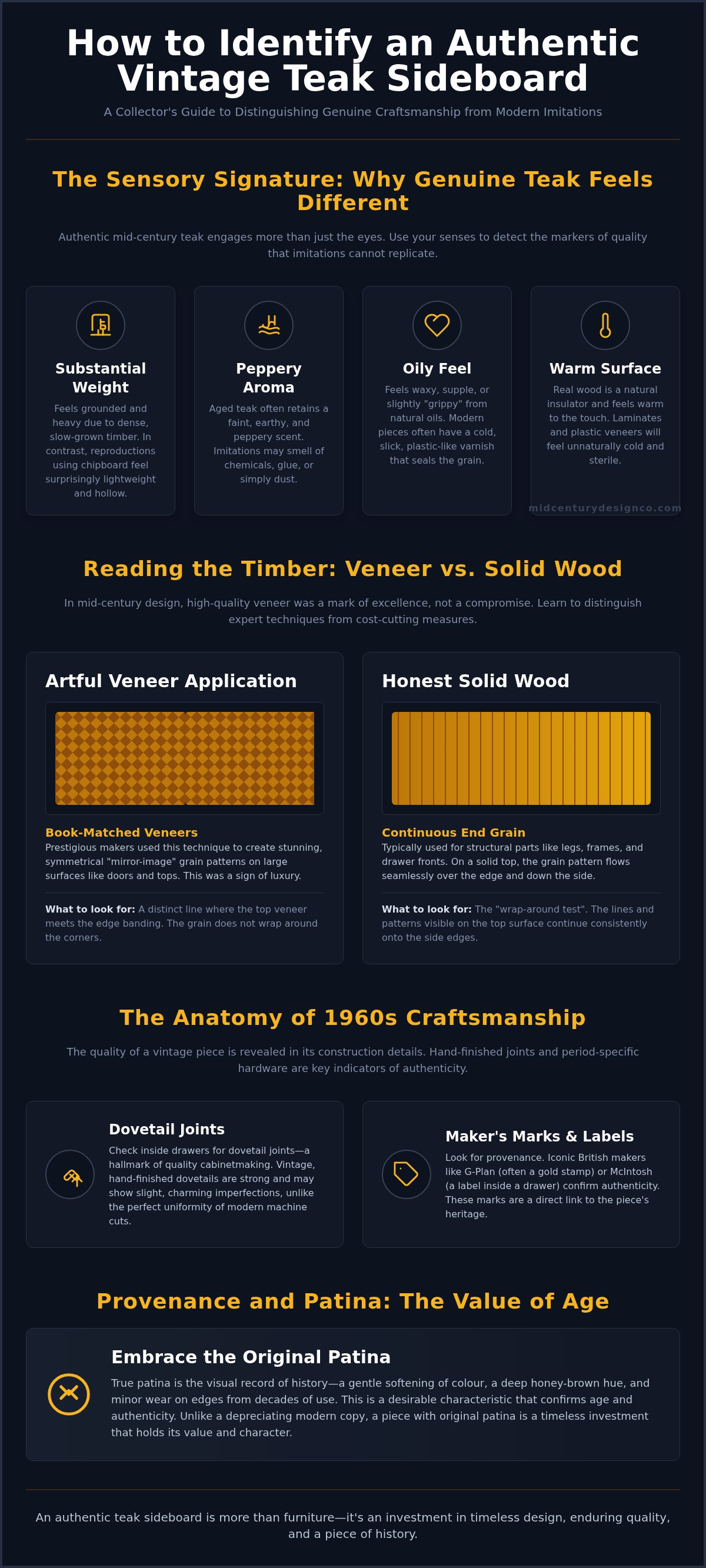
Genuine teak, scientifically known as Tectona grandis, possesses a unique chemical composition that sets it apart from common hardwoods. It's exceptionally rich in natural oils and silica, elements that acted as a biological shield against the damp British climate of the 1960s. When you're learning how to identify a vintage teak sideboard, your first interaction should be physical. Authentic pieces carry a surprising weight. Unlike modern flat-pack alternatives that rely on lightweight chipboard, a true mid-century sideboard feels grounded and substantial, a testament to the dense, slow-grown timber used by master craftsmen.
Don't hesitate to lean closer. Open a drawer and take a breath. Aged teak often retains a faint, peppery aroma; it's an earthy scent that lingers even after sixty years. It's a subtle marker of history that synthetic finishes or stained woods simply cannot replicate. If the piece smells of nothing but dust or chemicals, it might lack the organic integrity of true vintage timber.
The Oily Truth of Mid-Century Timber
The high oil content in vintage teak is more than just a protective layer. It's the source of the wood's inner life. During the mid-century era, designers favoured finishes that allowed the timber to breathe, resulting in a deep, honey-toned glow rather than a sterile, high-gloss shine. If a surface feels waxy or slightly "grippy" rather than slick, you're likely touching the natural resins of the wood. Modern imitations often hide behind thick, plastic-like varnishes that mask the grain and feel soulless to the touch. A genuine piece will feel supple, as if the wood still holds its vitality.
The Temperature of Authenticity
Wood is a natural insulator, and teak is particularly adept at maintaining a gentle, consistent temperature. You can perform a simple "palm test" to verify this. Place your hand firmly on the surface. Real teak will feel warm and inviting, quickly matching your body heat. In contrast, laminates and plastic veneers often feel startlingly cold or unnaturally smooth, lacking the organic texture of real grain. Patina is the visual record of a piece's journey through time, expressed through the softening of its colour and the gentle wear of its edges. Understanding these sensory details is essential for anyone discovering how to identify a vintage teak sideboard with absolute certainty.
Reading the Timber: Identifying Teak Veneer versus Solid Wood
To the untrained eye, the word veneer often suggests a compromise in quality. In the mid-century world, the opposite is frequently true. When you're learning how to identify a vintage teak sideboard, you'll soon discover that the most prestigious makers actually preferred high-quality veneers. These artisans used a technique called bookmatching to create stunning, symmetrical patterns on mid century modern sideboards. By slicing the timber into thin layers and flipping them like the pages of a book, they achieved a visual harmony that solid planks simply cannot provide.
Look for the end grain to verify the soul of the piece. This is a vital step in understanding how to identify a vintage teak sideboard with confidence. On a solid piece, the grain on the top surface should naturally continue down the side. With veneer, you may see a distinct line where the top layer meets the edge banding. Authentic vintage pieces also showcase mineral flecks and slight variations in tone. If the grain is perfectly uniform and lacks these organic imperfections, you're likely looking at a modern print. Over sixty years, genuine teak undergoes a beautiful colour evolution, shifting from a vibrant golden-orange to a deep, sophisticated honey-brown.
The Myth of Solid Wood Only
Master craftsmen of the 1960s understood that large, flat surfaces made of solid teak were prone to warping and splitting in centrally heated homes. To prevent this, they applied thick-cut veneers over stable cores. This wasn't a cost-cutting measure but a mark of engineering excellence. You can perform the wrap-around test by checking if the grain appears to flow seamlessly over the edges, a technique also found on a high-quality vintage Danish coffee table. If the veneer feels substantial and shows depth, it's a sign of investment-grade furniture. You might find your next heirloom amongst our authentic Danish sideboards.
Spotting Teak-Effect Imitations
Modern imitations often give themselves away through repetition. Because laminates are printed, you may spot the exact same knot or swirl appearing twice on a single door. Always check the underside or the back of the piece. Authentic vintage sideboards usually feature a secondary wood or a matching veneer on the reverse, whereas cheap reproductions often leave the raw chipboard or a white laminate exposed. Finally, look for ghosting. This occurs where a decorative object has shielded the wood from the sun for decades, leaving a pale silhouette that proves the wood is reactive and real.
The Anatomy of 1960s Craftsmanship: Joinery and Hardware Markers
The interior of a piece often reveals more than its facade. When considering how to identify a vintage teak sideboard, one must look past the golden grain to the silent engineering beneath. High-quality dovetail joints are a primary indicator of mid-century excellence. These interlocking wedges provide structural integrity without the need for excessive adhesives or nails. You'll find similar hallmarks of quality when inspecting an authentic mid century modern desk UK collectors prize. If the drawers are held together by staples or simple butt joints, it's likely a modern reproduction or a lower-end period piece.
Examine the fixings. In early 1950s furniture, Phillips-head screws were relatively rare in British workshops. Traditional flat-head screws were the standard. If a piece supposedly from the early fifties is riddled with cross-head screws, it suggests later repairs or a modern origin. Handles, too, tell a story. Authentic teak sideboards often feature handles sculpted directly from solid wood or integrated into the door's silhouette. These are far more complex to manufacture than the generic metal pulls found on modern high-street copies.
The drawer glide test is equally revealing. Original drawers should slide with a smooth, wood-on-wood friction. They don't rely on the clunky metal runners or plastic rollers common in today's furniture. It is a tactile, rhythmic experience that connects you to the original workshop. This test is a simple yet effective way to understand how to identify a vintage teak sideboard that was built to last.
Invisible Engineering and Sculpted Edges
Danish designers obsessed over the transition between elements. Legs should flow into the frame as if they grew there. You won't find unsightly L-brackets or plastic corner blocks in a masterfully crafted sideboard. This same precision is evident in the way a Staples Ladderax shelf fits with satisfying exactness into its upright, relying on physics and craftsmanship rather than crude fasteners. These pieces were designed to be beautiful from every angle, even those usually hidden from view.
Hardware and Hinges of the Golden Era
Hardware in the 1960s had a physical presence. High-end British and Danish sideboards frequently used brass piano hinges that run the full length of the door. These solid brass components develop a soft, dark patina over time. Modern "retro" furniture often opts for lightweight alloys or plated steel that feels flimsy and lacks the historical weight of the original metalwork. Understanding the quality of these small details is essential for any serious curator.
Provenance and Patina: Decoding Maker’s Marks and Signs of Age
The discovery of a maker's mark is a quiet triumph for any collector. It transforms an anonymous object into a documented piece of history. When you are learning how to identify a vintage teak sideboard, these labels provide the most direct evidence of origin. For British enthusiasts, the G-Plan stamp is iconic. The early 1960s featured a gold embossed label, whilst later versions transitioned to red or white. These small variations act as a chronological map of a piece's production life, allowing you to date the furniture with surprising accuracy.
McIntosh of Kirkcaldy, another titan of British design, often hid their insignia inside a drawer or on a door panel. You might find similar markers of authenticity when sourcing a retro dining table and chairs UK collectors covet. Danish pieces frequently carry the "Danish Furnituremakers’ Control" logo, a circular stamp that guarantees the highest standards of timber and construction. However, don't be discouraged by a lack of stamps. Some of the most exquisite Danish pieces rely entirely on their design language, such as the specific curve of a leg or the depth of a handle, to speak for their heritage.
The Search for the Hidden Label
Labels are often found in the most discreet corners. Check the interior walls of the top drawer or the lower corner of the back panel. If the physical label is missing, look for a "ghost." This is a rectangular shadow or a residue of adhesive left behind where a label once sat. It is a subtle yet compelling sign of a piece's true identity. Understanding how to identify a vintage teak sideboard involves looking for these whispers of the past that survive even when the paper does not.
Understanding Natural Ageing
Authentic patina is impossible to fabricate. It is the result of sixty years of light, life, and use. You might notice a sun-bleached effect where the top surface is slightly lighter than the protected interior. This is a mark of honesty. An original Staples Ladderax shelving unit should show slight wear on its uprights where the shelves have been adjusted over decades. This wear is not a defect; it is the soul of the object. Unlike modern distressed finishes that feel forced, original lacquer has a soft, diffused glow that only comes with time. Explore our curated collection of authentic mid-century furniture to see these marks of history for yourself.
Curating Your Sanctuary: Why an Original Teak Sideboard is a Design Investment
The decision to bring a mid-century icon into your home is an act of curation. It transcends simple furnishing. When you understand how to identify a vintage teak sideboard, you aren't just buying timber; you're securing a piece of 20th-century history. Unlike modern high-street furniture that begins to depreciate the moment it leaves the showroom, authentic teak often holds or increases its value. It is the antithesis of 'fast furniture' culture, offering a sustainable, circular choice that honours the resources of the past. By choosing a piece that has already endured sixty years, you're making an eco-friendly statement that prioritises longevity over the temporary.
Living with these objects doesn't require your home to become a museum. The beauty of mid-century design lies in its versatility. You can style a low-slung Danish sideboard amongst contemporary abstract art, vibrant indoor plants, and soft, neutral textiles to create a space that feels grounded. The rich, honeyed tones of the wood provide a tactile warmth that balances the clean, often sterile lines of modern architecture. There is a profound emotional reward in knowing your furniture has a narrative, one that connects your personal sanctuary to a golden era of global design.
The Longevity of Teak Design
The clean, functionalist lines of the 1960s remain as relevant in 2026 as they were at their inception. This enduring appeal stems from the structural integrity of mid-century British and Danish manufacture. These pieces were crafted for a lifetime of use, using dense, high-quality timber and precision joinery that modern mass-production rarely replicates. Building a collection of such pieces allows you to create a home with soul, where every item is an intentional choice rather than a placeholder. It is about moving away from furnishing a room and towards curating an environment that reflects your appreciation for true craftsmanship.
Sourcing with Confidence
Browsing anonymous marketplaces can be fraught with uncertainty. It is easy to feel overwhelmed by vague descriptions or the fear of overpaying for a clever imitation. Finding a specialist curator provides a vital layer of protection. A dedicated expert acts as a bridge between the piece's history and its future in your home, ensuring that every grain, joint, and maker's mark has been verified. This professional eye allows you to invest with absolute certainty, knowing that the spirit of the object is as authentic as its form. Explore our curated collection of authentic mid-century teak and discover the perfect centrepiece for your home.
Embracing the Soul of Mid-Century Design
Mastering the art of how to identify a vintage teak sideboard allows you to move beyond mere shopping and into the realm of true curation. By looking for the tactile warmth of natural oils, the precision of hand-finished joinery, and the honest markers of 1960s provenance, you ensure every piece in your home tells a genuine story. These objects are more than storage; they're functional art that matures alongside your family, gaining character and value with every passing decade. Authentic mid-century furniture offers a rare connection to a golden era of craftsmanship that modern copies simply cannot replicate.
As specialist curators of original Danish design and iconic Staples Ladderax modular systems, we're here to help you find that perfect, investment-grade centrepiece. We focus on pieces that retain their historical integrity and original patina, offering UK-wide delivery to help you build a sanctuary filled with enduring beauty. Discover our curated collection of authentic mid-century teak and begin your journey toward a home that truly reflects your eye for quality. Your next heirloom is waiting to be found.
Frequently Asked Questions
How can I tell if my teak sideboard is solid or veneered?
You can distinguish between solid and veneered teak by examining the edges and corners of the piece. On a solid timber sideboard, the grain on the top surface will flow seamlessly over the corner and down the side. High-quality mid-century pieces often use thick-cut veneers over stable cores to prevent warping. Look for a thin line where the top veneer meets the edge banding; this is a hallmark of master craftsmanship rather than a sign of inferior quality.
What should genuine vintage teak furniture smell like?
Genuine vintage teak possesses a distinct, subtle aroma that lingers decades after manufacture. When you open a drawer, you should detect a faint, peppery scent or a deep, earthy fragrance. This is the natural resin and oil within the timber reacting to the air. If a piece smells strongly of chemicals, modern varnish, or has no organic scent at all, it may be a modern reproduction or have been heavily treated with synthetic finishes.
Are all authentic mid-century sideboards marked with a maker’s stamp?
Not every authentic piece carries a visible maker's stamp. Whilst iconic British brands like G-Plan and McIntosh were diligent with labels, many high-end Danish workshops relied on the distinct design language of the piece to establish its provenance. Labels can also peel away over sixty years, leaving only a faint rectangular shadow or "ghost" behind. Learning how to identify a vintage teak sideboard involves looking for these subtle structural clues alongside any physical branding.
How do I distinguish between teak and stained mahogany?
Teak and stained mahogany differ significantly in their grain structure and tactile feel. Teak is naturally oily and features a varied, often "wild" grain pattern with dark mineral flecks. Mahogany tends to have a more uniform, straighter grain and feels drier to the touch. If you scratch a hidden area and the wood beneath is reddish or very light, it is likely a different timber that has been stained to mimic teak's golden-brown glow.
Is it worth buying an unmarked vintage teak sideboard?
Buying an unmarked sideboard is often a wise investment if the quality of construction is evident. Many exceptional pieces from smaller workshops or independent designers lacked formal branding but utilised the same high-grade timber and dovetail joinery as their famous counterparts. Focus on the weight of the piece, the smoothness of the drawer glides, and the beauty of the veneer matching. These sensory details often speak louder than a paper label in a drawer.
What are the most common signs of a modern teak reproduction?
Modern reproductions often give themselves away through their lack of physical weight and repetitive grain patterns. Because modern laminates are printed, you may spot the exact same knot or swirl repeated across the doors. Look for Phillips-head screws, plastic drawer runners, or lightweight chipboard visible on the underside. Authentic vintage pieces feel substantial and feature unique, non-repeating timber patterns that reflect the organic growth of the tree rather than a digital print.
Why is Danish teak often considered more valuable than British vintage furniture?
Danish teak furniture often commands a higher price due to its reputation for pioneering the minimalist aesthetic and its rigorous quality controls. The "Danish Furnituremakers’ Control" stamp was a mark of prestige that ensured exceptional timber selection and joinery. Whilst British makers produced beautiful, high-quality furniture for the domestic market, Danish designers like Hans Wegner or Finn Juhl achieved global status as icons of functional art, driving long-term investment value amongst collectors.
Can I use the grain pattern to identify the approximate age of the piece?
The grain pattern and colour can offer clues to a piece's era. Furniture from the 1950s often features darker, more traditional teak tones, whilst the 1960s embraced vibrant, book-matched veneers with striking, symmetrical swirls. By the 1970s, many designs moved toward straighter, more uniform grain patterns. Understanding how to identify a vintage teak sideboard includes recognising these stylistic shifts in timber selection, helping you place a piece within its specific decade of mid-century history.