

The Art of the Mid Century Modern Cocktail Table: A Vintage Collector’s Guide
A mid century modern cocktail table is far more than a resting place for a drink; it's a rhythmic statement of 20th-century social evolution and structural poetry. You've likely felt the frustration of scrolling through endless "retro" listings, only to find mass-produced replicas that lack the weight, scent, and soul of a true original. It's a common struggle to distinguish between a simple coffee table and a curated cocktail piece, especially whilst trying to avoid the high prices of pieces that lack genuine heritage. You want your living space to feel like a sanctuary, a curated gallery of your own taste, rather than a showroom of flat-pack imitations.
We believe your home deserves the warmth of authentic craftsmanship. Discover the rich history, organic materials, and enduring soul of authentic mid-century cocktail tables to find the perfect centrepiece for your home. We'll explore the historical significance of these 1950s and 60s designs, identify the hallmarks of quality teak and rosewood, and provide the confidence you need to select a piece with a story worth telling. By the end, you'll be ready to transform your living room into a space that feels thoughtfully curated rather than just furnished.
Key Takeaways
- Trace the evolution of the cocktail table from formal parlour furniture to the spirited social anchor of the post-war living room.
- Identify the sensory warmth of premium materials like golden teak and dramatic rosewood to secure a mid century modern cocktail table with authentic structural soul.
- Learn the specific design distinctions, including lower profiles and polished finishes, that elevate a cocktail table above the utility of a standard coffee table.
- Master the art of identifying original vintage craftsmanship by recognising authentic makers' marks and signature construction details like dovetail joints.
- Discover how to style your centrepiece using a "Slow Living" approach that pairs historical narratives with layered textures and curated objects.
The Evolution of the Mid Century Modern Cocktail Table
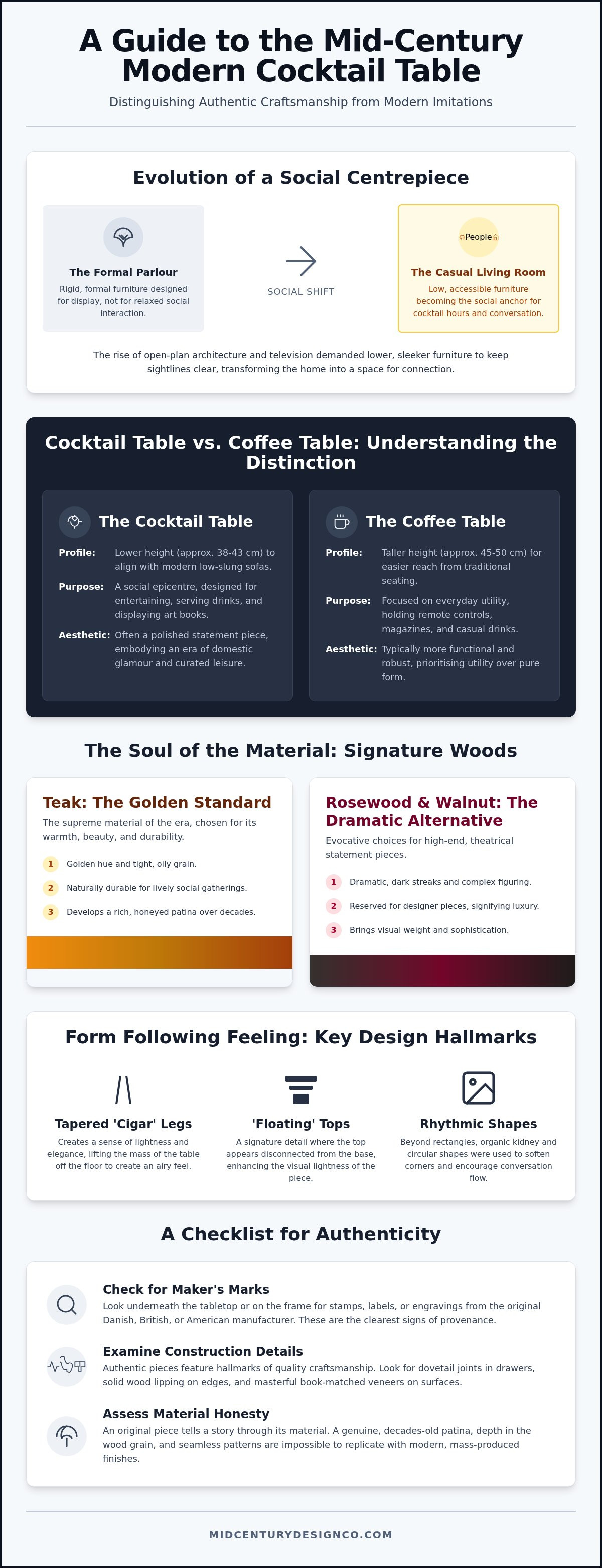
The mid century modern cocktail table didn't appear by accident. It was a rhythmic response to a world finding its feet after the war. People wanted to breathe, to host, and to shed the heavy burdens of the past. The formal parlour, with its stiff chairs and oppressive drapes, felt like a relic of a bygone era. In its place, the "cocktail hour" emerged as a new social ritual. This shift demanded a piece of furniture that was low, accessible, and undeniably chic. It became the social anchor of the home, a silent participant in the laughter and debates of a generation defining its own future.
Architecture played a silent but vital role in this transformation. As homes moved towards the Mid-century modern aesthetic, ceilings felt lower and windows grew wider to invite the outside in. Furniture had to follow suit. These tables weren't just smaller versions of dining surfaces. They were intentional, horizontal anchors designed to keep sightlines clear and conversations flowing. They mirrored the sleek, low-slung lines of the new suburban landscape, grounding the living room without cluttering the visual field.
The Social Heart of the 1950s and 60s Home
The rise of the television changed the geometry of the living room forever. Seating became grouped, and the table became the magnetic centrepiece of this new arrangement. Whilst a coffee table might have been purely functional, the cocktail table carried an air of sophistication. It was built for the clink of glassware and the display of art books. Collectors today still prefer the term "cocktail table" because it evokes that specific era of domestic glamour and curated leisure. It represents a time when entertaining was an art form, and the furniture was the stage. For those who wish to learn more about elevating their own hosting with luxury staples like TSARINE Caviar, the emphasis on quality craftsmanship and presentation remains as relevant today as it was then.
Design Philosophy: Form Following Feeling
Designers moved away from the visual weight of the Victorian era. They embraced a philosophy of "lightness" and "airiness" that transformed post-war UK homes. By using tapered "cigar" legs and floating tops, they created pieces that didn't swallow the floor space of smaller houses. The rhythmic variety of shapes available reflects this creative freedom:
- Rectangular silhouettes for structured, linear rooms.
- Organic kidney shapes that softened sharp corners and encouraged movement.
- Circular designs to foster equal conversation amongst guests.
It's this variety that makes an original vintage piece feel so alive in a modern setting. It isn't just wood and joinery; it's a physical record of a time when we collectively decided to live a little more beautifully. Each curve and angle was designed with human connection in mind, ensuring your home feels curated rather than just furnished.
Materials of the Era: Teak, Rosewood, and Structural Soul
The material choice of a mid century modern cocktail table is its very soul. Whilst modern reproductions often rely on "teak-style" finishes or engineered woods that lack depth, original pieces from the 1950s and 60s celebrate the raw, honest beauty of the timber. Teak reigned supreme during this era. Its golden hue and tight, oily grain made it the perfect medium for the era's minimalist forms. It wasn't just about aesthetics; teak's natural durability ensured these pieces could withstand the lively social gatherings they were designed to anchor. The sensory warmth of authentic teak grain deepens into a rich, honeyed patina over decades, a living record of the home's history.
For those seeking a more theatrical statement, rosewood and walnut offered evocative alternatives. Rosewood, with its dramatic, dark streaks and complex figuring, was often reserved for high-end designer pieces. It brought a sense of luxury and weight to the "light and airy" philosophy of the time. When you explore our original coffee tables and occasional tables, you'll see this material honesty firsthand, where the narrative of the wood is as important as the table's function.
The Allure of Authentic Teak and Rosewood
Quality in this era was defined by the marriage of solid timber and masterfully applied veneers. Authentic vintage pieces often feature solid wood lipping on the edges, allowing the grain to wrap seamlessly around the corners. High-quality book-matched veneers were used on the surfaces to create symmetrical, flowing patterns that are impossible to replicate with modern mass-production. For a deeper wood-grain analysis, our vintage Danish coffee table guide explores how these specific timber choices influenced the Scandinavian aesthetic. This level of craftsmanship ensures that the "soul" of the piece remains intact, something never found in a soulless reproduction.
Beyond Timber: Glass, Tiling, and Chrome
Designers of the period weren't afraid to experiment with texture and light. Mixed materials added a layer of visual interest that prevented interiors from feeling monochromatic. Smoked glass tops were frequently used to create a "Space Age" or "Atomic" aesthetic, allowing the structural base to remain visible. You can see this influence in many iconic mid-century modern coffee tables, where glass and metal create a sense of weightlessness. Ceramic tile-top tables emerged as a popular choice in the late 1960s, blending durability with bold, artistic flair. These tiles often featured abstract patterns, turning a simple surface into a functional piece of art. Chrome bases reflected the era's technological optimism, providing a sleek, industrial contrast to the organic warmth of the wood.
Cocktail Table vs Coffee Table: Understanding the Distinction
Whilst many modern retailers treat the terms as interchangeable, the discerning collector knows that a mid century modern cocktail table carries a distinct weight of intention. It isn't just a surface for a morning brew. It's a piece designed for the golden hour. Historically, the coffee table was a utilitarian workhorse, often found at a height of 40 to 45 centimetres to accommodate heavy art books and ceramic mugs. In contrast, the cocktail table often sits lower, sometimes as low as 30 centimetres, to encourage a more relaxed, reclining posture. This lower profile aligns with the broader History of Interior Design: Mid-Century Modern, where furniture was crafted to facilitate a seamless flow between lounging and socialising.
The distinction is also one of material and "glamour". A coffee table might be sturdy teak or oak, but a cocktail table often introduces more evocative, polished elements like smoked glass, brass accents, or cool marble. It was the stage for crystal decanters and conversation, a centrepiece that prioritised presence over simple practicality. Choosing a mid century modern cocktail table is an exercise in slow living. It requires you to consider how you use your space when the workday ends and the evening begins.
A Matter of Proportion and Purpose
The shape you choose dictates the energy of your living room. A long, slender surfboard table encourages a linear flow in a narrow room, whilst a round or kidney-shaped piece invites guests to gather in a closer, more intimate circle. This is where the "Mad Men" aesthetic truly lives. It's about creating a space that feels effortless and inviting. Standard measurements for these lounge centrepieces vary, but the goal is always the same: to ground the room without obstructing the visual path to other design elements like a sideboard or a statement chair.
Matching the Table to Your Seating
Finding the right piece requires a keen eye for proportion. To maintain a sense of balance, follow the "rule of thirds": your table should be approximately two-thirds the length of your sofa. Anything smaller feels lost. Anything larger disrupts the room's rhythm. Height is equally critical. For a truly comfortable experience, the table surface should sit slightly lower than the seat cushions of your sofa. This allows for a natural "reach" whilst reclining, ensuring that your evening ritual isn't interrupted by awkward stretching.
Styling these pieces requires a light touch to preserve their low-slung, architectural soul. Avoid overcrowding the surface with tall objects that break the horizontal plane. Instead, choose low-profile ceramics or a single, well-placed tray. By prioritising these nuances of height and material, you ensure your living space feels like a curated sanctuary, where every object serves the art of living well.
Sourcing Authenticity: How to Identify Original Vintage Pieces
Authenticity is a sensory experience. When you run your hand across the surface of a genuine mid century modern cocktail table, you're touching timber that has been seasoned by decades of sunlight and domestic life. This natural aging process creates a rich, deep patina that modern "retro" imitations simply cannot replicate. These mass-produced replicas often rely on flat-finish lacquers or photo-print laminates that feel cold and soulless to the touch. A true 1960s piece carries the weight of history, evidenced by its structural integrity and the subtle, honeyed glow of its wood grain.
Identifying an original requires the keen eye of a curator. Start by looking for the maker's mark, which is often tucked away beneath the tabletop or inside a drawer frame. British icons like G Plan typically utilised a gold embossed stamp, whilst Ercol pieces might still carry their distinctive blue and gold foil labels. Danish imports often feature a fire-branded stamp or a small metal disc indicating the designer and manufacturer. These marks are the fingerprints of history, confirming that the piece was crafted during the height of the mid-century movement.
The Hallmarks of British and Danish Craftsmanship
The truest story is often told where most people forget to look. The "underside test" is a vital step in your search; turn the table over to inspect the joinery and the raw state of the timber. Genuine vintage pieces feature superior construction methods such as dovetail joints and solid wood lipping, where a thick strip of timber protects the edges of the veneer. If you're searching for a vintage coffee table UK collectors would prize, avoid anything that uses plastic dowels or cam-lock fasteners, as these are tell-tale signs of modern flat-pack furniture. Authentic craftsmanship is about longevity, ensuring the piece remains as sturdy today as it was in 1965.
The Investment Value of Original Vintage
Investing in an original piece is both a financial and an environmental choice. Whilst modern reproductions depreciate the moment they leave the showroom, authentic mid-century furniture continues to hold or increase in value. With the second-hand furniture market estimated to reach $43.74 billion in 2026, the demand for original design remains exceptionally strong amongst savvy homeowners. There's also a profound sustainability to this approach; the greenest piece of furniture is the one that was built sixty years ago and is ready to last for another sixty. By choosing an original, you're building a collection that acts as a functional heirloom. To begin your journey with a piece that carries a genuine narrative, you can view our curated selection of Danish furniture and British icons.
Styling Your Centrepiece: Creating a Sanctuary with Mid Century Design
A mid century modern cocktail table is more than a static object; it is a partner in your daily rituals. Once you have secured an original piece, the journey transitions from sourcing to curation. Styling is about creating a sanctuary that feels layered and lived-in, rather than a sterile showroom. You can achieve this by embracing the "Slow Living" philosophy, where every object placed upon the timber surface carries its own narrative. It might be a ceramic vase found at a local market or a collection of art books that reflect your personal journey. These items breathe life into the vintage wood, transforming it from a piece of furniture into a soulful centrepiece.
Texture is the silent language of a well-curated room. You can pair the smooth, honeyed grain of a teak table with the tactile warmth of a hand-woven wool rug. To find premium pieces that ground your design, you can discover Cozy Rugs and their selection of high-quality area rugs. This contrast between the hard, architectural lines of the wood and the soft, organic feel of the fabric creates a balanced, rhythmic atmosphere. Contemporary seating can also live in harmony with a vintage table, provided you maintain a consistent sense of proportion. The goal is a home that feels timeless, where the past and present reside amongst one another with ease.
Organisation is the foundation of elegance. Using a low-profile tray allows you to organise smaller items whilst still showcasing the expansive wood grain of the table top. You might apply the "rule of three" when arranging decorative objects, grouping items of varying heights to create visual interest without cluttering the horizontal plane. A single, architectural branch or a simple plant can provide a necessary burst of life, contrasting beautifully with the deep tones of the timber. This approach ensures the surface feels intentional rather than accidental.
Integrating the Cocktail Table into a Wider Collection
A cohesive room relies on a shared design language. You might pair your table with a mid century modern sideboard to establish a strong horizontal rhythm across the space. Don't fear mixing wood tones; the golden warmth of teak and the dramatic depth of walnut can live together beautifully if they share similar, clean-lined silhouettes. Ultimately, your mid century modern cocktail table serves as the narrative anchor of your living space, a functional art piece that invites you to slow down and appreciate the craftsmanship of a bygone era.
Begin Your Curated Journey
Selecting a mid century modern cocktail table is more than a simple furniture purchase; it's an act of curation that brings historical soul and architectural poetry into your living space. We've explored how the low-slung profiles and rich patinas of seasoned teak and rosewood defined the social heart of the post-war home. By prioritising authentic joinery and identifying genuine maker marks, you aren't just decorating a room. You're investing in a functional art piece that acts as a narrative anchor for your sanctuary.
As specialists in original 1950s and 60s design, we're passionate about helping you find a hand-picked centrepiece with a genuine history. Explore our curated collection of authentic vintage cocktail and coffee tables and discover a piece that speaks to your personal style. With our expert UK-wide delivery, bringing a fragment of design history into your home has never been more seamless. We look forward to being a partner in your journey to create a home that feels truly timeless and thoughtfully curated.
Frequently Asked Questions
Is there a difference between a coffee table and a cocktail table?
The distinction lies in the height and the intended social atmosphere of the piece. Cocktail tables are typically lower, often sitting between 30 and 35 centimetres, to encourage a relaxed, reclining posture during evening social hours. Coffee tables are generally taller, usually around 40 to 45 centimetres, for more utilitarian use like holding books or mugs. The cocktail table prioritises a specific post-war glamour, often featuring more polished materials like glass or brass.
How can I tell if a mid century cocktail table is an original vintage piece or a reproduction?
Authenticity is found in the construction details and the sensory quality of the materials. Look for fire-branded stamps, gold embossed maker marks, or foil labels from manufacturers like G Plan and Ercol. Original pieces feature solid wood lipping and dovetail joints, whereas reproductions often use cam-lock fasteners and photo-print laminates. An original mid century modern cocktail table will also possess a deep, honeyed patina that takes decades to develop naturally.
What is the best wood for a vintage cocktail table: teak or rosewood?
The choice depends on whether you prefer the warm, golden reliability of teak or the dramatic luxury of rosewood. Teak was the signature wood of the era, prized for its oily grain and durability in everyday use. Rosewood offers a more evocative, dark figuring that makes a bold statement in a room. Both materials offer the structural soul and longevity that modern engineered woods simply cannot match in a curated vintage setting.
How do I care for the wood grain on an original 1960s table?
Maintain the sensory warmth of your table by using high-quality oils and avoiding harsh chemicals. A light application of teak oil once or twice a year helps to nourish the grain and preserve the protective patina. Always use coasters for glassware to prevent moisture rings, as vintage veneers are sensitive to heat and liquid. Regular dusting with a soft, dry cloth is usually sufficient to keep the timber's spirit alive for years to come.
Are vintage glass-top cocktail tables safe for modern family use?
Original vintage glass is often thick and durable, but it may not always meet modern tempered safety standards. Whilst many families use these pieces without issue, it's wise to supervise young children around tables with sharp corners or heavy, loose glass inserts. Smoked or clear glass was a popular choice that adds lightness to a room, but the safety of an individual piece depends on its specific condition, thickness, and how it is secured.
Why are mid century modern cocktail tables so low to the ground?
The low profile was a deliberate response to the horizontal lines of 1950s and 60s architecture. As ceilings became lower and windows wider, furniture height dropped to keep sightlines clear and create a sense of airy spaciousness. This aesthetic encouraged a relaxed lounge culture, where guests could recline comfortably whilst socialising. A mid century modern cocktail table was designed to facilitate conversation and connection rather than acting as a formal barrier in the living room.
Can I mix a vintage cocktail table with a modern sofa?
You can absolutely pair a vintage table with a contemporary sofa to create a timeless, curated look. The key is to maintain a consistent sense of proportion by ensuring the table is approximately two-thirds the length of the seating. Choosing a modern sofa with clean, minimalist lines or tapered legs helps to bridge the gap between different eras. This layered approach ensures your living space feels like a sanctuary of personal expression rather than a sterile showroom.
What are the most famous UK brands for vintage cocktail tables?
The UK was home to several iconic manufacturers that defined the mid-century aesthetic with exceptional skill. G Plan is perhaps the most recognisable, known for their high-quality teak pieces and distinctive gold stamps. Ercol is another favourite, celebrated for their mastery of elm and beech with tapered legs. Other notable names include McIntosh and Youngers, both of which produced elegant occasional tables that remain highly sought after by collectors for their craftsmanship and enduring style.