

The Essential Roundup of Mid Century Modern Cabinets in the UK
A vintage cabinet is far more than a mere storage solution; it is a silent narrator of design history that grows more soulful with every passing decade. You likely appreciate the honeyed glow of teak and the tapered elegance of 1960s craftsmanship, yet finding an authentic mid century modern cabinet UK collectors can truly trust is often a daunting pursuit. It's natural to worry about the structural integrity of a piece or the risk of mistaking a modern reproduction for a genuine heirloom, especially when trying to fit these iconic silhouettes into the unique dimensions of a British home.
We believe your furniture should be a form of functional art that retains its value whilst serving your daily needs. This article promises to guide you through the nuances of sourcing authentic storage, from the sculptural allure of Danish sideboards to the modular brilliance of Staples Ladderax systems. We will explore how to identify quality craftsmanship, understand the importance of original finishes, and select a piece that brings a sense of curated history into your personal sanctuary. By the end, you'll feel confident in choosing a timeless investment that defines your interior style.
Key Takeaways
- Understand how the "form follows function" philosophy makes these cabinets the perfect centrepiece for a contemporary British home.
- Explore the enduring appeal of teak and discover why its golden hues and durability make it the preferred choice for vintage enthusiasts.
- Uncover the history and modular brilliance of the Staples Ladderax system, a British design icon that offers flexible storage for modern interiors.
- Learn the specific markers of quality that define a genuine mid century modern cabinet UK, ensuring your investment remains a valuable piece of design history.
- Embrace a sustainable approach to interiors by choosing original vintage pieces that carry a unique narrative and historical soul.
The Allure of the Mid Century Modern Cabinet in British Interiors
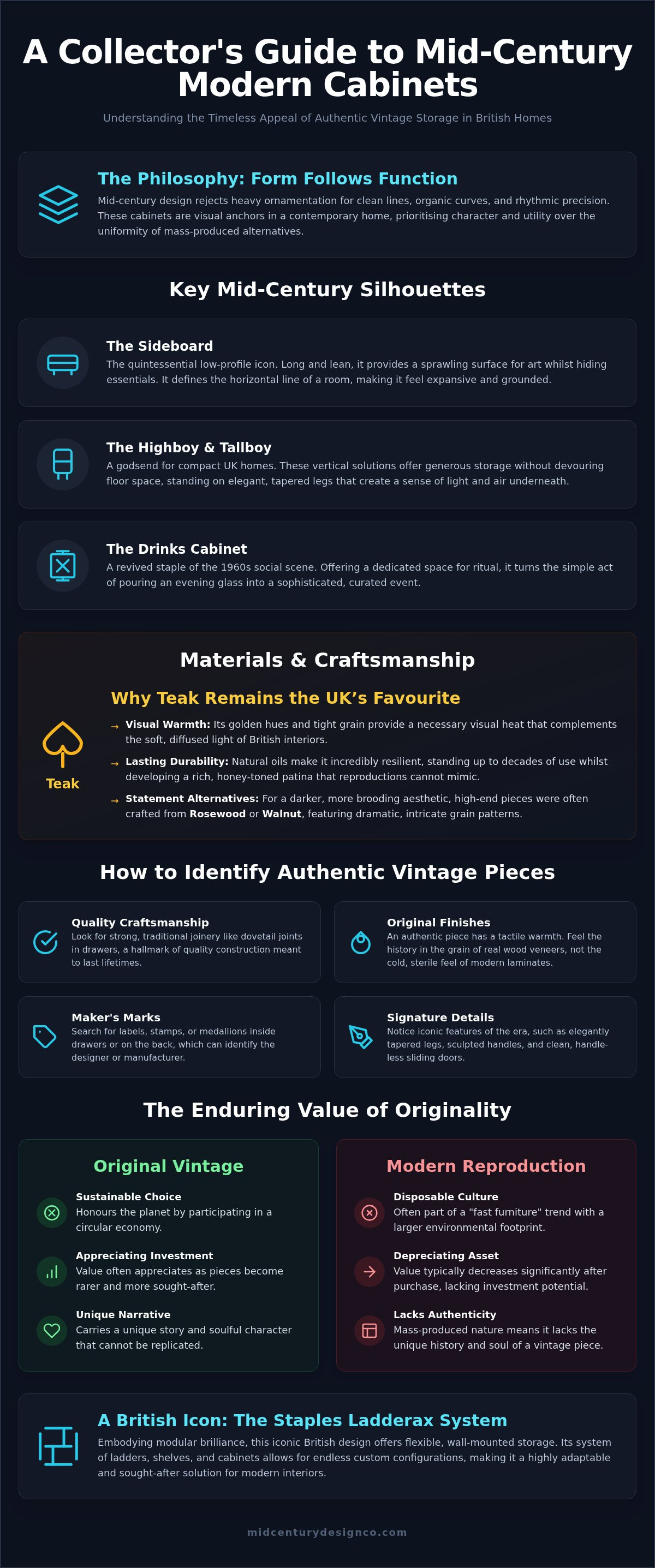
The mid-century modern cabinet is a study in restrained elegance. It is an object where form follows function with a rhythmic precision. Born from the Mid-century modern movement, these pieces eschew the heavy ornamentation of the past for clean lines and organic curves. In the contemporary British home, a mid century modern cabinet UK sourced is no longer just a place to tuck away linens. It has become a visual anchor. It is a statement of intent that prioritises character over the bland uniformity of mass-produced alternatives.
A quiet revolution has occurred within our living spaces. We've moved away from the era of disposable, flat-pack solutions. Today, homeowners seek heritage. They want pieces with a narrative, items that feel as though they've witnessed decades of living. This desire for longevity has turned vintage cabinets into the centrepiece of the modern lounge. They offer a tactile warmth that modern substitutes simply cannot replicate. It's a move toward "slow living" where every object in the room must earn its place through both beauty and utility.
A Taxonomy of Mid-Century Storage
Understanding the specific silhouettes of this era helps in curating a space that feels intentional. Mid-century storage isn't a monolith; it's a diverse collection of designs tailored for the evolving needs of the 1950s and 60s home.
- The Sideboard: This is the quintessential low-profile icon. Long and lean, it provides a sprawling surface for art whilst hiding away dining essentials behind sliding doors or banks of drawers. It defines the horizontal line of a room, making it feel expansive and grounded.
- The Highboy and Tallboy: These vertical solutions are a godsend for the often-compact UK bedroom or hallway. They offer generous storage without devouring precious floor space, standing tall on elegant, tapered legs that create a sense of light and air underneath.
- The Drinks Cabinet: Once a staple of the 1960s social scene, these have seen a romantic revival. They offer a dedicated space for ritual. They turn the simple act of pouring an evening glass into a sophisticated event.
Why Originality Matters for the Modern Home
The tactile experience of an original piece is incomparable. You can feel the history in the grain of authentic teak veneer. It has a warmth that feels alive compared to the cold, sterile nature of modern laminates. The way the light catches a hand-turned handle or a perfectly joined dovetail drawer tells a story of craftsmanship that was meant to last lifetimes.
Choosing between vintage furniture vs reproduction is a choice about legacy and investment. A genuine mid century modern cabinet UK collectors covet doesn't just hold its value; it often appreciates as these pieces become rarer and more sought after. Beyond the financial aspect, there's the environmental soul of the choice. By opting for pre-loved, high-quality furniture, you're participating in a circular economy that honours the planet as much as it honours design. It is a sustainable way to live with beauty, ensuring that the spirit of the past continues to enrich our present.
Materials and Craftsmanship: Why Teak Remains the UK’s Favourite
Teak is the undisputed protagonist of the vintage world. It possesses a sensory warmth that seems to defy the cool, grey light often found in British interiors. Whilst other woods have had their moments of popularity, teak remains the gold standard for a mid century modern cabinet UK enthusiasts seek out. Its tight grain and natural oils made it the perfect canvas for the sleek, handle-less designs of the 1960s. It wasn't just about the look; it was about resilience. Teak is incredibly durable, standing up to decades of use whilst developing a rich, honey-toned patina that reproduction pieces fail to mimic.
The specific quality of UK light plays a vital role in how we perceive these woods. In the soft, diffused glow of a British afternoon, the golden hues of teak provide a necessary visual heat. For those seeking something more dramatic, rosewood and walnut offer a darker, more brooding alternative. These woods were often reserved for high-end statement pieces, featuring intricate grain patterns that feel almost like a landscape painting. To understand the roots of this shift in taste, one might look to the legacy of the Gordon Russell Design Museum, which chronicles how British craftsmanship moved from traditional, heavy oak toward the sleek, international language of modernism.
The Teak Renaissance
Maintaining the "honey glow" of a vintage cabinet is surprisingly simple, requiring little more than an occasional application of high-quality teak oil. This minimal care preserves the wood's soul for another generation. High-end makers often employed "book-matching" veneers. This is a technique where two adjacent slices of wood are opened like a book to create a symmetrical grain pattern. It's a hallmark of quality that creates a mesmerising, mirrored effect across the front of a cabinet, turning a simple storage unit into a work of art.
Danish vs British Makers
Danish modern furniture set the pace for the rest of the world. Makers like Hans Wegner and Finn Juhl prioritised organic curves and sculptural joints that required immense skill to execute. This cross-pollination is why a mid century modern sideboard from Denmark often commands a premium amongst collectors. However, British makers like G-Plan and McIntosh were quick to respond. They adapted these Nordic influences for the UK market, combining Danish elegance with British manufacturing precision. The result was furniture that felt exotic yet was built to suit the proportions of a British home. If you’re searching for a piece that captures this specific warmth, our curated collection features original teak designs that have aged beautifully over sixty years.
Modular Mastery: The Staples Ladderax System and Beyond
Imagine a storage system that floats. It defies the heavy, immovable weight of traditional wardrobes, offering instead a sense of architectural lightness. The Staples Ladderax system, designed by Robert Heal in 1964 for Staples of Cricklewood, is a masterpiece of British engineering. It represents a pinnacle for anyone hunting for a mid century modern cabinet UK wide. It perfectly balances industrial strength with organic warmth. The black, white, or gold metal "ladders" provide a rhythmic, structural frame for cabinets finished in rich teak or rosewood. This aesthetic, often described as structural poetry, allows the system to occupy a room without overwhelming the visual space.
The allure of modularity isn't merely about aesthetics; it's about a psychological shift toward flexible living. In the post-war era, homes were becoming more dynamic, and furniture needed to keep pace. Staples Ladderax was the answer. It allowed the homeowner to become a curator. You could start with a single bay and expand as your collection of books or vinyl grew. Today, this flexibility remains its greatest strength. It’s a piece of design history that adapts to your life, rather than forcing you to adapt to it.
The Versatility of Ladderax
The true genius of the system lies in its adaptability. You aren't confined to a single, static configuration. A single bay might house a drop-down bureau for a discreet home office, whilst a larger three-bay setup could combine sliding-door cabinets and open shelving for a complete library. It organises a room with a lightness of touch. Because the system is typically freestanding, supported by its own ladders, it doesn't always require permanent wall fixings. This makes it a perfect companion for the fluid nature of modern life, especially in homes where space is at a premium.
Customising Your Modular Space
Creating a bespoke setup involves choosing the right uprights and components. You can opt for floor-standing ladders that lean gracefully against the wall or shorter versions designed for more compact arrangements. Mixing wood types, such as pairing teak shelves with a black metal frame, creates a fresh, contemporary feel that still honours its heritage. This versatility is why Ladderax is frequently featured as a cornerstone of mid century modern living room furniture. It provides a cohesive look that ties together disparate elements of a lounge.
Identifying original components is a skill worth honing for any serious collector. Look for the signature hooked metal rods that support the cabinets and shelves. These should fit snugly into the rungs of the ladders. The wood should show the authentic grain and sensory warmth that defines the era. For a deeper appreciation of how these modular systems fit into the wider world of 20th-century design, the Victoria and Albert Museum's Modernism collection offers a wonderful context. It reminds us that these pieces aren't just shelves. They are artefacts of a movement that sought to make high design accessible, functional, and beautifully adaptable for every British home.
Investing with Confidence: How to Identify Authentic Vintage Cabinets
Acquiring a mid century modern cabinet UK collectors will truly value requires more than just an appreciation for sleek silhouettes; it demands a curator’s eye for detail. You’re looking for a piece that carries its history with grace. Authentic vintage furniture possesses a specific sensory weight that modern reproductions simply cannot replicate. When you stand before a genuine 1960s piece, the wood should feel alive. It should have a narrative told through its grain and the gentle wear of decades. It's easy to be swayed by a polished exterior, but the true story of a cabinet is hidden in its construction and the small, often overlooked hardware that holds it together.
Identifying a genuine article involves looking for what shouldn't be there. Modern Phillips head screws, plastic drawer glides, or a perfectly uniform grain pattern are immediate red flags. These are the hallmarks of mass-produced replicas that lack the soul and longevity of original craftsmanship. Authentic pieces from the mid-century era were built to endure, using techniques that prioritised structural integrity. If you're looking for a piece with a guaranteed lineage, we invite you to browse our curated selection of original vintage cabinets where every item is chosen for its authentic spirit.
Wood Grain and Joinery Hallmarks
Dovetail joints are the gold standard of 20th-century cabinetry. Pull out a drawer and inspect the corners; those interlocking "teeth" are a sign of a maker who valued precision and durability. Whilst many high-end pieces used exquisite teak or rosewood veneers over solid secondary woods, the quality of that veneer is paramount. It should be thick and richly textured, unlike the paper-thin, repetitive laminates found in modern furniture. To check for an original patina, run your hand across the surface; it should feel smooth and slightly waxy, with a depth of colour that shifts subtly when viewed from different angles.
Identifying Makers’ Marks and Labels
The search for a maker's mark is often a rewarding moment of discovery. Check the back of the unit, the underside of shelves, or the inside of the top drawer for foil labels, heat-stamped logos, or even simple paper tags. For British-made furniture, the "Kite Mark" symbol is a significant find, indicating that the piece met the stringent quality standards of the British Standards Institution at the time of manufacture. If you find a stamp whilst viewing a piece, a quick search for the manufacturer can reveal the designer and the specific year of production. This historical context doesn't just add to the story of your home; it ensures your purchase holds its value as a documented piece of design history.
Curating Your Home with The Mid Century Design Co.
At The Mid Century Design Co., we believe that every home deserves a heartbeat. We don't just source storage; we find the soul within the timber. Whilst vast, unvetted marketplaces often leave you guessing about authenticity, we provide a curated alternative that prioritises the narrative of the object. Every mid century modern cabinet UK collectors discover through us has been vetted with a specialist's eye. We act as your expert friend, ensuring each piece carries the weight and character of a true heritage piece. It's a commitment to quality that transcends the transactional nature of modern retail.
Our philosophy is rooted in a deep respect for the original finish. We explicitly avoid modern reproductions and heavy restorations that strip away a piece's history. Instead, we celebrate the gentle patina that only sixty years of living can provide. This approach ensures that the furniture you bring into your sanctuary remains an authentic investment. We want you to envision these pieces as quiet companions to your daily rituals. They are the anchors of a room, providing a sense of calm and permanence in an increasingly disposable world.
Our Specialist Focus
From our dedicated studio, our search for excellence leads us to the finest examples of 20th-century design. We have a particular affinity for the sculptural elegance of authentic Danish sideboards and the industrial grace of Staples Ladderax systems. Every item is hand-selected by our small team. We look for the sensory warmth of the grain, the precision of the joinery, and the spirit of the maker. This personal touch ensures that our collection remains a testament to the longevity of the mid-century aesthetic. It's a slow, intentional process that honours the craftsmanship of the past whilst looking toward the future of your home.
Start Your Collection Today
Your journey toward a more curated home begins with a single discovery. Our online inventory is ever-changing, reflecting our latest finds from across the country. We've made the process of acquiring a mid century modern cabinet UK wide effortless by offering national delivery. This ensures your piece travels safely from our studio to your lounge, handled by those who understand its value. We invite you to explore our current collection and treat your home to a piece of functional art. It is an invitation to own a slice of design history that will hold its value and its beauty for decades to come.
Bring the Soul of Mid-Century Design into Your Home
Selecting a mid century modern cabinet UK collectors will cherish is an act of curation that extends far beyond simple storage. It is an investment in a narrative of craftsmanship; whether you're drawn to the golden warmth of a teak sideboard or the industrial poetry of a modular system, these pieces define the character of a room. You've discovered how to identify the hallmarks of quality, from dovetail joints to authentic makers' marks, ensuring your piece remains a valuable heirloom. By choosing original vintage over modern reproductions, you're embracing a sustainable, soulful way of living that honours the past whilst enriching your present sanctuary.
We are here to help you find that perfect piece. As specialists in original Staples Ladderax and authentic Danish design, we offer an expertly curated collection with no reproductions in sight. With nationwide UK delivery on all furniture, your next discovery is closer than you think.
Discover our curated collection of authentic mid-century cabinets
Your home is a canvas for your personal history. We look forward to helping you find the furniture that speaks to your spirit and transforms your living space into a gallery of functional art.
Frequently Asked Questions
Is mid century modern furniture a good investment in the UK?
Original vintage furniture is an excellent investment because these pieces are no longer in production, making them increasingly rare. Unlike modern flat-pack alternatives that lose value immediately, a well-chosen mid century modern cabinet UK sourced often appreciates over time. Collectors value the historical narrative and the superior craftsmanship of the era; this ensures your furniture remains a tangible asset within your home.
How can I tell if a mid century cabinet is an original or a reproduction?
Authenticity is revealed through the finer details of construction and the presence of historical markers. Look for dovetail joints in the drawers and the weight of the timber, as original pieces are significantly heavier than modern replicas. You should also search for foil labels or heat-stamped logos from manufacturers like G-Plan or McIntosh, which provide a documented lineage that reproductions simply cannot mimic.
What is the best way to clean and maintain a vintage teak cabinet?
Maintaining the sensory warmth of teak requires very little intervention beyond a gentle, consistent routine. Use a soft, lint-free cloth to remove dust and apply a high-quality teak oil once or twice a year to replenish the wood's natural oils. This process preserves the "honey glow" of the grain. It ensures the protective patina continues to develop beautifully over the coming decades.
Can I use a mid century sideboard as a TV stand?
Using a vintage sideboard as a media console is a popular way to blend heritage design with modern technology. These cabinets were built to support heavy dining sets, so they easily handle the weight of a contemporary television. Just ensure the height aligns with your seating position to maintain a comfortable viewing angle whilst the sleek, horizontal lines of the cabinet hide unsightly cables.
How do I know if a Staples Ladderax system will fit my wall?
Measuring for a Staples Ladderax system involves checking both the ceiling height and the level of your floor. Since the ladders come in specific heights, you'll need to ensure your chosen space can accommodate the vertical uprights without obstruction. It's also wise to check for skirting boards; many Ladderax ladders are designed to stand slightly away from the wall to clear these architectural details.
Why is Danish mid century furniture more expensive than British brands?
Danish pieces often command a premium because of their sculptural complexity and the international prestige of designers like Hans Wegner. Whilst British brands like G-Plan offered exceptional quality for the mass market, Danish makers focused on limited production runs with more organic, hand-finished joints. This scarcity, combined with a global desire for the "Danish Modern" aesthetic, naturally drives the market value higher for these Nordic imports.
Do mid century cabinets hold their value over time?
Authentic mid-century cabinets are remarkably resilient at holding their value, provided they are kept in good original condition. The market for mid century modern cabinet UK pieces remains robust because these items represent a finite period of design history. As long as you avoid harsh modern restorations and keep the original finish intact, your cabinet will likely remain a sought-after piece for future collectors.
Can I mix different wood types like teak and walnut in the same room?
Mixing different timbers like teak and walnut is a sophisticated way to add texture and depth to a room. Designers often use a variety of woods to create a curated, lived-in feel that avoids the sterile look of a matching furniture set. The key is to look for a shared design language, such as similar tapered legs or clean silhouettes, which allows disparate wood tones to live together in harmony.