

The Myth of the Impractical Antique: A Guide to the Vintage Wardrobe in the UK
Could a piece of furniture designed in the 1950s actually be more practical for your modern life than a brand-new assembly kit? Many homeowners assume that sourcing a vintage wardrobe UK wide means compromising on utility for the sake of aesthetics. You might worry about a lingering "old" scent, or perhaps you fear your modern hangers won't fit inside the depths of a mid-century frame. These concerns are understandable. It's often difficult to distinguish between a genuine teak masterpiece and a flimsy retro imitation that lacks the soul of the original.
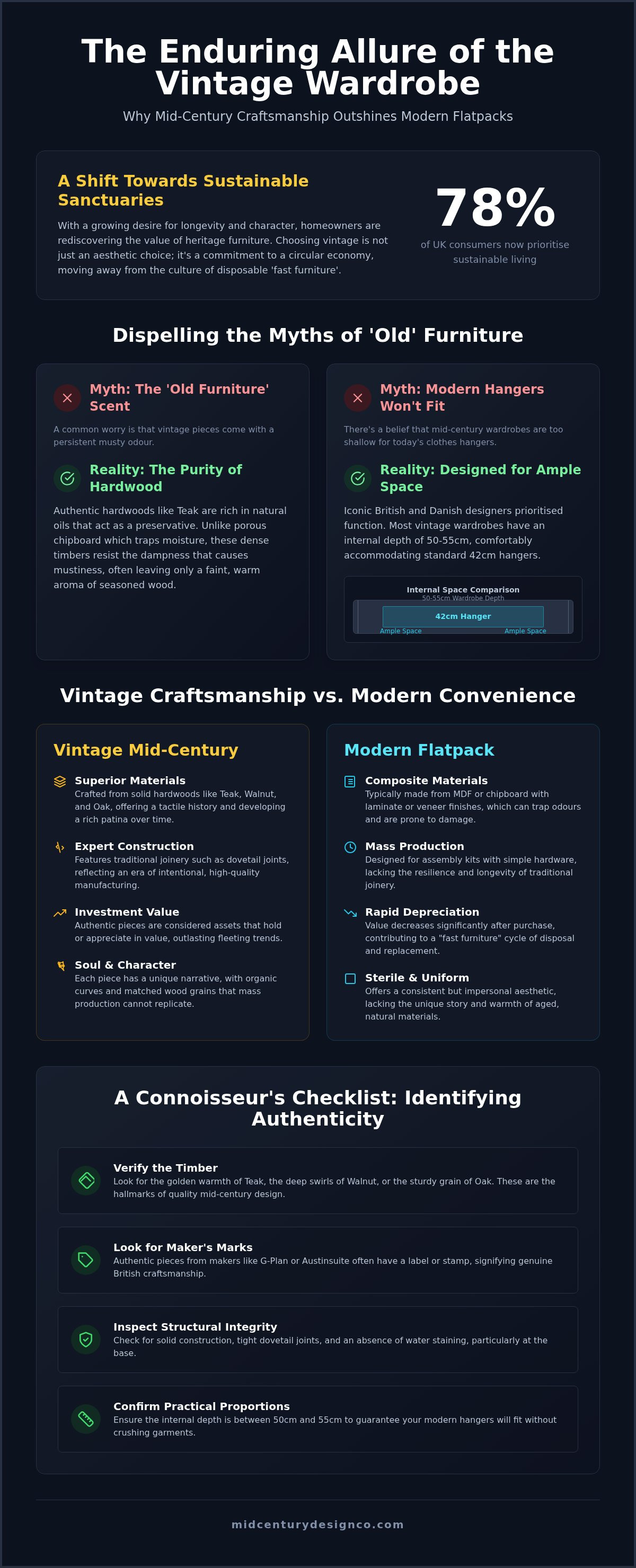
We agree that your bedroom should be a sanctuary, not a collection of disposable chipboard. With 78% of UK consumers now prioritising sustainable living, the move away from "fast furniture" has never been more relevant. This guide dispels the myths of the "impractical" antique. You'll discover how to identify authentic craftsmanship, verify structural integrity, and ensure your investment offers the longevity that modern flatpacks lack. We're moving beyond mass-produced storage; we are finding a home for your clothes that offers more soul-per-square-inch than any modern reproduction. You'll gain the confidence to choose a piece of functional art that brings character and a sense of history to your personal space.
Key Takeaways
- Learn how to distinguish between genuine mid-century craftsmanship and modern imitations, ensuring your piece possesses both structural integrity and soul.
- Discover why a vintage wardrobe UK enthusiasts treasure is often more durable and space-efficient than contemporary flatpack alternatives.
- Gain the practical knowledge to identify authentic makers' marks and high-quality timbers like teak and walnut, which define the Danish Modern aesthetic.
- Understand the environmental significance of investing in heritage furniture, contributing to a circular economy whilst avoiding the pitfalls of disposable design.
- Master the balance of styling historical pieces alongside modern decor to create a bedroom that feels like a curated sanctuary rather than a museum.
Myth-Busting the 'Old Furniture' Stigma: Are Vintage Wardrobes Practical?
The term "vintage" often conjures images of dusty attics or cluttered shops. However, a vintage wardrobe UK homeowners actually desire is a far cry from a forgotten relic. These pieces, primarily hailing from the mid-20th century, represent a pinnacle of British and Danish design where form followed function with obsessive precision. Tracing the history of the wardrobe reveals a transition from the heavy, ornate armoires of the Victorian era to the slender, architectural silhouettes of the 1960s. These later designs weren't just about storage. They were built to be functional art, offering a "soul" that mass-produced flatpacks simply cannot replicate. A vintage piece carries a narrative of craftsmanship, visible in the dovetail joints and the carefully matched wood grains that tell a story of a slower, more intentional era of manufacturing.
The 'Old Smell' Fallacy and Wood Hygiene
A common hesitation involves the "old furniture" scent. This is rarely an issue with high-quality mid-century pieces. Unlike modern porous materials like chipboard or MDF, which can absorb and trap moisture and household odours, authentic hardwoods like teak and oak are remarkably dense. Teak, in particular, is rich in natural oils that act as a preservative, keeping the wood healthy and resilient against the damp conditions that cause mustiness. To find a piece in peak condition, look for clear, vibrant grain and a lack of water staining on the base. A well-curated wardrobe from a reputable source has usually lived in a dry, ventilated home, meaning its only scent should be the faint, warm aroma of seasoned timber.
Dimensions and Modern Hangers
There's a persistent myth that mid-century furniture was built for smaller garments. Critics claim modern hangers will stick out or prevent the doors from closing. This simply isn't true for the majority of pieces from iconic British makers like G-Plan or Austinsuite. These designers understood the need for streamlined efficiency without sacrificing internal volume. The standard internal depth of an authentic mid-century wardrobe is typically between 50cm and 55cm. Given that a standard modern coat hanger measures roughly 42cm, your suits and dresses will hang freely without the "crushing" common in poorly designed contemporary units. Choosing vintage doesn't mean compromising on space; it often means gaining a more intelligently proportioned piece that occupies less floor area whilst offering superior internal organisation.
The Structural Poetry of 20th-Century Craftsmanship
The 20th century heralded a shift where utility met artistry. In the search for a vintage wardrobe UK collectors often prioritise the golden trio of timbers: the honeyed warmth of teak, the deep, chocolatey swirls of walnut, and the steadfast sturdiness of oak. Unlike the sterile, uniform surfaces of modern MDF, these woods possess a tactile history. They offer a sensory experience that changes with the light. British manufacturers in the 1950s and 60s were profoundly influenced by 'Danish Modern' principles. This movement prioritised clean lines and organic curves, proving that a functional storage unit could also be a sculptural centrepiece. Investing in these pieces isn't just about utility; it's about acquiring furniture that holds its value. While modern reproductions depreciate the moment they leave the showroom, authentic mid-century pieces are often considered investment-grade assets that withstand the rigours of daily life.
Teak: The Golden Standard of the 1960s
Teak became the undisputed favourite for mid-century designers across the UK. Its high oil content makes it incredibly durable, yet it maintains a soft, silken touch that invites the hand. As it ages, teak develops a rich patina, deepening in colour and character over decades. This enduring appeal makes it easy to create a cohesive home. For instance, pairing your bedroom storage with a vintage Danish coffee table in the living area establishes a thread of timeless elegance throughout your sanctuary. If you are looking to invite this warmth into your home, you might explore our latest hand-picked furniture collections to find a piece that speaks to your personal style.
Joinery and Longevity: Beyond the Screw and Glue
The secret to a wardrobe's survival over sixty years lies in its hidden details. Dovetail joints are the hallmark of quality, providing a mechanical strength that screws and glue cannot match. This level of craftsmanship is what allows these pieces to be moved from house to house without losing their structural integrity. Modern flatpacks often crumble after a single relocation, but vintage frames remain resolute. Insights from Victoria and Albert Museum conservation studies highlight how traditional construction methods preserve the life of furniture through centuries. Authentic joinery allows the wood to 'breathe' and move with the seasons, preventing the warping or cracking common in rigid, synthetic alternatives. When you run your fingers along the smooth, interlocking teeth of a drawer, you aren't just feeling wood; you're feeling a commitment to longevity that defines the spirit of the era.
Vintage vs. Modern Reproductions: The Hidden Costs of 'New'
Modern high-street retailers often tempt homeowners with "vintage-inspired" ranges. These pieces mimic the aesthetic of a genuine vintage wardrobe UK collectors search for, yet they frequently represent a false economy. You're purchasing a look rather than a legacy. Authentic mid-century furniture was built with an expectation of permanence, whereas modern "fast furniture" is designed for a transient lifestyle. There is a quiet beauty in the patina of an original piece. It's a soft, lived-in glow that a factory cannot replicate. Unlike upcycled items that hide their history under layers of modern paint, original pieces celebrate their narrative. They offer a connection to the past that feels grounded and real. They aren't just furniture; they're witnesses to decades of British domestic life.
The 'Chipboard' Reality Check
Contemporary "teak-effect" furniture is often little more than printed paper over compressed wood chips. It lacks the sensory warmth of real timber. It feels hollow. More importantly, it lacks the structural resolve of the originals. We often see modern shelves sag under the weight of a standard collection of clothes. An authentic mid century modern sideboard or wardrobe remains the benchmark for storage quality. These pieces were engineered to remain level and sturdy, regardless of what they hold. They don't just hold your clothes; they protect them within a frame that's as resolute today as it was in 1965.
Sustainability as a Design Choice
Buying vintage is an intentional choice for the planet. A piece that has already lasted sixty years has a carbon footprint that is effectively zero. It doesn't require new deforestation or the chemical-heavy glues found in modern MDF. The Museum of the Home's Rooms Through Time showcases how the British interior has evolved, moving from pieces built for life to items built for the moment. Choosing an original wardrobe supports the UK's circular economy. It ensures that craftsmanship is valued over convenience, turning your bedroom into a sanctuary of sustainable design. You're preserving a piece of history whilst refusing to participate in the cycle of disposable living.
A Connoisseur’s Checklist: Identifying Authenticity in the UK
Distinguishing a true vintage wardrobe UK hunters covet from a high-street "retro" imitation requires a keen eye for detail. Look beyond the silhouette. Authentic mid-century pieces possess a structural integrity that modern reproductions lack. Makers' marks are the gold standard of proof. You'll often find these embossed inside a drawer, stamped onto a back panel, or appearing as a small metallic badge. These marks aren't just logos. They are signatures of quality from an era when craftsmanship was a point of pride. Pay close attention to the hardware. Original handles should feel cool and substantial. The hinges should operate with a silent, heavy precision. A well-fitted door will close with a satisfying, muffled "click" that indicates the frame remains perfectly square after half a century.
Examine the wood grain. High-quality mid-century wardrobes often feature "book-matched" veneers. This is where two adjacent surfaces are cut from the same piece of timber to create a symmetrical, mirrored pattern. This level of artistry is never found in modern "teak-effect" furniture, which relies on repetitive, printed patterns.
Notable Names to Look For
British manufacturing during the 1960s was a hotbed of innovation. Look for the "E. Gomme" stamp of G-Plan, known for its accessible luxury, or the refined, sculptural lines of Austinsuite. McIntosh of Kirkcaldy remains a favourite for those who appreciate the heavier, more architectural side of Danish-inspired design. For those seeking modular flexibility, the Staples Ladderax for sale UK market offers a unique system of uprights and cabinets that can be tailored to your space. You can often spot the 'Danish' influence through tapered "cigar" legs and recessed "smile" handles, design cues that prioritise a clean, uncluttered profile.
Condition and Character: What to Accept
True vintage furniture wears its history. It's vital to distinguish between charming patina and structural damage. Small surface scratches or slight sun-fading are marks of authenticity rather than defects, proving the wood has lived and breathed in a real home. Avoid pieces with "racked" frames that lean to one side or deep water rings that have penetrated the veneer. Original oil or lacquer finishes are always more desirable than modern, thick polyurethane coats that mask the timber's natural texture. If you're ready to find your own authentic piece, you can browse our curated collection of wardrobes today.
Curating Your Sanctuary: The Wardrobe as an Investment
Your bedroom should be more than a place to sleep. It is a sanctuary. A curated gallery of your personal history. Choosing a vintage wardrobe UK collectors prize is an act of intention. It is a rejection of the disposable. When you surround yourself with objects that possess a narrative, you invite a sense of calm into your daily life. This is the essence of "slow furniture". It is about the psychological weight of quality. Objects that were built to last three generations carry a spirit that modern flatpacks cannot match. They anchor the room, providing a sense of permanence in a transient world. By selecting a piece with a soul, you aren't just organising your clothes; you are honouring the ritual of dressing.
Styling these historical pieces amongst contemporary decor is an art form. To avoid the "museum" look, embrace contrast. Pair the structured, architectural lines of a teak wardrobe with soft, natural linens or a plush wool rug. Use modern lighting to highlight the rich, honeyed tones of the wood. This balance ensures the room feels lived-in and unique rather than a period reproduction. The Mid Century Design Co. acts as your partner in this discovery, helping you find pieces that resonate with your personal aesthetic whilst maintaining their historical integrity.
Building the Master Bedroom Suite
A singular piece can transform a space, but a suite creates a sanctuary. Consider pairing your wardrobe with a vintage dressing table UK homeowners often use to complete their mid-century ritual. This creates a cohesive visual language. When balancing wood tones across different pieces, you don't need a perfect match. A walnut chest of drawers can sit beautifully alongside a teak wardrobe if they share a similar design language or leg style. The goal is a curated feel where each item is a focal point in its own right, contributing to a room that feels intentional and deeply personal.
The Future of Your Collection
Authentic mid-century furniture is a rare category of asset that you can enjoy daily whilst it likely appreciates in value. As the supply of original, well-preserved pieces from the 1960s diminishes, their desirability only grows. You are investing in a legacy. These are the heirlooms of the future, destined to be passed down to the next generation as examples of a golden era of design. We invite you to explore the curated collection at The Mid Century Design Co. to find your next investment. Each piece we select is more than just storage; it is a fragment of history waiting to become part of your home's story.
Investing in a Future with History
Choosing an authentic piece is about more than just storage. It's an invitation for craftsmanship and narrative to enter your home. We've explored how the practical dimensions of a vintage wardrobe UK collectors admire actually rival modern alternatives, offering a structural integrity that flatpacks simply cannot match. You now have the knowledge to identify genuine makers' marks and the confidence to value original patina over synthetic perfection. Surrounding yourself with objects of intention transforms a bedroom into a sanctuary. It creates a space that feels curated rather than just furnished.
As specialists in authentic mid-century design, we believe every home deserves a touch of this timeless soul. Our original pieces are hand-picked by our passionate experts and come with the convenience of nationwide UK delivery. We invite you to discover our curated collection of authentic vintage wardrobes and find a piece that resonates with your own story. Your journey toward a more soulful, sustainable home begins with a single discovery.
Frequently Asked Questions
Are vintage wardrobes in the UK standard sizes for modern homes?
Most mid-century pieces were designed for post-war British housing, making them remarkably compact and suited to modern rooms. While heights vary, the internal depths of a vintage wardrobe UK buyers typically find (50-55cm) accommodate modern hangers comfortably. Their slender silhouettes often fit into alcoves that bulky contemporary wardrobes struggle to navigate, offering a tailored look without the cost of bespoke cabinetry.
How do I know if a vintage wardrobe is made of solid wood or veneer?
Look for grain continuity across the edges of doors or panels. Mid-century designers favoured high-quality veneers over solid wood for stability and to showcase intricate grain patterns. If the grain on the front face wraps seamlessly around the corner, it's likely a veneer. Solid wood is more common in structural elements like legs, handles, and door frames to ensure longevity.
Do vintage wardrobes come apart for easy delivery and assembly?
Most mid-century wardrobes were built as rigid units; "knock-down" systems are rare for this era. Unlike modern flatpacks, they were constructed with permanent joinery for maximum strength. While internal shelves or hanging rails might be removable, the main carcass usually remains intact. Always measure your stairwells and doorways carefully before purchase to ensure the piece can reach its final sanctuary safely.
Can I use a vintage wardrobe in a nursery or child's room safely?
Yes, provided the piece is properly secured to the wall with modern safety brackets. Many vintage designs feature a narrower base, which can make them top-heavy when doors are fully opened. Ensure the original finish is intact and not flaking. These pieces offer a charming alternative to plastic-heavy nursery furniture, growing with your child as a timeless and sustainable heirloom.
How do I care for the teak finish on my vintage wardrobe?
Use a high-quality teak oil or a clear furniture wax to maintain the wood's natural lustre. Avoid modern aerosol sprays that contain silicones, as these can build up and dull the authentic patina over time. A simple wipe with a dry, lint-free cloth once a week is usually sufficient. Apply a small amount of oil every six months to keep the timber hydrated.
Is it worth buying a vintage wardrobe that needs minor repairs?
It depends on the nature of the damage. Surface scratches or minor "sun-bleaching" are easily treated with oil and contribute to the piece's history. However, structural issues like warped doors or split joints require professional attention. If the frame is square and the doors hang level, a piece with minor cosmetic wear can be a rewarding investment that only gains character with age.
Why should I choose an original vintage piece over a modern reproduction?
Original pieces possess a structural integrity and material quality that modern "retro-style" items often lack. As noted, 78% of UK consumers now prioritise sustainability, and buying a 60-year-old piece is a zero-waste choice. Beyond ethics, an original piece holds its value. While a modern reproduction depreciates instantly, a well-kept vintage wardrobe UK enthusiasts treasure remains a sought-after asset in the market.
How do I identify a genuine Staples Ladderax wardrobe system?
Look for the signature metal "ladders" and the specific hook-on brackets that define the system. Genuine Staples Ladderax components are modular, allowing cabinets and rails to be moved between rungs. Check for the "Staples" stamp, often found on the interior of the cabinet doors or back panels. The hardware should feel heavy and industrial, reflecting the system's reputation for versatile, high-quality British engineering.