

Vintage Danish Lounge Chair: 2026 UK Buying Guide
What makes the right vintage danish lounge chair UK buyers are searching for? It may not be the most famous design, but the one that feels at home in your room. The Danish label is appealing, yet it doesn’t tell the whole story. Design, materials and signs of careful craftsmanship matter just as much as a chair’s silhouette.
It’s understandable to hesitate over a vintage piece. Upholstery may show wear, a frame may have movement in its joints, and a chair that looks graceful in a photograph might not suit your comfort or available space. This guide explains how to assess design details, compare upholstery and frame condition, and judge comfort and scale before you choose. You’ll also learn how Danish design relates to the wider mid-century movement, so you can weigh each chair on its merits rather than relying on a label alone. The aim is to find a characterful lounge chair with the proportions and practical comfort to belong in a contemporary home.
Key Takeaways
- Understand why Danish modern describes a design tradition, not automatic proof of a chair’s maker or origin.
- Assess upholstery, frame construction and seating proportions to decide whether a chair suits your comfort and care preferences.
- Compare a vintage danish lounge chair UK shoppers might choose with a chair pair or compact sofa by seating needs, room placement and visual presence.
- Follow a practical inspection sequence and review available photographs and product details before choosing.
- Explore original vintage lounge chairs and sofas to compare distinctive materials, forms and character.
What makes a vintage Danish lounge chair distinctive?
A well-designed lounge chair can feel sculptural without sacrificing comfort. Its lines draw the eye, its proportions invite you to sit, and the wear of a lived-in original gives it character. When comparing a vintage danish lounge chair UK listings offer, look beyond an appealing silhouette to the design, materials and information available about that particular piece.
In brief: Danish modern is a design tradition associated with functional forms, considered proportions and thoughtful use of materials. Mid-century is a broader period and style category. A chair described as Danish in style isn’t automatically Danish-made.
“Danish style” can describe appearance rather than verified history. A seller’s label alone doesn’t establish who designed or made a chair, when it was produced or where it came from. Compare any claims about a piece with its available details, instead of drawing conclusions from its shape alone.
Which design details are worth noticing?
Look at how the parts work together. A restrained outline, balanced proportions and a frame that meets the upholstery neatly can give a chair visual harmony. Exposed timber brings warmth and makes the frame part of the design; shaped arms add a sculptural note, whilst slender legs can make a chair feel lighter in a room. These details help explain its appeal, but they don’t prove Danish manufacture or a particular designer.
Notice how the frame and upholstery share attention. Does the fabric soften the structure, or does the timber remain the dominant feature? Consider the chair’s visual weight beside your other furniture. A low, open frame may feel discreet, whilst a generously upholstered form can become the room’s focal point.
Danish design and mid-century style: how do they relate?
Danish modern belongs within the wider mid-century landscape, but the terms aren’t interchangeable. Mid-century describes a broader design period and range of styles; Danish modern refers to a more specific design tradition, often associated with functionalism, clean lines and natural materials. For context, read this overview of Danish Modern design principles and history.
Use style as a starting point, then consider materials and construction alongside any documented maker, label or attribution. Visible timber and well-judged proportions help explain a chair’s design appeal, but neither confirms its origin. Keep descriptions of the maker, date and provenance tied to evidence for that piece. This lets you appreciate its visual character without overstating what is known about its history.
How to assess comfort, materials and construction in a Danish lounge chair
A chair’s appearance matters, but so does how it supports the hours you plan to spend in it. Vintage danish lounge chair UK listings may show polished timber, softened leather or textured fabric, yet photographs can’t fully convey firmness, surface feel or how the seat supports your posture. Use the images and description to form expectations, and don’t assume a chair is sound or comfortable when those details aren’t shown.
What should you inspect on upholstery and frame?
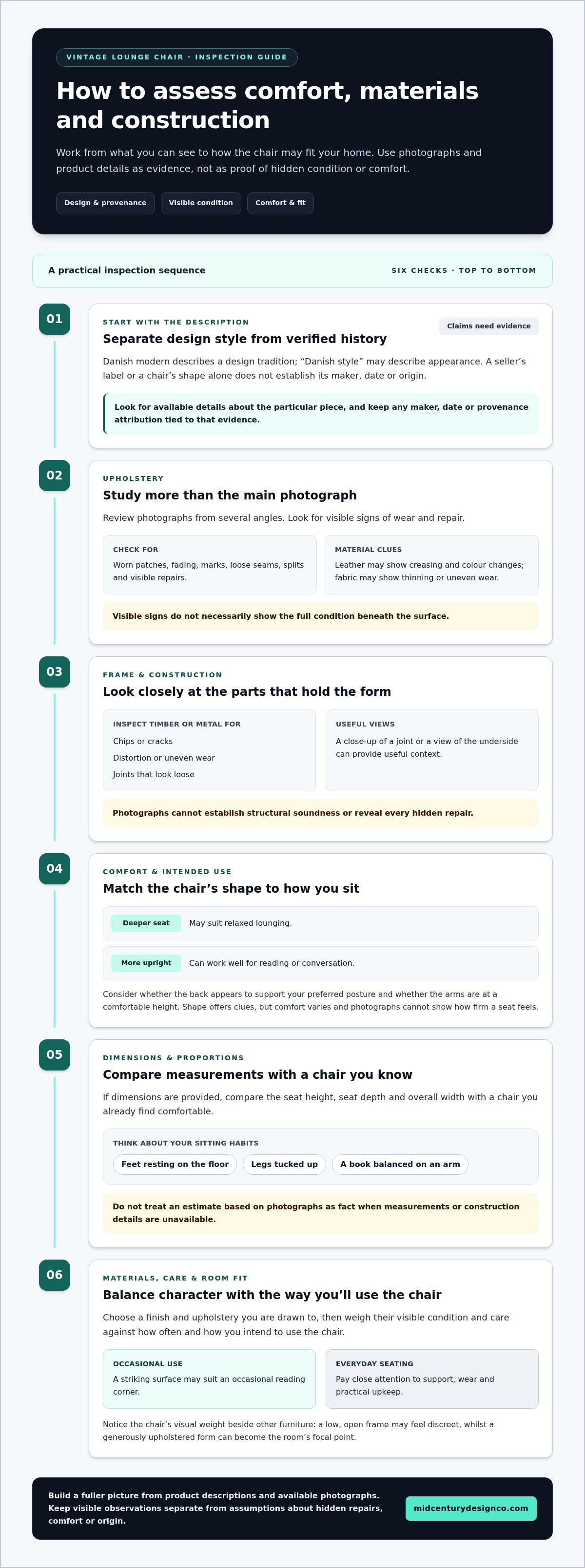
Study photographs from several angles, not just the main listing image. Look for worn patches, fading, marks, loose seams, splits and visible repairs in the upholstery. Leather may show creasing and changes in colour; fabric can reveal thinning or uneven wear. These signs show what is visible, but not necessarily the full condition beneath the surface.
Check timber or metal parts for chips, cracks, distortion, loose-looking joints and uneven wear. A close-up of a joint or the underside gives useful context, but a photograph can’t establish structural soundness or reveal every hidden repair. For a broader perspective on Danish materials and craftsmanship, explore Designmuseum Danmark’s design collections.
How can you judge whether a chair will feel right?
Start with its intended role. A deeper seat may suit relaxed lounging, whilst a more upright shape can work well for reading or conversation. Consider whether the back appears to support your preferred posture and whether the arms are at a comfortable height. Shape offers clues, but personal comfort varies and images can’t show how firm the seat feels.
If dimensions are provided, compare the seat height, depth and overall width with a chair you already find comfortable. Think about how you sit, too: feet resting on the floor, legs tucked up or a book balanced on an arm all call for different proportions. Don’t treat an estimate based on photographs as fact if measurements or construction details aren’t available.
Balance material character with intended use: choose a finish and upholstery you’re drawn to, then consider their visible condition and care alongside how often and how you’ll use the chair. A striking surface may suit an occasional reading corner; for everyday seating, pay close attention to support, wear and practical upkeep.
Use product descriptions and available photographs to build a fuller picture, keeping observations separate from assumptions about hidden repairs or comfort. To compare different forms and materials, browse the vintage lounge chairs and sofas.
Vintage Danish lounge chair or another lounge piece: how to compare
A single chair, a pair and a compact sofa each shape a room differently. Compare more than style: consider how many people you want to seat, how much visual space the piece occupies, what materials and condition details are documented, and whether its design attribution is supported. A vintage danish lounge chair UK shoppers are considering may suit a quiet corner, whilst a pair or sofa can create a stronger gathering point.
| Piece | Visual presence and seating | Material and placement | Condition information |
|---|---|---|---|
| Single accent chair | A distinct focal point; seating for one. | Materials and silhouette vary. Consider a reading corner or space beside a sofa. | Assess the individual chair’s upholstery, frame and visible wear. |
| Chair pair | Creates a balanced arrangement; seats two separately. | Works opposite a sofa or around a shared table, if the room has space. | Compare the condition of both chairs, including whether their wear appears consistent. |
| Compact sofa | A broader, more unified form for shared seating. | Often anchors a smaller sitting area; check how its materials relate to surrounding furniture. | Review the available details for the whole piece, not just the most prominent view. |
When is a single lounge chair the better fit?
Choose a single chair when you want flexible extra seating, a reading spot or an expressive shape to bring character to a room. Compare its footprint with your sofa and leave enough clear space to move around it. A distinctive chair can add contrast without crowding the room when its scale suits the surrounding furniture. Danish attribution is separate from visual appeal: other mid-century or Art Deco-inspired pieces may share a striking silhouette without being Danish designs.
When should you consider a pair or two-seat sofa?
A pair gives you two separate seats that can be angled towards one another or moved to suit conversation. The collection’s Ercol lounge chair pair is described as solid light elm and includes a footrest. It’s a useful example of comparing material and form, but shouldn’t be mistaken for a Danish design.
A sofa offers shared seating in one continuous form. The Werner Langenfeld piece is a Danish two-seat design for ESA Møbelværk, so it provides a clearly attributed sofa comparison, not a lounge chair. To plan the proportions of a living-room arrangement, explore this guide to vintage Danish coffee tables. A table’s scale and position can help you decide whether a chair pair or sofa leaves the room composed and easy to use.
How to buy a vintage lounge chair: a practical inspection checklist
A considered inspection turns an appealing listing into a more confident decision. When comparing a vintage danish lounge chair UK buyers can purchase online, follow the same steps each time. Use all available photographs and product details, not just the polished hero image.
- 1. Define the chair’s role. Decide whether it’s for reading, occasional guests or everyday lounging. Its intended use will guide what matters most in its shape, support and upholstery.
- 2. Assess scale and access. Compare stated width, depth and height with the space where the chair will sit. Measure doorways, hallways and turns along the route into the room, too. A piece can suit the floor plan but prove difficult to move through the house.
- 3. Inspect visible condition. Look for clear views of the seat, back, frame, joints and any marks. Note wear, fading, damage or visible repairs, and distinguish what the images show from what they can’t establish about hidden areas or structural soundness.
- 4. Compare materials. Read the description alongside close views of timber, metal and upholstery. Consider how each material’s visible condition and character fit the way you plan to use the chair.
- 5. Review the details. Check dimensions, stated materials and included components against your needs. Treat broad labels such as “Danish style” as a description of appearance, not proof of a maker, designer or production date.
Which listing details help you decide?
Useful listings show more than one angle, including the seat, back, frame and joints, as well as any visible marks. Read the product description carefully and compare it with the photographs: do the stated materials and included components match what you can see? If the wording is vague, focus on the chair’s actual form and documented details rather than filling gaps with assumptions.
What common buying mistakes can you avoid?
Don’t choose on appearance alone. A striking silhouette still needs to suit your room, intended use and comfort preferences, and visible condition deserves close attention. A Danish-style description doesn’t prove a specific maker or date, either. Compare like with like: a single armchair, a pair of chairs and a sofa differ in seating and footprint.
Once you’ve settled on the right scale and role, explore ideas for styling mid-century modern furniture to picture how a vintage piece might sit within a contemporary home. Browse vintage lounge chairs and sofas to compare forms and materials.
Explore vintage lounge chairs and sofas with character
A considered collection makes it easier to compare the qualities that matter: the warmth of timber, the presence of metal, the texture of leather, and the difference between a single chair and shared seating. The Mid Century Design Co. specialises in original vintage furniture, with pieces that each have their own form and material character. If “vintage danish lounge chair UK” is your search, read each piece’s description rather than assuming every vintage chair in a collection is Danish.
Compare distinctive chairs across materials and form
The Ercol lounge chair pair is described as solid light elm and includes a footrest. The visible timber gives this pair a different character from an upholstered chair with a metal frame, whilst the footrest is another feature to consider when deciding how you’ll use the seating.
A leather-and-polished-chrome directors armchair offers a contrasting combination of leather upholstery and a polished chrome frame. The aluminium-and-chestnut-leather aviator armchair has a more industrial-inspired presence. These material and form descriptions help distinguish the pieces, but neither chair should be labelled Danish on appearance alone.
Browse lounge seating beyond a single-chair silhouette
For shared seating, consider the Werner Langenfeld sofa, a Danish leather-and-chrome two-seat design for ESA Møbelværk. It offers a different scale and purpose from a lounge chair, pairing leather with a chrome frame in a continuous two-seat form. The Ercol Model 359 loveseat is another two-seater, described as solid elm. It’s a loveseat, not a single lounge chair, and its timber construction gives it a distinct material character.
As you compare, think about how each piece will sit alongside the furniture already in your room. A chair pair creates two separate places to sit, whilst a sofa brings shared seating together. Material, silhouette and stated design attribution can all help you decide which suits your space.
Browse vintage lounge chairs and sofas to compare the collection and find a piece whose form and character feel at home in your room.
Choose a vintage piece that feels at home
The right chair is more than a Danish-style silhouette. Look for design details supported by the available information, assess visible condition and materials, then consider comfort, room proportions and how you’ll use the piece. This approach makes it easier to compare a vintage danish lounge chair UK option with other distinctive lounge seating.
The Mid Century Design Co. specialises in original vintage furniture, with lounge seating that includes an Ercol solid light elm chair pair with a footrest, leather-and-chrome accent chairs and a Danish two-seat sofa. Each has a different form and material character. Choose the piece that suits both your room and your everyday life.
Take your time with the details, then browse vintage sofas and lounge chairs to compare the pieces and choose a vintage addition for your home.
Frequently Asked Questions
What defines a vintage Danish lounge chair?
A vintage Danish lounge chair combines lounge seating with design influences from the Danish modern tradition, often seen in considered proportions, functional form and thoughtful use of materials. Timber frames, shaped arms and restrained silhouettes may contribute to its appeal, but no single detail defines every example. The term describes design character, not automatic proof of a chair’s maker, production date or Danish origin.
How can you tell if a Danish lounge chair is authentic?
Look for evidence tied to the individual chair, such as a maker’s label or stamp, documented attribution, and details that can be compared with reliable examples of the designer’s work. Materials, construction and signs of age provide useful context, but appearance alone can’t confirm authenticity. Treat a “Danish style” description as a visual label unless the chair’s maker, date or provenance is supported by further evidence.
Are vintage Danish lounge chairs comfortable for everyday use?
Some can be, but comfort depends on the chair’s proportions, upholstery and condition, as well as your posture and preferences. Consider the seat depth, back support and arm height in relation to how you’ll use it, whether for reading, conversation or relaxed lounging. Photographs can suggest shape, but can’t convey seat firmness or the feel of aged materials, so use dimensions and descriptions to guide your expectations.
What should I check when buying a vintage lounge chair?
Start with the chair’s intended role and whether its dimensions suit your room and access route. Examine all available photographs for upholstery wear, fading, visible repairs, frame damage and uneven wear around joints. Compare the stated materials and included components with what you can see. Keep observable condition separate from assumptions about hidden repairs or structural soundness, and don’t rely on one attractive listing photograph.
Is every mid-century lounge chair Danish?
No. Mid-century is a broad design period that includes furniture from different countries and traditions; Danish modern is one distinct design tradition within it. A chair may share a pared-back silhouette or visible timber with Danish designs without being Danish-made. Look beyond broad style labels and consider the material, construction and any documented maker or provenance details specific to that piece.
Should I choose a lounge chair or a two-seat sofa?
Choose a lounge chair if you want an individual seat, a reading spot or a flexible accent. A two-seat sofa brings shared seating together and may create a more unified focal point. Compare each option’s dimensions and visual presence with your room, existing furniture and usual seating needs. Keep the categories clear: a chair pair offers two separate seats, whilst a sofa provides two places within one form.
How do I style a vintage Danish lounge chair in a modern home?
Give the chair room to be appreciated, then connect it to the rest of the space through a considered colour, material or shape. Visible timber can sit comfortably beside other natural finishes, whilst leather or textured upholstery may add contrast to a simpler setting. A well-proportioned side table or soft lighting can make a reading corner feel complete. Let the chair bring character without overcrowding the room.