

Vintage Teak Dining Chairs in the UK: An Expert Guide to Mid-Century Authenticity
A chair is never just a place to sit; it is a sixty-year-old testament to a design revolution that refused to sacrifice soul for mass production. You likely appreciate the warm, honeyed glow of mid-century timber and the way it anchors a room with quiet, architectural confidence. It's natural to feel a sense of hesitation when browsing for vintage teak dining chairs UK, particularly when the market is crowded with modern imitations that lack the weight, scent, and history of an original G Plan or McIntosh set.
We understand the worry of choosing a reproduction by mistake or questioning if a delicate-looking frame can truly support a family gathering after six decades. This guide promises to transform you from a curious admirer into a savvy collector. You'll learn to identify the subtle differences between afromosia and true teak, recognise the hallmarks of authentic craftsmanship, and ensure your investment supports a sustainable, circular way of living. We will examine the structural integrity of these mid-century icons and explore how their unique stories can breathe new life into your dining space.
Key Takeaways
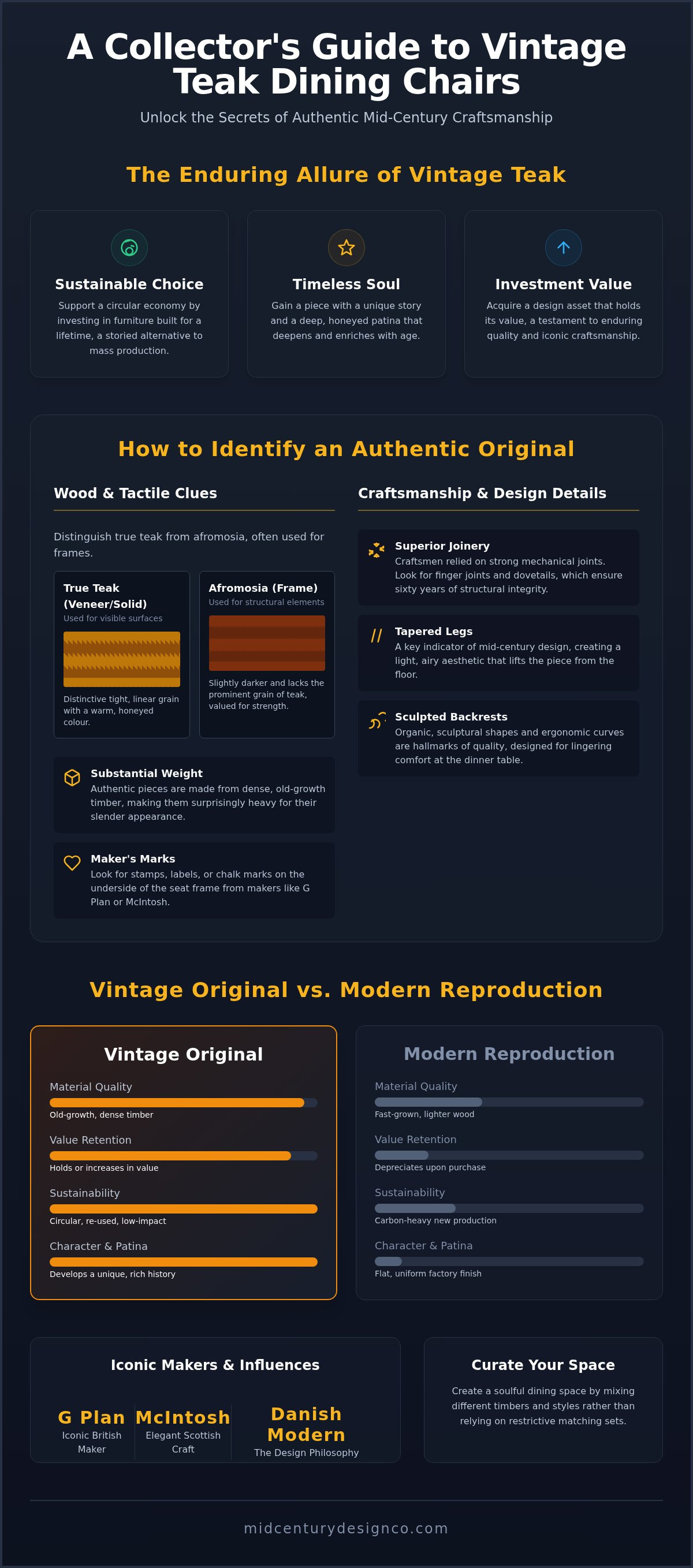
- Recognise the distinctive, tight grain patterns of old-growth timber to distinguish authentic teak from similar woods like afromosia.
- Identify the signature design elements of iconic British makers like G Plan and McIntosh alongside the gold-standard craftsmanship of Danish Modern masters.
- Gain the confidence to source authentic vintage teak dining chairs UK wide by understanding the joinery techniques that ensure sixty years of structural integrity.
- Create a curated, soulful dining space by learning how to mix different timbers and styles rather than relying on restrictive matching sets.
- Support a sustainable and circular furniture economy by investing in pieces that hold their value and offer a storied alternative to mass production.
The Enduring Allure of Vintage Teak Dining Chairs in the UK
The golden-brown timber of teak isn't just a material. It's a memory. In the post-war years, teak became the backbone of the British home, offering a sensory warmth that colder, darker woods simply couldn't match. When sourcing vintage teak dining chairs UK collectors are often drawn to that specific honeyed glow, a colour that has deepened and matured over decades. Unlike the flat, soulless finish of modern mass-produced items, an original piece carries a patina. It's a record of life. It's the soft sheen where hands have pulled out a chair for sixty years of Sunday roasts and late-night conversations.
Choosing pre-loved furniture in 2026 is also a radical act of sustainability. By opting for items that already exist, you're stepping away from the carbon-heavy cycle of new production. You're supporting a circular economy that values longevity over the disposable. These chairs weren't built for a fleeting season. They were crafted for a lifetime. This enduring quality has made them a staple of contemporary British interior design, where they bring a sense of history and "soul" to even the most modern minimalist spaces.
The Materiality of Mid-Century Teak
Teak is naturally oil-rich. This inherent quality makes it incredibly resistant to the spills and scuffs of a busy dining room. During the 1950s, many pieces were constructed from solid timber, but as the 1960s progressed, designers mastered high-quality veneers. These weren't the cheap alternatives we see today. They were exquisite slices of old-growth wood applied to stable cores, allowing for the organic, sculptural shapes that define the era. Over time, the timber reacts with light. It doesn't just age; it settles into a richer, more inviting version of itself that feels alive to the touch.
A Design Icon in the British Dining Room
Before the mid-century movement, British dining rooms were often weighed down by heavy, dark Victorian silhouettes. The arrival of teak changed the very atmosphere of the home. It introduced a light, airy aesthetic that prioritised flow and function. This shift was heavily influenced by the Danish Modern design movement, which championed the idea that beautiful furniture should be accessible and practical.
These chairs transformed the social behaviour of the British dinner party. They invited guests to linger. The ergonomic curves and sturdy joinery meant that comfort was finally part of the design language. Today, these pieces remain as structural as the day they left the workshop. It’s a legacy of craftsmanship that ensures your investment holds its value whilst telling a unique story in your home.
Identifying Authenticity: A Collector’s Guide to Teak Construction
Authenticity is felt as much as it is seen. When you run your hand across the backrest of genuine vintage teak dining chairs UK collectors often describe a specific, oily warmth that modern replicas simply cannot mimic. This is the hallmark of old-growth teak. These trees matured slowly over decades, resulting in a tight, linear grain and a high natural oil content. It’s this density that gives an original 1960s chair its surprising weight. If a piece feels flimsy or light, it’s likely a contemporary imitation using fast-grown plantation timber.
To verify a piece’s lineage, start by looking where others don't. Original makers marks are often tucked away on the underside of the seat frame or hidden beneath the removable seat pad. You might find a gold embossed stamp from G Plan, a subtle paper label from McIntosh, or even a handwritten chalk mark from a workshop long since closed. These small details are the fingerprints of history. For those wishing to deepen their knowledge of how these pieces were originally catalogued, the V&A furniture collection provides an extraordinary record of mid-century British and international design standards.
Joinery and Structural Details
The soul of a mid-century chair lives in its joints. True craftsmanship from this era relied on mechanical strength rather than just adhesives. Look for finger joints where the arm meets the frame or dovetails in more complex constructions. Tapered legs and sculpted, organic backrests are also key indicators of quality. In the UK, manufacturers often used Afromosia, sometimes called African Teak, for the solid structural frames whilst using teak veneers for the visible surfaces. Afromosia is slightly darker and lacks the prominent grain of teak, but it provided the immense strength required for those iconic, slender silhouettes. If you want to ensure your home is filled with these genuine structural marvels, it helps to browse a curated collection of original pieces where the vetting has already been done by an expert eye.
Spotting the Signs of Era-Specific Wear
A sixty-year-old chair should look like it has lived. We look for a healthy patina, a soft, diffused glow that comes from decades of gentle use and polishing. This is entirely different from damage. Whilst we avoid deep gouges or structural cracks, small "honesty marks" often confirm the piece's age. Original upholstery can also be a significant clue. Many British chairs were finished in heavy-duty black vinyl or textured wool blends. If the hardware, such as the screws or brackets, looks too shiny or modern, the piece may have been tampered with or poorly restored. Authentic pieces retain their original spirit, holding their value precisely because they haven't been stripped of their history.
From G Plan to Danish Modern: Iconic Makers and Designs
The post-war British home underwent a profound aesthetic shift. It moved away from the heavy, dark oak of previous generations towards a lighter, more optimistic design language. This evolution was deeply rooted in the Festival of Britain design principles, which celebrated modern materials and efficient, beautiful forms. When sourcing vintage teak dining chairs UK collectors often find themselves choosing between two distinct design philosophies: the robust elegance of British manufacturers and the ethereal, sculptural perfection of the Danish masters.
British Heritage: The Rise of G Plan and McIntosh
G Plan remains perhaps the most recognisable name in the British mid-century landscape. Their Fresco range, launched in the 1960s, became a masterclass in mass-market teak elegance. These chairs often featured afromosia for the structural frames and legs, a choice made for its immense strength, whilst using richly grained teak for the backrests and seats. North of the border, McIntosh of Kirkcaldy was carving its own path. They combined traditional Scottish craftsmanship with sleek Scandinavian lines, creating pieces that felt both grounded and sophisticated. The "Roundette" dining set, designed by Hans Olsen for McIntosh, remains a marvel of small-space engineering, with chairs that tuck seamlessly under the table to form a unified, circular silhouette.
The Danish Masters: Sculptural Perfection
Whilst British makers focused on durability and mass-market appeal, Danish designers were pushing the boundaries of organic minimalism. Chairs by Hans Wegner or Niels Otto Møller are often considered the gold standard of the era. They frequently utilised a "floating seat" aesthetic, where the seat appears to hover independently of the frame, creating a sense of lightness and grace. These high-end Danish pieces were the vanguard of a global Golden Era, where furniture was treated as functional art.
Their slender, tapered legs and organic curves pair beautifully with vintage Danish coffee tables, allowing you to create a cohesive, curated atmosphere throughout your living space. Whether you choose the robust "Fresco" or the ethereal "Sawbuck", you are investing in a design legacy that continues to define the modern British home. Each piece serves as a bridge between historical craftsmanship and contemporary living, ensuring your dining space tells a story of quality that has endured for over sixty years.
Sourcing and Styling Your Teak Chairs in a Modern Home
The honeyed warmth of teak acts as a visual anchor. It's a material that invites touch. When you introduce vintage teak dining chairs UK into a contemporary setting, the goal isn't to recreate a period showroom. Instead, it's about layering textures. You might pair a set of sculptural Danish chairs with an authentic mid century modern desk in a multifunctional living area. This mixing of timbers, perhaps teak alongside afromosia or even light oak, prevents the room from feeling flat or overly coordinated.
Lighting plays a vital role in showcasing the timber's soul. Positioning your dining set near a source of natural light allows the tight grain patterns to shimmer. In the evening, soft, low-level lighting from a pendant lamp can highlight the organic curves of the backrests. Don't be afraid to update the textiles. Replacing tired seat pads with high-quality wool or textured bouclé can breathe new life into the vintage frames whilst maintaining their historical integrity.
The Art of the Eclectic Dining Set
There is a quiet confidence in the mismatched. You don't need a uniform set of six to achieve a sophisticated look. Mixing different models from the same era, perhaps G Plan Fresco chairs alongside McIntosh ladder-backs, creates a relaxed, curated aesthetic. This approach helps you style mid century modern furniture without falling into the "museum" trap. A retro dining table and chairs UK can serve as a powerful focal point in an open-plan home, bridging the gap between kitchen utility and dining room elegance.
Care and Longevity for Your Investment
These chairs have already survived sixty years. With the right care, they'll easily see another sixty. Daily maintenance is simple. Use a high-quality teak oil or a natural beeswax to preserve the wood's glow and prevent it from drying out. British homes pose specific challenges; central heating can be particularly drying for vintage timber. Position your chairs away from direct radiator heat to prevent the joints from loosening. Buying original pieces is a deliberate hedge against the disposable furniture trend. It's a commitment to quality that holds its value. If you're ready to find your next heirloom, browse our curated selection of authentic dining chairs today.
Investing in the Soul of Design with The Mid Century Design Co.
A home should be a collection of stories. It’s a sanctuary built from objects that resonate with your personal history. At The Mid Century Design Co., we believe that every piece of furniture carries a narrative, a whisper of a past era that brings character to the present. When you choose vintage teak dining chairs UK from our collection, you aren't just buying seating. You're acquiring a piece of history that has been hand-selected for its soul and its spirit. We act as your expert friend, bridging the gap between the mid-century workshops of the 1960s and your contemporary British home.
Our Philosophy of Quality
We don't believe in the disposable. Our philosophy is rooted in the enduring power of original design, which is why we focus exclusively on authentic vintage pieces. You won't find modern reproductions here. Every item in our inventory undergoes a rigorous selection process where we examine the tightness of the grain, the precision of the joinery, and the overall structural integrity. We look for that specific sensory warmth that only old-growth teak can provide. It's about more than aesthetics; it's about creating a sanctuary. We help you choose items that offer a sense of calm and permanence in an increasingly fast-paced world. By valuing the original, we support a circular way of living that respects both the environment and the heritage of the makers.
Discovering Your Next Statement Piece
Building a curated home is an intentional journey. It often begins with a single discovery, perhaps a pair of iconic chairs that spark a new appreciation for craftsmanship. From there, you might look to anchor your space with other storied objects, such as our range of mid century modern sideboards or modular shelving systems. We provide a national service for collectors across the UK, ensuring that these rare finds are delivered safely to your door. We handle the logistics so you can focus on the vision for your space.
We invite you to linger over our current collection. Each piece is unique, a one-off find that cannot be replicated by a factory line. Whether you're a seasoned collector or just beginning to appreciate the allure of mid-century design, we're here to help you find an heirloom that will last for generations. Explore our curated inventory online and find the piece that speaks to the soul of your home.
Bringing the Spirit of Mid-Century Design to Your Table
Choosing the right seating is about more than finding a functional set of chairs; it's about investing in a narrative of British and Scandinavian craftsmanship that's endured for over six decades. By understanding the nuances of old-growth timber and the signature joinery of makers like G Plan and McIntosh, you can source vintage teak dining chairs UK wide with absolute confidence. These pieces offer a sensory warmth and structural integrity that modern alternatives simply can't replicate, ensuring your dining space remains a sanctuary of sustainable, timeless style.
At The Mid Century Design Co., we're passionate collectors who believe every home deserves a touch of historical soul. We focus exclusively on authentic 1950s and 60s originals, each expertly curated to ensure it meets our exacting standards for character and quality. With national UK delivery, your next statement piece is closer than you think. We invite you to explore our curated collection of authentic vintage teak chairs and discover the perfect addition to your home's story. Your journey into the world of mid-century elegance is just beginning.
Frequently Asked Questions
How can I tell if my dining chairs are real teak or just a veneer?
You can identify real teak by examining the end grain on the edges of the timber. Solid teak displays a continuous grain pattern that wraps around the corner; a veneer will show a distinct line where a thin layer of wood meets a composite core. Most 1960s chairs utilise solid teak for high-stress areas like legs, whilst using exquisite veneers for the curved backrests to achieve those iconic, organic shapes.
Which UK mid-century furniture makers are the most collectable for dining chairs?
G Plan and McIntosh of Kirkcaldy remain the most sought-after names for collectors of vintage teak dining chairs UK wide. G Plan’s Fresco range offers a quintessential mid-century silhouette, whilst McIntosh is celebrated for its Scottish craftsmanship and Scandinavian influence. A. Younger is another name to watch; their pieces were often produced in smaller numbers, making them a rarer find for those seeking a more exclusive aesthetic in their dining room.
Is it better to buy a set of 4 or 6 vintage teak chairs?
A set of six is generally the superior choice for long-term value and practicality. Whilst a set of four is easier to source, finding two matching chairs later to expand your set is notoriously difficult due to variations in timber grain and patina. A complete set of six or even eight represents a more significant investment, but it offers a unified look that holds its financial weight much better in the secondary market.
How do I care for the original finish on my 1960s teak furniture?
Preserving the original finish requires a gentle touch and regular attention. Dust your chairs with a soft, lint-free cloth and apply a high-quality teak oil or natural beeswax every few months to feed the wood. Avoid modern silicone-based polishes as they create a dulling film over time. It’s also vital to position your furniture away from direct sunlight and radiators, as extreme temperature changes can cause the sixty-year-old joints to shrink or crack.
Why are Danish teak chairs usually more expensive than British ones?
Danish chairs often command higher prices because they were typically produced in smaller, artisan workshops rather than large factories. Designers like Niels Otto Møller or Hans Wegner focused on complex, sculptural joinery and architect-led designs that pushed the boundaries of what wood could do. These pieces were positioned as luxury items from their inception, whereas British makers like G Plan focused on bringing high-quality teak elegance to a broader, mass-market audience.
Can I mix vintage teak chairs with a modern dining table?
Mixing vintage chairs with a contemporary dining table is an excellent way to create a curated, soulful home. The organic warmth of mid-century teak provides a beautiful counterpoint to the clean, sometimes clinical lines of modern glass, marble, or steel. This eclectic approach prevents your space from feeling like a period showroom, instead creating a layered interior that reflects a sophisticated, personal journey of discovery and appreciation for timeless design.
What is the difference between teak and afromosia in mid-century furniture?
Afromosia, often called African Teak, was frequently used by British manufacturers for the structural frames and legs of dining chairs. It is a denser, darker, and more finely grained wood than true teak, offering the immense strength required for slender, tapered legs. True teak was typically reserved for the highly visible backrests and seats, where its rich, golden-brown figures and honeyed glow could be showcased to their full aesthetic potential.
Are vintage teak dining chairs a good financial investment?
Authentic mid-century furniture is a remarkably stable financial investment compared to mass-produced modern alternatives. Original pieces from the 1950s and 1960s have consistently held or increased their value over the last decade as global demand for sustainable, high-quality design grows. When you buy an original set, you are purchasing a finite piece of history. These items don’t depreciate the moment they leave the showroom; they mature, both in beauty and in historical weight.