

A Connoisseur’s Guide to Sourcing Vintage G Plan Furniture in the UK
Is that sleek, teak sideboard a finite piece of 1960s British history, or simply a modern imitation masquerading as a mid-century icon? For the discerning homeowner, the allure of vintage G Plan furniture UK lies in its soul; the tactile warmth of honey-toned wood and the architectural elegance of a "floating" base. You likely understand that these pieces aren't just furniture. They're functional art, carrying a heritage of craftsmanship that mass-produced replicas simply cannot mirror.
Finding an authentic masterpiece amongst a sea of listings can feel daunting. You might worry about hidden damage or feel confused by the distinction between newer "G Plan Vintage" lines and the original mid-century collections. We're here to help you decipher these nuances with confidence whilst ensuring your investment holds its value. This guide reveals how to identify genuine labels, evaluate the condition of iconic ranges like Fresco or Librenza, and source these heavy teak treasures without the logistical stress of national delivery. By the end, you'll be equipped to curate a home filled with characterful, sustainable designs that truly stand the test of time.
Key Takeaways
- Decode the history of G Plan maker's marks to confidently distinguish between early 1950s originals and the iconic 1970s red label collections.
- Master the technical details of vintage G Plan furniture UK, including how to identify genuine teak veneers and solid afrormosia edges for lasting quality.
- Explore the enduring appeal of the Fresco and Sierra ranges to understand why these specific designs remain essential for a curated mid-century home.
- Learn how to scrutinise online listings for common vintage issues, such as sun fading or structural wear, to ensure your investment is sound.
- Discover the value of sourcing authentic, hand-selected pieces that preserve the soul and narrative of British post-war design history.
The Allure of Vintage G Plan Furniture: A British Design Renaissance
To own a piece of vintage G Plan furniture UK is to possess a fragment of British social history. It's more than wood and joinery. It represents a moment when the nation shook off the grey dust of post-war austerity and embraced a bright, modernist future. Donald Gomme didn't just sell sideboards; he sold a new way of living. His vision transformed the British home from a place of dark, heavy Victorian relics into a sanctuary of light, air, and sculptural simplicity.
The Evolution from E. Gomme to G Plan
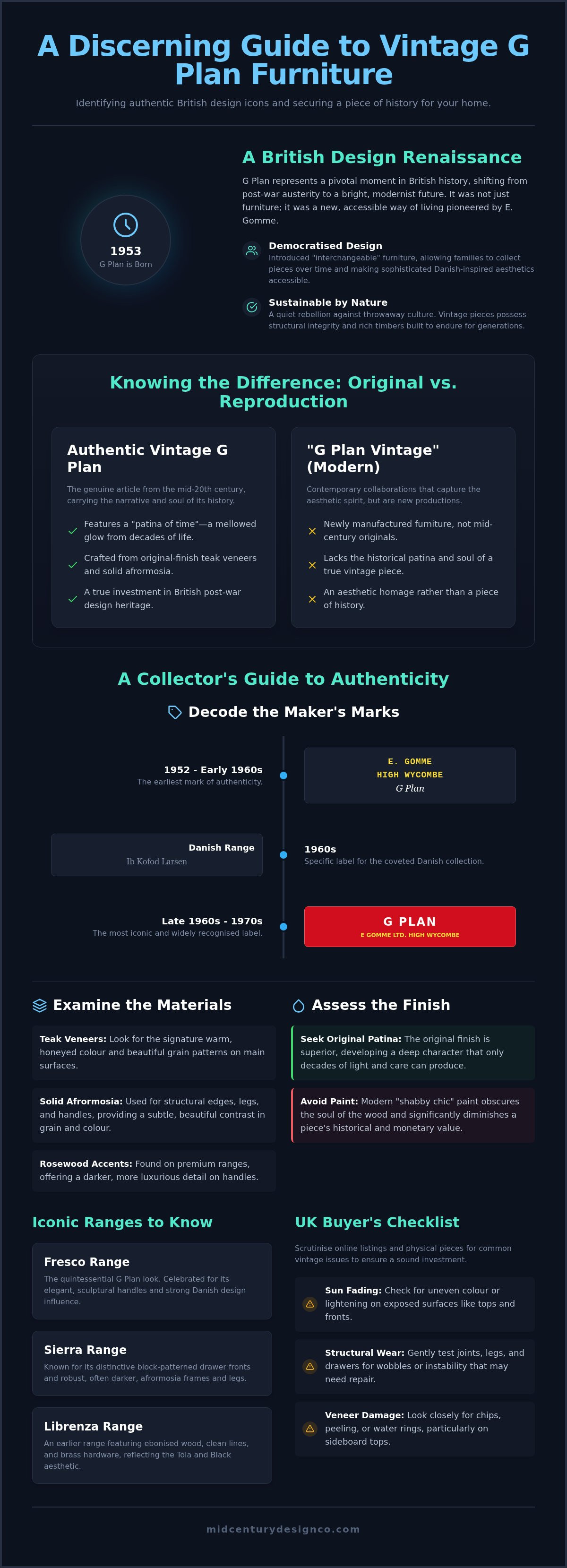
G Plan emerged from the traditional workshops of E. Gomme Ltd in High Wycombe. The History of G Plan reveals a radical pivot in 1953, heavily influenced by the optimistic, clean lines showcased at the 1951 Festival of Britain. By introducing the concept of "interchangeable" furniture, Gomme democratised high-end design. Families no longer had to buy an entire dining suite at once. They could collect pieces over years, building a coordinated interior that felt both cohesive and deeply personal. This shift marked the birth of the "Standard of Modernism" in the UK, making sophisticated Danish-inspired aesthetics accessible to the burgeoning middle class.
Choosing original vintage is a quiet act of rebellion against today's throwaway culture. A 1970s teak sideboard possesses a structural integrity that modern flat-pack equivalents simply cannot replicate. It has survived decades of Sunday roasts and family gatherings, acquiring a narrative that only time can bestow. There's a profound sustainability in longevity. These pieces were built to endure, crafted from rich timbers that have mellowed into a deep, honeyed glow. This emotional weight is what makes a genuine G Plan piece feel like a member of the family rather than a mere utility.
Vintage vs. "G Plan Vintage": Knowing the Difference
A common point of confusion for new collectors is the contemporary "G Plan Vintage" range. While these modern collaborations capture the aesthetic spirit of the past, they are new productions. They lack the "patina of time" that defines an authentic mid-century original. Authentic vintage G Plan furniture UK carries the subtle marks of its previous lives; a slight darkening of the teak or a faint, storied wear on a handle. Sourcing from a specialist curator who understands this distinction ensures you aren't just buying a look, but a genuine piece of heritage with its soul intact. For the connoisseur, the allure lies in that history, the tactile warmth of the original finish, and the knowledge that your furniture has already stood the test of time.
Identifying Authenticity: How to Spot Genuine G Plan Pieces Online
Sourcing vintage G Plan furniture UK requires more than an appreciation for the aesthetic; it demands a detective’s eye for detail. Authenticity is the cornerstone of any collection. When browsing digital galleries, you must look beyond the silhouette to find the signatures of E. Gomme’s High Wycombe workshops. These markers distinguish a finite piece of history from a modern imitation, ensuring your home remains a sanctuary of genuine heritage.
Decoding the G Plan Labels
Labels are the most immediate proof of lineage. From 1952 through the early 1960s, pieces were marked with a gold embossed stamp featuring "E. Gomme, High Wycombe" and "G Plan" in block capitals. The highly collectible 1960s Danish range carries a specific label with Ib Kofod Larsen’s signature. By the late 1960s, the transition to the iconic red label began. Early versions were paper squares that often detached over time; later versions from the mid-70s featured more durable gold metallic lettering. A missing label doesn't necessarily mean a piece is fraudulent, but it should prompt you to perform a more rigorous physical inspection.
The Tactile Truth: Wood Grain and Finish
Authenticity lives in the materials. G Plan’s signature look relies on warm, honeyed teak veneers paired with solid afrormosia (African teak) for the structural edges and handles. This creates a subtle, beautiful contrast in grain and colour that defines the era. Premium ranges often incorporated rosewood for handles to provide a darker, more luxurious accent. Original finishes are vastly superior to modern "shabby chic" painted alternatives. Paint obscures the soul of the wood and significantly diminishes the piece's historical value. Look for the natural patina that only decades of light and care can produce.
The "Dovetail Test" remains a reliable gauge of quality. A genuine vintage chest of drawers or sideboard will showcase precision dovetail joints, a hallmark of the brand’s commitment to longevity. Recognising the sculptural "lip" handles of the Fresco range or the distinctive sled-like legs of Quadrille is essential when investing in mid-century furniture. These details reflect a standard of craftsmanship that modern replicas fail to achieve. If you're seeking a piece with a guaranteed lineage, you might consider exploring our curated collection of authentic sideboards and storage.
The 1970s Teak Revolution: Why the Fresco and Sierra Ranges Endure
The 1970s marked a pivotal chapter for vintage G Plan furniture UK. While earlier ranges introduced modernism to the masses, the "Teak Revolution" of this decade cemented the brand's place in the British cultural psyche. This era produced pieces that were not only aesthetically daring but incredibly robust. For the serious collector, these ranges represent a tangible investment. Unlike mass-produced modern alternatives, an original G Plan piece retains its value, often appreciating as the supply of high-quality, sustainably sourced vintage timber dwindles. It's an entry point into a world where furniture is an asset, not an expense.
The Iconic Fresco Sideboard
Victor Wilkins’ Fresco range is arguably the most recognisable collection in the history of British furniture. It’s a functional marvel. The signature "floating" base provides a sense of lightness, whilst the sculpted organic handles offer a tactile connection to the wood that feels remarkably modern. In a contemporary setting, these sideboards are prized as elegant solutions for media storage, perfectly housing technology within a frame of historical character. For a deeper look at these masterpieces, explore The Definitive Guide to Authentic Mid Century Modern Sideboards.
Dining in Style: The 1970s Teak Dining Set
The G Plan dining set remains the heart of many homes. There is a quiet magic in the circular extending table, particularly those featuring the ingenious "butterfly" leaves that stow away seamlessly. These sets exemplify a commitment to social living. When sourcing, pay close attention to the frame construction of the chairs; authentic 1970s models feature sturdy, well-engineered joints that have withstood decades of use. You can learn more about these enduring designs in our guide to Retro Dining Table and Chairs UK.
The Sierra range offers a compelling alternative for those who prefer a more minimalist aesthetic. It’s streamlined. It’s understated. By stripping away the more sculptural elements of Fresco, Sierra allows the natural grain of the teak to take centre stage. Both ranges sit effortlessly amongst contemporary UK interior trends, from industrial lofts to traditional cottages. They provide a warm, organic counterpoint to the clean lines of modern architecture, proving that good design is never truly out of fashion.
Sourcing Investment-Grade Vintage Furniture: A UK Buyer’s Checklist
Transitioning from an admirer to a collector of vintage G Plan furniture UK requires a shift in perspective. You are no longer just looking at a silhouette; you are evaluating a tangible asset. Condition is the primary driver of value. Whilst a few light surface character marks can enhance the narrative of a piece, significant "ring marks" or harsh "sun fading" can disrupt the visual harmony of your space. Sourcing investment-grade furniture means finding pieces that have been cherished, not merely used.
The Online Inspection: What to Look For
When browsing digital galleries, transparency is your greatest ally. A reputable dealer will provide unedited, high-resolution photography that captures the piece from every angle. Look specifically for shots of the drawer interiors and the back panels. These hidden areas often reveal the true history and structural integrity of the item. Pay close attention to the edges for "veneer chips" or scuffs. Originality is paramount; replaced handles or modern hardware strip away the design's historical soul. If a price seems remarkably low, it often indicates hidden damage or a lack of authentic provenance. True quality commands a fair price in the vintage market.
Securing Your Piece: Delivery and Care
The journey of a teak treasure to your home is a delicate process. These mid-century masterpieces are substantial and heavy. A 1970s wardrobe or a long Fresco sideboard demands a specialist two-person delivery service rather than a standard courier. Specialists understand how to navigate tight UK hallways without compromising the timber. Before your piece arrives, measure your space carefully and ensure a clear path for the handlers. National delivery should be a seamless, stress-free experience that respects the fragility of the object.
Once your furniture is in situ, adopt a "Slow Living" approach to its maintenance. Modern chemical aerosol sprays are often too harsh, leaving a sticky residue that dulls the natural grain over time. Instead, use a high-quality beeswax or a specialised teak oil once or twice a year to nourish the wood and maintain its honeyed glow. This simple ritual ensures your investment remains a vibrant part of your home for decades. For those looking to start with smaller occasional pieces, The Collector’s Guide to Buying a Vintage Coffee Table Online in the UK offers excellent specific advice. To see how these principles are reflected in our own curated offerings, you can view our current selection of hand-picked vintage G Plan.
Curating Your Sanctuary with The Mid Century Design Co.
At The Mid Century Design Co., we don't view ourselves as mere retailers. We are curators of a legacy. Our collection of vintage G Plan furniture UK is hand-selected with a singular purpose; to help you find the "hero piece" that anchors your living space. Each sideboard, chest of drawers, and dining set is chosen for its authentic character and the narrative it carries from its previous life. We believe your home should be a sanctuary. It should be a curated gallery of functional art that reflects your personal journey and appreciation for timeless craftsmanship.
Finding the right piece is an emotive experience. It’s about the tactile warmth of the teak grain and the sculptural silhouette that transforms a room. Whether you are searching for a Fresco sideboard to house your vinyl collection or a circular dining set for slow Sunday lunches, our curation focuses on pieces that have retained their soul. We prioritise longevity and historical weight, ensuring that every item you bring into your home is a genuine fragment of British design history.
Beyond G Plan: Completing the Mid Century Look
A truly characterful home often layers different textures and systems to create a cohesive aesthetic. Whilst G Plan provides the warm, organic heart of a room, modular elements can add a sophisticated, architectural edge. Many of our clients pair their teak sideboards with Staples Ladderax shelving to create a versatile home office that feels both professional and storied. This modular approach allows your interior to evolve alongside your lifestyle, maintaining a balance between utility and elegance.
To soften the clean lines of a modular system, consider integrating Danish coffee tables. These pieces introduce a touch of Nordic nuance, offering a subtle contrast to the more robust British G Plan designs. Our curation is intentional. We look for objects that speak to one another, creating a visual dialogue through shared materials like afrormosia and teak. By mixing these elements, you create a space that feels collected over time rather than bought from a showroom floor.
Your Journey Starts Here
The path to owning a piece of vintage G Plan furniture UK should be as seamless as the design itself. We have removed the logistical stress often associated with sourcing heavy mid-century items. Our national UK delivery focus ensures that your chosen treasure is handled with the respect it deserves, arriving safely at your door regardless of where you are in the country. We invite you to linger over our digital gallery and envision these pieces within your own personal space.
Your home is an ever-evolving narrative. It is a place for slow living, for appreciating the finer details, and for surrounding yourself with objects that possess a spirit of their own. We are here to act as your expert guide, sharing our discoveries and helping you build a home that is sustainable, authentic, and deeply characterful. Discover our latest curated G Plan arrivals and begin the next chapter of your home’s story.
Embracing the Soul of British Design
Your journey into the world of vintage G Plan furniture UK is more than a search for utility; it's an invitation to curate a space with narrative and soul. By mastering the nuances of maker's marks and appreciating the structural honesty of 1970s teak, you've moved beyond the realm of simple furniture into the world of serious collecting. These pieces aren't just objects. They are functional art forms that carry the warmth of history into your daily life.
We're here to act as your expert partner in this discovery. As specialists in original mid-century modern curation, we offer only authentic heritage pieces with no modern reproductions. Our focus on national UK delivery on all vintage furniture means your chosen masterpiece arrives with the care it deserves. Explore our curated collection of authentic G Plan furniture today to find the piece that truly speaks to you. Your home is a sanctuary, and it deserves a story that is as enduring as it is beautiful.
Frequently Asked Questions
Is G Plan furniture still made in the UK today?
G Plan continues to manufacture furniture in the UK today, primarily focusing on contemporary sofas and upholstery. It is essential to distinguish between these new pieces and the original mid-century collections. The modern "G Plan Vintage" range is a collaboration that recreates older styles, but for those seeking the soul of the 1950s and 60s, only authentic, original pieces from the E. Gomme era provide that genuine historical narrative.
How can I tell if my G Plan furniture is from the 1960s or 1970s?
Identification often relies on the maker's label and specific design silhouettes. Pieces from the early 1960s frequently feature a gold embossed stamp or, in the case of the Danish range, Ib Kofod Larsen's signature. By contrast, the 1970s era is defined by the iconic red label. You can also look at the handles; the sculpted, organic "lip" handles of the Fresco range became a definitive hallmark of 1970s British design.
What is the most valuable G Plan range for collectors?
The Danish range, designed by Ib Kofod Larsen in the 1960s, is generally considered the most valuable due to its high-quality construction and limited production. These pieces often feature rosewood handles and more refined, slender proportions. While the Fresco range is incredibly popular and holds its value well, the rarity and designer pedigree of the Danish range make it the primary target for serious investment-grade collectors in the UK.
How do I clean and maintain a vintage teak G Plan sideboard?
Maintaining the honeyed glow of a vintage teak G Plan sideboard requires a gentle, intentional approach. Avoid modern aerosol sprays, as they contain chemicals that can leave a dulling residue on the grain. Instead, use a soft, lint-free cloth to remove dust. Every six to twelve months, apply a high-quality teak oil or natural beeswax to nourish the timber. This simple ritual preserves the wood’s tactile warmth and ensures its longevity for future generations.
Why is G Plan furniture so popular in the UK mid-century market?
Vintage G Plan furniture UK remains popular because it represents the perfect marriage of high-end modernist design and exceptional build quality. In the post-war era, G Plan democratised the "Danish look," making sophisticated interiors accessible to British homeowners. Today, these pieces are prized for their sustainability and character. They offer a storied alternative to mass-produced furniture, providing a sense of historical weight and craftsmanship that modern flat-pack items simply cannot replicate.
Can I buy genuine 1970s G Plan furniture online safely?
Yes, you can source genuine 1970s pieces online with confidence by choosing a specialist curator. Look for dealers who provide detailed, unedited photography of drawer interiors and back panels to verify structural integrity. It is also essential to ensure the business uses specialist two-person delivery teams rather than standard couriers. This ensures that heavy, finite items like sideboards are handled with the respect and care required to prevent damage during transit.
What should I look for in a vintage G Plan maker’s label?
The maker's label is a vital clue to a piece's heritage. Look for the gold embossed "E. Gomme, High Wycombe" stamp on pieces from the 1950s and early 60s. The 1960s Danish range features a signature label from Ib Kofod Larsen. From the late 60s through the 1980s, the brand utilised red paper or metallic labels. Authenticating these marks helps confirm you are purchasing a genuine piece of British design history rather than a reproduction.
Is vintage G Plan furniture a good investment for the future?
Investing in vintage G Plan furniture UK is widely considered a sound decision because the supply of original, high-quality pieces is finite. As demand for sustainable, characterful interiors grows, the value of iconic ranges like Fresco and Brasilia continues to rise. Unlike new furniture that depreciates, well-maintained vintage pieces often appreciate. They serve as a tangible asset that adds both aesthetic soul and financial value to your home over time.