

Exploring Genuine 1960s Furniture in the UK: A Collector’s Guide to Authenticity and Style
That sleek teak sideboard in your living room isn't just a place to rest a lamp; it's a silent witness to a design revolution. It's a piece of history that carries the weight of craftsmanship and the spirit of an era that redefined the British home. You've likely felt the frustration of scrolling through endless online listings, only to find yourself second-guessing whether a piece is a true mid-century icon or a mass-produced modern imitation. It's difficult to distinguish between the rich, warm glow of aged timber and the hollow, clinical feel of a contemporary replica.
This guide is designed to transform that uncertainty into the quiet confidence of a seasoned collector. You'll learn to spot the subtle hallmarks of genuine 1960s furniture UK, from the distinctive grain of high-quality veneers to the hidden maker's marks that define a piece's true heritage. We'll explore the enduring appeal of brands like G Plan and Staples Ladderax, helping you source authentic items that bring both soul and sustainable quality to your modern interior. From understanding wood types to finding trusted sources, you're about to discover how to curate a space that feels both timeless and deeply personal.
Key Takeaways
- Learn to recognise the specific maker's marks and joinery techniques that verify genuine 1960s furniture UK as an authentic piece of design history.
- Understand the transition from post-war utility to the organic, sculptural silhouettes that defined the 1960s aesthetic.
- Discover the legacy of iconic British and Nordic makers, including the timeless elegance of G Plan and the modular genius of Staples Ladderax.
- See why investing in original vintage teak is a sustainable choice that offers superior longevity compared to modern high-street alternatives.
- Master the art of styling vintage sideboards and coffee tables to bring soul and character to a contemporary interior.
Defining Genuine 1960s Furniture: More Than Just a Retro Look
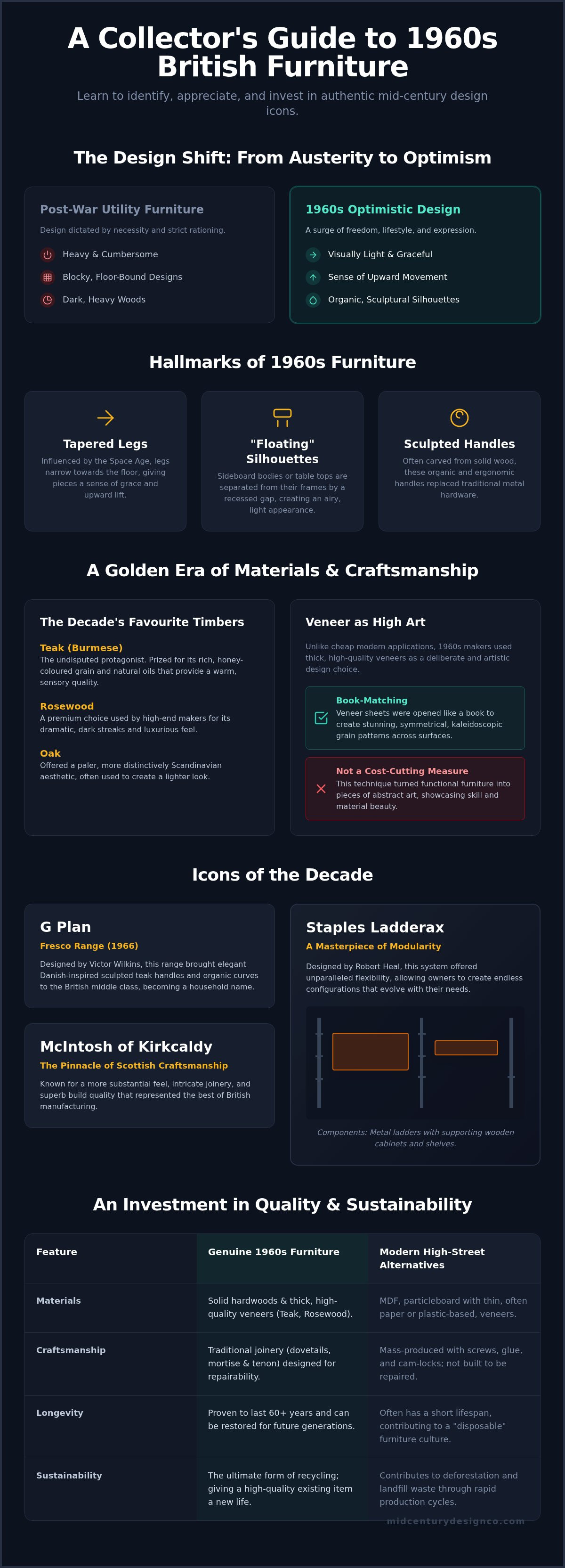
To truly appreciate genuine 1960s furniture UK, one must first look at the stark landscape that preceded it. Post-war Britain was defined by the Utility Furniture Scheme; a period of strict rationing where design was dictated by necessity rather than desire. As the 1960s arrived, this austerity vanished. It was replaced by a surge of cultural optimism that translated into furniture with a distinct soul. Design became about lifestyle, expression, and a newfound sense of freedom that rejected the heavy, dark, and often cumbersome styles of the early 20th century.
The Philosophical Shift in 1960s Design
Designers began to experiment with visual lightness. The goal was to create pieces that seemed to hover within a room rather than dominate it. This led to the iconic "floating" silhouette, a technique where table tops or sideboard bodies are separated from their legs by a subtle, recessed gap. Tapered legs became the standard, influenced by the sleek, aerodynamic lines of the Space Age. These legs didn't just support a piece; they gave it a sense of upward movement and grace. It was a radical departure from the blocky, floor-bound designs of the previous generation, prioritising a sense of air and light in the modern home.
Key Materials and Textures of the Decade
Teak was the undisputed protagonist of the 1960s. Specifically, Burmese teak was prized for its rich, honey-coloured grain and natural oils. It offered a sensory warmth that felt modern yet grounded. While teak dominated the British market, premium makers often turned to rosewood for its dramatic, dark streaks or oak for a paler, more Scandinavian feel. The era was defined by a specific tactile quality; surfaces were smooth, often finished with oils that allowed the wood to breathe and age gracefully over decades.
The use of veneers in this era is often misunderstood by modern buyers. Unlike contemporary flat-pack furniture where thin veneer is used to hide cheap substrates, 1960s makers treated it as a high-art form. They used thick, high-quality wood veneers to achieve grain patterns that would be impossible with solid timber alone. Techniques like "book-matching" created symmetrical, kaleidoscopic patterns across sideboard doors and dining tables. This wasn't a cost-cutting measure; it was a deliberate aesthetic choice that turned a functional object into a piece of abstract art. This decade represented a golden era of manufacturing where firms blended traditional joinery with adventurous new aesthetics, creating pieces built to last lifetimes.
The Icons of British and Nordic Design: Makers that Defined the Decade
The 1960s wasn't just a decade of change; it was a decade of icons. In the United Kingdom, certain makers rose to prominence by successfully marrying Scandinavian elegance with British manufacturing prowess. G Plan's Fresco range, launched in 1966, remains perhaps the most recognisable example. Designed by Victor Wilkins, it brought the sculpted teak handles and organic curves of Danish design to the British middle class. Meanwhile, McIntosh of Kirkcaldy became the pinnacle of Scottish mid-century craftsmanship. Their pieces often featured more intricate joinery and a more substantial feel. Finding a piece of genuine 1960s furniture UK that retains its original finish and structural integrity is the ultimate goal for any serious collector.
Modular Mastery: The Staples Ladderax System
Robert Heal’s design for the Staples Ladderax shelving unit was a masterpiece of modularity. It offered a flexibility previously unseen in British homes. The system relies on metal uprights, typically finished in gold, black, or white, which support various cabinets and shelves. Identifying an original piece requires looking at the tension of the ladders and the quality of the wood. Teak is common, but rosewood versions are exceptionally rare and highly prized. It's a system that grows with you. It allows for endless configurations as your living space evolves, making it as relevant today as it was sixty years ago.
Danish Influence on 1960s British Sideboards
The Nordic influence was inescapable. Designers like Hans Wegner and Finn Juhl set a benchmark for quality that British firms strove to match. This led to the popularity of mid century modern sideboards that featured a "long and low" aesthetic. These pieces often utilised hidden, finger-pull handles or beautifully sculpted wooden grips rather than traditional metal hardware. This minimalist approach emphasised the natural beauty of the timber grain. It created a sense of understated luxury. If you are looking for a centrepiece for your home, you might browse our curated selection of Danish furniture to find a piece of genuine 1960s furniture UK that truly resonates with this timeless aesthetic.
British manufacturers like White & Newton also embraced this trend. They often experimented with darker veneers and more architectural shapes. Their tallboy chests and sideboards are prized for their clean lines and lack of fuss. Whether it is a Scottish McIntosh or a Danish import, the quality of 1960s construction ensures these pieces remain functional art for the modern era.
Why Genuine 1960s Furniture is an Investment in Quality and Sustainability
In a world increasingly dominated by disposable interiors, there's a profound satisfaction in owning something that has already stood the test of time. Choosing genuine 1960s furniture UK is a quiet rebellion against the "fast furniture" cycle that sees mass-produced items reach landfills within years. These pieces weren't designed for a single season. They were crafted as life-long companions. Whilst modern high-street replicas often rely on flimsy particle board, original mid-century items utilised robust construction methods that have already weathered six decades of use.
The Superiority of 1960s Construction
The secret to this longevity lies beneath the surface. Original makers prioritised structural integrity, using solid wood frames and high-density plywood that doesn't warp or crumble. This is why a retro dining table and chairs UK from the 1960s remains a practical choice for a busy household. The craftsmanship is evident in the joinery, with dovetail drawers and solid timber edges that protect the more delicate veneers. These veneers were applied by skilled artisans, often thick enough to allow for gentle restoration if needed. It's a level of quality that modern manufacturing often sacrifices for speed.
A Tangible Financial Asset
Beyond their physical durability, these pieces represent a tangible financial asset. The demand for authentic 1960s teak has grown significantly as more homeowners seek out unique, characterful interiors. Unlike new furniture which depreciates the moment it leaves the showroom, iconic items like a mid century modern desk UK tend to hold or even increase their value over time. Collectors often value "unrestored but well-loved" pieces because they carry a patina that is impossible to fake.
There's also the environmental factor. Buying vintage is one of the most sustainable ways to furnish a home, as it requires no new timber and prevents the high carbon cost of global shipping for new goods. Each piece carries a narrative, a whisper of the homes it has graced before, bringing a sense of soul and history that mass production can never replicate. It's an investment in beauty, planet, and heritage that transforms a house into a sanctuary.
How to Identify and Verify Authentic 1960s Pieces in the UK
Verification is a tactile art form that requires both a keen eye and a patient hand. When hunting for genuine 1960s furniture UK, your first instinct should be to look where others don't. The underside, the interior of a drawer, and the hidden joinery often reveal more than the polished surface. This forensic approach ensures you are investing in a piece of design history rather than a modern imitation that lacks the structural narrative of the original era.
- Scrutinise the joinery: Authentic pieces almost always feature dovetail joints in the drawers. These interlocking wedges are a hallmark of structural pride. Look at the edges of sideboards; you should see a thick strip of solid wood protecting the veneer.
- Examine the underside: Original pieces often carry the ghost of their creation. Look for fading paper labels, bold manufacturer stamps, or even handwritten chalk marks left by the craftsman during assembly.
- Feel the wood: Genuine teak possesses a natural, oily sensory warmth. It should feel smooth and substantial, never clinical or plastic-like.
- Check the hardware: Whether it is a sculpted wooden handle or a solid brass pull, original hardware feels heavy and intentional. It shouldn't rattle or feel hollow.
- Verify the silhouette: Tapered legs and "floating" tops are classic markers. If the proportions feel clumsy or the legs are perfectly cylindrical without a taper, proceed with caution.
Decoding Makers Marks and Labels
Makers were proud of their output. G Plan pieces often carry a red embossed stamp inside a drawer or on a backboard, whilst McIntosh of Kirkcaldy favoured elegant gold medallions. Don't panic if a label is missing; many were lost over sixty years of use. In these cases, you must rely on the design language. The specific curve of a Fresco handle or the unique profile of a Ladderax upright can be just as definitive as a signature. If you are ever in doubt, it is always safer to source from a trusted specialist in authentic 1960s furniture who has already verified the piece's heritage.
Spotting the Difference: Genuine vs Reproduction
The "veneer test" is your best defence against modern replicas. On original 1960s pieces, the veneer is noticeably thicker, often applied over high-quality plywood or solid timber. Modern reproductions use paper-thin layers over flimsy MDF that peel at the slightest knock. Weight is another giveaway. Authentic teak furniture is surprisingly heavy due to the density of the timber. Finally, look for modern shortcuts. If you spot cam-lock screws or plastic dowels, you are looking at a modern "mid-century style" item rather than a true vintage original.
Curating Your Space with The Mid Century Design Co.
Finding genuine 1960s furniture UK is a journey of discovery. It's about more than filling a void in a room. It's about finding a narrative that resonates with your personal style. At The Mid Century Design Co., we act as your expert friend. We bridge the gap between the bold design movements of the past and the practical needs of your modern British home. Our approach is steady and intentional. We value the spirit of an object as much as its physical form, ensuring that every piece we offer carries a sense of historical weight and sensory warmth.
The Art of the Curated Collection
Every piece in our inventory is handpicked. We look for the evocative ripple of a teak grain. We scrutinise the structural integrity of every joint. We strictly avoid modern reproductions. They lack the history and soul we value. Our collection is a celebration of craftsmanship. Whether it is a minimalist Danish desk UK collectors adore or a rare storage find, each item is chosen for its design merit and character. We focus on pieces that have aged gracefully, maintaining the heritage of the original makers whilst offering a fresh perspective for contemporary living.
Your Partner in Home Creation
Styling these icons requires a delicate touch and an appreciation for balance. A vintage Danish coffee table can become the anchor of a contemporary lounge, bringing a sensory warmth that balances modern, cool-toned textiles. We invite you to embrace the "slow living" aesthetic. Treat your furniture as functional art that encourages you to linger and appreciate the finer details of your surroundings. Our goal is to help you create a sanctuary, a space that feels curated rather than merely decorated.
We understand that sourcing delicate vintage icons requires trust. We ensure safe passage for every piece with our dedicated nationwide UK delivery service. From the initial discovery to the moment it enters your home, we are here to provide guidance and expertise. If you're looking to build your own mid-century collection or simply want advice on a specific piece, we encourage you to reach out. Your home should be a reflection of your story. We're here to help you tell it through pieces that possess both soul and longevity.
Embrace the Legacy of Authentic Design
Choosing a piece of history for your home is a deeply personal act. It's about finding that perfect balance between form and function, where the warm grain of teak meets the architectural precision of the mid-century era. We've explored the importance of verifying the structural narrative of your finds, ensuring you invest in quality that has already endured for sixty years. By prioritising original craftsmanship over modern replicas, you bring a unique soul and sustainable character to your living space.
Whether you're drawn to the modular genius of Staples Ladderax or the sculptural elegance of Danish sideboards, the right piece is waiting to be discovered. At The Mid Century Design Co., we specialise in authentic systems and curated British and Nordic designs, offering expert nationwide UK delivery to ensure your vintage icons arrive safely. Your journey into the world of genuine 1960s furniture UK is just beginning, and we're here to guide you every step of the way.
Ready to find your next heirloom? Explore our curated collection of genuine 1960s furniture and start creating a home that tells a story of timeless quality and sophisticated style.
Frequently Asked Questions
Is 1960s furniture always made of solid teak?
Not exclusively. Whilst solid wood was used for frames and legs, many iconic pieces utilise high-quality teak veneers applied over solid timber or stable plywood. This was a deliberate choice by designers to achieve the beautiful, symmetrical grain patterns seen in book-matching. It also ensured the furniture remained structurally sound without warping. If you find a piece of genuine 1960s furniture UK, you'll likely see this masterful use of materials that prioritises both beauty and longevity.
How can I tell if my 1960s sideboard is a genuine G Plan piece?
Authenticity is often found in the details. Most original G Plan items from the 1960s feature a red embossed stamp, typically located inside a drawer or on the backboard. Beyond the mark, you should examine the design language. Look for the signature solid teak handles of the Fresco range or the elegant, tapered legs that defined Victor Wilkins' work. These structural hallmarks are often as definitive as the brand label itself when verifying a piece.
Why is 1960s furniture so popular in modern UK interiors?
Its enduring appeal lies in the perfect marriage of visual lightness and structural integrity. The "long and low" silhouettes and tapered legs create a sense of space, making it ideal for the proportions of modern British homes. Beyond aesthetics, there's a growing desire for sustainability. Collectors are increasingly rejecting disposable "fast furniture" in favour of pieces with a narrative and soul. It's a way to bring historical weight into a contemporary, sanctuary-like environment.
Can I use 1960s dining chairs every day without them breaking?
Absolutely. These chairs were crafted using traditional joinery techniques, such as dovetails and mortise and tenon joints, which are significantly more robust than the glue and cam-locks used in modern mass production. Provided the frame is structurally sound, original 1960s dining chairs are perfectly capable of surviving daily family use. They offer a level of durability that ensures they remain functional art for another sixty years with just basic care.
What is the difference between mid-century "style" and genuine 1960s furniture?
The distinction lies in the soul and the substance of the piece. Mid-century "style" typically refers to modern reproductions made from inferior materials like MDF or thin, paper-like veneers. Genuine 1960s furniture UK refers to original vintage pieces manufactured during the decade. These authentic items possess a historical weight, a unique patina, and a level of craftsmanship that modern replicas simply cannot replicate. Buying original is an investment in both quality and heritage.
How do I care for the wood grain on my original 1960s coffee table?
Care should be gentle and intentional. Regular dusting with a soft, lint-free cloth is usually sufficient for daily maintenance. To maintain the sensory warmth of the teak, you can occasionally apply a small amount of high-quality teak oil or a natural beeswax. It's vital to avoid modern aerosol spray polishes. These often contain silicone, which can build up over time and dull the natural spirit and lustre of the original wood grain.
Is it worth buying 1960s furniture that has some minor scratches?
Minor scratches are often considered a badge of honour. This gentle wear, known as patina, tells the story of the piece's journey through time and adds to its character. Surface-level marks on teak can often be masked with a little oil or wax. Whilst you should avoid pieces with major structural damage, minor cosmetic imperfections shouldn't deter you. They represent the soul of an object that has been loved and used for decades.
Does genuine 1960s furniture hold its value better than modern pieces?
Authentic vintage pieces represent a tangible financial asset. Unlike new furniture, which depreciates the moment it leaves the showroom, 1960s furniture often appreciates as it becomes rarer. The market for iconic British and Danish brands remains exceptionally strong. Collectors value the longevity and historical narrative of these pieces, making them a much wiser investment than mass-produced items. You're buying a piece of history that retains its value whilst providing daily utility.