

How to Tell if Mid-Century Furniture is Original: The Collector’s Guide
That sleek teak sideboard you spotted in a local shop might look like a masterpiece of 1960s design, but beneath the surface, it could be a hollow imitation. You've likely felt that magnetic pull towards the clean lines and warm wood of the era, yet the fear of overpaying for a modern reproduction often creates a sense of hesitation. It's frustratingly easy to confuse a high-quality vintage veneer with a cheap modern laminate whilst standing in a crowded market. Understanding how to tell if mid century furniture is original requires looking past the silhouette and into the soul of the piece.
This guide will help you master the art of identifying authentic craftsmanship through construction, materials, and those subtle hallmarks that mass-production cannot replicate. You'll gain the confidence to spot a fake at a glance, appreciating why original patina and honest joinery add such immense value to your home. We'll explore the secrets hidden in dovetail joints, the weight of authentic timber, and how to identify prestigious makers even when the paper labels have vanished. By the end, you'll be ready to curate a sanctuary-like space filled with pieces that carry genuine history, storied narratives, and timeless character.
Key Takeaways
- Recognise the specific production window between 1945 and 1975 to distinguish a piece's true soul from the hollow spirit of modern fast-furniture imitations.
- Master the nuances of grain patterns and high-quality vintage veneers to understand how to tell if mid century furniture is original rather than a mass-produced copy.
- Learn exactly where to uncover hidden stamps and iconic labels like G-Plan and Ercol to verify the prestigious heritage and narrative of your find.
- Inspect hardware and finishes to distinguish between honest, hand-rubbed oil patinas and the clinical, "too perfect" spray-lacquers found amongst modern replicas.
- Discover why sourcing from dedicated specialists ensures your collection remains a sustainable, investment-grade addition to your home.
The Soul of the Era: Why Authentic Mid-Century Design Matters
Authenticity isn't just about a label. It's about a spirit. When we speak of original pieces, we refer to the golden era of production occurring roughly between 1945 and 1975. This was a time when furniture was conceived as functional art, a stark departure from the disposable, flat-pack culture that dominates the current market. Understanding how to tell if mid century furniture is original starts with recognising this commitment to quality. The Mid-century modern design movement wasn't interested in fleeting trends; it was a revolution of form, light, and material designed to last a lifetime.
An original piece carries its history in its skin. We call this patina. It's the gentle darkening of teak, the slight smoothing of a chair's armrest, or the honest wear around a handle. These aren't defects. They're the hallmarks of a life well-lived. A modern reproduction can mimic the shape, but it can't replicate the sensory warmth that only decades of existence can provide. For the discerning collector, these subtle signs of age are precisely what give a room its character and depth. It's the difference between a house that feels like a showroom and a home that feels like a sanctuary.
The Investment Value of Originality
Buying an original is a sensible financial decision. Whilst a mass-produced copy loses value the moment it leaves the shop, authentic pieces often appreciate. This is particularly true for iconic British and Danish designs that have become globally coveted. Collectors seek the integrity of the original build because they know the materials used then are often no longer available for commercial furniture today. Investment-grade vintage is the perfect marriage of rare, slow-grown materials and iconic silhouettes that remain relevant decades later. To protect your capital, you must learn how to tell if mid century furniture is original before committing to a purchase.
Sustainable Style: The Eco-Conscious Choice
Choosing vintage is an act of environmental stewardship. By opting for an existing piece, you're reducing the demand for new timber and industrial manufacturing. These are forever pieces. They were built to survive generations, not just a few house moves. Your home becomes more than a living space; it's a curated sanctuary of history. Every sideboard or dining chair tells a story that transcends the temporary nature of modern retail. When you invest in an original, you're honouring the craftsmanship of the past whilst protecting the future of our planet.
The Anatomy of Authenticity: Construction and Materials
To understand how to tell if mid century furniture is original, you must look far beyond the silhouette. It's a sensory investigation. Authentic pieces from the mid-20th century possess a physical weight and a structural integrity that modern flat-pack alternatives simply cannot emulate. When you run your hand along a sideboard or pull a drawer from a chest, you're looking for the quiet evidence of a master craftsman. These objects were built with a grounded, substantial feel, using materials that were chosen for their longevity rather than their ease of shipping.
Joinery: The Silent Mark of Quality
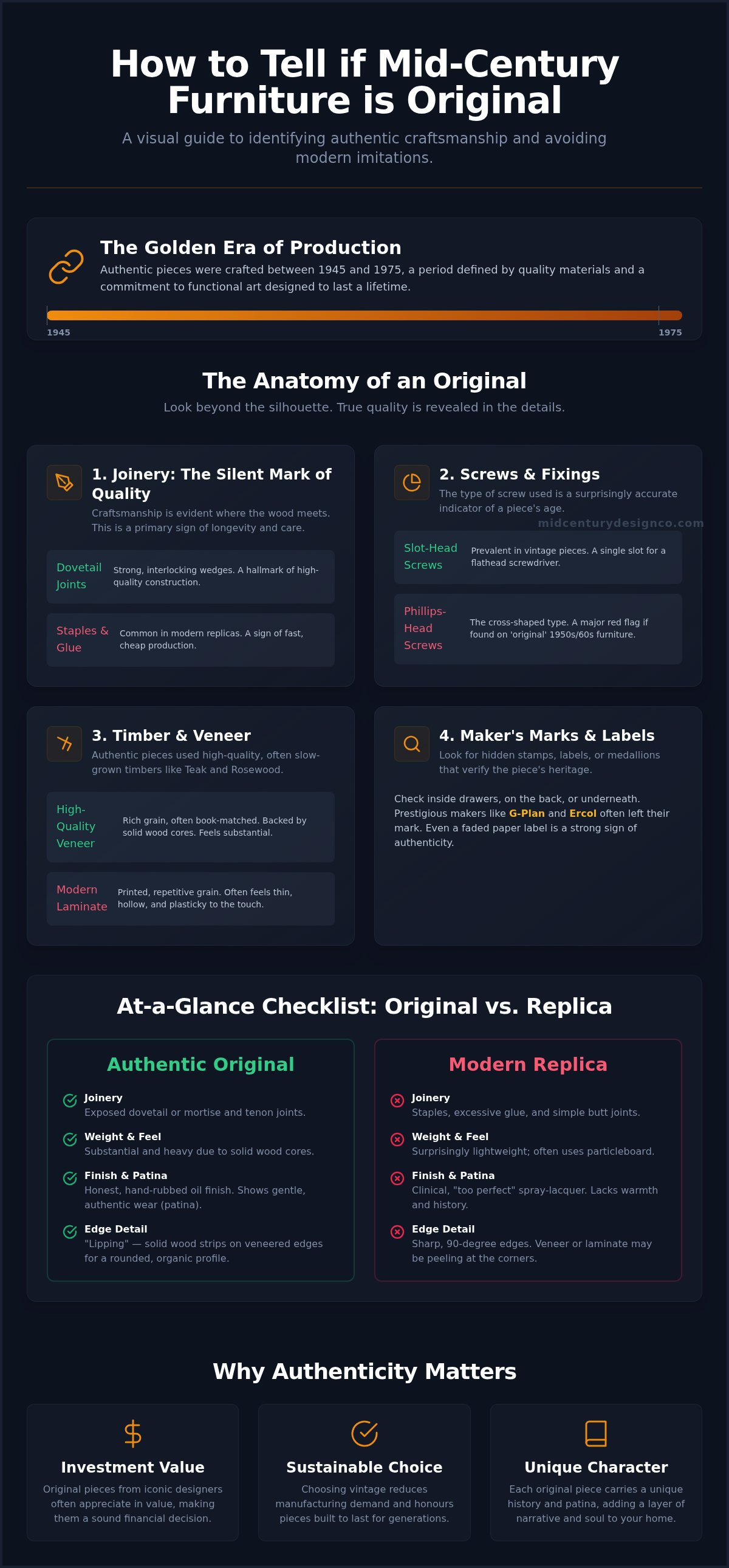
Precision was the hallmark of the era. If you inspect a vintage teak chest of drawers, you'll often find exposed dovetail joints. These interlocking wedges of wood are as beautiful as they are strong. They represent a commitment to longevity that today's manufacturers often bypass in favour of staples and excessive glue. If you pull a drawer and find it is held together by metal staples or simple butt joints, you're likely looking at a modern replica.
Another vital clue is the hardware. Original pieces typically utilised slot-head screws or bespoke wooden fixings. If you see Phillips-head screws, the cross-shaped variety, on a supposedly 1950s piece, it's a significant red flag. Look also for "lipping" on the edges of panels. This is a strip of solid wood, often 5mm to 10mm thick, applied to the edge of a veneered board. This clever construction allows for a rounded, organic profile that feels substantial to the touch, a detail rarely found in contemporary copies.
Timber and Texture
The materials of the 1960s were chosen for their soul and sensory warmth. Teak was the preferred timber, prized for its natural oils and its ability to age into a deep, honey-toned glow. Rosewood offers a more dramatic, dark grain, whilst oak provides a sturdy, tactile presence. You should look for the unique, irregular flow of a natural grain. Modern laminates often reveal themselves through repetitive, printed patterns that lack the depth and spirit of real wood.
Don't be deterred by veneer. In the mid-century period, high-quality veneer was a mark of sophistication, allowing designers to create expansive, book-matched grain patterns that solid wood could not achieve. This is vastly superior to modern "solid wood" copies made from fast-grown, characterless timber. A hand-finished Danish sideboard offers a tactile experience that is soft, warm, and distinctly organic, whereas a modern replica often feels clinical under the fingertips. To see these authentic details in person, you might wish to explore our curated guide to sideboards and discover the difference for yourself.
Decoding Maker’s Marks and Design Provenance
A maker's mark is more than a branding exercise; it's a signature of intent. When investigating how to tell if mid century furniture is original, your first task is often a quiet game of hide and seek. These marks aren't always shouting from the front. They're tucked away in the shadows. You'll find them on the undersides of chair seats, burned into the interior lining of a drawer, or stamped onto a back panel. Sometimes, they're simply a faded paper tag that has survived half a century of use and several house moves.
Identifying British Icons
British manufacturing during this era possessed a distinct, robust elegance. G-Plan is perhaps the most recognisable, often identified by a gold embossed stamp inside a drawer or on a backboard. A McIntosh piece might carry a striking blue and gold label, whilst Ercol is famous for its blue and gold metallic stickers. If you're looking for an authentic Staples Ladderax shelving unit, the proof is in the engineering. Look for the signature steel uprights and the precise way the wooden supports hook into them. British makers also had "tells" in their design language. Notice the specific tapered leg profiles or the sculpted solid wood handles that feel perfectly weighted in the hand.
The Allure of Danish Modern
Danish pieces often speak a more organic, sculptural language. When examining vintage Danish coffee tables, look for the "Danish Control" mark. This was a prestigious quality seal granted only to manufacturers who met rigorous standards of craftsmanship. You might find "Made in Denmark" burned into the wood alongside the names of luminaries like Hans Wegner or Finn Juhl. This stamp is a guarantee that the piece was produced during the height of the Nordic design revolution.
Don't be discouraged if a label is missing. Paper tags were often lost or forgotten, and some smaller workshops never used them at all. In these cases, authenticity is found in the proportions. Original Danish design is celebrated for its ethereal lightness and balanced geometry. A piece that feels clunky or "off" in its measurements is likely a modern imitation. The soul of the object remains in its construction, even when the signature has faded over time. Understanding how to tell if mid century furniture is original involves training your eye to see these subtle, elegant ratios that no mass-produced replica can quite capture.
Spotting the Replica: Modern Fakes vs Vintage Originals
The silhouette of a replica might mimic the iconic lines of the 1960s, but the illusion often shatters upon closer inspection. Modern "mid-century style" pieces, frequently found in high-street catalogues, prioritise ease of assembly and cost-efficiency over the narrative of the object. When you are learning how to tell if mid century furniture is original, you must train your eye to look for the "clunky" compromises of mass production. Original designers obsessed over slimline profiles and elegant, tapered legs that seem to defy gravity; modern replicas often thicken these elements to accommodate cheaper, less stable materials.
A simple underside inspection often reveals the truth. In the 20th century, manufacturers rarely finished the parts of a piece that weren't intended to be seen. You should expect to find raw, unfinished wood on the bottom of a chair or the back of a sideboard. If the entire piece is perfectly coated in a uniform, clinical finish, or if you spot the tell-tale texture of particle board, you're likely looking at a contemporary copy rather than a vintage treasure.
Hardware and Fixings
The internal mechanics of a piece are often its most honest components. Original mid-century furniture was never designed for flat-pack delivery. You will rarely find Allen keys, cam-locks, or those familiar silver circular fixings found in modern modular furniture. Instead, authentic pieces utilise period-correct brass hinges, bespoke wooden drawer runners, and slot-head screws. Look closely at the joints for any hidden plastic components. Authentic 1950s and 60s craftsmanship relied on the integrity of the wood and metal, never the convenience of plastic brackets or synthetic glues.
Finish and Patina
The finish of an original piece possesses a depth and sensory warmth that factory spray-lacquer cannot match. Modern replicas often have a "too perfect" sheen that feels like a plastic coating rather than wood grain. In contrast, an original finish-whether it was hand-rubbed oil or a light wax-allows the character of the timber to breathe. You should look for the natural darkening of the wood caused by decades of light exposure, particularly on teak and rosewood. This original patina is a badge of honour that adds significant value, reflecting a life well-lived amongst generations of owners. To see the difference between a clinical reproduction and a piece with true heritage, we invite you to browse our latest collection of authentic mid-century furniture and experience the soul of original design.
Curating Your Collection with Confidence
Curating a home is an act of storytelling. Once you've mastered how to tell if mid century furniture is original, the next step is to weave these disparate pieces into a cohesive, personal narrative. You don't need a house full of matching sets to create a sanctuary. In fact, the most evocative spaces often blend the robust, British honesty of G-Plan or McIntosh with the sculptural, organic elegance of Danish design. It's about finding the common thread of quality and spirit that runs through each object. When you select pieces with intention, your home becomes a reflection of your own sophisticated taste.
Sourcing with Certainty
The unvetted marketplace can be a minefield of over-restored relics and clever imitations. This is why sourcing from dedicated specialists is so vital for the serious collector. At The Mid Century Design Co., we focus exclusively on original vintage inventory from the 1950s to the 1970s. We believe that every sideboard, desk, or dining set should come with a verified history and a soul that hasn't been scrubbed away. By choosing a curated collection, you bypass the uncertainty of the high street and invest in pieces that have been selected for their character, their condition, and their enduring visual impact.
Styling for the Modern Home
A common fear amongst new collectors is that their home might begin to resemble a film set or a static exhibition. Learning how to style mid century modern furniture is about embracing the narrative of the era without feeling trapped by it. These pieces were designed for living. They thrive when paired with contemporary art, lush textiles, and the comfortable clutter of real life. An original teak sideboard isn't just a storage solution; it's a conversation starter that carries the weight of history whilst remaining perfectly functional for a modern UK home. It's about creating a balance between the vintage and the new.
Before you welcome a new piece into your sanctuary, run through a final mental checklist to ensure it meets your standards:
- Condition: Is the wear honest and the patina original?
- Authenticity: Does it meet the construction criteria for how to tell if mid century furniture is original?
- Visual Impact: Does the piece possess the slimline, graceful proportions typical of the era?
- Craftsmanship: Is the joinery sound and the material authentic timber?
The journey of a collector is one of constant discovery and appreciation. It's about more than just utility; it's about the joy of finding an object that resonates with your personal aesthetic. Trust your instincts and your newfound knowledge. When you invest in original craftsmanship, you aren't just buying furniture. You're becoming the custodian of a piece of design history that will continue to tell its story for generations to come.
Investing in Design Heritage for Your Home
Your journey into the world of 20th-century design is a path toward creating a home that feels both grounded and inspired. It's a rewarding pursuit. By focusing on the nuances of joinery, the warmth of authentic timber, and the presence of verified maker's marks, you've gained the essential knowledge of how to tell if mid century furniture is original. These pieces are more than just functional objects; they're sustainable investments that carry the narrative of a revolutionary era.
Choosing an original piece ensures your space remains a sanctuary of quality rather than a collection of fleeting trends. As specialists in iconic Staples Ladderax systems and expertly curated vintage Danish and British design, we provide UK-wide delivery on investment-grade pieces selected for their soul and structural integrity. There's a profound joy in owning an object that has already stood the test of time.
Discover our curated collection of authentic mid-century originals and find the perfect piece to begin your own story. Trust your eye for craftsmanship and enjoy the enduring beauty of a life surrounded by genuine history.
Frequently Asked Questions
How can I tell if my mid-century sideboard is real teak or just a veneer?
To determine if a sideboard is real teak or veneer, inspect the grain's continuity. Authentic mid-century pieces frequently utilised high-quality teak veneers to achieve beautiful, book-matched patterns across large surfaces. This is a sign of prestige, not a lack of quality. Look at the edges for solid wood lipping which allows for rounded profiles. Modern imitations often use paper-thin laminates or printed patterns that lack the depth and oily texture of genuine vintage timber.
What are the most common maker’s marks to look for on British mid-century furniture?
British manufacturers often used distinctive branding that has become iconic amongst collectors. You should look for the gold-embossed G-Plan stamp inside drawers or the blue and gold McIntosh label on a sideboard's interior door. Ercol pieces frequently carry a blue and gold metallic sticker. Other notable marks include the Staples and Co stamp on Ladderax components or the stamped logos of Austinsuite and Younger found on back panels or drawer linings.
Is mid-century furniture always marked with a designer’s name?
Original furniture is not always marked with a designer's name. Whilst prestigious Danish designers like Hans Wegner or Finn Juhl often had their signatures stamped into the wood, many exceptional British pieces were the work of talented in-house design teams. Manufacturers like G-Plan or McIntosh focused on brand identity rather than individual attribution. A lack of a specific name doesn't diminish the piece's authenticity or its status as a masterpiece of 20th-century design.
How do I identify an original Staples Ladderax system from a modern copy?
Identifying an authentic Staples Ladderax system involves examining the engineering of the modular components. Look for the signature steel upright rungs that are precisely spaced to allow for flexible shelf positioning. Original units often bear the Staples and Co Ltd mark. Modern copies frequently use different metal gauges or lack the specific hooked wooden supports that allow the system to remain stable without the need for complex fixings or permanent wall attachments.
Does a lack of a label mean my vintage furniture is a fake?
A missing label is common and does not automatically mean a piece is a replica. Paper tags and foil stickers often peeled away during decades of use or whilst being moved between homes. Understanding how to tell if mid century furniture is original requires a holistic approach. You should examine the quality of the timber, the presence of dovetail joints, and the specific proportions of the design to confirm its vintage heritage.
What is the difference between "mid-century modern" and "mid-century style"?
The distinction lies in the era of production and the integrity of materials. Mid-century modern refers to authentic pieces manufactured between 1945 and 1975 using traditional craftsmanship. Conversely, mid-century style is a contemporary label for modern reproductions. These copies often use inferior materials like particle board and are designed for flat-pack assembly, lacking the soul, historical weight, and investment value found in a genuine vintage sideboard or dining set.
Are dovetail joints a guaranteed sign that furniture is original?
Dovetail joints are a strong indicator of quality but should be viewed alongside other evidence. Whilst they were a standard mark of 20th-century craftsmanship, some high-quality modern pieces still utilise them. To be certain, you must also inspect the timber's patina, the style of the hardware, and the construction of the back panels. True vintage dovetails often show slight, honest irregularities that reflect the hand-finished nature of the original manufacturing process.
Why is original mid-century furniture more expensive than modern replicas?
Original pieces command higher prices because they are investment-grade assets made from superior, often rare materials. Old-growth teak and rosewood offer a density and grain beauty that modern fast-grown timber cannot replicate. When you discover how to tell if mid century furniture is original, you realise you are investing in a sustainable piece of history. Unlike replicas that depreciate instantly, authentic vintage furniture retains its value and offers a soul that mass production cannot mimic.