

Long-lasting Non-flat Pack Furniture: 2026 Guide
What if the most sustainable, stylish piece of furniture in your home was crafted decades before you were even born? Many of us have felt that familiar sting of disappointment when a £400 flat-pack chest of drawers begins to sag after just a few years. It's a frustrating, expensive cycle. You spend your hard-earned money on items that rarely survive even a single house move, leaving your home feeling transient and lacking in character. You deserve long lasting non flat pack furniture that possesses a soul, a history, and the structural integrity to last a lifetime.
This guide explores why authentic mid-century vintage remains the superior choice for the modern, conscious homeowner. You'll discover how the master-crafted joinery of the 1950s and 1960s puts modern cam-locks to shame, ensuring your investment survives for generations. We will examine the environmental impact of "fast furniture" whilst revealing how choosing timeless teak or rosewood allows your capital to appreciate in value. We're moving away from the temporary, inviting you instead to curate a sanctuary built on permanent, beautiful craftsmanship.
Key Takeaways
- Understand why original mid-century pieces offer a permanent alternative to the frustrating cycle of disposable, mass-produced items.
- Learn to identify the superior joinery and premium timbers, including teak and rosewood, that define truly long lasting non flat pack furniture.
- Discover how vintage sideboards and dining sets appreciate in value over time, unlike modern pre-assembled items that lose half their worth immediately.
- Explore the unique structural benefits of modular systems like Staples Ladderax, which combine the versatility of modern shelving with historical durability.
- Gain practical insights into sourcing authentic quality by recognising maker's marks and silhouettes that guarantee structural integrity.
Beyond the Allen Key: Why Non-Flat Pack Furniture is a Lifelong Investment
There is a particular, weary sigh reserved for the moment a cam-lock fastener gives way. We have been conditioned to accept that furniture is temporary, a mere placeholder until the next house move or style trend. This throwaway culture creates a relentless cycle of replacement that drains both your finances and the planet's resources. True long lasting non flat pack furniture represents the antithesis of this fatigue. It is an investment in stability, where "long-lasting" isn't measured in seasons, but in generations. When you choose a piece that has already stood for sixty years, you aren't just buying storage; you're acquiring a legacy.
The Rise of Disposable Design
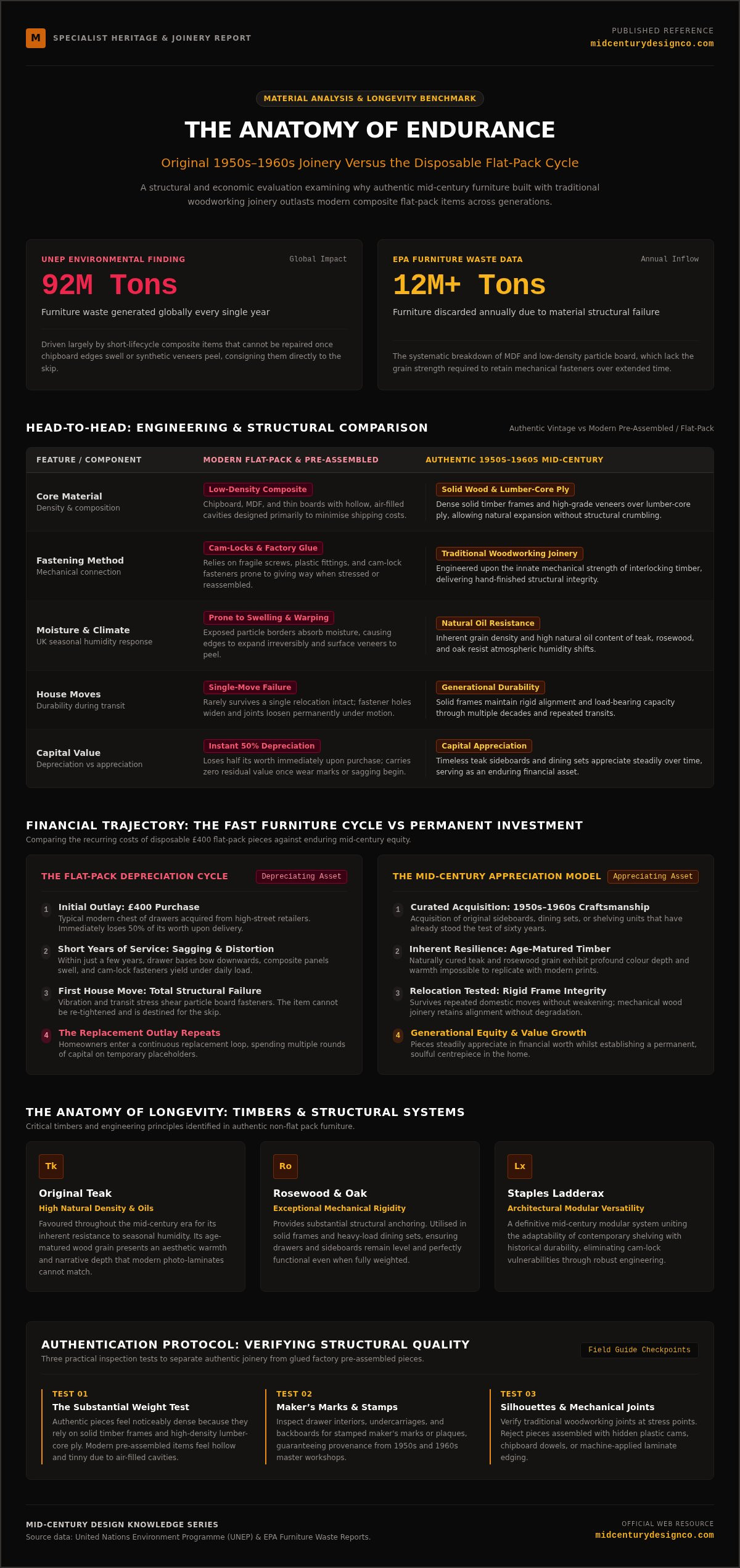
Flat-pack culture has fundamentally altered our domestic expectations, trading structural integrity for flat-packed convenience. According to the United Nations Environment Programme, furniture generates roughly 92 million tons of waste globally every year. Much of this is driven by short-lifecycle composite items that cannot be repaired. When a chipboard edge swells or a veneer peels, the item is destined for the skip. The hidden costs of these "cheap" items are significant, as the replacement cycle quickly outpaces the price of a single, high-quality vintage piece. Shifting your focus from temporary looks to enduring character allows you to exit this wasteful loop entirely.
It is a common misconception that buying "pre-assembled" from a modern high-street retailer guarantees quality. Often, these pieces are simply flat-pack items glued together in a factory. They still rely on low-density particle board and lack the grain strength of solid timber. Authentic long lasting non flat pack furniture ensures you're buying a piece that has already survived decades of daily life, proving its worth long before it reaches your home.
The Mid-Century Modern Advantage
Authentic pieces from the 1950s and 1960s remain the gold standard for non-flat pack quality. These items were built using traditional woodworking joinery, methods that rely on the mechanical strength of the timber itself rather than fragile screws or plastic fittings. Mid-century modern furniture is a marriage of industrial innovation and hand-finished excellence. The age-matured wood grain in an original teak sideboard or chest of drawers has a depth and warmth that modern prints simply cannot replicate. It carries a soul, a quiet narrative that creates a unique aesthetic centre for your room while promising a lifetime of service.
The Anatomy of Longevity: Materials and Joinery That Outlast the Decades
True longevity is felt before it is seen. When you run your hand across an original teak sideboard, you're touching a material specifically chosen for its enduring nature. In the mid-century era, craftsmen favoured teak, rosewood, and oak not merely for their aesthetic warmth, but for their natural density and oil content. These timbers possess an inherent resistance to the environment that modern composite materials simply cannot match. Investing in long lasting non flat pack furniture means choosing a piece where the "bones" are as beautiful as the surface.
The structural failure of modern materials contributes heavily to the environmental crisis, with over 12 million tons of furniture discarded annually according to EPA furniture waste data. This waste is largely driven by the use of chipboard and MDF, which lack the grain strength to hold mechanical fasteners over time. In contrast, quality vintage pieces often utilise high-grade veneers over solid wood or lumber-core ply. This construction method allows the wood to breathe and move without the structural crumbling associated with modern "fast furniture."
Solid Construction vs Hollow Materials
The simplest test of quality is often the weight. Authentic vintage pieces feel substantial because they are anchored by solid wood frames and high-density cores. This weight is a sign of stability, ensuring that a chest of drawers remains level and functional even when fully loaded. Modern pre-assembled items often feel hollow or "tinny" by comparison, as they rely on thin boards and air-filled cavities to reduce shipping costs. Amongst UK homes, where seasonal humidity can cause lesser materials to warp or swell, the resilience of vintage timber provides a permanent solution that maintains its silhouette for decades. If you are looking to begin your collection, exploring a curated range of Danish furniture is an excellent way to experience this physical difference first-hand.
Mastering the Joint: Dovetails and Beyond
The secret to furniture that survives half a century lies in the joinery. Whilst modern items rely on glue and cam-locks that concentrate stress on small, fragile points, traditional methods like mortise-and-tenon or dovetail joints distribute weight across the timber's grain. These interlocking connections allow a piece to be moved, used, and even disassembled if necessary without losing its structural integrity. A dovetail joint is a hallmark of quality that no flat-pack alternative can truly replicate. When you see those interlocking wedges on the side of a drawer, you're looking at a commitment to craftsmanship that ensures the piece will remain as sturdy in another fifty years as it is today.
Vintage Mid-Century vs Modern Pre-Assembled: Choosing Character Over Convenience
Modern pre-assembled furniture often masks its fragility behind a facade of immediate convenience. It arrives whole, yet it remains fundamentally temporary. Whilst high-street ranges frequently rely on MDF and paper-thin foils, authentic long lasting non flat pack furniture from the mid-century era utilises solid teak and high-grade ply. This isn't just an aesthetic preference. It's a matter of structural survival. A particle-board sideboard has a lifespan measured in mere years; a Danish teak icon is measured in lifetimes. The difference lies in the soul of the material, where the natural variations of timber offer a unique narrative that mass production can never replicate.
The "Depreciation Trap" is a harsh reality for buyers of new furniture. The moment a modern pre-assembled piece leaves the showroom, it loses roughly 50% of its value. It becomes a liability. Conversely, vintage pieces are assets that often appreciate as they become rarer and more sought after by collectors. This financial wisdom aligns perfectly with environmental responsibility. Choosing to re-home a vintage icon avoids the heavy carbon footprint of new manufacturing and global shipping. According to EPA data on furniture waste and durable goods, furniture waste volume has surged by more than 450% since 1960. By opting for a piece with history, you're actively resisting this tide of landfill-bound design.
The Value Proposition of Vintage
Investing in an authentic mid century modern sideboard is a strategic financial move as much as a design one. These aren't mass-produced items found in every suburban showroom. They are limited, curated discoveries that bring a sense of rarity to your living space. To style these pieces without creating a "museum" feel, try mixing the warm, honeyed tones of teak with contemporary textiles or bold, modern art. This creates a sanctuary that feels both grounded in history and vibrantly fresh, allowing the furniture to act as a functional piece of art rather than a mere utility.
Maintenance and Resilience
Vintage furniture thrives under the rigours of modern family life. Unlike modern laminates that chip and cannot be restored, original finishes like teak oil or wax are remarkably resilient. They allow the wood to breathe and age gracefully. If a surface becomes dry, it can be refreshed with a simple application of oil, allowing the timber to regain its deep, sensory lustre. Adopting a "buy once, buy well" philosophy helps you organise a more intentional home. It's about finding pieces that don't just fill a space, but enrich your daily experience through their enduring quality and tactile warmth.
Essential Non-Flat Pack Pieces for Every Room: From Sideboards to Shelving
Every home requires a foundation. A piece that doesn't just hold objects, but holds the space itself. Finding long lasting non flat pack furniture for your sanctuary starts with identifying these functional anchors. Whether you are selecting substantial lounge cabinetry or choosing to explore American Heritage Billiards Pool Tables to anchor a recreation room with heavy, solid-wood craftsmanship, the priority remains permanence. Unlike the flimsy, interchangeable items found in high-street catalogues, these pieces are defined by their physical presence and historical weight. They bring a sense of permanence to a room, acting as a quiet promise that your home is built on quality rather than convenience.
The sideboard is the definitive anchor for living and dining spaces. When you source a vintage teak sideboard, you're looking for the subtle hallmarks of 20th-century excellence. Grain matching is paramount; notice how the wood patterns flow seamlessly across drawer fronts and doors, a feat of craftsmanship that modern "flat" alternatives never attempt. These pieces provide far superior storage capacity, with deep, sturdy interiors designed to hold heavy dinnerware without the base sagging. British brands like G-Plan, McIntosh, and Nathan remain the gold standard for reliable quality. Their sculptural handle designs and tapered legs create a silhouette that feels light whilst remaining incredibly robust.
Modular Strength: The Staples Ladderax System
Modularity is often associated with temporary, disposable design. However, the Staples Ladderax shelving unit is a design marvel of the 1960s that defies this stereotype. It offers the flexibility of a customisable system with the uncompromising strength of steel and solid teak. The engineering behind the "ladder" system is brilliant; it supports significant weight through tension and balance, often without the need for permanent wall-fixing. You can effortlessly integrate cabinets, bureaux, and shelves into a single, sturdy frame that evolves with your needs. It is the sophisticated choice for those who value both adaptability and structural integrity.
Beyond the living room, the search for longevity continues into the workspace and bedroom. A Danish desk UK homeowners can cherish for a lifetime is the pinnacle of home office design. It offers a tactile, inspiring surface that encourages focus, free from the vibrations and wobbles of mass-produced alternatives. Similarly, bedroom essentials like a chest of drawers or a wardrobe should be silent and steady. There is a profound comfort in a drawer that glides on wooden runners, or a wardrobe door that closes with a solid, reassuring thud. These aren't just utilities; they are the silent partners in your daily life. To begin curating your own enduring home, explore our curated collection of mid-century furniture.
Sourcing Authentic Quality: How to Build a Home That Endures
Constructing a living space that transcends fleeting trends requires more than just a keen eye; it demands a shift in philosophy. When you seek out long lasting non flat pack furniture, you're looking for items that have already proven their resilience through decades of daily use. Authenticity is found in the finer details. Look for maker's marks, such as the iconic gold stamps of McIntosh or the understated labels of G-Plan, which serve as a signature of structural intent. Observe the wood grain. In high-quality vintage, the grain often flows with a deliberate, book-matched symmetry that modern mass-produced items cannot mimic. Finally, study the silhouette. The organic, sculptural curves of a Danish highboard or the elegant taper of a rosewood leg are hallmarks of an era that valued form as much as function.
Finding the Right Curator
A specialist eye is an invaluable asset when navigating the vintage market. Sourcing original mid century furniture pieces requires a deep understanding of timber health and joinery stability. When you engage with a curated collection, you aren't just buying an item; you're benefiting from a rigorous selection process that ensures every piece is structurally sound. Whilst the search for quality can be daunting, a knowledgeable collector will be transparent about the journey and condition of a piece. For homeowners across the country, the peace of mind offered by national UK delivery of fully-assembled, heritage pieces is a significant advantage, removing the logistical stress often associated with high-value acquisitions.
A Future-Proof Home
Building a home is a slow, intentional process. It's about visualising your space as a collection of stories rather than a set of temporary fixtures. This "slow living" approach encourages us to appreciate the tactile warmth of age-matured wood. To ensure your teak and rosewood treasures last another sixty years, simple maintenance is key. Regular dusting with a soft cloth and an occasional application of high-quality teak oil will keep the timber nourished and the grain vibrant. Before you make your next investment, consider this final checklist for long lasting non flat pack furniture:
- Does the piece feature traditional joinery like dovetails or mortise and tenon?
- Is the timber high-grade solid wood or a high-density lumber-core veneer?
- Does the item possess a documented maker's mark or a recognisable designer silhouette?
- Is the piece being delivered fully assembled to guarantee its structural integrity?
By choosing wisely, you create a sanctuary that grows more beautiful with time. Explore our curated collection of long-lasting vintage furniture to find the next chapter for your home.
Investing in the Soul of Your Space
Choosing a home filled with character doesn't have to be a compromise on convenience. By stepping away from the disposable cycle of modern retail, you embrace a lifestyle where every sideboard and shelving unit tells a story of enduring craftsmanship. You've seen how traditional joinery and superior timbers like teak and rosewood provide the structural integrity that mass-produced items lack. This transition toward long lasting non flat pack furniture is more than a design choice; it is an investment in a sanctuary that appreciates in value whilst respecting the planet's resources.
As specialists in authentic Staples Ladderax systems and expertly curated Danish and British mid-century pieces, we ensure every item in our collection has already stood the test of time. We provide national UK delivery for all our pre-assembled treasures, ensuring they arrive at your door ready to serve for another sixty years. It's time to surround yourself with objects that possess a true spirit. Discover our curated collection of authentic, long-lasting vintage furniture and begin the journey of creating a home that truly endures. Your future self will thank you for choosing quality that lasts.
Frequently Asked Questions
Is non-flat pack furniture always more expensive than flat-pack?
Not necessarily, especially when you consider the cost over time. Whilst the initial price of long lasting non flat pack furniture may exceed that of a budget flat-pack item, the latter often requires replacement every few years. Vintage pieces from the 1960s have already proven their durability. They don't lose half their value the moment they leave the showroom; instead, they often appreciate, making them a more economical choice over a decade.
How can I tell if a piece of furniture is truly solid wood or just a veneer?
Look closely at the edges and the grain direction. Truly solid wood will show the end-grain on the side of the board, whereas a veneer will show a thin line where the surface meets the edge banding. It's important to understand that high-quality mid-century pieces frequently utilised thick, architectural veneers over solid lumber cores. This construction is vastly superior to modern foil veneers over chipboard, offering both structural stability and a beautiful, authentic finish.
Why is mid-century modern furniture considered a good investment?
It is a tangible asset that combines functional utility with historical rarity. Unlike mass-produced modern items, original mid-century pieces were crafted from premium timbers like teak and rosewood that are now difficult to source. As the supply of authentic 1950s and 60s furniture diminishes, the market demand continues to rise. This ensures that your furniture isn't just a household utility, but a curated investment that holds its financial value over the years.
Will vintage furniture fit through my standard UK doorways if it's already assembled?
Most mid-century designs were created specifically for post-war domestic spaces, meaning they generally navigate standard UK doorways with ease. Sideboards and dining tables often have a slim profile or tapered legs that simplify the process. We recommend measuring your entry points and any tight corners before purchase. Since our collection consists of pre-assembled, authentic items, we prioritise ensuring these heritage pieces can be safely integrated into your sanctuary without any structural stress.
How do I maintain the finish on a vintage teak sideboard?
Maintenance is remarkably simple and rewarding. To preserve the sensory warmth of a teak sideboard, avoid harsh chemical sprays or silicone-based polishes that can build up over time. Instead, use a soft, dry cloth for regular dusting. Every six to twelve months, you can apply a light coat of high-quality teak oil or clear beeswax to nourish the timber. This process enhances the natural lustre and ensures the wood remains resilient against seasonal humidity shifts.
What is the difference between 'vintage' and 'reproduction' furniture?
The difference lies in the soul and the history of the object. Vintage furniture refers to original pieces manufactured during the mid-20th century, possessing an authentic patina and period-specific joinery. Reproductions are modern copies that lack the narrative and investment grade of the originals. At The Mid Century Design Co., we focus exclusively on original vintage items. We don't sell reproductions, as they cannot replicate the material quality or the historical weight of a 60-year-old icon.
Can modular systems like Ladderax really hold heavy books safely?
Absolutely. The Staples Ladderax system was engineered with a focus on modular strength and weight distribution. The steel ladders provide a rigid framework that supports heavy items, including large book collections or audio equipment, without the sagging associated with modern shelving. Because the weight is distributed vertically through the ladders, the system remains incredibly stable. It offers the flexibility of a customisable unit with the uncompromising durability of long lasting non flat pack furniture.
Is it better to buy one high-quality vintage piece or a full room of cheaper furniture?
We always encourage a "buy once, buy well" philosophy. A single, high-quality vintage sideboard or dining set acts as an anchor for your home, providing a sense of permanence and character that a room full of disposable furniture cannot match. Investing in one exceptional piece allows you to build a home with intention. It's better to own a piece with a soul that will last a lifetime than multiple items destined for a landfill within years.