

Mixing Mid-century and Modern Furniture: A Curated Guide
What if the most contemporary thing you can do for your home is to look sixty years into the past? Many homeowners fear that introducing a vintage piece will make their space look dated or cluttered, yet the most soulful interiors often rely on the tension between different eras. Knowing how to mix mid century furniture with modern pieces isn't about following rigid rules; it's about finding the architectural soul in a piece of authentic craftsmanship. You likely want a home that feels curated and personal, not a space that feels like a cold, characterless catalogue. It's natural to feel uncertain about clashing wood grains or the museum effect when blending old and new.
This curated guide will help you navigate the art of the mix, ensuring your space feels cohesive, intentional, and timeless. We'll explore how to identify high-quality vintage pieces, how to use anchor items like a Danish sideboard to define a room, and how to balance rich teak tones with contemporary materials. By the end, you'll have the confidence to source authentic 1960s design and create a sanctuary that reflects your unique narrative.
Key Takeaways
- Learn why your home should be a conversation between eras rather than a museum, starting with a single "anchor" piece like a vintage sideboard to ground your design.
- Discover the essential principles of how to mix mid century furniture with modern interiors by balancing warm teak grains with contemporary textures like velvet and wool.
- Understand how modular systems like Staples Ladderax can maximise vertical space in modern flats whilst providing a versatile, "style chameleon" storage solution.
- Gain the confidence to choose authentic vintage craftsmanship over modern reproductions, ensuring your furniture remains a soulful, long-term investment.
- Master the art of wood tone coordination to ensure your golden-hued vintage pieces sit comfortably alongside modern oak or walnut flooring.
The Philosophy of the Eclectic Mix: Beyond the Museum Myth
A home shouldn't be a time capsule. It's easy to fall into the trap of the "Museum Myth," where every lamp, chair, and table must strictly adhere to a single decade. This approach often results in a space that feels sterile and staged, lacking the warmth of a lived-in sanctuary. Instead, view your interior as a deliberate conversation between the past and the present. Learning how to mix mid century furniture with modern elements allows you to create a space that feels evolved rather than purchased all at once. This dialogue between the old and the new prevents your home from feeling like a static showroom, giving it a layered, personal atmosphere.
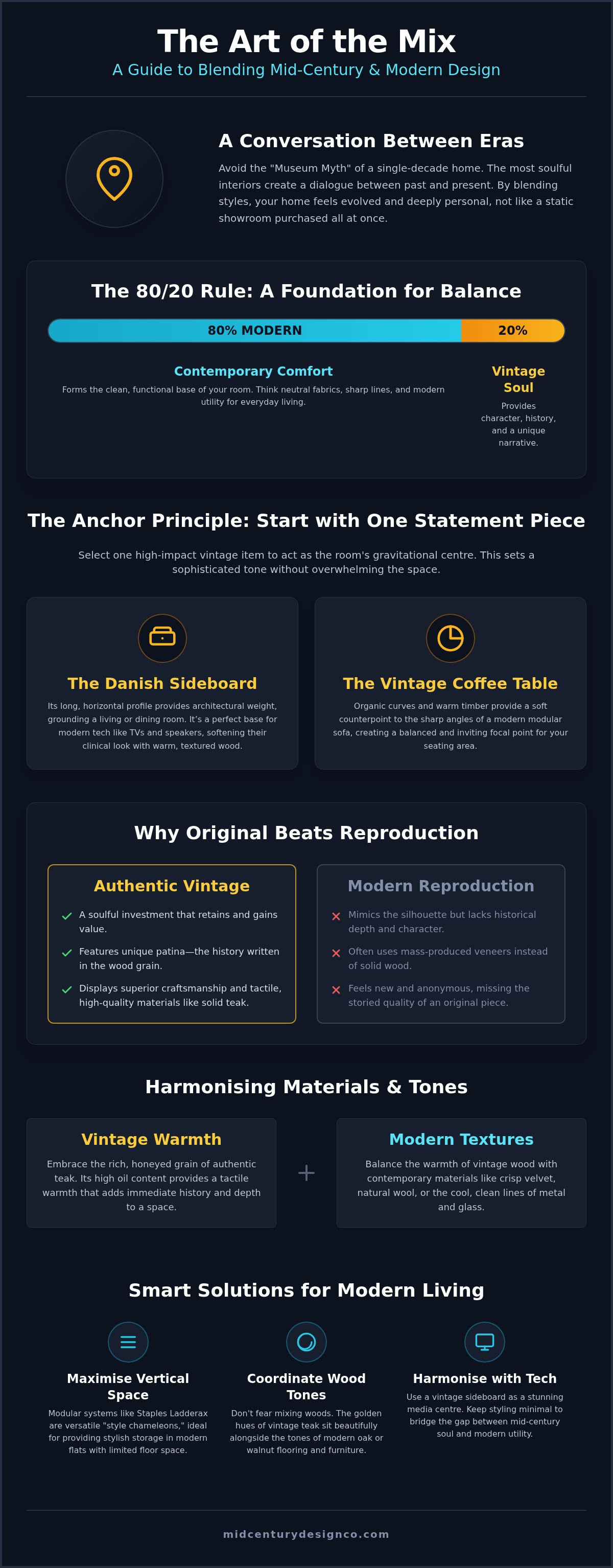
Consider the concept of visual tension. A sharp, contemporary sofa with clean lines and neutral fabric acts as a quiet canvas. When you place a 1960s Danish sideboard against it, the vintage piece's organic curves and rich wood tones become more striking. This contrast prevents the room from feeling one-dimensional or predictable. When mastering how to mix mid century furniture with modern styles, the 80/20 rule is your most reliable tool. Let 80% of your room be contemporary for modern comfort and utility, and reserve the remaining 20% for authentic vintage pieces that provide the room's character and soul.
Why Authenticity Matters in a Modern Context
There is a profound sensory difference between the mass-produced veneers found in modern retail and the deep, honeyed grain of authentic vintage teak. Teak, with its high oil content and tight grain, possesses a tactile warmth that feels alive under your fingertips. While new-build homes can sometimes feel clinical, the presence of an original piece introduces an immediate sense of history. This is largely due to the patina. Patina is the history of a piece written in its wood grain. These imperfections aren't flaws; they're the spirit of the object, adding a textured depth that new furniture simply cannot offer. This appreciation for artisanal quality can be extended to home accessories; for example, adding handcrafted baskets or mats from Lolli's Loops provides a tactile contrast that enhances the organic feel of a room.
The Evolved Interior: Furniture as Functional Art
Treat your furniture as more than just storage or seating. An authentic mid century modern sideboard functions as a gallery piece, a focal point that invites guests to linger and appreciate its craftsmanship. Every original 1950s or 60s item brings a narrative into your home. It's a connection to a specific designer's vision and a previous owner's life. This storied quality is something a modern reproduction cannot replicate, no matter how closely it mimics the silhouette. By choosing original pieces, you aren't just decorating; you're curating a collection of functional art that will endure for another sixty years.
Choosing Your Anchor: The Art of the Statement Piece
Success in how to mix mid century furniture with modern design often relies on the "Anchor Principle." This involves selecting one high-impact vintage piece to serve as the room's gravitational centre. Instead of overwhelming a space with too many competing eras, a single statement piece sets a sophisticated tone for the entire interior. Authentic sideboards are perhaps the most effective entry point for this strategy. Their long, horizontal profiles provide an architectural weight that grounds a living or dining room, offering a sense of permanence that lightweight modern alternatives often lack.
Scale is a critical factor when selecting your anchor. Modern furniture, particularly sofas and armchairs, tends to be significantly larger and deeper than its mid-century counterparts. To ensure your vintage piece isn't swallowed by contemporary proportions, choose items with substantial presence. A vintage Danish coffee table is an excellent choice for centring a seating area. Its organic curves and warm timber provide a soft counterpoint to the sharp angles of a modern modular sofa, creating a balanced and inviting focal point.
The Vintage Sideboard as a Modern Media Centre
Integrating contemporary technology doesn't have to mean sacrificing aesthetic integrity. A 1960s teak sideboard provides a stunning base for an OLED TV or high-end speakers. The rich, textured grain of the wood softens the clinical look of black glass and plastic, creating a more harmonious living environment. To maintain this balance, keep the styling minimal. A single piece of ceramics or a curated stack of books alongside your tech will help bridge the gap between the mid-century soul and modern utility. If you are ready to find your own statement piece, you can explore our curated collection of authentic sideboards.
Dining Room Alchemy: Vintage Tables and Modern Chairs
The dining room is where the "Mix and Match" strategy truly shines. Pairing a retro dining table and chairs UK with contemporary lighting creates a space that feels both timeless and current. You don't need a perfectly matched set to achieve a curated look. Consider these approaches to create a space that feels personal and evolved:
- Try pairing an authentic 1950s dining table with modern chairs in a contrasting material like metal or moulded plastic to create visual interest.
- Update vintage chair frames with modern upholstery in bold, contemporary colours to refresh their appearance whilst honouring their heritage.
- Hang a modern architectural pendant light low over a vintage teak table to create an intimate, sophisticated dining atmosphere.
This approach allows the history of the table to shine whilst the modern elements ensure the room feels grounded in the present day. It's about finding harmony in the contrast.
Material Harmony: Bridging the Gap Between Old and New
Achieving a cohesive interior isn't about matching every wood grain perfectly. It's about understanding the "temperature" of your materials. When considering how to mix mid century furniture with modern flooring, don't fear the contrast between the golden glow of vintage teak and the cooler tones of contemporary oak or the deep chocolate of modern walnut. These variations create a layered, organic feel that suggests a home has been assembled over time. Mastering how to mix mid century furniture with modern aesthetics requires a willingness to let different timber species coexist, provided they share a similar level of quality and craftsmanship. The key is to repeat these tones elsewhere in the room to create a sense of rhythm.
Texture is your most powerful ally in softening the hard edges of mid-century timber. A vintage teak sideboard or coffee table finds its perfect partner in the tactile luxury of a velvet sofa or the plush warmth of a large wool rug. This interplay between the smooth, aged wood and soft, contemporary fabrics creates a sensory richness that makes a room feel inviting. You can further bridge the gap between eras by using modern accessories. A contemporary matte ceramic vase or a sleek architectural lamp from the Artistry Deco Shop placed atop a 1960s chest of drawers acts as a visual "handshake" between the decades, tying the disparate elements together.
Colour palettes play a vital role in this harmony. Mid-century design is famous for its "dirty" tones, such as mustard yellows, olive greens, and burnt oranges. These earthy, saturated colours provide a sophisticated pop when set against a backdrop of modern neutrals like charcoal grey, navy blue, or soft off-white. This prevents the room from feeling like a period set whilst ensuring the vintage pieces feel grounded in the present day. It's about using the past to punctuate the present.
Mixing finishes adds an extra layer of sophistication to your curated space. The elegant, tapered wooden legs of a vintage chest of drawers look remarkably fresh when paired with modern matte black metal accents or industrial steel elements. This combination is particularly effective in a workspace. Integrating the industrial feel of an authentic mid century modern desk UK into a contemporary home office creates a professional yet soulful environment. The contrast between the warm timber and cool metal finishes ensures the space feels both functional and thoughtfully designed.
The Power of Negative Space
In a modern minimalist room, less is always more. Authentic vintage furniture often possesses a sculptural quality that deserves to be seen. Instead of crowding a corner, allow the elegant silhouette of a Danish chair to breathe by surrounding it with negative space. This highlights the piece's craftsmanship and prevents the "cluttered" look that many homeowners fear when introducing older items. By giving each piece room to exist, you treat your furniture as functional art rather than mere utility, allowing the spirit of the design to truly resonate within your sanctuary.
Modular Magic: Integrating Staples Ladderax in Modern UK Homes
The Staples Ladderax shelving unit is perhaps the ultimate "style chameleon" for the contemporary British flat. Its modular nature allows it to evolve alongside your lifestyle, making it a perfect example of how to mix mid century furniture with modern requirements. Unlike heavy, static wardrobes or bookcases, Ladderax offers a lightness that breathes life into smaller rooms. Integrating this system into your home is a simple, four-step process that respects both the past and the present.
- Step 1: Measure your vertical space. Ladderax is designed to maximise the often-underutilised height of modern rooms. By drawing the eye upwards, it creates an illusion of space that makes compact apartments feel significantly larger.
- Step 2: Choose your rails with intent. Black metal rails offer a sharp, industrial modern look that pairs beautifully with monochrome decor. Alternatively, white rails provide a softer, "scandi-minimalist" feel that blends seamlessly into neutral walls.
- Step 3: Mix your components. Don't feel restricted to simple shelving. Incorporating a desk bureau creates a sophisticated "cloffice" (closet-office) solution, allowing you to hide work away at the end of the day.
- Step 4: Style with intent. Balance the old with the new. Intermingle vintage leather-bound books with contemporary ceramics and smart speakers to anchor the system in the present.
This approach ensures the system feels like a curated part of your home rather than a salvaged relic. It’s about finding the balance between 1960s innovation and 21st-century utility.
The Ultimate "Work from Home" Solution
A modular Ladderax system effortlessly replaces bulky modern office furniture. By utilising wall-mounted or floor-standing ladders, you create a "floating" look that maintains precious floor space in compact UK rooms. It's a functional art piece that works as hard as you do, providing a dedicated workspace without the clinical feel of a standard desk. If you're looking to transform your study, view our authentic Staples Ladderax systems to find your perfect configuration.
Ladderax in the Living Room: A Multi-Functional Hub
In the lounge, these systems become a hub for personal expression. You can house a modern vinyl collection alongside vintage storage cabinets, creating a textured visual narrative that reflects your taste. The true beauty lies in its flexibility. As your modern needs change, you can reconfigure the shelves and cabinets without needing to replace the entire unit. It’s a sustainable, enduring choice that honours 1960s design whilst serving the practicalities of modern life.
The Investment of Authenticity: Why Original Beats Reproduction
Choosing an original piece is more than a purchase. It is an act of stewardship. Whilst modern reproductions often mimic the silhouette of 1960s design, they lack the architectural soul and material weight of the originals. When you learn how to mix mid century furniture with modern interiors, you quickly realise that authentic vintage pieces act as appreciating assets. Unlike mass-produced "fast furniture" that loses value the moment it leaves the showroom, a well-chosen Danish sideboard or teak dining set holds its worth. It is a tangible investment in history, craftsmanship, and the enduring beauty of old-growth timber.
The soul of these pieces is found in the finer details. Look closely at the joinery. Authentic mid-century items feature hand-finished dovetail joints that have remained sturdy for over sixty years. Compare this to the cam-locks and plastic clips found in modern flat-pack alternatives. There is a quiet confidence in a piece that has already survived six decades of daily life. As your "expert friend" in design, I must share one vital rule: never paint over authentic teak. Covering that rich, honeyed grain with grey or white gloss is a cardinal sin that strips the piece of its history and its market value. Respect the wood, and it will reward you with a lifetime of warmth.
Sustainability is the natural byproduct of this longevity. By integrating vintage storage or seating into your home, you are stepping away from the cycle of disposable consumption. A 60-year-old chest of drawers is not just a functional object; it is a survivor. It represents a time when furniture was built to be passed down through generations, making it the most eco-conscious choice for a contemporary sanctuary.
Avoiding the "Dated" Look
The most common fear when exploring how to mix mid century furniture with modern elements is creating a space that feels like a 1960s film set. To avoid the trap of "over-theming," you must ensure your vintage pieces have room to breathe. Contrast is your best tool. Pairing a vintage teak desk with bold, contemporary abstract art or a modern architectural floor lamp prevents the room from feeling stuck in the past. Understanding how to style mid century modern furniture with contemporary accents ensures your home feels current, curated, and deeply personal.
Sourcing with Confidence
Sourcing vintage furniture requires a discerning eye. Buying from a specialist curator ensures you aren't investing in a "Frankenstein" piece—an item cobbled together from mismatched parts or poorly restored. A specialist understands the narrative of each designer and the specific requirements of the era's materials. There is a profound joy in living amongst history, knowing that your home tells a story that spans decades. We invite you to explore our latest curated collection of authentic 1950s and 60s designs to find the next chapter for your own space.
Your Journey Toward a Curated Home
Creating a home that feels both soulful and current is a delicate art. By mastering how to mix mid century furniture with modern design, you move beyond the museum-set trap to create a space that reflects your unique narrative. Remember to lead with a single anchor piece, embrace the textural contrast of mixed materials, and prioritise the enduring quality of original craftsmanship. These authentic objects carry a spirit and a history that modern reproductions simply cannot replicate.
Whether you are seeking the modular versatility of a Staples Ladderax system or the sculptural elegance of a Danish sideboard, we are here to guide your discovery. We specialise in authentic vintage icons and offer nationwide UK delivery on our entire curated collection. You won't find reproductions amongst our offerings; only the warmth and soul of original 1950s and 60s design. This commitment to authenticity ensures your furniture remains a valuable asset for decades to come.
Explore our curated collection of authentic mid-century icons and begin building a sanctuary that will stand the test of time. Your home is a living story. It's time to add a chapter worth keeping.
Frequently Asked Questions
Can I mix different types of wood, like teak and modern oak, in the same room?
You can absolutely mix different wood types, provided you pay attention to the visual "temperature" of the timber. Whilst teak has a warm, honey-toned glow, modern oak is often cooler and paler. The secret to success lies in repetition; try to echo the teak's warmth in smaller accessories or picture frames. This creates a sense of intentionality rather than a random collection of pieces, allowing the disparate grains to coexist harmoniously within a curated space.
Is it okay to put a modern TV on a vintage mid-century sideboard?
Placing a modern TV on a vintage sideboard is a brilliant way to ground contemporary technology with organic warmth. The long, horizontal profile of a 1960s sideboard is structurally ideal for larger screens. However, ensure the weight is evenly distributed to protect the timber surface. Using a contemporary soundbar or minimalist speakers alongside the TV can help bridge the gap between the mid-century soul of the wood and the sleekness of modern electronics.
How do I know if a mid-century piece is an original or a modern reproduction?
Identifying an original piece requires a close inspection of the joinery and materials. Authentic 1950s and 60s furniture typically features hand-finished dovetail joints and solid timber edges, whereas reproductions often rely on cam-locks and thin veneers over MDF. Look for maker's marks or stamps from manufacturers like G-Plan or McIntosh. These labels are often tucked inside drawers or on the underside of tables, providing a definitive link to the piece's historical narrative.
Will vintage furniture look too "heavy" in a small, modern UK flat?
Vintage design is actually perfect for smaller UK flats because of its "leggy" and airy aesthetic. Many mid-century pieces, such as Danish chairs and sideboards, sit on elegant tapered legs that allow you to see the floor underneath. This creates a sense of openness that prevents the room from feeling cramped. When learning how to mix mid century furniture with modern interiors, these elevated silhouettes are essential for maintaining a light, uncluttered atmosphere in compact spaces.
How do I care for authentic teak furniture in a centrally heated modern home?
Central heating can be drying for vintage timber, so it's important to maintain a stable environment. Keep your teak pieces away from direct heat sources like radiators to prevent the wood from shrinking or cracking. Applying a high-quality teak oil once or twice a year will nourish the grain and preserve its natural lustre. This simple ritual ensures the furniture remains supple and continues to age beautifully within the modern home.
What modern colours work best as a backdrop for mid-century furniture?
Modern neutrals like charcoal grey, deep navy, and soft off-white provide the most sophisticated backdrop for mid-century timber. These cooler tones allow the rich, orange-hued warmth of teak and rosewood to truly stand out as focal points. If you want to lean into the era's heritage, consider using "dirty" accents like mustard yellow or sage green on a single feature wall. This creates a vibrant yet grounded environment that feels both retro and current.
Can I use Staples Ladderax in a room with modern plasterboard walls?
Staples Ladderax is remarkably versatile and can be installed on plasterboard walls with the correct hardware. Whilst the system is designed to be self-supporting through its ladders, securing it to the wall prevents tipping. Use heavy-duty hollow wall anchors or find the timber studs behind the plaster for maximum stability. This allows you to enjoy the iconic "floating" look of modular shelving even in a modern new-build home with less substantial wall construction.
Is it worth investing in original Danish furniture over high-street modern alternatives?
Investing in original Danish furniture is a far better long-term decision than purchasing high-street modern alternatives. Authentic pieces are crafted from superior materials that have already proven their durability over sixty years of use. Unlike mass-produced items that depreciate rapidly, original mid-century icons often increase in value. Understanding how to mix mid century furniture with modern elements ensures your investment feels like a soulful, permanent part of your home rather than a fleeting trend.