

The Soul of the Workspace: A Guide to the Danish Mid Century Office Chair
Is your desk chair merely a functional necessity, or is it the silent partner in your most creative hours? For the discerning homeowner, an authentic Danish mid century office chair is far more than a seat. It is a structural poem. It is a tether to a golden age of design that bridges the gap between 1960s organic modernism and the contemporary need for a mindful, evocative workspace. You likely recognise that your surroundings dictate your focus, yet the fear of accidentally purchasing a modern reproduction often stands in the way of acquiring a piece with genuine soul.
We understand the hesitation that comes with searching the vintage market, from identifying rare wood types to finding proportions that suit the scale of a British home office. This guide will help you distinguish a masterpiece from a replica, ensuring your investment remains a source of pride and professional status. We will explore the nuances of teak and rosewood, the importance of original finishes, and how to style these icons for a life of warm minimalism. You are about to discover how to choose a chair that doesn't just occupy space, but tells a story.
Key Takeaways
- Learn how to identify genuine 1960s craftsmanship by spotting authentic maker's marks and the "Danish Control" seal to avoid modern reproductions.
- Discover why an original Danish mid century office chair is a sound financial investment that appreciates in value whilst offering superior longevity.
- Explore the sensory warmth of teak and rosewood materials and the ergonomic benefits of the era's signature "floating seat" silhouettes.
- Find practical advice on scaling furniture for British rooms, including how to pair your seating with modular Staples Ladderax shelving to create a cohesive workspace.
- Understand the importance of original finishes and why choosing a piece with its history intact is preferable to modern restorations.
Beyond Utility: The Soul of a Danish Mid Century Office Chair
To step into a workspace anchored by a Danish mid century office chair is to enter a silent dialogue with history. It isn't just about sitting; it's about the marriage of ergonomic intent and organic form. During the 1960s, a profound shift occurred in the design world. The clinical, cold, and often metal-heavy aesthetics of the early industrial office were replaced by the warmth of the "home-office" concept. This era prioritised the human spirit, moving away from rigid utility toward a more compassionate way of working.
Soul is often dismissed as a vague concept, yet in vintage Danish furniture, it's a measurable quality found in the depth of the wood grain. The way a teak backrest curves to meet the spine or how the honey-coloured patina of a rosewood frame catches the afternoon light isn't accidental. It's the deliberate result of a craftsman's hand. For the modern professional, this chair is functional art that signals both personal taste and a commitment to quality that transcends seasonal trends.
Why Danish Design Dominates the Workspace
The global dominance of the Danish Modern movement redefined how we perceive professional environments. Nordic designers didn't just strip away the unnecessary; they prioritised the human form whilst maintaining a strict structural minimalism. This was a radical departure from the heavy, dark, and imposing Victorian desks and chairs that preceded them. Instead of weight, we saw light, floating lines and a sense of visual airiness that made even the smallest British study feel expansive. A Danish mid century office chair provides that rare combination of physical support and aesthetic weightlessness.
The Emotional Impact of a Curated Office
Your surroundings shape your creative behaviour. Surrounding yourself with objects that carry historical weight can significantly improve focus and clarity. There is a specific sensory experience in touching 60-year-old teak or rosewood; it feels soft, almost skin-like, compared to the cold plastics of modern retail. Danish Modernism is a philosophy that seeks to harmonise the quiet dignity of nature with the functional demands of human life. By choosing an authentic piece, you aren't just buying furniture; you're curating an atmosphere that respects your professional status and your need for a sanctuary-like home.
Materiality and Form: The Signature of 1960s Danish Craftsmanship
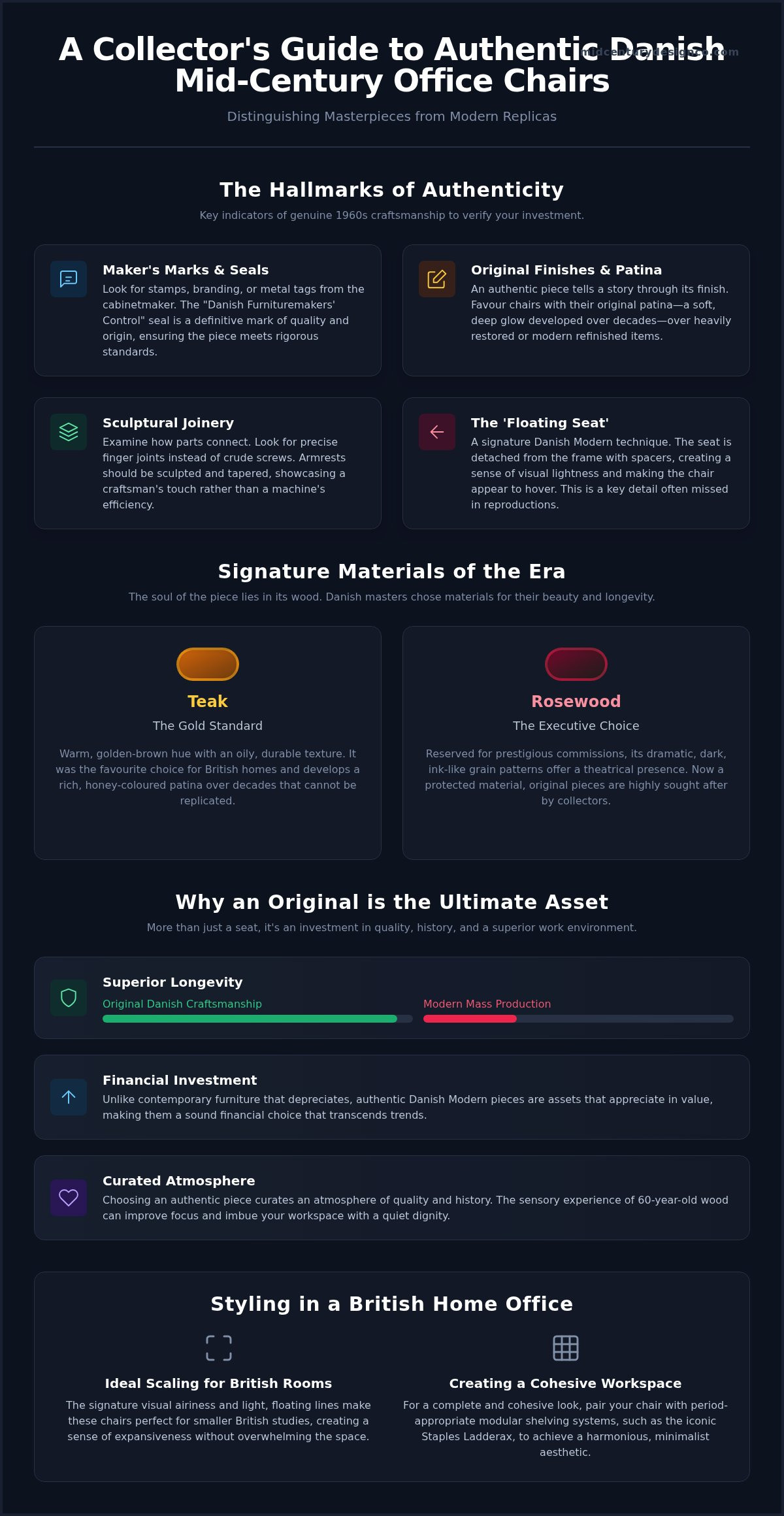
The 1960s represented a pinnacle of cabinetmaking excellence. During this period, the Danish mid century office chair became a canvas for showcasing the inherent beauty of exotic hardwoods. Unlike the mass-produced pieces of today, these chairs were defined by a deep respect for materiality. Teak was the undisputed gold standard. Its warm, golden-brown hue and oily, durable texture made it the favourite choice for British homes. Rosewood, particularly the dramatic Brazilian variety, was reserved for the most prestigious executive commissions. Its dark, ink-like grain patterns are highly sought after amongst collectors today.
As noted by the experts at Designmuseum Danmark, the hallmark of this era was the seamless integration of form and function. This is most evident in the "floating seat" design. By detaching the seat from the frame using discreet spacers, designers created a sense of visual lightness. It makes the chair appear to hover. This technique was pioneered by cabinetmakers who understood that office furniture should feel as elegant as a dining set.
The Allure of Teak and Rosewood
Teak's dominance in the UK market wasn't just about fashion. It was about longevity. Over decades, original teak develops a rich, honey-coloured patina that simply cannot be faked. It deepens into a glow that reflects a life well-lived. If you're looking for a piece that anchors a room, the dramatic grain of rosewood offers a more theatrical presence. It’s an investment in a material that is now strictly protected. These woods aren't just surfaces; they're the very soul of the piece. For those inspired by this dedication to material excellence, FVCreations offers a guide on how to identify top-tier timber for any woodworking project.
True Danish craftsmanship is found in the details that modern machines often ignore. Look for finger joints where the armrest meets the frame. These interlocking wood "fingers" provide immense strength without the need for metal screws. The armrests themselves are often sculptural. They are carved with a taper that feels natural under the hand, providing a tactile connection to the maker's intent.
A genuine Danish mid century office chair is designed to be seen from 360 degrees. In a modern British study, your chair is often positioned in the centre of the room. The "back view" is just as important as the front. The elegant curvature of the backrest isn't just for show. It supports the lumbar spine through long hours of creative work. Most authentic pieces from this era feature period-correct upholstery in black leather or high-quality vinyl. These materials offer a sharp, professional contrast to the warm wood tones. You might find that such a piece is the perfect companion to an authentic Danish desk, creating a workspace that feels both focused and historically rich.
The Collector’s Eye: Distinguishing Authentic Vintage from Modern Imitations
Developing a collector's eye requires more than just an appreciation for beauty; it demands a forensic attention to detail. At Mid Century Design Co., we focus exclusively on original vintage pieces because we believe the soul of a Danish mid century office chair cannot be replicated in a modern factory. Beyond the aesthetic allure, choosing vintage is a statement of ethics. It is the ultimate green choice, favouring the longevity of existing craftsmanship over the environmental cost of new production. Every original piece you bring into your home is a victory for the circular economy.
An original chair possesses a physical gravity that modern imitations lack. When you lift an authentic piece, the weight of solid teak or rosewood is unmistakable. Modern reproductions often rely on lightweight MDF or thin veneers that feel hollow and insubstantial. This density is the foundation of the Danish Modern design movement, where quality was never sacrificed for convenience. A genuine piece feels anchored to the floor, providing a sense of permanence that fleeting modern trends cannot offer.
Red Flags and Reproduction Risks
The most common pitfall for new collectors is the "too perfect" finish. Original 1960s pieces carry a soft, wax-like glow, whilst modern copies often have a plastic-looking lacquer that feels cold to the touch. You should also inspect the hardware. Authentic chairs use robust, period-correct screws and joinery, whereas imitations often hide flimsy metal brackets or modern ball-bearing glides. Be particularly wary of pieces that appear over-sanded. This aggressive approach often strips away the original patina and rounds off the crisp, sculptural edges that define the designer's intent.
Understanding Maker’s Marks
Look for the "Danish Furnituremakers’ Control" stamp, a circular seal that was the industry's mark of quality. Whilst not every masterpiece was stamped, the presence of this mark provides immediate peace of mind for the investor. Some of the finest chairs remain unmarked, yet they reveal their identity through the complexity of their finger joints and the specific, elegant taper of their legs. An original 1964 label acts as a quiet time capsule, preserving the moment the chair left the cabinetmaker's workshop for its first home. Identifying these subtle signatures is part of the joy of collecting, transforming a simple purchase into a journey of discovery.
Creating a Cohesive Workspace: Styling Your Danish Chair in a British Home
Styling a Danish mid century office chair within a British home requires a delicate balance of scale and texture. Many UK home offices are converted bedrooms or study alcoves where every centimetre of floor space is precious. The inherent "visual lightness" of Danish design is your greatest asset in these environments. Unlike heavy, traditional executive chairs that can overwhelm a room, these pieces use tapered legs and open silhouettes to allow light to pass through. You don't need to match every wood grain with clinical precision. Mixing a teak chair with an oak desk or a rosewood sideboard creates a layered, curated look that feels gathered over time rather than bought from a catalogue. To extend this inviting atmosphere to a lounge corner with contemporary sofas, you can check out Ja Tak Møbler.
For a truly cohesive 1960s aesthetic, consider the structural partnership between your chair and a Staples Ladderax shelving unit. This modular system mirrors the clean, vertical lines of Danish seating, allowing you to organise your workspace without sacrificing visual airiness. It provides a skeletal framework that feels light whilst offering substantial storage for your library and professional essentials. To avoid the sterile feel of a showroom, follow our advice on how to style mid century modern furniture, which focuses on blending these vintage icons with personal treasures to create a lived-in sanctuary.
Lighting and Texture
The crisp, sculptural lines of a Danish mid century office chair benefit from the softening influence of textiles and thoughtful lighting. A high-quality desk lamp featuring brass or brushed steel accents will echo the metallic hardware often found on vintage swivel bases. To ground the piece, place a natural wool or jute rug beneath the desk. The contrast between the organic, tactile warmth of the rug and the smooth, hand-finished wood of the chair legs creates a sensory depth that defines a sophisticated workspace. By making the chair the room's centre of gravity, you create a dedicated zone for focus and creative behaviour.
If you're ready to elevate your study with a piece that carries both history and soul, explore our latest collection of original Danish furniture to find a chair that resonates with your professional status.
Investing in Longevity: Why an Original Danish Piece is the Ultimate Office Asset
Choosing an original Danish mid century office chair is a decision that rewards the head as much as the heart. In a market often saturated with disposable "fast furniture" that loses its value the moment it crosses your threshold, an authentic vintage piece stands as a resilient financial asset. When you consider the cost per year of a chair built to last a century, the investment becomes remarkably modest. A piece crafted in 1965 that remains structurally sound and aesthetically relevant in 2026 has already proven its worth. It isn't just furniture; it's a legacy of mid-century excellence that you're merely stewarding for the next generation.
At Mid Century Design Co., our curation process prioritises pieces that offer both historical soul and investment potential. We look for the rare grain patterns, the untouched original finishes, and the unmistakable signatures of master cabinetmakers. This focus ensures that your workspace reflects your professional status whilst serving as a hedge against the depreciating nature of modern retail goods. Owning a piece of functional art means your office grows in character and value every year you use it.
The Resale Reality
The financial argument for vintage is compelling. Data shows that the demand for mid-century modern furniture increased by 70% in the five years leading up to 2022, reflecting a significant shift toward quality amongst UK collectors. Whilst flat-pack office chairs are destined for landfill, authentic Danish furniture has consistently risen in value. Even within the broader wooden office furniture market, a 4.84% price increase has been observed recently, driven by a "flight to quality" amongst discerning buyers. A single, well-chosen Danish mid century office chair can define the value of an entire collection, acting as a "hero piece" that anchors your interior's market appeal.
Your Sanctuary Awaits
The final step in your journey is choosing a piece that speaks to your personal narrative. These chairs are survivors. They've witnessed decades of creative work and are ready for another sixty years of service in your home. By selecting an original, you're rejecting the "clunky" proportions of modern replicas in favour of the visual lightness and sensory warmth that only 1960s teak and rosewood can provide. It's time to create a workspace that isn't just a place of toil, but a sanctuary of inspiration. Explore our curated collection of authentic Danish desks and office furniture to find the piece that will complete your professional story.
Elevate Your Creative Sanctuary
Your workspace is more than a room; it's a reflection of your professional narrative and appreciation for timeless artistry. By choosing an authentic Danish mid century office chair, you're investing in a piece that harmonises ergonomic comfort with the enduring warmth of 1960s teak and rosewood. You've discovered how to identify the subtle marks of craftsmanship and how to scale these icons for the modern British home. These pieces are not merely survivors of a bygone era; they are functional assets that grow in character with every year of use.
Whether you're looking for a sculptural teak swivel or a rare rosewood piece to pair with a Staples Ladderax system, the right chair acts as the soulful centre of your study. We are specialists in original vintage furniture, curating each piece for its historical integrity and aesthetic impact. With our national delivery service, bringing a touch of Nordic heritage into your home is effortless. Discover our latest collection of authentic vintage Danish furniture and find the silent partner for your next decade of work. Your perfectly curated office is waiting to be realised.
Frequently Asked Questions
Are authentic Danish mid-century office chairs comfortable for daily work?
Yes, these chairs are remarkably comfortable for daily work because they were built with a deep understanding of the human form. Unlike modern plastic seating, a Danish mid century office chair relies on sculpted wood and organic curves to provide lumbar support. Whilst they don't offer the complex pneumatic adjustments of today's task chairs, their ergonomic intent ensures focus and clarity throughout the working day.
How can I tell if a Danish office chair is a genuine 1960s piece or a reproduction?
Authenticity is found in the finer details of construction and branding. You should look for the circular "Danish Control" stamp or specific maker's labels under the seat. Genuine 1960s pieces feature solid teak or rosewood frames rather than the lightweight materials found in modern copies. The joinery is also a giveaway; look for hand-finished finger joints rather than the metal brackets typical of reproductions.
What is the best way to clean and maintain a vintage teak office chair?
Maintenance is straightforward if you use the correct materials. You should avoid modern aerosol polishes and silicone sprays, as these can damage the wood's natural breathability. Instead, apply a small amount of high-quality teak oil with a soft cloth every few months. This practice nourishes the timber and preserves the rich, honey-coloured patina that makes vintage Danish furniture so evocative and desirable.
Do I need a specific type of desk to match a Danish mid-century chair?
Whilst these chairs are versatile, they thrive amongst pieces of similar "visual lightness". You don't necessarily need a matching teak desk, but pairing your chair with an authentic Danish desk or a modular Staples Ladderax system creates a cohesive aesthetic. The goal is to avoid heavy, imposing furniture that might overwhelm the delicate, tapered lines of your mid-century seating.
Why is rosewood more expensive than teak in Danish furniture?
Rosewood's higher cost is a reflection of its rarity and dramatic aesthetic. During the 1960s, rosewood was considered a luxury material and was typically reserved for the most prestigious executive commissions. Brazilian rosewood is now strictly protected, which means the supply of vintage pieces is finite. Its intricate, dark grain patterns make it a highly sought-after investment for serious collectors.
Can I use a Danish dining chair as an office chair?
Using a dining chair is possible, but it may not offer the same support as a dedicated Danish mid century office chair. Office-specific designs from the era often include swivel mechanisms, adjustable heights, or castors to facilitate movement. If you choose a dining chair for your desk, ensure it provides the correct seat height to prevent strain during longer periods of creative behaviour.
What should I look for in the upholstery of a vintage office chair?
Period-correct upholstery is essential for maintaining the chair's historical integrity. Black leather or vinyl were the standard choices in the 1960s, offering a sharp contrast to the warm wood tones. When inspecting a piece, look for high-quality stitching and a fit that follows the chair's sculptural curves. Avoid fabrics that feel overly modern or bulky, as these can detract from the minimalist silhouette.
Is it better to buy a chair in its original condition or one that has been fully restored?
Original condition is generally the superior choice for investment and character. A chair that retains its original finish possesses a soul and patina that modern restoration often strips away. At Mid Century Design Co., we value the narrative of a piece. Whilst we ensure our furniture is clean and structurally sound, we believe the marks of history are part of the object's beauty.