
The Vintage Bureau Desk UK: A Curated Guide to Mid-Century Workspace Elegance
What if your workspace didn't demand a permanent takeover of your living room, but instead offered a graceful retreat that vanished at the close of the day? Most homeowners today feel the quiet exhaustion of "fast furniture," those disposable flat-pack desks that promise utility but lack the soul and narrative of a piece built to last. When space is a luxury, the search for an authentic vintage bureau desk UK becomes more than a shopping trip. It is a quest for a functional art piece that respects the boundaries of your home.
You likely recognise the frustration of choosing between a bulky office setup and a flimsy "retro" reproduction that feels hollow to the touch. We understand that a home should be a sanctuary, not a showroom for the temporary. This curated guide will help you identify the hallmarks of genuine mid-century craftsmanship, from rich teak grains to the ingenious joinery of Danish masters. You'll discover how to source investment-grade furniture that grows in value whilst providing a dedicated, fold-away office. By the end, you will know exactly how to select a piece that brings both history and harmony to your modern British interior.
Key Takeaways
- Learn to distinguish an authentic vintage bureau desk UK from modern reproductions by examining the movement of the teak grain and the precision of traditional dovetail joinery.
- Understand how the "fall-front" design creates a vital psychological boundary between work and home, allowing you to mentally close the door on your professional day.
- Recognise the influence of Danish Modernism on iconic British manufacturers like G Plan and McIntosh to ensure your chosen piece carries a true historical pedigree.
- Discover the spatial advantages of a vertical footprint, which allows you to establish a sanctuary-like workspace without sacrificing the floor space of a standard desk.
- Gain the confidence to source original mid-century pieces that serve as sustainable, investment-grade furniture whilst preserving the unique narrative of 1960s craftsmanship.
What Defines an Authentic Vintage Bureau Desk in the UK?
An authentic bureau is far more than a simple writing surface; it is a masterpiece of spatial economy. Wikipedia describes a bureau as a compact, multi-functional piece of furniture, characterised by its hinged writing surface that folds away when not in use. In the British home, this form underwent a radical transformation during the mid-century period. We moved away from the heavy, imposing mahogany of the Victorian era towards the streamlined, airy silhouettes that define the 1950s and 60s. This shift wasn't just about fashion. It was a response to a new way of living that demanded furniture be both beautiful and exceptionally functional.
The 1960s teak bureau became a staple of British interior design for its ability to hide the clutter of daily life behind a single, elegant panel. It represents the height of "slow furniture" in our increasingly digital-first world. There is a quiet, meditative joy in the tactile experience of unfolding a solid teak lid. It creates a physical boundary for your thoughts, turning a corner of a room into a private sanctuary of productivity. Owning a vintage bureau desk UK collectors prize means owning a piece of history that prioritises the soul of the object over mass-market convenience.
The Anatomy of Mid-Century Craftsmanship
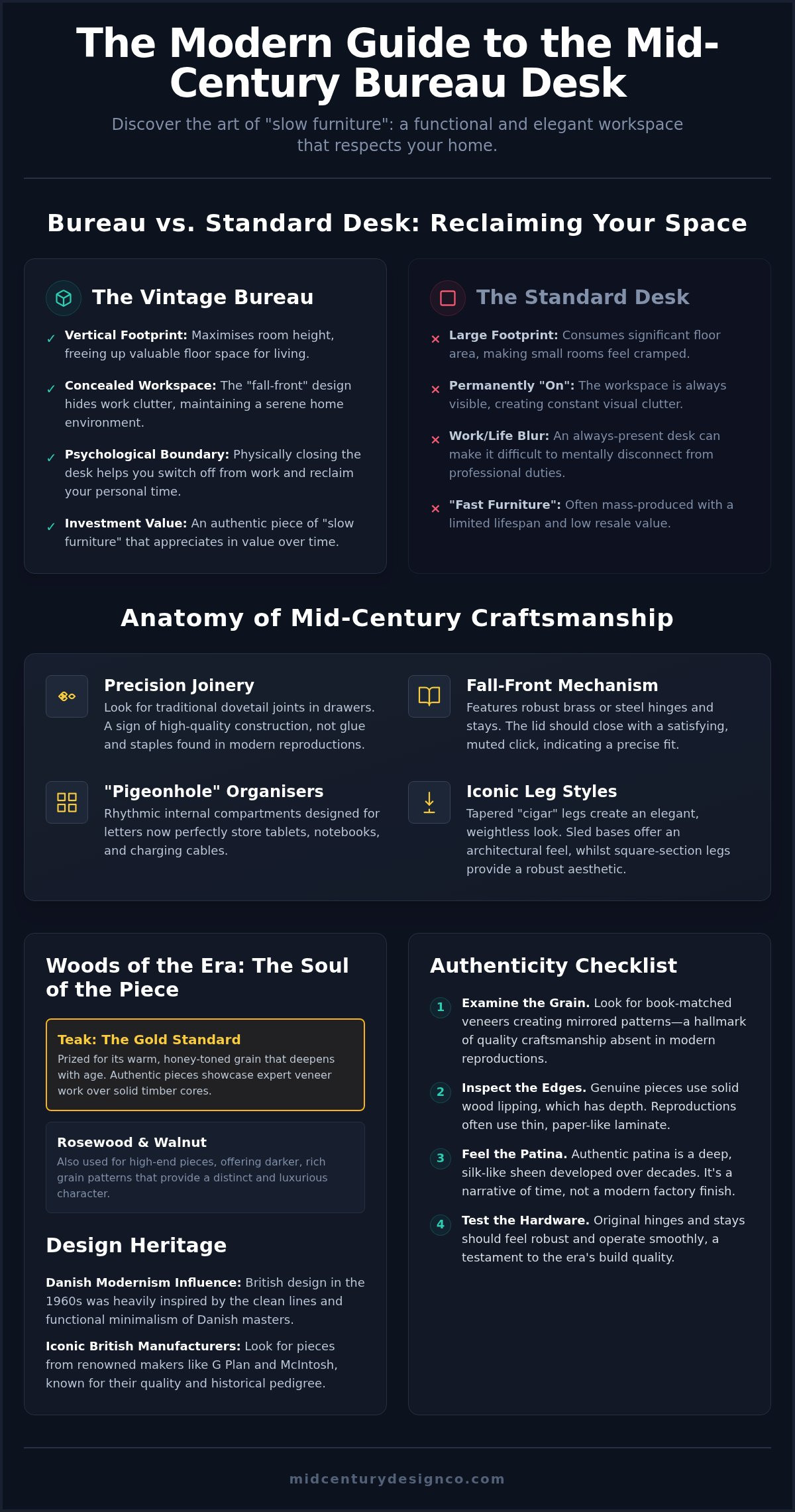
The integrity of a mid-century bureau is found in its mechanical details. A quality piece features robust brass or steel hinges and stays that support the fall-front writing surface without any hint of instability. You should look for that satisfying, muted click as the lid meets the frame, a sign of precision joinery. Inside, the rhythmic arrangement of "pigeonholes" provides a structured home for your essentials. While originally designed for letters and inkwells, these compartments now serve as the perfect organised retreat for tablets, chargers, and notebooks.
Leg styles often dictate the entire personality of the piece. You'll typically encounter these iconic forms:
- Tapered "Cigar" Legs: These slender, turned legs create a sense of weightless elegance, lifting the bureau off the floor to make a room feel larger.
- Sled Bases: A more architectural choice, providing a sturdy, minimalist foundation that mirrors the clean lines of Scandinavian design.
- Square-Section Legs: Often found on later 1960s models, offering a more robust and masculine aesthetic.
Woods of the Era: Teak, Rosewood, and Walnut
Teak remains the undisputed gold standard for the UK vintage collector. It possesses a sensory warmth and a honey-toned grain that seems to hold the light. Authentic mid-century pieces showcase the "spirit" of the wood through the expert use of veneers over solid timber cores. This allowed craftsmen to book-match grains, creating mirrored patterns that are impossible to find in modern furniture. To identify a genuine vintage bureau desk UK find, inspect the edges. Original pieces use solid wood lipping, whereas modern reproductions rely on thin, paper-like laminates that lack the depth and longevity of the real thing.
The Enduring Appeal of the 1960s Teak Bureau
Mid-century furniture possesses a rare architectural honesty. It is a design philosophy where form follows function without the distraction of unnecessary flourish. When you look at a high-quality vintage bureau desk UK collectors value, you aren't just seeing a piece of furniture; you're seeing a solution to the modern living problem. Every line serves a purpose, from the precise angle of the fall-front to the thoughtful placement of the internal drawers. This clarity of design is why these pieces remain so relevant in contemporary British homes, where every square inch must justify its existence.
A crucial element of this enduring appeal is the patina. This isn't just wear and tear. It's the narrative of time captured in the wood's surface. Decades of gentle sunlight and use create a depth of colour and a soft, silk-like sheen that modern factory finishes can't replicate. For the serious collector, original condition is paramount. While some choose to paint or "upcycle" these pieces, doing so often strips away the historical soul and investment grade of the item. Preserving the original teak grain ensures the piece remains a functional asset that appreciates over time, much like a piece of fine art.
Danish Influence on the British Workspace
The 1960s saw a dramatic shift as British manufacturers like G Plan and McIntosh embraced the "Nordic nuance" of Danish Modernism. They moved away from bulky, dark office furniture towards organic curves and sculpted handles. This era brought a domestic softness to the workspace, making the bureau feel like a natural part of a living room rather than an industrial intrusion. Sculpted teak handles and tapered legs became the hallmarks of this elevated style. If you're drawn to these refined silhouettes, you might enjoy our ultimate guide to sourcing an authentic Danish desk in the UK.
Modular Mastery: Staples Ladderax Bureau Components
For those with truly limited space, the Staples Ladderax system offered a stroke of genius. By integrating a bureau component into a wall-mounted shelving unit, it allowed the workspace to exist within a larger storage system. This modularity is the perfect solution for the evolving UK home, where rooms often serve multiple purposes. You can simply adjust the height of the bureau unit to suit your seating, or move it entirely as your needs change. You can find more detail in our expert buying guide to the Staples Ladderax shelving unit. Explore our curated collection of desks and office chairs to find a piece that speaks to your home's unique story.
Bureau vs. Standard Desk: Choosing for the Modern Home
Choosing between a standard desk and a vintage bureau desk UK homeowners often find, comes down to how you wish to interact with your work. A traditional desk is an open invitation; it remains a constant visual reminder of tasks yet to be completed. In contrast, the bureau offers a definitive psychological end to the day. When you fold up the writing surface, you aren't just tidying a room. You're reclaiming your home. This mental health win is essential in an era where the lines between professional and personal life have become increasingly blurred.
The spatial argument is equally compelling. Most UK homes, particularly those in urban centres, struggle with the horizontal sprawl of a standard pedestal desk. A bureau utilises vertical space. It provides a compact footprint that fits into alcoves or corners that would otherwise remain unused. Whilst it stands closed, it masquerades as a sophisticated cabinet, hiding the cables, chargers, and "digital clutter" that often disrupt a room's aesthetic harmony. The internal cubbies and drawers offer a level of storage density that a flat-top desk simply cannot match.
When to Choose a Traditional Desk
There are times when a bureau might not be the practical choice. If your work requires a permanent setup with a 27-inch monitor or multiple screens, the internal dimensions of a vintage piece may feel restrictive. You must also consider the trade-off between storage density and legroom. A bureau prioritises drawers and cubbies, whereas a desk offers more freedom for those who prefer to stretch out. If your hardware demands more surface area, you can learn how to source and style an authentic mid century modern desk in the UK to find your perfect fit.
The Bureau as a Multi-Room Solution
Because of its dual nature, the bureau thrives in spaces where a desk would look out of place. It sits comfortably in a hallway or a dining room, serving as a focal point for curated décor. You can use the top surface to display a mid-century lamp, a collection of ceramics, or trailing greenery, ensuring the piece contributes to the room's character even when you aren't working. Opening the lid becomes a morning ritual. It is an intentional act that signals the start of your productive hours, turning a simple piece of furniture into a sanctuary for focus; many find that adding a physical visual timer from timeqube.com helps maintain this concentration without the intrusion of digital alerts.
Sourcing a vintage bureau desk UK collectors value is an exercise in patience and observation. You aren't just looking for a shape; you're looking for the fingerprint of a craftsman. Begin by inspecting the grain. Authentic mid-century teak possesses a depth and shimmering movement that flat, printed laminates cannot replicate. Run your hand over the surface. You should feel the organic texture of the wood, not the cold, sterile finish of a modern reproduction. This tactile connection is the first sign that you've found a piece with a genuine narrative.
Next, turn your attention to the joinery. Open the drawers and look for the interlocking "fingers" of a dovetail joint. This technique, used by iconic British makers like G Plan and Nathan, is a hallmark of structural integrity. Look for the maker's mark, often a gold stamp or a metal plaque tucked inside a drawer or on the back panel. This label is your guarantee of quality and future resale value. Assess the condition with a gentle touch. Small surface scratches are part of the piece's history, but structural wobbles or warped lids suggest neglect that goes beyond charming wear. A well-maintained vintage bureau desk UK find should feel solid and intentional.
Identifying Original Wood vs. Modern Reproductions
The weight test is often the most revealing. Original vintage furniture is significantly heavier and more substantial than modern equivalents because it relies on solid wood lipping and high-quality veneers over sturdy cores. There is also a distinct sensory experience. Aged wood carries a subtle, warm scent of wax and history, unlike the chemical odour of mass-produced resins. We explicitly exclude modern reproductions from our curated collection. They lack the soul, the historical weight, and the investment potential that only an original 1960s piece can offer.
Styling Your Bureau for the 21st Century
Once you've secured your piece, focus on the harmony of your workspace. Pairing your teak bureau with an authentic mid century office chair creates a cohesive, gallery-like feel. For the modern professional, cable management is the primary challenge. Avoid drilling holes into the original timber. Instead, use magnetic clips or felt-lined adhesive loops to guide wires discreetly along the tapered legs. Finally, treat the internal pigeonholes as a canvas for visual harmony. Organise your stationery and tech with an eye for balance; sourcing high-quality items from a comprehensive retailer like megaofficesupplies.com.au can help you find the perfect tools to fill your desk while leaving space for the wood grain to breathe. If you're ready to find your own sanctuary-like workspace, you can view our latest curated arrivals of authentic mid-century bureaus today.
At The Mid Century Design Co., we believe that a home is more than a collection of utilities. It is a gallery of your personal history. Our approach to sourcing a vintage bureau desk UK collectors seek is rooted in a deep respect for the original narrative of each piece. We focus exclusively on furniture in its original, untouched condition. By preserving the authentic patina and the spirit of the 1950s and 60s, we ensure that every bureau we offer remains a functional asset with a soul. This commitment to authenticity is what separates a curated sanctuary from a room filled with disposable, modern "retro" imitations.
Choosing an original mid-century bureau is the ultimate sustainable act. These pieces have already stood the test of time, carrying no new carbon footprint into your home. They were built using slow-grown timbers and traditional joinery designed to last for generations, not just a few seasons. In a world of "fast furniture," an investment-grade vintage piece represents a conscious choice for longevity and historical weight. Our ever-evolving collection includes sideboards, dining sets, and Staples Ladderax storage systems, each chosen for its ability to bring character and purpose to the modern British interior.
A National Focus on Authentic Design
Authentic design should be accessible to every corner of the country. We act as a bridge between the sophisticated aesthetics of the past and the practical demands of modern UK living. Our curators possess an expert eye for the nuances of wood grain and the integrity of 1960s joinery; they identify the "soul" of an object before it enters our collection. Because we offer a dedicated national delivery service, the process of sourcing an original vintage piece becomes effortless. We bring the finest examples of mid-century craftsmanship directly to you, regardless of where you are located in the UK.
Your Journey to a Sanctuary-Like Home
Living with vintage furniture shouldn't feel like residing in a gallery. It is about integrating these pieces into your daily life, allowing them to witness your own story. We encourage you to move beyond the "museum myth" and embrace the tactile warmth of teak in your workspace. You can find inspiration on how to achieve this in our guide on how to style mid century modern furniture: debunking the museum myth. If you are ready to transform your home into a sanctuary of focused productivity, we invite you to view our current collection of authentic vintage bureaus and desks.
Cultivating Your Mid-Century Sanctuary
A home should be a reflection of your values; a place where history and productivity coexist in quiet harmony. By choosing a vintage bureau desk UK collectors admire, you are doing more than simply furnishing a room. You are establishing a vital psychological boundary that allows you to close the lid on your professional day, protecting the peace of your living space. We have explored how the enduring appeal of teak and the modular mastery of Staples Ladderax systems offer a sustainable, investment-grade alternative to the fleeting nature of modern flat-pack furniture.
At The Mid Century Design Co., we act as your expert partner in this journey. We are specialists in original Staples Ladderax systems and expertly curated mid-century modern furniture, ensuring every piece in our collection possesses a genuine narrative. With our national UK delivery on all investment-grade pieces, bringing a slice of design heritage into your home is effortless. We invite you to explore our curated collection of authentic vintage bureaus and discover the functional art that awaits. Your home deserves a piece with a soul.
Frequently Asked Questions
What is the difference between a bureau and a secretaire?
A bureau traditionally features a slanted, fall-front lid that serves as the writing surface when opened. A secretaire, or secrétaire à abattant, is often a taller, more upright cabinet where the writing desk is hidden behind a vertical drop-front panel. Whilst the terms are sometimes used interchangeably, the mid-century vintage bureau desk UK collectors prefer usually follows the compact, slant-top form that prioritises a smaller footprint for domestic interiors.
Can a vintage bureau support a modern computer monitor?
A vintage bureau can easily support a slim laptop or a small monitor, but you must check the weight capacity of the fall-front stays. These pieces were designed for handwriting and lightweight typewriters, so a heavy 27-inch monitor might strain the original hinges. If you use a larger screen, we recommend placing it on the top shelf of the bureau rather than the writing surface to ensure the structural integrity remains intact.
How do I care for the teak finish on my vintage bureau?
Teak is a resilient, oil-rich wood that requires minimal but consistent care to maintain its sensory warmth. Avoid modern aerosol polishes that contain silicones, as these can build up and dull the grain. Instead, use a high-quality teak oil or a clear beeswax every six months to nourish the timber. Wipe away spills immediately with a soft, dry cloth to prevent the wood from staining, preserving that iconic 1960s honey-toned glow.
Is it worth buying a vintage bureau as an investment?
Authentic mid-century furniture is considered an investment-grade asset because its value is tied to its historical narrative and scarcity. Unlike mass-market furniture that depreciates instantly, a well-maintained vintage bureau desk UK find tends to hold or increase its value over time. As the UK antiques market grows, forecasted to reach approximately £1.32 billion by 2033, original pieces from makers like G Plan or McIntosh remain highly sought after by discerning collectors.
How can I tell if a bureau is a modern reproduction or an original 1960s piece?
Original pieces possess a weight and depth of grain that modern imitations simply lack. Look for the maker's mark, such as a gold G Plan stamp, and inspect the joinery for traditional dovetail joints. Modern reproductions often use thin laminates or chipboard cores, whereas original 1960s bureaus feature solid wood lipping and high-quality veneers. The scent of aged wood and the presence of authentic mid-century mechanical stays are also clear indicators of a genuine piece.
What should I look for in a Staples Ladderax bureau component?
When inspecting a Staples Ladderax bureau, check that the original hooks are secure and that the fall-front mechanism operates smoothly without sticking. These modular components are designed to sit between two metal or wood ladders, offering a height-adjustable workspace. Ensure the internal pigeonholes are intact and that the teak grain matches the rest of your system. As specialists in authentic Ladderax, we look for pieces that have retained their structural balance and original finish.
Why is teak the most popular wood for mid-century bureaus in the UK?
Teak became the definitive wood of the mid-century era due to its remarkable durability and beautiful, straight grain. It was favoured by Danish designers and British manufacturers alike for its ability to be sculpted into organic, minimalist forms. The wood's natural oils provide a protective barrier, whilst its warm, amber hues bring a sense of sanctuary and light to domestic interiors. It remains the most popular choice for those seeking a timeless, investment-grade aesthetic.
Do you offer international shipping for your vintage furniture?
We do not offer international shipping for our furniture collection. Our focus is entirely national, ensuring that we can provide a reliable and curated service to customers across the United Kingdom. By concentrating our efforts on national delivery, we maintain the highest standards of care for our original mid-century pieces. This allows us to guarantee that your chosen bureau arrives in the same beautiful, investment-grade condition in which it left our collection.